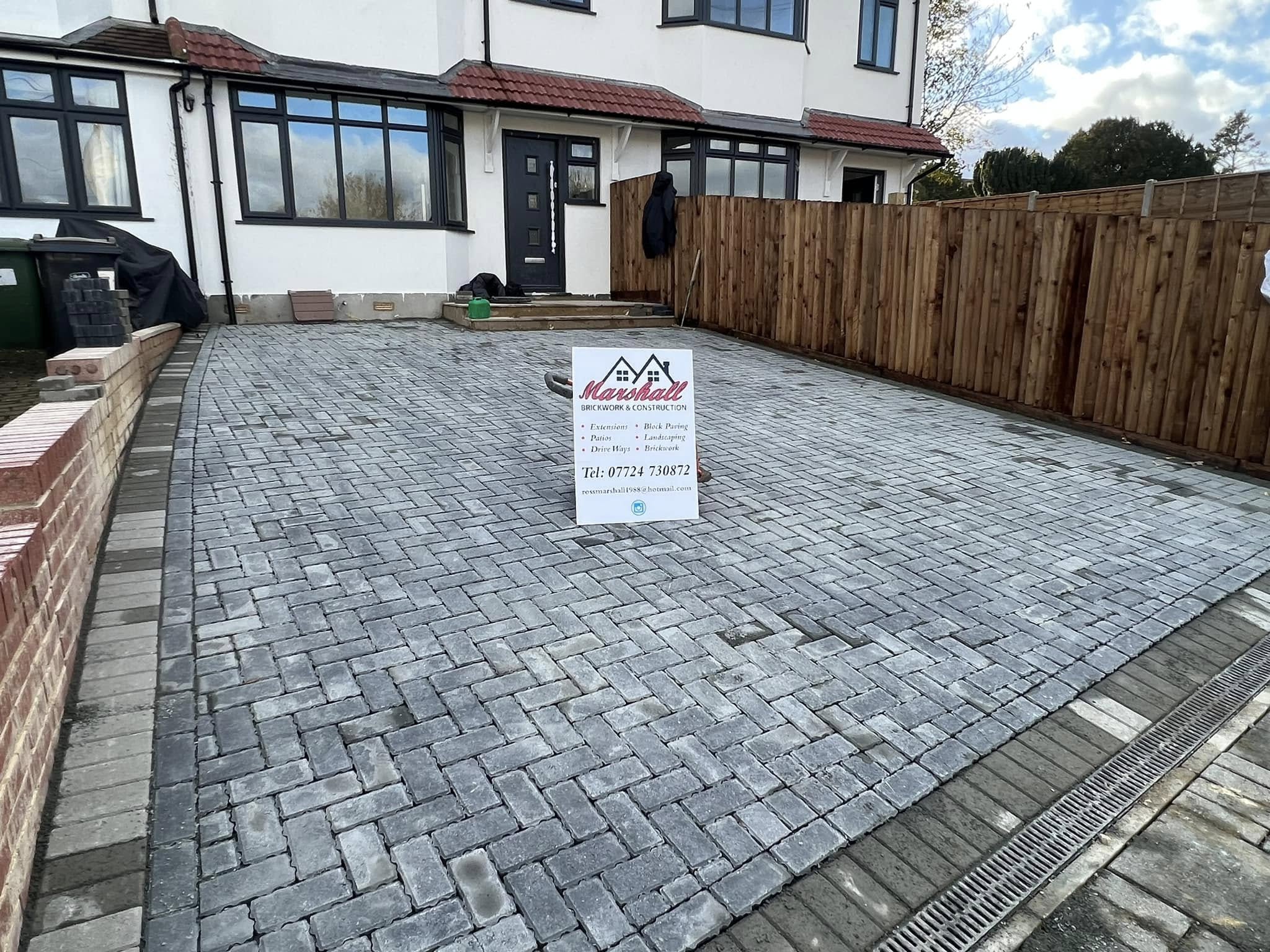
Expert brickwork, driveways, patios and landscaping in Faversham. Marshall Brickwork & Construction — lime mortar specialists, conservation area aware, free site visits.
Faversham is different from most Kent towns. Not simply older — though it is one of the oldest market towns in England, with a continuous history stretching back to Saxon times and a medieval core that remains largely intact. Different in the way it wears its history — not as a museum piece, but as a living, active residential town where period buildings are homes, where conservation area designations are taken seriously, and where the quality of construction work matters more than in most places because the buildings being worked on genuinely deserve care.
For any contractor working in Faversham, this character creates both an obligation and an opportunity. The obligation: understanding what the housing stock demands — lime mortar for period brickwork, heritage-appropriate materials for conservation area projects, the craft knowledge that protects buildings rather than damaging them. The opportunity: a market where quality construction work is recognised, valued, and sought out by homeowners who know the difference between a contractor who understands period property and one who does not.
MB Construction Group — Marshall Brickwork & Construction serves Faversham and the surrounding Swale district from the Rochester base — approximately 25 miles along the A2/M2 corridor that has connected the Medway towns to east Kent for centuries. The team has been working in Faversham and the surrounding villages for over fifteen years, bringing the full-service outdoor construction capability — brickwork and repointing, driveways, patios, landscaping, garden walls, fencing, extensions, and groundworks — that Faversham's varied and demanding property base requires.
Understanding Faversham: The Town That Demands Construction Expertise
The Historic Core and Conservation Area
Faversham's conservation area is one of the most extensive and most carefully managed in Kent. The town contains over 500 listed buildings — one of the highest concentrations of listed structures in any Kent market town — and the conservation area boundary covers not just the medieval core around Market Place, Court Street, and Abbey Street, but extends into the surrounding residential streets where Victorian and Edwardian development created some of the most characterful period housing in the county.
For any construction work within the conservation area, the implications are specific and important. Materials must be sympathetic to the existing character — facing brick that matches the local stock brick tradition, lime mortar for period brickwork, natural stone or heritage-appropriate materials for hard surfaces. Works that would be permitted development elsewhere may require conservation area consent in Faversham. And the quality standard expected by Swale Borough Council's conservation team — and by Faversham's engaged and historically aware resident population — is genuinely high.
Marshall's familiarity with Swale Borough Council's planning environment — the same authority that governs Sittingbourne and the wider Swale district — means the conservation area implications for any Faversham project are understood and addressed from the initial consultation. This is not an afterthought; it is built into the professional process from day one.
The Housing Stock: Five Centuries in One Town
What makes Faversham's construction market genuinely interesting — and genuinely demanding — is the range of building periods represented within a relatively compact town.
The medieval timber-framed buildings of the historic core are among the oldest inhabited structures in Kent. The Georgian townhouses of Court Street and the surrounding streets represent the prosperity of Faversham's eighteenth-century brewing and gunpowder manufacturing industries. The Victorian and Edwardian terraces of the residential streets north and south of the town centre were built for the workers of those industries. And the twentieth-century development on the town's edges includes everything from interwar semis to contemporary new builds.
Each building period demands different construction knowledge. The Georgian and earlier properties require lime mortar — both for repointing and for any new brickwork additions — and conservation area awareness. The Victorian and Edwardian properties share the lime mortar requirement that applies to period brickwork throughout Kent. The more modern properties accommodate contemporary construction approaches. The ability to work across this entire range — and to specify correctly for each context — is what distinguishes a genuinely expert contractor from one who applies the same approach regardless of what they are working on.
The Faversham Creek and Tidal Influence
Faversham's position at the head of Faversham Creek — the tidal inlet that connects the town to the Swale and the wider Thames Estuary — creates specific ground condition and moisture exposure considerations for construction work in parts of the town.
Properties close to the Creek, in the Quayside area and the lower-lying streets that drain toward it, sit on ground that has higher seasonal groundwater levels than the town's more elevated residential areas. This affects foundation depth requirements for any structural construction and drainage specification for driveways and patios in these locations. Marshall's site assessment process identifies these specific conditions at each project location rather than applying a standard specification regardless of the site's position within the town.
The coastal proximity — Faversham is less than five miles from the Swale estuary and the open coastal exposure of Whitstable and Seasalter — also creates the salt-laden air conditions that affect material specification for exposed positions. Facing brick with good frost resistance and low water absorption, mortar specified for enhanced weather exposure, and fixings specified in stainless steel or hot-dip galvanised steel rather than standard mild steel — these specification decisions are standard practice for Marshall's Faversham projects.
Brickwork Services in Faversham
Brickwork is where Marshall's expertise is most directly relevant to Faversham's property base — and where the gap between a contractor who understands the town's buildings and one who does not is most consequential.
Repointing Faversham's Period Properties
Faversham's Victorian and Edwardian housing stock — the terraces of Preston Street, the larger villas of the West Street area, the denser residential development north of the town centre — was built with the lime-based mortars that all pre-1930 brickwork required. Those mortars are designed to be sacrificial — softer than the bricks they bond, absorbing and releasing movement through the joint rather than through the brick face.
When this mortar reaches the end of its service life, the correct specification for replacement is lime-based mortar — a mix assessed for the specific brick type and exposure conditions at the specific location, tested on a sample section before full application, and finished in a joint profile that sheds water appropriately for the elevation's exposure.
The damage caused by incorrect cement mortar repointing on Faversham's period properties is the same as across the rest of Kent's period housing stock — the cement is harder than the brick, movement and moisture stress go through the brick face rather than the joint, and the brick spalls progressively over ten to twenty years. But in Faversham's conservation area context, this damage has additional significance: spalled brick faces on listed buildings or conservation area properties are more difficult and more expensive to remedy correctly, and the planning implications of damage caused by incorrect maintenance can be significant.
Marshall's repointing service across Faversham uses lime mortar as the standard specification for all pre-1930 properties — not an optional upgrade, the baseline approach. The colour matching process — testing a sample panel and allowing it to dry before committing to the full application — is standard practice for every Faversham repointing commission.
Listed Building Brickwork
For Faversham's 500+ listed buildings, any external brickwork work requires Listed Building Consent from Swale Borough Council in addition to any planning permission that might otherwise be required. This includes repointing, brick repair, and any alterations to the external fabric of the building.
Marshall's approach to listed building brickwork in Faversham begins with engagement with Swale Borough Council's conservation officer before any work is scoped or quoted. Understanding what is and is not acceptable in the specific context of each listed building — the correct mortar specification, the approved repair methodology, the materials that will be accepted — prevents the expensive mistake of completing work that requires retrospective consent or, worse, removal and reinstatement.
Brick Repair in Faversham
Brick repair in Faversham's period property stock typically involves one of three distinct challenges: spalling caused by previous incorrect cement mortar repointing; frost damage on exposed northern elevations where water penetration has caused brick face deterioration over multiple winters; or structural cracking from settlement or movement that needs to be understood before any repair is undertaken.
The diagnostic approach is the same as for brick repair across the county — understanding the cause before specifying the remedy. A crack in a Faversham Victorian terrace could reflect thermal movement, foundation settlement on the town's variable ground conditions, or moisture-related expansion in saturated brickwork. Each requires a different response, and repointing over a structural crack without understanding its origin produces a repair that fails again on the same timeline.
Brick sourcing for repairs on Faversham's period properties requires specific knowledge. The local stock bricks used throughout the town's Victorian development have a distinctive warm buff and cream character — the east Kent stock brick tradition — that is quite different from the warm reds of the Medway area. Matching these bricks for repair work requires access to compatible reclaimed materials, and Marshall's established supply relationships with Kent's reclamation yards provide the sourcing capability that period brick matching demands.
Driveways in Faversham
Faversham's residential driveway market combines the practical demand for off-street parking — the town's medieval street pattern creates parking pressure in the historic core that makes a private driveway genuinely valuable — with the conservation area sensitivity that governs material choice in many locations.
Conservation Area Driveway Specification
For properties in Faversham's conservation area where the front garden is visible from a public highway, the choice of driveway material is not simply a practical or aesthetic decision — it is a planning consideration. Swale Borough Council's conservation area guidance for Faversham addresses hard surfacing in front gardens within the designated area, and certain materials may require consent even if they would be permitted development outside the conservation area.
Natural materials — gravel, clay pavers, natural stone setts, and traditional brick — are the most conservation-sympathetic choices for Faversham's historic residential streets. Resin bound gravel in warm amber or natural flint aggregate sits more comfortably in the historic context than contemporary pale grey aggregate finishes. Granite setts are historically appropriate for Faversham's period streets and consistently accepted in conservation area applications.
Marshall addresses the planning position for every Faversham driveway project during the initial consultation — before any material is selected or any scope is committed. The complete planning permission guide for Kent covers the general rules; the Faversham-specific application of those rules requires knowledge of Swale Borough Council's local policies and conservation area guidance.
Ground Conditions and Sub-Base Specification
Faversham's ground conditions vary by location across the town. The central and elevated areas of the town sit on more stable ground than the lower-lying areas toward the Creek. On the more stable ground, standard sub-base specifications apply. In lower-lying areas with higher groundwater, sub-base depth and drainage provision require site-specific assessment.
The groundworks expertise Marshall brings to every Faversham driveway project includes this site assessment — identifying the specific ground conditions at each location and specifying the sub-base depth and drainage accordingly. This is the invisible work that determines whether a driveway performs for twenty-five years or starts showing problems within five.
Patios in Faversham
Faversham's residential gardens — particularly the larger rear gardens of the Victorian villas in the more prosperous residential streets — create patio commissions that combine the desire for contemporary outdoor living with the period property context that makes natural materials the most appropriate choice.
Indian sandstone is consistently the most appropriate patio material for Faversham's period properties — the warm, organic character of natural stone complements the handmade brick, the mature planting, and the unhurried character of Victorian garden design in ways that manufactured materials do not. The specific palette — Kandla Grey's silver-buff tones, Raj Green's warm ochres, Fossil Mint's lighter cream — each suits different aspects of Faversham's varied brick character.
Porcelain is the right choice for Faversham's more contemporary properties — the new builds on the town's edges, the extended and modernised Victorian properties where a kitchen extension with bi-fold doors calls for the indoor-outdoor visual continuity that large-format porcelain delivers. The maintenance advantages of porcelain — no sealing, no moss treatment, genuinely long service life — are compelling for the many Faversham homeowners who want a beautiful outdoor space without a demanding maintenance programme.
The complete patio construction guide and the patio cost guide cover every material option and specification consideration for Kent homeowners.
Landscaping in Faversham
The landscaping character of Faversham's residential gardens reflects the town's period property identity — mature planting, established boundaries, gardens that have evolved over decades rather than being created from scratch. Complete garden landscaping transformations in Faversham typically work with existing character rather than against it — respecting mature trees, retaining established planted features, and introducing new hard and soft elements that complement rather than replace what is already there.
Raised brick flower beds are particularly effective in Faversham's period gardens — brick planters in stock brick matched to the house create planted features that read as always having been there. The contrast between warm brick and the seasonal planting within is one of the defining aesthetic qualities of the best Faversham garden projects.
Artificial grass is appropriate for specific Faversham garden situations — north-facing gardens under significant tree canopy where natural grass struggles, family gardens where year-round usability outweighs the aesthetic advantage of natural lawn, and gardens where the maintenance commitment of natural grass has become impractical. For period gardens where the naturalistic character of the outdoor space is the priority, natural grass alternatives or considered planting remain the more sympathetic choice.
Fencing in Faversham
Garden fencing in Faversham's conservation area streets requires the same material sensitivity as other construction work. Traditional closeboard fencing in natural timber finish, post-and-rail fencing for rural and semi-rural positions, and painted hardwood fencing for the more formal period garden boundaries — all sit more comfortably in the Faversham context than contemporary composite fencing or powder-coated steel panels.
For rear garden boundaries where the fencing is not visible from the street and conservation area restrictions do not apply, the material and style choice is driven by practical requirements — privacy, security, durability — rather than planning considerations. Closeboard fencing correctly installed on concrete posts set at adequate depth in properly mixed concrete delivers the long service life that Faversham's homeowners expect.
Extensions and New Builds in Faversham
Home extensions on Faversham's period properties require the brick matching expertise that Marshall brings from fifteen years of period property brickwork across Kent. The east Kent stock brick tradition — the warm buff and cream bricks of Faversham's Victorian housing — is a specific local character that extension brickwork must respond to correctly. Using a modern red brick on the extension of a buff stock brick Victorian terrace creates a visual discontinuity that no amount of planning compliance can resolve.
The conservation area planning process for extensions in Faversham involves Swale Borough Council's planning and conservation teams, whose design expectations in the designated area are high. Marshall's familiarity with the planning environment — the same authority as Sittingbourne — and the relationship established through multiple projects in the area means planning engagement is managed from a position of knowledge rather than uncertainty.
New build structural brickwork in Faversham and the surrounding villages — the small-scale residential development that the Swale Local Plan accommodates in the area — requires the same period-sensitivity for infill plots in established streets and the same technical competence for foundations on the town's varied ground conditions.
Why Marshall for Faversham
Faversham's construction market is well served by local trades for basic maintenance work. What it has historically lacked is a full-service outdoor construction contractor who combines genuine brickwork craft expertise — including the lime mortar knowledge and conservation area awareness that Faversham's period properties demand — with the complete range of outdoor construction capability: driveways, patios, landscaping, fencing, extensions, and groundworks.
That is the Marshall proposition for Faversham. The same full-service capability that the company delivers across Rochester and Medway, Chatham and Gillingham, Canterbury, Maidstone, and Tonbridge, Tunbridge Wells and Sevenoaks — brought to one of Kent's most characterful and most historically significant market towns.
One contractor. Every outdoor construction service. Correct specification for Faversham's specific buildings, ground conditions, and planning environment. Work guaranteed.
Frequently Asked Questions — Faversham Construction Projects
How far is Marshall from Faversham? Marshall Brickwork & Construction is based at 14 Poplar Road, Rochester, ME2 2NR — approximately 25 miles from Faversham via the A2/M2. Travel time is typically 30–35 minutes. There is no travel surcharge for Faversham projects.
Do you cover the villages surrounding Faversham? Yes. Marshall covers all villages within and surrounding the Faversham area — Boughton, Doddington, Eastling, Luddenham, Newnham, Ospringe, Preston, Selling, Sheldwich, Teynham, and the surrounding rural parishes of Swale Borough.
Are you familiar with Swale Borough Council's planning requirements? Yes. Swale Borough Council manages planning for both the Sittingbourne area and Faversham. Marshall's established familiarity with Swale's planning policies, conservation area requirements, and the Listed Building Consent process means projects in Faversham are managed with the correct planning understanding from the outset.
Can you work on listed buildings in Faversham? Yes, subject to the appropriate Listed Building Consent being obtained from Swale Borough Council. Marshall advises on the consent requirements during the initial consultation and coordinates with the council's conservation officer as part of the project management process.
Do you use lime mortar for Faversham period properties? Yes — lime mortar is the standard specification for all pre-1930 brickwork work in Faversham. This is not an optional premium; it is the correct specification that protects the building. Marshall does not use Portland cement mortar on period brickwork in Faversham or anywhere else across Kent.
How soon can you visit for a quote in Faversham? Faversham projects typically receive a free site visit within a few days of enquiry. Contact the team to confirm current availability.
Getting Started with Your Faversham Project
Whether you are a Faversham homeowner with period brickwork that needs careful attention, a property developer working in the town's conservation area, or a family planning a new driveway, patio, or garden transformation on any type of Faversham property — Marshall Brickwork & Construction is ready to help.
The free site visit covers everything: ground conditions assessed, planning implications identified, specification options discussed, and a detailed written quote produced. No vague line items, no post-start surprises.
Browse the completed projects gallery for work completed across Kent including period property brickwork, driveways, patios, and complete garden transformations. Read the expert brickwork guide to understand the technical standards Marshall applies to every brickwork project. And if you are evaluating contractors for the first time, the guide to choosing a builder in Kent provides the complete evaluation framework.
Phone: 07724 730872 Email: info@mbconstruction.group Contact: mbconstruction.group/contact/
Marshall Brickwork & Construction. Serving Faversham, its surrounding villages, and the whole of the Swale district with the quality that one of Kent's finest market towns deserves.
Marshall Brickwork & Construction Ltd | MB Construction Group | 14 Poplar Road, Rochester, ME2 2NR | 07724 730872 | mbconstruction.group