Expert brickwork, driveways, patios, landscaping and extensions across Tonbridge, Tunbridge Wells and Sevenoaks. Marshall Brickwork & Construction — 15+ years, 5-star rated.
West Kent is different from the rest of the county. The towns of Tonbridge, Royal Tunbridge Wells, and Sevenoaks sit within one of the most prosperous residential corridors in the South East — an arc of market towns, commuter villages, and established estates where property values are consistently higher, gardens are consistently larger, and the expectations placed on outdoor construction work are consistently more exacting than almost anywhere else in Kent.
The properties here tell a different story from the Victorian terraces of Medway or the post-war estates of Sittingbourne. Sevenoaks's tree-lined residential roads carry substantial Edwardian and interwar houses with gardens that were designed to be features in their own right. Tunbridge Wells's famous Pantiles district and surrounding conservation area contain some of the finest period architecture in Kent. Tonbridge's affluent residential villages and the growing premium development along the surrounding greenbelt edges bring demanding clients with specific, well-researched requirements for outdoor construction quality.
Marshall Brickwork & Construction serves this western Kent market from the Rochester base — less than 25 miles from Tonbridge, reachable across the full length of the A21 corridor that connects Medway to the Weald. The team has been working in Tonbridge, Tunbridge Wells, and Sevenoaks for over fifteen years, bringing the full-service outdoor construction capability that these demanding markets require: genuine brickwork craftsmanship, properly engineered driveway construction, correctly specified patio installation, and coherent landscaping design — delivered by a single team with a single standard throughout.
This guide covers what outdoor construction in west Kent specifically demands, why the ground conditions here require different specification decisions from those made in the Medway towns, what the competitive landscape looks like and where it falls short, and how Marshall delivers across every service discipline in this part of the county.
Understanding West Kent: Ground, Geology and Property Character
The first thing any experienced contractor needs to understand about working in Tonbridge, Tunbridge Wells, and Sevenoaks is that the ground beneath these towns is fundamentally different from the London Clay that dominates the Medway area — and the differences matter for every outdoor construction specification decision.
The Wealden Clay and the Greensand Ridge
Tonbridge sits at the junction of two geological formations. The town itself and the Medway valley running through it occupies the Wealden Clay — a highly plastic, seasonally active clay that expands and contracts with moisture change in the same way as London Clay, and with similar implications for sub-base depth requirements on driveways and patios. Gardens on the Wealden Clay in and around Tonbridge need the same conservative sub-base specification as the Medway area — not the lighter specification appropriate for stable, chalk-based ground.
Away from the valley floor, the ground rises onto the Lower Greensand ridge — the geological formation that creates the distinctive elevated topography north and south of Tonbridge and through much of the Sevenoaks district. Greensand is fundamentally more stable than Wealden Clay and generally better-draining, but it has its own characteristics: it can be remarkably free-draining (creating its own irrigation challenges in dry periods) and in some locations the sandy nature of the subsoil affects bearing capacity calculations for foundation design.
Sevenoaks itself sits primarily on Chalk — the North Downs formation that gives the area its characteristic rolling landscape and provides excellent natural drainage and stable foundation conditions. Properties on chalk-based ground in Sevenoaks can accommodate lighter sub-base specifications than clay sites, and the drainage challenges are generally less severe.
Tunbridge Wells occupies yet another geological context — the Tunbridge Wells Sand and associated formations of the High Weald, with the clay Weald beds to the south and the sandstone ridges that create the distinctive topography of the Pantiles area and surrounding commons. The variable, often sloping ground of Tunbridge Wells creates specific challenges for level outdoor construction — terracing, retaining features, and drainage design that works with the topography rather than against it.
Understanding which geological formation underlies a specific site in west Kent — and specifying groundworks accordingly — is the starting point for every outdoor construction project Marshall delivers in this part of the county.
Period Property Character and Conservation Area Sensitivity
Tunbridge Wells is one of the most conservation-sensitive towns in Kent. The Tunbridge Wells Borough has extensive conservation area designations covering not just the historic Pantiles and the Victorian core of the town, but many of the surrounding residential streets where the Edwardian and interwar housing stock has genuine architectural character worth protecting.
For brickwork and repointing on properties within these conservation areas, the lime mortar question is not an optional consideration — it is a fundamental material specification requirement. Victorian and Edwardian brickwork in Tunbridge Wells was built with soft handmade bricks and lime-based mortars. Using modern Portland cement for repointing on these buildings causes spalling, damp penetration, and structural damage that repair cannot undo without wholesale brick replacement. The conservation area designation reinforces what good practice already demands: match the original specification.
Sevenoaks has its own conservation area network covering the historic town centre and several residential areas with significant architectural character. The Sevenoaks District Council planning team takes conservation area compliance seriously, and any external construction work in designated areas — including driveway surfacing, boundary walls, and external repointing — may require planning consent or at minimum should avoid materials and treatments that conflict with conservation area character.
Marshall's team is familiar with the planning environment across all three towns and advises on conservation area implications proactively during the initial site consultation — not as an afterthought once the quote is already accepted.
Brickwork Services Across Tonbridge, Tunbridge Wells and Sevenoaks
The brickwork service Marshall provides in west Kent covers the full range — from urgent brick repair and repointing of period properties through to new structural brickwork for extensions, garden walls, and commercial construction across the business districts of all three towns.
Repointing and Brick Repair in Tunbridge Wells
The dense Victorian and Edwardian housing of Tunbridge Wells presents repointing challenges that require genuine period property expertise. Properties built between 1870 and 1930 — which represent a large proportion of the residential stock in the town's established neighbourhoods — were constructed with handmade or machine-made soft bricks and lime-based mortars of varying composition.
Correct repointing specification for these properties requires assessment of the existing mortar's composition, strength, and texture before specifying the replacement mix. A lime:sand ratio appropriate for one part of the town may be inappropriate for another if the original build used a harder or softer lime. Joint preparation to the correct depth — 15-20mm minimum — ensures the new mortar has adequate key and thickness to perform. Matching the joint profile to the original — whether weatherstruck, flush, or recessed — preserves the visual character that conservation area designations are designed to protect.
The most common repointing failure Marshall encounters when assessing Tunbridge Wells period properties is the consequence of previous cement repointing carried out in the 1970s, 1980s, and 1990s — a period when lime mortar specification was largely forgotten and Portland cement was considered a universal mortar solution. That cement is now stronger than the surrounding brickwork, and the moisture and movement stress that cannot escape through the joint is slowly destroying the brick faces instead. Diagnosis of this damage and correct specification of the remedy is where Marshall's period property knowledge translates most directly into tangible value for the homeowner.
Garden Walls, Boundary Features and Entrance Pillars
The large gardens that characterise many Sevenoaks and Tonbridge properties — particularly the substantial detached houses on the more exclusive residential roads — often include significant boundary wall infrastructure: long runs of brick garden walls that define the property from the highway, entrance pillars, decorative gate piers, and internal garden walls that divide different areas of the outdoor space.
These features, when properly built and maintained, contribute significantly to the kerb appeal and character of a property. They also represent a significant maintenance challenge — particularly on older properties where the original brick and mortar specification is deteriorating, where copings have failed and allowed water ingress, or where ground movement has produced structural cracking.
Marshall's brickwork team handles garden wall repair, rebuilding, and new construction across west Kent to the same craft standards applied to all structural brickwork. The foundation specification for a freestanding garden wall — particularly one of significant height or length — requires proper engineering consideration: adequate strip foundation depth for the soil conditions, appropriate mortar specification for the exposed application, and correct capping detail to prevent water ingress from the top.
Driveways in Tonbridge, Tunbridge Wells and Sevenoaks
The driveway market in west Kent is shaped by the character of the properties being served. Large detached houses on Sevenoaks's premium residential roads have generous front approaches where the driveway surface significantly affects the property's overall presentation. The decision between block paving, resin-bound, porcelain, and natural stone carries more visual weight on these properties than on a smaller suburban semi — and the investment in quality surface specification is more thoroughly justified.
Block Paving in West Kent
Block paving remains popular across west Kent's residential market — the design versatility of block paving, its repairability (individual blocks can be lifted for service access and relaid without visible evidence), and its strong performance record over decades make it a reliable choice for the larger driveways that characterise this market.
The sub-base specification for block paving in west Kent must reflect the specific ground conditions at each site. On Wealden Clay in the Tonbridge valley, the specification is similar to the Medway area — generous sub-base depth, geotextile membrane, vibration-compacted aggregate. On greensand and chalk sites in Sevenoaks, the specification can be lighter, though never compromised. The dropped kerb and vehicle crossover at the highway boundary requires consultation with Kent County Council Highways as the relevant authority across most of the west Kent area.
Resin Bound Driveways
Resin-bound surfacing is the contemporary driveway choice that has made the strongest inroads in west Kent's premium residential market over the past five years. The clean, contemporary aesthetic — available in a wide range of aggregate colours and combinations — sits particularly well with the architectural character of Sevenoaks's Edwardian houses and the modern extensions being added to Tunbridge Wells's larger Victorian properties.
The permeability of resin-bound surfacing makes it the straightforward planning-compliant solution for front garden driveways — no separate drainage engineering is required because the surface itself allows water through. This simplifies the installation significantly on the many west Kent properties where planning compliance for hard surfacing is a relevant consideration.
Natural Stone and Porcelain Driveways
At the premium end of the west Kent driveway market, natural stone — Indian sandstone, granite setts, limestone — and large-format porcelain are increasingly specified for the main approach to larger properties. The full driveway construction guide covers the specification requirements for each surface type in detail.
For the specific comparison between porcelain and natural stone surfaces — a question that comes up frequently in west Kent's premium residential market — the complete guide covers every performance variable: slip resistance, maintenance requirements, frost behaviour, and the specific sub-base demands of each material.
Patio Construction in Tonbridge, Tunbridge Wells and Sevenoaks
West Kent's outdoor living market is mature and well-developed. Homeowners here expect quality — the specification shortcuts that might pass unremarked in a less discerning market get noticed, get challenged, and get reviewed unfavourably.
The Patio Design Challenge in Sloping Gardens
Tunbridge Wells in particular — where the High Weald topography creates gardens with significant gradients — presents patio design challenges that require both engineering competence and design intelligence. A garden that slopes away from the house at a meaningful gradient cannot simply receive a flat patio laid against the back wall; the level change between the house threshold and the garden's natural gradient must be resolved through terracing, stepped levels, or retaining features.
The patio construction guide covers the technical specification in detail — sub-base, bedding layer, drainage falls, edge detailing. What it covers less specifically is the design challenge of making a sloping garden work as an outdoor living space — which is where the combination of Marshall's brickwork expertise (for the retaining walls, steps, and level-change features) and landscaping capability (for the wider garden design) becomes a genuine competitive advantage.
A retaining wall in a Tunbridge Wells garden that holds a significant level change needs to be built as a structural brickwork element — proper strip foundation, appropriate mortar specification, drainage provision behind the wall to prevent hydrostatic pressure build-up. It cannot be assembled decoratively from block or stone without structural design consideration. This is where Marshall's brickwork identity — the same craft knowledge applied to period property repointing and extension structural brickwork — produces results that general landscaping companies without deep brickwork roots cannot reliably replicate.
Material Selection for West Kent Patios
For Sevenoaks and Tunbridge Wells's period properties, Indian sandstone is the most contextually appropriate patio material. The warm, naturally varying surface of Indian sandstone — Kandla Grey, Raj Green, Autumn Brown — complements the hand-made brick, warm stone, and mature planting of large Edwardian and Victorian gardens in a way that manufactured materials rarely achieve. The organic character of natural stone reads as belonging; porcelain's precision can read as imposed.
For contemporary extensions on these same period properties — where a modern kitchen-diner with bi-fold doors opens onto the garden — large-format porcelain creates the indoor-outdoor visual continuity that contemporary design demands. The zero-maintenance quality of porcelain is also appealing in the west Kent market, where many homeowners are time-poor commuters for whom a beautiful outdoor space is valued precisely because it doesn't generate weekend maintenance obligations.
The complete patio cost guide gives full detail on what patio installation involves in terms of investment across all material types.
Landscaping in Tonbridge, Tunbridge Wells and Sevenoaks
The gardens of west Kent's premium residential areas are among the most ambitious outdoor construction commissions Marshall takes on anywhere in the county. Large-scale garden transformations — combining hard landscaping, structural brickwork features, planting design, artificial grass, water features, and lighting — are more common here than in any other part of the market.
Large Garden Transformations
The scale of outdoor construction work on the larger properties of Sevenoaks and the surrounding villages — Kings Hill, Borough Green, Westerham, Edenbridge — often requires project management capability alongside construction expertise. A complete garden transformation on a half-acre plot involves sequencing earthworks, hard landscaping, drainage, planting, and finishing across a timeline that needs careful coordination.
Marshall's single-contractor capability — one team responsible for groundworks, hard landscaping, brickwork features, and soft landscaping — eliminates the coordination complexity of managing multiple specialist contractors on a single project. The groundworks team that prepares the formation for the patio is the same team that builds the retaining walls and sets the fencing posts. One site supervisor, one programme, one accountability chain.
Artificial Grass in West Kent
Artificial grass has established itself firmly in west Kent's garden design market — particularly for family gardens where the combination of heavy use, shaded areas, and the desire for a well-presented outdoor space year-round makes natural lawn management increasingly difficult.
The higher-end of the artificial grass market — premium pile heights, realistic thatch layers, UV-stabilised fibres — is exactly the product specification that west Kent's discerning homeowners should be receiving. Budget artificial grass products that look convincing in the brochure fade, flatten, and age poorly within a few years. Marshall sources from established premium suppliers and installs to the correct base specification — geotextile membrane, adequate compacted aggregate depth, correct drainage provision.
Garden Walls, Raised Features and Planting Areas
The large, well-established gardens of Sevenoaks and Tonbridge often include significant infrastructure — existing walls, mature trees, drainage features, and level changes — that must be worked around or incorporated into the new design. Reading a garden's existing character and design history is as important as understanding its ground conditions.
Raised planting areas built in brick — constructed to brickwork standards rather than assembled decoratively — are one of the most requested features in west Kent garden projects. The combination of structural integrity, longevity, and the warm character of quality facing brick makes them a natural fit for the period property context that dominates this market.
Fencing Across West Kent's Residential Character
Garden fencing in west Kent must be specified for the specific exposure conditions of each site — the sheltered valley gardens of Tonbridge have different wind load requirements from the exposed ridgeline properties south of Tunbridge Wells, and the coastal influence that affects Swale and Medway is absent here.
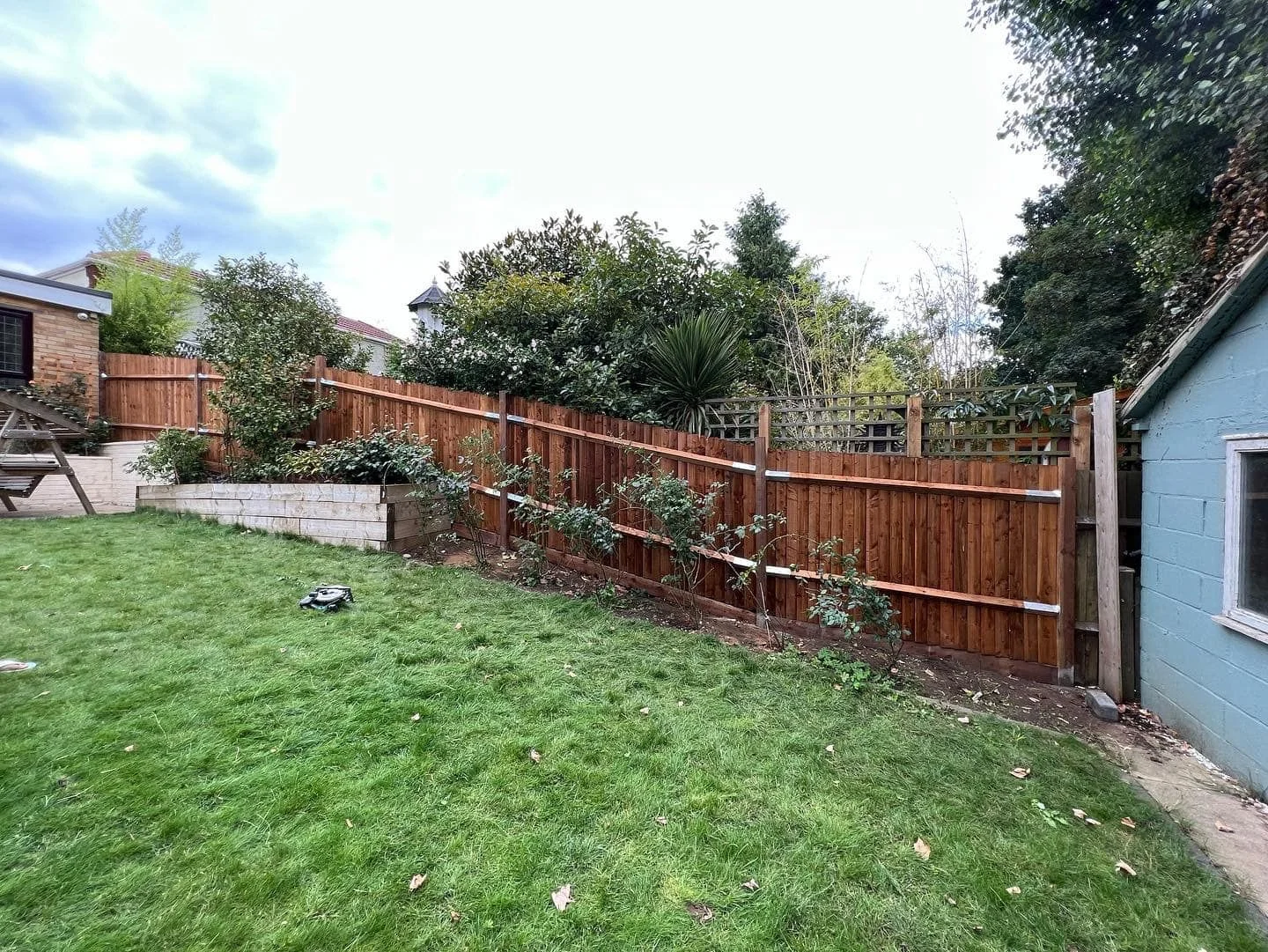
The most common fencing requirement across west Kent's premium residential market is the replacement and upgrading of rear garden boundary fencing — often closeboard panels that have reached the end of their service life. The specification principles are the same as anywhere: posts set at adequate depth in properly mixed concrete, pressure-treated timber throughout, gravel boards at the base, consistent installation quality throughout the run.
For front boundaries — where the fencing faces the highway and contributes to the property's streetscape character — the material choice matters more than in enclosed rear gardens. Traditional post-and-rail in timber, painted hardwood picket fencing, or decorative steel railings may be more appropriate than standard closeboard panels for the character of premium Sevenoaks or Tunbridge Wells properties. Marshall advises on boundary fence type during the site consultation, with specific regard to conservation area requirements where relevant.
Home Extensions in Tonbridge, Tunbridge Wells and Sevenoaks
Home extensions in west Kent's premium residential market are among the most technically demanding and highest-value projects Marshall delivers anywhere in the county. The properties involved are typically larger, the planning environment more complex, and the expectations for finish quality higher than in most other parts of the Kent market.
Planning Permission in Tunbridge Wells and Sevenoaks
Tunbridge Wells Borough Council and Sevenoaks District Council are both active planning authorities with well-resourced planning teams and clear policies on residential extensions. The extensive conservation area coverage across both districts means that many extension projects require full planning permission rather than simply satisfying permitted development criteria.
Key considerations for extension planning in west Kent include the relationship of the extension to the existing property's architectural character (materials, roof pitch, window proportions), the impact on adjacent properties' light and outlook, and the compliance with conservation area character guidelines where relevant.
Marshall's team is familiar with the planning environment across Tunbridge Wells Borough and Sevenoaks District, and advises on likely planning requirements during the initial site consultation. For projects that require formal planning permission, Marshall can recommend experienced local architectural technicians and structural engineers who understand the specific planning context.
Foundation Specification in the Weald
Extension foundations in the Wealden Clay areas of Tonbridge require the same careful approach as foundation work in the Medway clay areas — adequate depth to reach stable, undisturbed material below the active shrinkage zone, with specific attention to the proximity of established trees. The mature gardens that characterise west Kent's premium residential stock frequently include significant trees whose root systems affect foundation specification significantly.
The building control process — with the foundation excavation inspection before concrete is poured — is managed as standard practice on all Marshall extension projects. No concrete is poured without the building control officer's sign-off on excavation depth and profile.
Why Marshall for West Kent
The competitive landscape in Tonbridge, Tunbridge Wells, and Sevenoaks includes several active contractors. The search results reveal Parallel Builders, GM Construction, HD Groundwork & Construction, Benchmark Landscaping, Crown Contractors Kent, and Templar Developments all operating in various parts of this market.
Most of these operators are strong in their specific discipline. Benchmark Landscaping has an excellent patio and landscaping reputation. Parallel Builders and GM Construction bring genuine general building capability. HD Groundwork provides solid groundworks and driveway services from a Tonbridge base. Crown Contractors covers brickwork and fencing across the area.
What none of them offers — and what the west Kent premium market specifically requires — is the combination of genuine craft brickwork depth alongside complete outdoor construction capability, delivered by a single team whose 15-year track record and 500+ completed projects provides verifiable evidence of consistent quality. When a Sevenoaks homeowner needs a Victorian garden wall rebuilt to lime mortar specification, a new porcelain driveway with correctly specified drainage, and a patio transition to a new artificial grass lawn, they need one contractor who can do all three to the same quality standard. That is the Marshall proposition.
Browse the completed projects gallery for evidence of what Marshall delivers across west Kent and the wider county. The portfolio covers every service category — driveways, patios, brickwork, landscaping, fencing, and extensions — across the full range of property types from Victorian terraces to contemporary new builds.
Location Coverage: West Kent and the Surrounding Villages
Marshall covers the full west Kent market from the Rochester base, with no travel surcharge for Tonbridge, Tunbridge Wells, or Sevenoaks. Coverage extends across all surrounding towns and villages:
Tonbridge and surrounding areas including Hildenborough, Shipbourne, Borough Green, West Malling, Paddock Wood, and Hadlow. Royal Tunbridge Wells and surrounding areas including Southborough, Pembury, Speldhurst, Langton Green, Bidborough, and Fordcombe. Sevenoaks and surrounding areas including Westerham, Oxted, Edenbridge, Otford, Kemsing, Ightham, Borough Green, and the Darent Valley villages.
For specific location guides covering other parts of Kent, see the dedicated guides for Rochester and Medway, Sittingbourne and Swale, and Canterbury.
Getting Started: Free Site Visit Across West Kent
Every Marshall project begins with a free site visit — a thorough assessment of your property, ground conditions, drainage characteristics, and planning context before any quote is produced. The written quote that follows is itemised and specific: the sub-base depth, the drainage provision, the material specification, the programme. Nothing vague, nothing to be clarified later.
Phone: 07724 730872 Email: info@mbconstruction.group Contact form: mbconstruction.group/contact/
Learn more about the team and business background, explore the full range of services, or browse the project gallery to see completed work across Kent.
Marshall Brickwork & Construction. Serving Tonbridge, Tunbridge Wells, Sevenoaks, and the whole of west Kent with the quality the area's properties deserve.
Marshall Brickwork & Construction Ltd | 14 Poplar Road, Rochester, ME2 2NR | 07724 730872 | mbconstruction.group