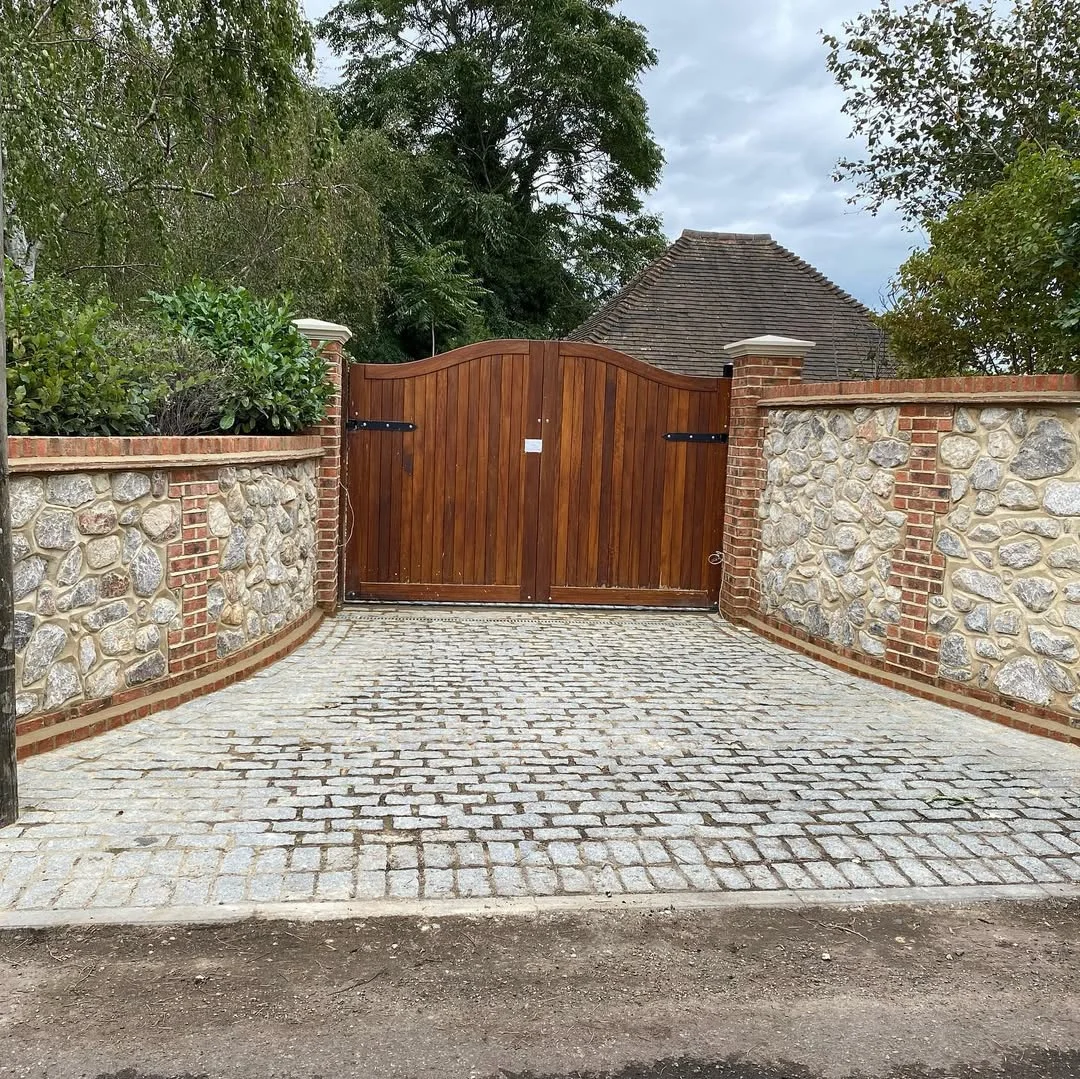
Garden walls in Kent — the complete guide to new build, repair and restoration. Foundation specification, mortar selection, planning permission and free site visits.
A well-built garden wall does something quietly remarkable. It defines a space without dominating it. It creates privacy without closing the garden off. It provides the structural backbone that makes everything planted or paved alongside it look considered — the difference between a garden that was designed and one that simply grew.
Across Kent's residential landscape, garden walls are one of the most visible expressions of a property's character and one of the most telling indicators of how seriously a homeowner — and their builder — has approached the outdoor space. A garden wall built properly, on correct foundations, in well-specified materials, with the right mortar for the site conditions, stands for decades with minimal maintenance. A garden wall cut to corners — inadequate foundations, incorrect mortar, poor drainage provision — starts telling its own story within a few winters: the lean that develops gradually, the crack that appears after a frost, the coping stone that lifts and allows water into the top course.
Marshall Brickwork & Construction has been building, repairing, and restoring garden walls across Kent for over 15 years. It is, in the most direct sense, what Marshall does — brickwork is the company's identity, and garden walls are among the most frequent and most varied expressions of that identity across the county. This guide covers everything a Kent homeowner needs to know: the types of garden wall, the construction requirements that determine longevity, the specific challenges that Kent's ground conditions and conservation areas present, the repair and restoration options for walls that have deteriorated, and how garden walls integrate with the wider outdoor construction picture.
The Types of Garden Wall and What Each One Does
Garden walls serve different purposes, and the purpose shapes the specification. Understanding the distinction matters because a wall built for the wrong application — structurally under-specified for its actual load, or over-engineered for a decorative role — wastes either the homeowner's money or the wall's structural capacity.
Boundary Walls
Boundary walls define the edge of a property — marking the line between private and public, garden and road, your space and your neighbour's. They range from low decorative walls of 300–450mm height at the edge of a front garden through to full-height boundary walls of 1.8–2.1 metres providing privacy and security to a rear garden.
Boundary walls are subject to planning considerations that depend on their location relative to the highway. A wall adjacent to a highway — the front boundary of a property, facing the road — is limited to 1 metre in height before planning permission is required. Walls not adjacent to a highway can reach 2 metres without permission in most circumstances. Conservation area properties, listed buildings, and properties in designated areas may have different or more restrictive rules.
The structural requirements for a boundary wall depend primarily on its height and exposure. A low front garden wall of 450mm height has modest foundation requirements. A 1.8 metre rear garden boundary wall in an exposed position — particularly in the Swale district's coastal-influenced sites, or on elevated ground in the Sevenoaks area — needs more careful consideration of wind loading, foundation depth, and pier placement.
Retaining Walls
A retaining wall holds back earth — it is a structural element whose primary function is to prevent soil from moving into the space beyond it. Gardens with significant gradient changes, terraced landscapes, and sloped sites all require retaining walls of some kind to create level usable areas.
Retaining walls are among the most frequently under-specified garden structures in Kent. The forces acting on a retaining wall — the passive earth pressure from the retained soil, the surcharge from anything above the retained area, and the hydrostatic pressure from water trapped against the back face — are genuine structural loads that require engineering thought, not decorative assembly.
The foundation of a retaining wall must be specified for the retained height and soil type. For walls retaining more than 600mm of earth, structural engineering input is advisable. The base of the wall must be wider than the top — the wall thickens toward the foundation to resist the overturning moment created by the retained earth. Drainage behind the wall is not optional — it is the element that prevents the hydrostatic pressure that causes most retaining wall failures. Weep holes at the base of the wall face, or a perforated pipe in granular material behind the wall connected to a discharge point, are the standard drainage provisions.
Marshall's groundworks expertise is directly relevant here. Retaining walls that fail almost always fail for groundworks reasons — inadequate foundations, insufficient drainage, or formation movement that was never accounted for in the design. Building a retaining wall correctly means thinking about what goes beneath and behind it as carefully as what goes in front.
Raised Planting Beds and Garden Features
Raised planting beds built in brick are one of the most frequently requested garden features across Kent — both because they are genuinely functional (creating well-drained growing conditions independent of the underlying soil, which matters enormously on the London Clay of Medway and Sittingbourne) and because they add architectural structure and visual interest to an outdoor space that grass and planting alone cannot provide.
A raised planting bed is not a retaining wall — the retained height is modest, the structural loading is relatively light, and the construction requirements are correspondingly straightforward. But it still needs a proper foundation, correctly specified mortar, and adequate drainage weep holes at the base to prevent the water that would otherwise saturate the root zone and the wall base simultaneously.
Entrance pillars, gate piers, seating walls, and decorative garden features all fall within this broader category of brickwork garden features where the structural requirements are modest but the craft quality is visible. Consistent coursing, clean bed and perpend joints, plumb faces, and correctly capped tops are what distinguish professional brickwork from ambitious amateur attempts — and they are what the completed projects across Kent consistently demonstrate.
Material Choices: Brick, Stone, Block and Render
The material choice for a garden wall should reflect three things: the character of the surrounding property and garden, the practical performance requirements for the application, and the planning context where relevant.
Facing Brick
Facing brick is the dominant material for residential garden walls across Kent, for entirely rational reasons. It is durable, requires minimal maintenance, is available in an enormous range of colours and textures, and — when matched correctly to the existing property brickwork — creates a visual coherence between the house and garden that other materials cannot replicate.
The range of facing brick available spans from the clean, uniform wire-cut bricks used in most modern housing to the hand-thrown, textured bricks that complement period properties, to the reclaimed London stock and multi-coloured handmade bricks that suit the older housing stock of Rochester, Sittingbourne, Canterbury and Tunbridge Wells.
Brick selection for a garden wall that is to be built against, or adjacent to, an existing brick building requires care. The colour and texture of the wall brick should be compatible with the house brick — not necessarily identical, but compatible in character and palette. A hard engineering blue brick wall alongside a soft cream stock brick Victorian house creates a jarring visual discontinuity that a more considered brick choice would avoid.
For period properties — particularly those built before 1930 in conservation areas across Kent — reclaimed brick is frequently the right choice for new walls that need to read as part of the existing character. The weathered, hand-made quality of reclaimed London stocks and local Kent bricks is visible at close inspection in a way that new reproduction bricks rarely replicate convincingly.
Natural Stone
Natural stone — Kent ragstone, flint, sandstone, limestone — is appropriate for properties and locations where stone is the vernacular material. Ragstone walls are characteristic of much of rural west Kent and the Sevenoaks area, where the local geology and building tradition make stone walls the contextually correct choice. Flint walls are characteristic of coastal Kent and the chalk downland areas.
Stone walls require more skilled and time-consuming construction than brick walls of equivalent size — the irregular shapes of natural stone require more individual adjustment during laying, and the pointing of irregular joints demands greater craft attention than the regular coursing of brickwork. The result, when well executed, is a garden wall with genuine character and a depth of quality that no manufactured material fully replicates.
Rendered Block
Rendered blockwork walls — concrete block built and then rendered smooth or with a textured finish — are appropriate for contemporary properties and modern garden designs where a clean, minimal aesthetic is the design intent. Rendered walls can be finished in a range of colours and render textures, including through-coloured render that eliminates the need for periodic repainting.
The key specification consideration for rendered walls is the render system. Lightweight EWI-type render systems applied over blockwork perform well and resist cracking better than traditional sand and cement render, which is prone to shrinkage cracking that allows water ingress and undermines the render bond over time. For any rendered garden wall, the coping detail at the top is particularly important — water entering through a failed or absent coping causes the most rapid deterioration of rendered finishes.
Foundation Specification: The Invisible Determinant of Longevity
Garden wall foundations are where the longevity of the wall is determined, in the ground, before a single course of brickwork is laid. This is the element most often shortcut on budget garden wall projects, and the source of most garden wall failures.
Foundation Depth for Kent's Ground Conditions
The minimum foundation depth for a freestanding garden wall on stable ground is 450mm — taking the concrete below the zone most affected by frost and surface moisture change. On the London Clay that underlies much of the Medway towns, Sittingbourne, and significant parts of mid-Kent, this minimum is not sufficient. Clay movement — the volumetric expansion and contraction that accompanies the seasonal moisture cycle — creates ground movement in the upper 600–900mm that transmits directly to inadequately founded structures.
On clay sites, garden wall foundations should typically reach 600mm minimum depth, and preferably 750mm. On sites with established trees nearby — a constant consideration in Kent's mature residential gardens — the influence of root systems on soil moisture can extend the required foundation depth significantly, as the clay around tree roots experiences more dramatic shrinkage during dry periods than surrounding areas.
Marshall's groundworks approach treats foundation depth as a site-specific question assessed at the initial visit, not a standard figure applied universally. The ground at a Medway terrace garden is not the same as the ground at a Sevenoaks detached house — and the foundation specification should reflect that difference.
Foundation Width and Wall Height
The relationship between foundation width and wall height is a structural principle that garden wall construction must respect. A freestanding wall is essentially a vertical cantilever resisting wind loading and its own weight — the wider the foundation relative to the wall's height, the more stable the structure.
For single-skin brick walls (102mm thick, one brick wide), the foundation should be at minimum 300mm wide. For one-brick walls (215mm thick), 450mm minimum. Taller walls — anything over 1.2 metres — benefit from pier construction at regular intervals (typically 1.8–3 metres depending on height and exposure), which both break the wall into structurally stable panels and add visual interest.
Concrete Specification
The concrete used for garden wall strip foundations should be minimum C20 grade — a mix of one part cement, two parts sand, and four parts aggregate. Ready-mixed concrete to the relevant specification is the most reliable approach for foundation work; hand-mixed concrete is acceptable for small walls but the consistency of hand mixing is harder to guarantee.
The concrete should be placed in a single pour where possible, avoiding cold joints that create planes of weakness. It must be allowed to cure adequately before any wall construction begins — minimum 24 hours, and longer in cold or wet conditions. Starting brickwork on green concrete causes differential settlement in the mortar bed that undermines the levelness of the first course throughout the wall's life.
Mortar Specification: The Most Misunderstood Garden Wall Element
Mortar specification is the aspect of garden wall construction that generates the most damage when got wrong, and the least discussion when commissioning the work.
Portland Cement Mortar vs Lime Mortar
Modern Portland cement mortar — the standard mix of cement, sand, and water used in most contemporary construction — is appropriate for garden walls built in modern brick on modern properties. It is strong, sets quickly, and provides good weather resistance for the facing application it was designed for.
It is completely wrong for period brick and stonework. Victorian and Edwardian bricks — the soft, handmade or early machine-made bricks that make up the majority of Kent's period housing stock in Rochester, Maidstone, Chatham and across the county — were made to work with lime mortar. The mortar was designed to be softer than the brick, so that any movement or stress in the wall would cause the mortar joint to fail before the brick face. Mortar is replaceable; spalled brick faces are not.
Using Portland cement mortar on period bricks reverses this relationship. The mortar is harder than the brick. Movement and moisture stress that cannot escape through the rigid cement joint go through the brick face instead. Spalling begins — typically within a decade on exposed walls — and accelerates. What started as a repointing or new wall project using the wrong mortar becomes, over fifteen to twenty years, a brick replacement project.
The repointing guide covers mortar specification in depth for repair contexts. For new wall construction alongside or matching period property brickwork, the same principles apply: lime-based mortar, mixed to a strength and composition appropriate for the brick specification, coloured to match the existing mortar character.
Mortar Colour and Joint Profile
The visible mortar joint is one of the most significant design elements of a brick wall. The colour of the mortar — whether it is a light buff that makes the brickwork read as a continuous pale field, or a dark grey that emphasises each brick as an individual unit — changes the character of the wall more dramatically than many homeowners anticipate.
Colour matching for new walls built alongside existing period brickwork is a craft skill. It involves assessing the existing mortar's colour in both dry and damp conditions (mortar reads differently depending on moisture content), testing sample mixes on inconspicuous sections before committing to the full application, and selecting pigments that will weather compatibly with the existing pointing over time.
Joint profile — the shape in which the mortar is finished flush with, recessed from, or slightly proud of the brick face — also affects both appearance and weather performance. Bucket handle and weatherstruck profiles shed water more effectively than flush or recessed profiles. Recessed profiles on exterior walls in exposed positions are inappropriate — they create a horizontal ledge that collects water at every course, accelerating frost damage and biological growth.
Planning Permission for Garden Walls in Kent
The planning position for garden walls is simpler than many homeowners expect, with a few critical exceptions that matter significantly across Kent's conservation-sensitive towns.
The Permitted Development Position
Under the Town and Country Planning (General Permitted Development) Order, garden walls are generally permitted development — meaning no planning application is required — subject to height limits. Walls adjacent to a highway are limited to 1 metre. Walls not adjacent to a highway are limited to 2 metres. These limits apply to the wall itself; gates, piers, and other structures may have separate considerations.
Conservation Areas and Listed Buildings
Kent has an exceptionally large number of conservation areas relative to most English counties. Rochester's historic centre, the Pantiles area of Tunbridge Wells, Faversham's medieval core, the older residential districts of Maidstone, the historic streets of Canterbury, and many village conservation areas across the county — all have additional restrictions that modify permitted development rights.
In conservation areas, permitted development rights for walls and gates are more restricted. Some conservation areas have Article 4 Directions that remove permitted development rights for external alterations entirely, requiring planning applications for work that would be permitted elsewhere. The material specification for new walls in conservation areas is frequently a consideration — inappropriate materials (concrete block, render finishes inconsistent with local character) may be refused even where the structure itself would be acceptable.
Listed buildings require Listed Building Consent for any external works within the curtilage, regardless of planning permission status. A garden wall within the grounds of a listed property — even if the wall itself is not listed — falls within this requirement.
Marshall advises on conservation area and listed building implications during the initial site consultation, before any design decisions are made that may subsequently need to be revisited.
Garden Wall Repair and Restoration
An existing garden wall that has deteriorated does not always need to be demolished and rebuilt. Understanding the repair options — and the situations where repair is appropriate versus full replacement — is part of the honest assessment Marshall brings to every site visit.
Repointing Existing Walls
If the brick faces are sound but the mortar joints are crumbling, open, or incorrectly specified from a previous cement repointing job, repointing is the appropriate intervention. Old mortar is raked out to 15–20mm depth, the joints are cleaned, and new mortar in the correct specification for the brick type is applied and finished to the appropriate profile.
Repointing restores the wall's weather resistance, improves its appearance, and extends its service life by decades when correctly executed. It is often the most cost-effective intervention available on walls where the underlying structure is sound.
Brick Replacement
Where individual bricks have spalled, cracked, or been physically damaged, brick repair involves removing the affected bricks and replacing them with matching units in the same mortar specification. Sourcing matching bricks for period walls requires knowledge of the original brick type and an established supply of compatible alternatives — either new facing bricks in a compatible colour and texture, or reclaimed bricks from demolition salvage.
The skill in brick replacement is making the repair invisible. A brick patch carried out by an inexperienced operative is visible for decades — the replacement bricks sit at a different depth or have different joints from the surrounding wall. Done well, a repair in matching material with matched mortar is invisible at normal viewing distances within a season as the pointing weathers.
Structural Repair and Rebuilding
Where a garden wall has moved significantly — developing a lean, a bow, or a bulge — the structural issue causing the movement must be identified before any surface repair is attempted. A wall that has moved due to foundation failure will continue moving if the foundation failure is not addressed. A wall that has moved due to water pressure behind a retaining element will move again if the drainage is not improved.
In some cases, the correct answer is partial or full rebuilding. An honest assessment of when repair is viable and when rebuilding is the better long-term investment is part of what Marshall's experience across thousands of brickwork assessments across Kent delivers.
Garden Walls as Part of a Complete Outdoor Design
Garden walls rarely exist in isolation. They are elements within a wider outdoor design — and the way they integrate with patios, planting, driveways, fencing, and landscaping determines whether the finished garden feels coherent or assembled from separate projects.
The most effective garden projects Marshall delivers in Kent combine multiple elements into a single coordinated commission. A garden transformation that includes a patio in Indian sandstone or porcelain, raised brick planting beds along the boundary, an artificial grass lawn in the main garden area, and closeboard fencing along the rear boundary produces a result that reads as a designed space — not a series of separate purchases. The brickwork, paving, grass, and fencing are all specified and executed together, with consistent materials and coordinated levels.
For homeowners planning a home extension alongside garden works, coordinating the external brickwork of the extension with the garden wall brickwork is particularly important. The extension walls should match the garden walls in brick specification and mortar colour — creating the visual impression that the whole outdoor environment was conceived together, not built in stages by different contractors with different material selections.
For driveways, the relationship between driveway construction and boundary walls is one of the most visible aspects of a property's front-of-house character. A quality block paving driveway framed by brick piers and a low brick boundary wall creates a complete front-of-house picture. The same driveway next to a deteriorating rendered wall with a failed coping reads as incomplete regardless of the driveway quality.
Marshall's full-service capability — brickwork, driveways, patios, landscaping, fencing, extensions — means all of these elements can be delivered by a single contractor, to a consistent standard, within a coordinated programme. This is the complete outdoor construction capability that most of the Kent market, with its specialist single-trade contractors, simply does not offer.
Garden Wall Services Across Kent
Marshall delivers garden wall construction, repair, and restoration across the full Kent coverage area. In the Medway towns — Rochester, Chatham, Gillingham, Strood — the combination of London Clay ground conditions and Victorian housing stock creates the most frequent demand for both correct-specification new walls and lime mortar repointing on period brickwork. In Sittingbourne and the Swale district, the exposure conditions and clay soils require the same conservative foundation and drainage specification. In Canterbury and the historic towns of east Kent, conservation area awareness is the primary constraint on material selection. In Tonbridge, Tunbridge Wells, and Sevenoaks, the premium residential market and the variable geology of the High Weald and greensand ridge create the most varied and demanding garden wall projects.
Every project — wherever in Kent it sits — begins with the same starting point: a free site visit, a thorough assessment, and an honest recommendation about what is needed and how it should be built.
Frequently Asked Questions About Garden Walls in Kent
Does a garden wall require building regulations approval?
Most freestanding garden walls — boundary walls, raised beds, decorative features — do not require Building Regulations approval provided they are below the heights that trigger the need for structural engineering sign-off. Retaining walls above approximately 1.2 metres retained height, and any wall that forms part of a structure (such as a wall integral to a building), typically does require Building Regulations involvement. Marshall advises on this during the site consultation for each project.
How long does a professionally built brick garden wall last?
A garden wall built on correct foundations, in appropriate materials, with correctly specified mortar, and fitted with a good coping detail at the top should last 50 to 100 years with periodic maintenance. The maintenance requirements are minimal: checking the coping and top course every few years, repointing sections as mortar reaches the end of its service life (every 20–30 years on sheltered walls, sooner on very exposed aspects). The walls that fail in 5–10 years do so because the foundations were shallow, the mortar was wrong, or water was allowed to enter through a failed coping.
Can you match the brickwork of my existing house?
In most cases, yes — though the ease and precision of matching depends on the original brick. Modern machine-made bricks from identified manufacturers can usually be matched with current production. Victorian and Edwardian handmade bricks require sourcing from reclamation yards and careful selection for colour and texture compatibility. Marshall's established relationships with Kent's brick merchants and reclamation suppliers make this matching process more reliable than attempting it without that supply chain access.
How much disruption does garden wall construction cause?
For a standard garden wall project, disruption is modest and well-defined. Excavation for foundations is the noisiest phase, typically completed in one day. The brickwork itself proceeds quietly. Mortar needs 24–48 hours curing time before the wall can be loaded. A typical boundary wall project of 10–15 linear metres is complete within three to five working days.
Getting Started: Free Site Visit Across Kent
If you are planning a new garden wall, considering repair or restoration of an existing structure, or looking at a wider outdoor project where brickwork features are part of the design — the starting point is always the same: a free site visit.
Marshall Brickwork & Construction visits your property, assesses the existing conditions and ground, discusses the design intent and any planning constraints, and produces a detailed itemised quote covering foundation specification, materials, and programme. There is no charge and no obligation.
Phone: 07724 730872 Email: info@mbconstruction.group Contact: mbconstruction.group/contact/
Browse the completed projects gallery for garden wall and brickwork work across Kent. Explore the full services range — brickwork, driveways, patios, landscaping, fencing, and extensions. Read about the company and the team behind the work.
Garden walls. Built properly. Built to last. That is what Marshall Brickwork & Construction has been doing across Kent for fifteen years — and what every garden wall we build will continue doing for the decades after we leave site.
Marshall Brickwork & Construction Ltd | 14 Poplar Road, Rochester, ME2 2NR | 07724 730872 | mbconstruction.group