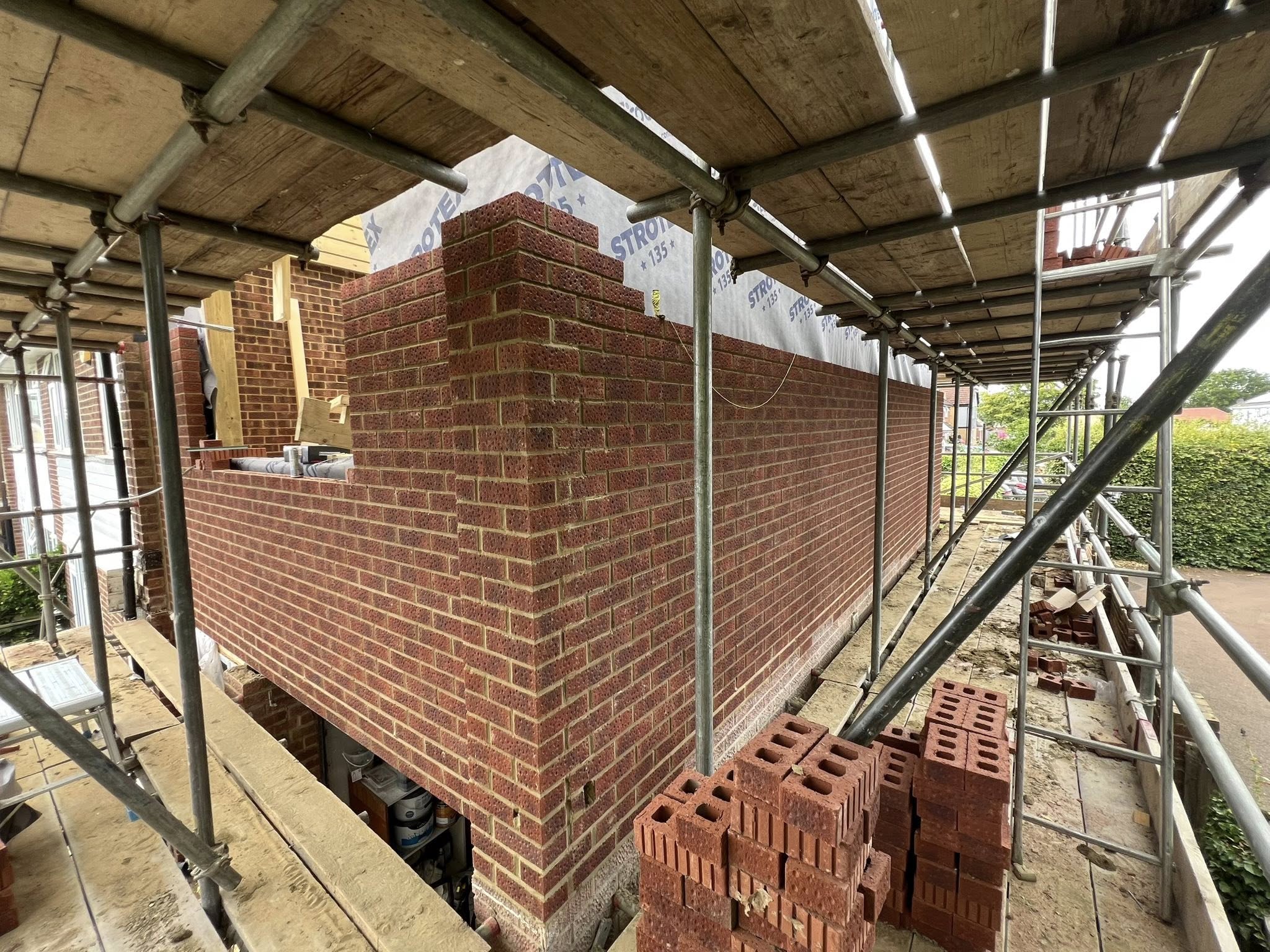
What does precision brickwork actually mean? The complete technical guide — bond patterns, mortar specification, lime vs cement, and how to recognise quality bricklaying in Kent.
Every brickwork contractor in Kent describes their work as quality. They use the same words — precision, craftsmanship, built to last, attention to detail — and they deploy them confidently, because they know that homeowners cannot easily assess whether the words are accurate until years after the project is complete and the contractor is long gone.
This guide is different. It is written by a brickwork company that is confident enough in its own standard to explain exactly what that standard looks like — technically, in measurable terms, in the specific details that distinguish genuine craft brickwork from work that merely looks like it on the day it is done.
By the end of this guide, any Kent homeowner will understand what precision brickwork involves in practice, what questions to ask before commissioning any brickwork project, what to look for when inspecting work in progress or on completion, and why the technical standards covered here are the determinants of longevity — not the marketing language that surrounds them.
MB Construction Group — Marshall Brickwork & Construction has been delivering brickwork across Kent for over fifteen years. Brickwork is not one service among many — it is the company's identity, the craft discipline at the core of everything Marshall does, and the standard against which every project is measured. The knowledge in this guide comes from that fifteen years of assessment, execution, and accumulated technical depth.
Why Brickwork Quality Is Invisible on Day One — and Visible for Decades
There is a specific problem with brickwork quality that makes it different from most other home improvement categories. On the day a brickwork project is completed, a well-executed job and a poorly executed one can look almost identical to a homeowner without specific technical knowledge.
Consistent bed joints and inconsistent bed joints both look like horizontal mortar lines. Correctly specified lime mortar and incorrectly specified cement mortar both look like grey pointing. A wall set plumb within one millimetre per metre and a wall set plumb within five millimetres per metre both look vertical to the casual eye. Foundation depth that is adequate for a clay-bearing Medway site and foundation depth that is 100mm too shallow both look like an invisible footing.
The differences become visible over years and decades. The inconsistent bed joints create differential stress points in the wall that cause cracking under frost loading. The incorrect cement mortar causes brick spalling as it forces moisture through brick faces rather than through the sacrificial joint. The wall that is two millimetres out of plumb per course, across twenty courses, has a lean that becomes increasingly apparent as the courses accumulate. The foundation that was 100mm too shallow on London Clay begins to transmit seasonal movement to the wall above it.
Understanding that quality brickwork is a long-term investment — and that the differences between quality levels are invisible on day one but compounding over time — is the foundation for commissioning intelligently rather than simply choosing the most confident-sounding quote.
The Technical Standards That Define Precision Brickwork
These are the measurable standards that professional bricklayers are assessed against and that Marshall applies to every project across Kent. They are not aspirational targets — they are minimum standards for work that deserves to be called quality.
Bed Joint Consistency
The bed joint is the horizontal mortar layer between courses of bricks. Standard UK brickwork specifies a bed joint of 10mm — the thickness determined by the historical relationship between brick dimensions and the mortar thickness that distributes load evenly between courses.
Bed joint consistency means every joint is 10mm — not 10mm in some places and 14mm in others because the bricklayer was rushing or not checking gauge regularly. Variation in bed joint thickness produces differential load distribution in the wall, aesthetic inconsistency that becomes more visible as weather affects the mortar, and structural weakness at the points where oversized joints create stress concentrations.
The way precision bricklayers maintain consistent bed joints: they work to a gauge rod — a timber rod marked at 75mm intervals (the standard height of a brick plus a 10mm bed joint) that allows every course to be checked against the intended level before the next course is started. A bricklayer who does not use a gauge rod is working by eye and feel. A bricklayer who uses one consistently is working to a measurable standard.
Perpend Joint Alignment
The perpend joint is the vertical mortar joint between bricks within each course. Consistent perpend joints should align vertically across courses in a pattern determined by the bond — creating the regular, rhythmic appearance of quality brickwork.
The specific alignment depends on the bond pattern. In standard stretcher bond — the most common residential brickwork bond in the UK — perpend joints should be offset by exactly half a brick (approximately 112mm) between alternate courses, creating the familiar running bond pattern. Perpend joints that do not align correctly — where the offset varies, or where joints in alternate courses are close to aligning (a fault called "half-lap" variation) — create weakness in the wall and visible irregularity in the finished surface.
Perpend joint consistency requires careful attention to brick laying rather than speed. It requires the bricklayer to set out each course before laying it, to check perpend positions against the course below, and to cut bricks accurately rather than approximately where cuts are needed.
Plumb and Level
Every brick wall must be plumb — vertical — and every course must be level — horizontal. These are the most fundamental standards in brickwork and the ones whose failure is most visible over time.
Plumb is checked with a spirit level or plumb bob on the face of the wall at regular intervals — typically every three to four courses. A wall that is not checked for plumb regularly develops a cumulative lean that is difficult to correct once several courses are in place.
Level is checked across the top of each course using a spirit level or a long straightedge. Courses that are not level cause all subsequent courses to be out of level, and the cumulative effect across a wall of twenty courses is significant. On a long garden wall, a level error of one millimetre per metre is barely perceptible over a two-metre run but visible and structurally concerning over an eight-metre run.
The standard for precision work: plumb to within 3mm per metre of height, level to within 3mm per metre of length. These are achievable standards for any competent bricklayer working carefully. They are standards that production-speed brickwork — where the incentive is square metres laid per day — frequently compromises.
Return Angles and Corners
Corners are where brickwork quality is most easily assessed by someone who knows what to look for. A corner — where two wall faces meet at 90 degrees — must be precisely square, plumb on both faces, and returned cleanly with the bond pattern carrying through the corner without disturbing the consistent alignment of bed and perpend joints on either face.
Achieving this requires accurate setting out before any bricks are laid, careful construction of the corner leads (the angled sections laid first at each end to guide the infill courses), and consistent checking of square and plumb throughout. A corner that is not truly square produces a wall run that drifts out of line progressively as it extends from the corner. Corners that look slightly off at completion look significantly off after a year of weather and settlement.
Marshall's bricklayers are specifically experienced in the corner details that define the quality of any brickwork project — both the technical execution of accurate corners and the aesthetic craft of maintaining consistent joint profiles and brick alignment through the turn.
Bond Patterns: The Structural and Aesthetic Logic of How Bricks Are Laid
Bond patterns are not merely aesthetic choices — they are structural systems that determine how load is distributed through a wall and how strong the wall is against the forces acting on it. Understanding the most common bond patterns used in Kent brickwork explains why certain patterns are appropriate for certain applications.
Stretcher Bond
The most common bond pattern in modern UK residential brickwork. Bricks are laid with their long face (the stretcher face) on the outside surface, offset by half a brick between alternate courses. Stretcher bond is used for cavity wall construction — where two independent single-brick-wide leaves are separated by a cavity and tied together with wall ties — and for decorative brick screens.
Stretcher bond is structurally appropriate for cavity wall leaves because the wall tie system provides lateral stability. It is not appropriate for freestanding walls of any significant height without piers, because a single-leaf stretcher bond wall lacks the inherent bond strength of multi-wythe construction.
English Bond
One of the oldest and strongest traditional masonry bonds. Alternate courses of headers (bricks laid with their short end facing outward) and stretchers create a pattern that bonds the two wythes of a solid wall together throughout its depth, creating a wall of exceptional lateral strength.
English bond is most commonly encountered in Kent's Victorian and Edwardian period properties, built before the introduction of cavity wall construction. The strength of English bond is one of the reasons Victorian brick buildings perform so well over a century of use — the structural integrity of the bond pattern is integral to the wall's resilience.
For garden walls, boundary walls, and any solid masonry construction in Kent, English bond is the structurally superior choice for walls requiring maximum lateral strength. Garden walls and retaining features built in English bond on correctly specified foundations are among the most durable outdoor masonry structures available.
Flemish Bond
An alternating pattern of headers and stretchers within each course — a header followed by a stretcher, repeated across the course, with the pattern offset between alternate courses. Flemish bond is visually distinctive and structurally strong, and it is one of the most characteristic patterns of Georgian and early Victorian architecture in Kent.
In Canterbury's Georgian streetscape, Flemish bond is the dominant pattern. In Tunbridge Wells Victorian properties, Flemish bond is common in the more prestigious elevations. For new brickwork that must integrate with an existing Flemish bond wall — an extension, a new entrance feature, a repaired section — matching the bond pattern is as important as matching the brick and mortar.
Rat Trap Bond
A distinctive pattern in which bricks are laid on edge rather than flat, with the cavity between alternate header pairs creating a hollow wall. Rat trap bond is primarily associated with the Victorian industrial and agricultural building stock of Kent — farm buildings, warehouses, boundary walls on large estates — and requires specific knowledge to replicate or repair correctly.
Specialist knowledge of traditional bond patterns — including the less common ones like rat trap, monk bond, and English garden wall bond — is part of what distinguishes a genuine brickwork authority from a competent production bricklayer. Marshall's team works across the full range of bond patterns found in Kent's varied building stock.
The Mortar Question: The Most Consequential Technical Decision in Kent Brickwork
If there is a single technical knowledge question that separates brickwork contractors with genuine craft expertise from those without it, it is the mortar specification question. It is also the question with the most severe long-term consequences when got wrong.
The principle, clearly stated: the mortar in any brickwork assembly must be weaker than the bricks it bonds.
The reason is physical: masonry walls move. Thermal expansion and contraction with temperature change, moisture absorption and drying, the seasonal volumetric change of the clay soils on which most Kent properties sit — all of these cause tiny but cumulative movements in the wall. Those movements must be accommodated somewhere. The correct place is the mortar joint — the designed weak point in the assembly that absorbs movement and releases it without damaging the brick. If the mortar is harder than the brick, the movement is forced through the brick face instead. The brick spalls.
Lime Mortar for Period Brickwork
For any property in Kent built before approximately 1930 — and that category encompasses the majority of Rochester, Chatham, Gillingham, Sittingbourne, Canterbury, Maidstone, and the older residential areas of virtually every Kent town — the correct mortar specification for repointing and any new brickwork work is lime-based mortar.
Victorian and Edwardian bricks were fired at lower temperatures than modern bricks. They are softer, more porous, and more flexible. They were designed to work with lime mortar, which has been the standard masonry binder for millennia precisely because of its flexibility, its breathability, and its sacrificial nature. A lime mortar joint that fails can be raked out and replaced without damage to the surrounding brickwork. This is the system working as designed.
When Portland cement mortar — introduced for masonry use in the twentieth century and stronger than virtually any traditional UK facing brick — is used to repoint period brickwork, the designed failure point is eliminated. The wall can no longer accommodate movement through the joint. Movement stress goes into the brick instead. The brick spalls. The damage accumulates over years until the visible consequence appears: broken, crumbling brick faces that require replacement rather than simple repointing.
Marshall has encountered this damage — caused by previous incorrect cement repointing — on period properties across every Kent location where the company works. The pattern is entirely predictable from the specification used: cement mortar on soft Victorian brick produces spalling within ten to twenty years, every time. And the remedy is more expensive than the original correct work would have been.
The lime mortar specification for any given project is not a single fixed formulation — it requires assessment. The composition and strength of the original lime mortar, the absorption rate and strength of the specific brick, the exposure conditions of the elevation — all of these affect the appropriate lime:sand ratio, the sand type, and whether hydraulic lime or non-hydraulic lime is appropriate. This assessment is craft knowledge, not a formula from a product data sheet.
Colour Matching: The Craft Element of Repointing
Beyond the strength specification, the colour of the new mortar must be matched to the existing. This seems straightforward and is in practice one of the most skill-dependent elements of quality repointing work.
Mortar colour is determined primarily by the aggregate — the sand — rather than by the binder. A Medway grey stock brick with silver-buff pointing and a Kentish red brick with warm tan pointing require completely different sand specifications. Natural sands from different sources — silver sand, building sand, washed pit sand — produce dramatically different mortar colours. Pigment additions fine-tune the result.
The correct approach: mix a test sample at the proposed specification, apply it to a small inconspicuous section of the wall, allow it to fully dry (mortar colour changes significantly between wet and dry states, typically lightening by one to two shades), and compare in both daylight and shade. Only when the dry test matches the existing mortar acceptably across viewing distances does the full application proceed.
A contractor who does not mention this testing process — who intends to mix mortar and apply it across the whole elevation without a tested sample — is either experienced enough to have a reliable intuition for colour matching (uncommon) or unconcerned about the colour result (more common). Ask about the testing process before accepting any repointing quote.
What Precision Brickwork Looks Like in Practice: A Project-by-Project Guide
Residential Repointing
Precision repointing on a Kent period property involves every element described above — mortar specification, colour matching, joint preparation depth, application technique, and joint profile — applied consistently across the entire elevation.
The additional precision element specific to repointing is the raking preparation. Old mortar must be removed to a minimum of 15–20mm depth before new mortar can be applied. This depth provides adequate key for the new mortar and ensures the full thickness of new material that is required for weather resistance. Shallow raking — 5–8mm — produces a thin sliver of mortar on top of failed old mortar. It fails within one to two winters.
Raking must be done without damaging the brick arris — the sharp 90-degree edge of the brick face where it meets the joint. Damage to the brick arris from angle grinders (the most common source of brick edge damage on repointing jobs) is irreversible. Hand raking with appropriate tools, or mechanical raking with equipment designed for mortar removal rather than cutting, is the correct approach.
New Garden Walls and Boundary Features
Precision garden wall construction involves all the standard setting out work described above — accurate corners, consistent gauge, plumb and level throughout — plus the specific details that determine a garden wall's longevity rather than merely its initial appearance.
Foundation specification for the ground conditions. On London Clay in Medway and Sittingbourne, minimum 600mm depth strip foundation. On more stable chalk-based ground in parts of Sevenoaks and east Kent, 450mm may be adequate. The correct depth is assessed at the site, not assumed from a standard specification.
Damp proof course placement. Any wall with a closed coping (a coping that sheds water onto both faces) needs a DPC at the base to prevent rising damp. Any freestanding wall needs a DPC under the coping to prevent water penetrating the wall body from above when the coping eventually develops even hairline cracks.
Coping specification. The coping is the most maintenance-critical element of a garden wall — the top surface that sheds water away from the wall body. A correctly specified coping oversails both faces of the wall by a minimum of 25mm, has a drip groove on its underside to prevent water tracking back against the wall face, and is bedded and jointed in mortar with the correct flexibility for the thermal movement that a top-of-wall position experiences. Engineering or natural stone copings outlast brick-on-edge copings by decades in exposed positions.
Pier placement. Freestanding walls above 450mm require piers — thickened sections of wall — at maximum intervals of approximately 3 metres (varying with height and exposure) to provide lateral stability. Walls without adequate pier spacing rely entirely on the mortar bond for lateral resistance, which is inadequate for wind loading in Kent's exposed positions.
Extension Structural Brickwork
Extension brickwork requires all of the above standards applied at the pace and programme of a live construction site, plus the specific precision requirements of matching the extension brickwork to the existing house.
Brick matching. The facing brick used for the extension must be visually compatible with the existing house brick — in colour, texture, and unit size. For post-1970 properties built with modern machine-made bricks, the manufacturer and range can often be identified and current production sourced. For Victorian and Edwardian properties, the original handmade or wire-cut bricks are no longer produced in their original form, and matching requires sourcing compatible new production bricks or reclaimed bricks from sympathetic demolitions.
Marshall's established relationships with Kent's brick merchants and reclamation suppliers are a direct practical advantage in extension brick matching. The knowledge of what is available, what will weather compatibly, and where to source it comes from fifteen years of solving this problem on period properties across the county.
Mortar consistency between new and existing. The mortar used on the extension elevation must match the existing house mortar in colour and profile, so that the new brickwork reads as belonging. This is most challenging where the existing mortar has weathered to a colour significantly different from its original state — aged lime mortar in particular develops a silver-grey weathered surface that new lime mortar takes several years to replicate.
Cavity wall specification. Modern extension cavity walls must meet current building regulations thermal performance requirements. The cavity width, insulation specification, wall tie type and spacing, and cavity tray details above all openings are building regulations requirements that must be documented and inspected during construction. Marshall manages this building control process as standard, scheduling inspections at the correct stages and maintaining the records required for the completion certificate.
Brick Repair and Heritage Work
Brick repair on period properties — replacing spalled, cracked, or missing bricks — is the area where the precision demand is highest and where the gap between skilled and unskilled work is most immediately visible.
Cutting out and replacing individual bricks without disturbing the surrounding mortar or adjacent bricks requires controlled mechanical cutting, careful hand work, and sufficient experience to read how a specific brick is bonded and positioned before attempting to remove it. A brick that is removed without understanding its role in the bond pattern can destabilise adjacent bricks. A brick that is removed with too much force can damage the surrounding arris.
Replacement bricks must match the original in size, colour, and texture. A replacement brick that is 3mm larger than the surrounding bricks distorts the joint pattern on both sides of the repair. A replacement brick that is significantly different in colour creates a visible patch that draws attention to the repair rather than making it disappear.
The mortar used to set replacement bricks must, again, be specified for the brick type. A lime mortar repair in the correct specification, allowed to cure correctly, is invisible at normal viewing distances within two to three years as the mortar weathers to match. A cement mortar repair remains visible indefinitely.
What Precision Brickwork Means for the Long Term
The consistent theme through every technical standard described in this guide is the relationship between quality of execution and length of service. Precision brickwork does not require significantly more material than adequate brickwork. It does not require fundamentally different tools. It requires more knowledge, more care, more consistent checking, and more time at the craft stages of the work.
The return on that additional care is not visible in the first year. It is visible across twenty, thirty, and forty years of the wall's life. It is visible when the repointing that was correctly specified in lime mortar has not caused spalling, when the garden wall that was built on correct foundations has not moved, when the extension that was built in correctly matched brick is invisible as an addition because it reads as original.
This is what "built to last" actually means. Not a phrase on a website. A standard of care applied at every stage of the work, verified against measurable benchmarks, and evidenced by completed projects that are still performing and still looking right years after the contractor left site.
Recognising Quality Brickwork: What to Look For
Armed with the standards described in this guide, here is the practical checklist for assessing any brickwork — whether on a property you are considering buying, on a project you are commissioning, or on work being carried out currently.
Check the gauge consistency. At a point away from corners and openings, count the courses and check that the gauge is consistent — that every course is the same height and the mortar joints are the same thickness. Inconsistent gauge is visible as varying course heights and is one of the clearest indicators of rushed work.
Check perpend joint alignment. Look at the vertical joints between bricks and check that they align consistently — that in stretcher bond, the offset is consistently half a brick, not varying between one-third and two-thirds of a brick width across different sections of the wall.
Sight along the wall face. Stand at one end of a wall and look along its face toward the other end. Any deviation from plumb or from a straight line is immediately visible from this angle. Walls that look plumb and straight face-on often reveal significant variations when sighted along their length.
Check corner quality. At any corner, look at whether the return is truly 90 degrees and whether the bond pattern carries cleanly through the corner without visible irregularities.
Ask about mortar specification. For any period property, ask specifically whether lime or cement mortar is being used. Ask why. The answer to this question is diagnostic of the contractor's period property knowledge.
Check the joint profile. Mortar joints in external brickwork should be finished in a profile that sheds water — weatherstruck or bucket handle. Recessed joint profiles on external walls collect water at every course and are inappropriate in Kent's climate.
Marshall's Brickwork Standard Across Kent
The technical standards described in this guide are the standards Marshall Brickwork & Construction applies to every project — from a single repointing elevation in Chatham to a complete garden wall installation in Sevenoaks to extension structural brickwork in Canterbury.
The company's brickwork expertise is not a marketing claim layered over general construction capability. It is the foundation — the starting point from which everything else Marshall delivers flows. The groundworks are specified correctly because they underpin brickwork that must perform. The repointing uses lime mortar because the brickwork knowledge makes that requirement undeniable. The new builds and extensions are built with correctly matched brick and correctly specified mortar because there is no other way to do it right.
Explore the complete brickwork services range across Kent. Browse completed brickwork projects — repointing, garden walls, extensions, new build structural masonry — across the county. Read the specific service guides for brick repair, repointing, garden walls, and commercial brickwork.
Before commissioning any brickwork project, the guide to choosing a builder in Kent provides the full evaluation framework — including the specific brickwork questions that reveal whether a contractor has the knowledge this guide describes.
Phone: 07724 730872 Email: info@mbconstruction.group Contact: mbconstruction.group/contact/
Precision brickwork. Built to last. Demonstrated in every gauge rod check, every mortar test panel, every corner return, and every project that is still performing exactly as it should a decade after completion. That is the Marshall standard — and now you know exactly what it means.
Marshall Brickwork & Construction Ltd | MB Construction Group | 14 Poplar Road, Rochester, ME2 2NR | 07724 730872 | mbconstruction.group