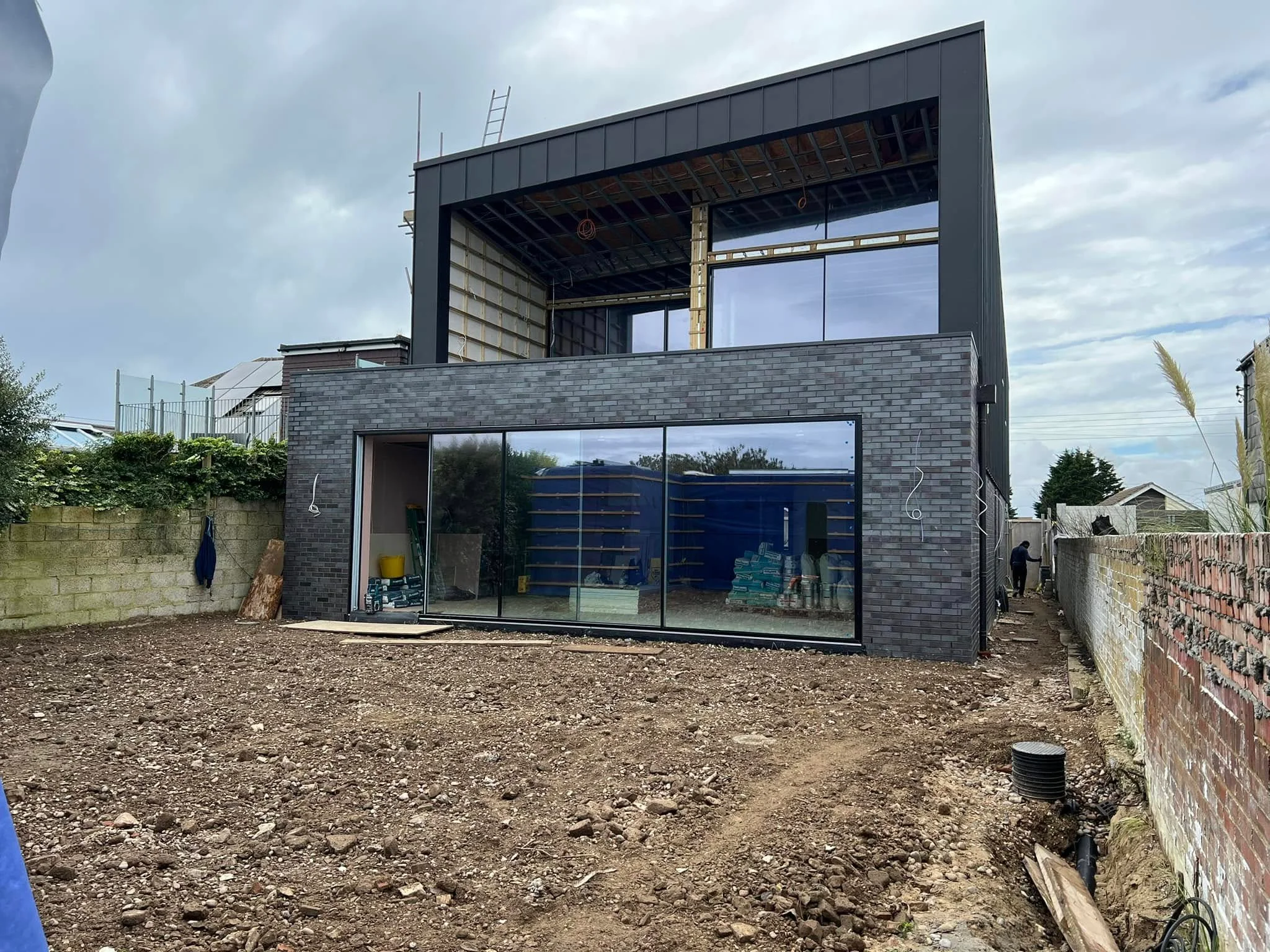
How to choose a builder in Kent — the complete guide to finding, evaluating and commissioning a contractor. Questions to ask, red flags to spot and what quotes must include.
Finding a good builder is one of the most consequential decisions a Kent homeowner makes. Get it right and you have a quality outdoor space, a solid extension, or restored brickwork that will perform and look exceptional for decades. Get it wrong and you have a project that costs more than it should, takes longer than promised, and may need remediation work within a few years.
The difficulty is that the Kent construction market looks reassuringly similar from the outside. Websites are professional. Quotes arrive promptly. Contractors use confident language about experience, quality, and customer satisfaction. The differences that actually matter — sub-base depth, mortar specification, drainage design, groundworks methodology — are invisible at the quoting stage and only reveal themselves in the quality of the work and how it performs over time.
This guide gives Kent homeowners the specific knowledge to evaluate builders intelligently. Not generic advice about getting three quotes and checking for insurance — though both of those matter — but the specific questions, the specific local knowledge, and the specific evaluation criteria that separate contractors who understand what they are doing in Kent from those who are competent but working without the local and technical specificity that Kent's ground conditions, housing stock, and planning environment demand.
MB Construction Group — Marshall Brickwork & Construction has been operating in Kent for over fifteen years. We are one of the contractors you will be evaluating. We have written this guide honestly, which means it will occasionally reveal criteria that reveal our own strengths — but it will also be genuinely useful regardless of which contractor you ultimately choose. A Kent homeowner who commissions any contractor to a higher standard of evaluation produces better outcomes for the whole market.
Why Choosing the Right Builder in Kent Is Harder Than It Should Be
The residential construction market in Kent has specific characteristics that make the selection process more challenging than the generic advice suggests.
The full-service gap. Most contractors in Kent specialise in one or two disciplines. Brickwork specialists don't do driveways. Driveway contractors don't do brickwork or extensions. Landscaping companies don't do structural brickwork for retaining walls. When a homeowner needs a project that combines elements — a new driveway with brick pillars and garden wall, or a patio with raised planted borders — they are typically forced to commission multiple contractors who must coordinate with each other, with all the communication and programme risks that creates. Identifying contractors with genuine full-service capability before commissioning is a significant evaluation criterion.
The sub-base invisibility problem. The most consequential quality decisions in any outdoor construction project — how deep the sub-base is, whether a geotextile membrane was laid, how thoroughly the hardcore was compacted — are completely invisible in the finished work. A driveway with a 100mm sub-base on London Clay and a driveway with a 150mm sub-base look identical on installation day. They look very different in year three. This invisibility means that price competition in the Kent construction market is often a competition to see who can cut corners most efficiently — and that the homeowner who chooses on price is often choosing a product that will fail earlier than one quoted at a higher figure.
The lime mortar knowledge gap. A significant proportion of Kent's housing stock is Victorian and Edwardian — properties built with soft bricks and lime-based mortars that require lime mortar for any repointing or repair work. Using Portland cement mortar on these properties causes progressive spalling damage that is invisible on the day of completion and increasingly costly to remedy over subsequent years. Many Kent contractors do not understand this distinction, or know it but use cement anyway because it is cheaper and faster. Evaluating a contractor's lime mortar knowledge before commissioning any repointing or brickwork on a pre-1930 property is essential.
The planning knowledge requirement. Kent has extensive conservation area coverage — in Rochester, Canterbury, Tunbridge Wells, and many other towns — where planning requirements affect material choices and may require consent for work that would be permitted development elsewhere. A contractor who installs an impermeable front driveway without raising the planning compliance question, or who repoints a conservation area property without considering the material implications, is not providing the full professional service the homeowner needs.
The Evaluation Framework: What Actually Matters
Step One: Define the Scope Precisely Before Contacting Contractors
The single most common cause of problematic contractor experiences is an insufficiently defined scope at the point of commissioning. When homeowners approach contractors with a vague brief — "we'd like a new patio" — they receive quotes that are incomparable because each contractor has made different assumptions about what the patio involves. Material type, size, drainage provision, edge detail, sub-base specification, disposal of arisings — all of these variables are in the quote if it is good, and hidden assumptions if it is not.
Before contacting any contractor, define:
What you want built, in as much material specificity as you can manage. Not "a patio" but "a rear garden patio of approximately 35 square metres in Indian sandstone, with a channel drain along the house wall, a step down to the lawn area, and raised planting borders on the two side boundaries." Not "a new driveway" but "a new front driveway in block paving, approximately 40 square metres, with a new dropped kerb, block paving in a herringbone pattern and granite sett border."
What the access situation is. Can a mini digger access the rear garden? Is there a gate, and how wide is it? Can a skip be placed on the road or driveway? These access constraints significantly affect the programme and sometimes the cost of a project, and knowing them before you invite quotes ensures every contractor is working to the same site conditions.
Any relevant planning context. Is the property in a conservation area? Is it listed? Is the work at the front of the house where the 2008 front garden hard surfacing rules may apply? These questions determine what is and is not possible before anyone starts drawing up a specification.
Step Two: Source Candidates Intelligently
Personal recommendation is still the most reliable route. A neighbour whose driveway you have admired for three years is evidence of longevity — not just initial appearance but sustained performance. A friend who had a positive experience with a contractor in the last two years is more useful than any review platform recommendation. Ask specifically about the post-completion experience: was the site left clean? Were any snagging points addressed promptly? Has anything moved, cracked, or changed since installation?
Review platforms provide useful supplementary evidence with important caveats. Google Business Profile reviews, Checkatrade, TrustATrader, and similar platforms are useful for identifying contractors with consistent track records — but they skew toward recent, positive experiences. Look for the pattern over time and across a volume of reviews, not individual five-star entries. Look at how the contractor responds to any negative reviews — the response reveals character and professionalism more clearly than the review itself.
The local planning authority building control office maintains records of contractors who have successfully completed building regulations work across Kent. If the project involves extensions, new builds, or any structural work requiring building control sign-off, a contractor who is known to the local building control team — and known positively — is a contractor who has delivered compliant work consistently.
Trade association membership provides a baseline check. The Federation of Master Builders (FMB), TrustMark, Checkatrade vetting, and similar schemes require contractors to have passed insurance and reference checks to be listed. Membership does not guarantee quality, but it eliminates some of the worst actors and provides a recourse mechanism if things go wrong.
Step Three: Qualify Contractors Before Inviting Quotes
Time spent qualifying contractors before they visit the site saves significantly more time spent managing the consequences of choosing the wrong one. A brief phone conversation — ten minutes, no more — reveals a great deal.
The first question to ask any Kent contractor: "Have you worked in this specific area before, and are you familiar with the ground conditions?"
An experienced Kent contractor who has worked in Medway will know about London Clay without being prompted. They will mention sub-base depth in the context of clay ground conditions without you raising it. They will know that the dropped kerb for a new driveway in a Medway postcode goes through Medway Council rather than Kent County Council. This local knowledge is not universal among contractors who claim to cover the area.
Ask about their experience with the specific work type. Not "do you do patios?" but "can you tell me about a patio project you completed in the last year — what was the sub-base specification, what surface material did you use, and what did the drainage look like?" A contractor who has done this work recently and correctly will answer specifically. A contractor who is working at the edge of their experience will be vague.
Ask how they handle the lime mortar question if repointing is involved. The correct answer, for any pre-1930 property, is that lime-based mortar is the appropriate specification. A contractor who answers "we use a standard cement and sand mix" for a Victorian property is not the contractor for that job. The repointing guide explains in detail why this matters. A contractor who cannot explain why it matters should not be entrusted with period property brickwork.
Ask about their insurance. Public liability insurance — minimum £1 million, preferably £2 million or more for larger projects — is non-negotiable. Employers' liability if they have employees on site. Ask for a copy of the certificate, not just a verbal confirmation.
What a Good Quote Looks Like — and What a Poor One Reveals
The written quote is the most revealing document in the contractor evaluation process. Understanding what it should contain — and what its absence reveals — is the most directly useful evaluation tool available.
What Should Be in Every Quote
A specific, itemised scope. Not "driveway installation including labour and materials" but a line-by-line breakdown: excavation to Xmm depth, arisings disposal, geotextile membrane, Xmm compacted Type 1 MOT sub-base, bedding layer, surface material and specification, edge restraint type and fixing method, drainage channel including discharge point, completion and cleanup.
For a natural stone driveway quote, the stone type, thickness, finish, and source should all be specified. For a resin bound driveway quote, the resin product brand, the UV stability specification, and the aggregate type should all appear. For a tarmac driveway quote, the binder course and wearing course depths and specifications should appear separately.
A quote that says only "driveway installation as discussed" has committed to nothing. It is not a quotation — it is a number. And a number without a scope is worth nothing when the dispute arises about what was included.
A specified sub-base depth. This is the most important single specification item in any outdoor surface project in Kent. The quote should state, explicitly, the depth of compacted hardcore being provided and the material being used. If this information is not in the quote, ask for it in writing before accepting. A contractor unwilling to specify the sub-base depth in writing is a contractor intending to cut corners on it.
Drainage provision. Where does the surface water go? Is a channel drain included? What is the designed drainage gradient? For any impermeable surface — block paving, tarmac, natural stone — the drainage provision must be explicit. A quote that does not address drainage has not thought about drainage.
A programme. When does the work start, how long will it take, and what are the milestones? A contractor without a programme is a contractor without a schedule — and a contractor without a schedule is one who will fit your project around their other commitments rather than delivering on a commitment to you.
A workmanship guarantee. What does the contractor guarantee, for how long, and what remediation do they commit to if something fails? A one-year workmanship guarantee is a minimum. Two years is better. A contractor who will not provide a written guarantee is a contractor who is not confident in their own work.
Payment terms. Stage payments tied to project milestones — not large upfront payments before work begins. A reasonable deposit (10–25% maximum) to confirm booking. Further payments on completion of groundworks, on completion of surface, and a retention payment (5–10%) held for thirty days after completion. A contractor demanding 50% or more upfront before work starts is a contractor with cash flow problems. Do not pay it.
Red Flags in Quotes and Contractor Behaviour
Unusually low quotes without explanation. A quote that is significantly below others for what appears to be the same scope is almost always reflecting a different scope — typically a shallower sub-base, cheaper materials, or reduced drainage provision. Ask specifically what the quote assumes about sub-base depth and material. The answer will explain the price difference. If the cheaper contractor is specifying 100mm of hardcore on a Medway clay site while the more expensive contractor is specifying 150mm, the difference is not the contractor's margin — it is the sub-base depth that will determine whether the driveway is still level in year five.
Pressure to decide immediately. "I can only hold this price until Friday" and "I have another job starting nearby next week and I can fit you in" are sales pressure techniques, not genuine logistical constraints. Reputable contractors with full schedules do not need to pressure homeowners into rapid decisions. Take the time to evaluate properly.
Requests for large cash deposits. This indicates either cash flow problems or a business that does not want a paper trail. Both are reasons to decline.
Reluctance to put the scope in writing. Any contractor who resists providing a written, itemised quote — preferring instead to give a verbal price — is protecting their ability to claim later that additional work was always in scope or that the original quote excluded something it should have included.
No verifiable local examples. A contractor who cannot provide addresses of completed work in Kent — within a reasonable distance, of a similar type to the project being commissioned — is either new to the area or does not have the track record they claim. Ask for addresses, not just photographs. Real photographs of real local projects, with addresses that can be verified, are significantly more credible than portfolio images of uncertain provenance.
Specific Questions to Ask About Specific Project Types
For Driveway Projects
"What sub-base depth are you specifying, and in what material?" For clay-bearing sites across Medway and Sittingbourne, expect 150mm minimum compacted Type 1 MOT. For chalk-based sites in parts of Sevenoaks and Canterbury, 100mm may be adequate — but the contractor should be able to explain why.
"How are you managing drainage, and where does the surface water discharge?" The drainage provision for an impermeable driveway must be designed, not assumed.
"Does this project require dropped kerb approval, and are you familiar with the process for this specific local authority?" Medway Council and Kent County Council have different processes. A contractor who does not know which applies, or who proposes to proceed without approval, is exposing you to enforcement action.
"Is this surface planning-compliant for front garden use?" The 2008 rules on front garden hard surfacing apply across Kent. Impermeable surfaces over 5m² require drainage provision. Resin bound is inherently permeable; block paving and tarmac are not. The contractor should raise this proactively.
Read the complete driveway construction guide and the driveway cost guide before any driveway consultation to understand the full technical context.
For Patio Projects
"What bedding system are you using for this surface material?" Porcelain requires a full wet mortar bed with primer — not sand bedding. Natural stone requires a full semi-dry mortar bed — not spot bedding. A contractor who proposes sand bedding for porcelain does not understand the material.
"How are you designing the drainage falls, and at what level?" Drainage should be designed into the formation — the bottom of the excavation — not corrected in the mortar bed layer. A contractor who specifies drainage without mentioning formation level has not thought carefully about the design.
"What is the relationship between the finished patio level and the damp-proof course?" The patio surface must sit at least 150mm below the DPC level of the house. A contractor who does not raise this question has not thought about it.
The patio construction guide, patio cost guide, and porcelain vs Indian sandstone guide together cover the full technical context for patio commissioning.
For Brickwork and Repointing Projects
"What mortar specification are you using, and why?" For any property built before 1930, lime-based mortar is the correct answer. A contractor who specifies Portland cement for Victorian brickwork has either not assessed the property correctly or has prioritised their own convenience over the building's long-term welfare.
"How deep will you rake out the existing mortar joints?" The minimum is 15–20mm. Shallower raking does not provide adequate key for the new mortar and produces joints that fail prematurely.
"Can you match the existing mortar colour?" Mortar colour matching is a craft skill that requires testing a sample on the wall before full application. A contractor who does not mention testing before full application is either overconfident or not planning to colour-match carefully.
The repointing guide and brick repair guide provide the technical context for evaluating any brickwork quote.
For Extension Projects
"Who is providing the structural engineer's drawings, and how do you manage building control inspections?" Extensions require building control approval and inspection at specified stages. A contractor who is vague about this process does not manage it actively — and building control delays caused by poor programme management are one of the most common sources of project overrun.
"What foundation depth are you specifying, and why?" On London Clay in the Medway towns, strip foundations for extensions typically need to go to 750mm or deeper. A contractor specifying shallower foundations on clay sites has either not assessed the ground conditions or is applying a standard specification regardless of site.
"How do you coordinate drainage connections from the extension to the existing drainage system?" Foul drainage from any new kitchen or bathroom must connect to the foul sewer correctly, with the appropriate falls and inspection chambers. This is a building control requirement that a professional contractor manages proactively.
The complete home extensions guide covers the full extension commissioning process in detail.
For Garden Walls and Structural Brickwork
"What foundation specification are you providing for this wall?" A freestanding garden wall requires strip foundations at adequate depth — 450mm minimum on stable ground, 600–750mm on Kent clay sites. A contractor who does not mention foundations when quoting a freestanding wall is not thinking about the wall's long-term stability.
"How are you coping the top of the wall, and what drainage provision is at the base?" Failed copings are the primary cause of garden wall deterioration. The coping specification and how it sheds water should be explicit in any garden wall quote.
"Does this wall require planning permission?" Walls adjacent to highways are limited to 1 metre without permission. Conservation area properties may have additional restrictions. The contractor should raise planning implications proactively for any boundary wall project.
The garden walls guide covers the full specification and evaluation context for garden wall projects.
Understanding the Difference Between a Quotation and an Estimate
This distinction matters legally and practically. An estimate is a guide price — it can change as work progresses and unforeseen conditions emerge. A quotation is a fixed price commitment for a defined scope — it should not change unless the scope changes.
For most residential outdoor construction projects in Kent — driveways, patios, garden walls, fencing, landscaping — a fixed-price quotation is achievable and appropriate. The scope can be defined precisely enough that a contractor who has assessed the site can commit to a price.
For extension foundations and structural work, the ground conditions create genuine uncertainty — what is found when the trench is excavated may differ from what was anticipated from surface assessment. In these cases, a quotation for the defined scope with a clearly stated process for handling unforeseen ground conditions is the appropriate document. The process for handling unforeseen conditions — who decides the response, how the cost implication is communicated, and how approval is obtained before additional work proceeds — should be explicit before work starts, not negotiated during it.
The Maintenance Obligation: Understanding the Long-Term Commitment
A significant proportion of outdoor construction disputes in Kent arise not from workmanship failures but from mismatched expectations about maintenance. A homeowner who expected an Indian sandstone patio to be maintenance-free is disappointed when biological growth develops in year two. A homeowner who expected resin bound to never require attention is alarmed when a joint lifts in year six.
Before commissioning any outdoor project, understand the maintenance commitment of the chosen material and surface type. The driveway maintenance guide, patio maintenance guide, and brickwork maintenance guide cover the full seasonal maintenance requirements for every surface type across Kent. A contractor who does not discuss maintenance expectations when presenting material options is not giving you the complete picture you need to make the right choice.
Making the Final Decision: The Factors That Should Drive It
After evaluation, qualification, site visits, written quotations, and reference checks, the final decision comes down to a combination of factors that should be explicitly weighted rather than felt.
Specification completeness. The contractor whose quotation is most detailed and most specific has demonstrated the most careful thinking about your project. This is the single highest-correlating indicator of quality in the outdoor construction market.
Local knowledge demonstrated. The contractor who raised the clay sub-base question, who knew the dropped kerb authority without being asked, who mentioned the lime mortar requirement for your period property without prompting — this contractor is working from genuine knowledge of Kent, not generic trade competence.
Communication quality. The contractor who returned calls promptly, answered questions specifically, and provided requested information without delay during the quoting process will manage the project with the same responsiveness. The contractor who was difficult to reach or vague in answers during the quoting process will not improve when your money is committed.
The right question asked, not just the right answer given. A contractor who raises issues you had not considered — the planning permission question you had overlooked, the drainage implication you had not thought about, the lime mortar requirement you did not know to ask for — is a contractor who is bringing professional knowledge to bear on your project. This is qualitatively different from a contractor who simply answers the questions you ask and lets everything else pass unremarked.
Why MB Construction Group for Your Kent Project
MB Construction Group — Marshall Brickwork & Construction is based in Rochester and has been working across Kent for over fifteen years. The team delivers the complete outdoor construction range — brickwork and repointing, driveways, patios, landscaping, artificial grass, fencing, garden walls, extensions, and new builds — from a single team with a single quality standard throughout.
Every quote is written to the standard this guide describes: specific scope, specified sub-base depth, drainage provision explained, planning implications raised, workmanship guarantee included. Every project is delivered with the local knowledge of a team that has worked across Kent's varied ground conditions, housing stock, and planning environments for fifteen years.
Browse completed projects across Rochester, Chatham, Gillingham, Maidstone, Sittingbourne, Canterbury, Tonbridge, Tunbridge Wells, Sevenoaks, and the wider county. Read the detailed guides for every service. Ask any question. Get a free site visit with no obligation.
Phone: 07724 730872 Email: info@mbconstruction.group Contact: mbconstruction.group/contact/
The contractor who writes a guide explaining how to evaluate contractors is confident that evaluation will go in their favour. That is the Marshall position — and it is the position of a team that has nothing to hide and everything to demonstrate.
Marshall Brickwork & Construction Ltd | MB Construction Group | 14 Poplar Road, Rochester, ME2 2NR | 07724 730872 | mbconstruction.group