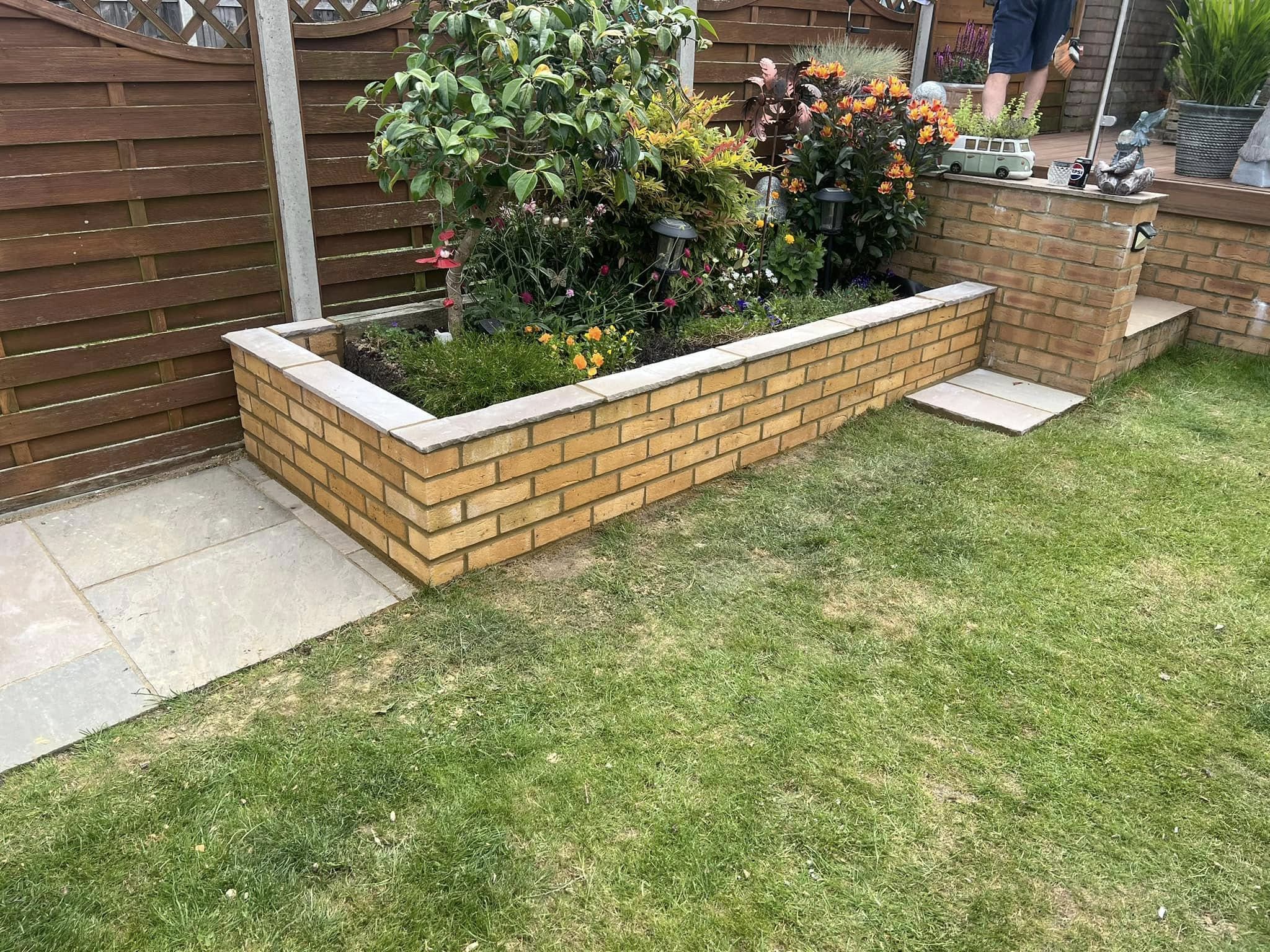
Beautiful raised flower beds in Kent — complete guide to brick raised beds, garden planters, planting borders and flower bed construction that lasts. Free site visits.
There is a moment in every garden design conversation where the whole picture shifts. It usually happens when raised flower beds come up. Not the afterthought borders around a patio edge — the proper, well-constructed, brick-built raised beds that frame a garden, define its structure, and give the outdoor space the architectural quality that separates a designed garden from one that simply grew.
Raised flower beds do something that planting in open ground cannot. They create level, well-drained growing conditions independent of whatever the garden's underlying soil provides. They introduce a vertical element that gives the garden scale and structure. They frame the outdoor living space — the patio, the lawn, the path — with a permanence and a character that temporary planting or flat borders never achieve. And when they are built in facing brick matched to the house or garden wall, they become one of the most distinctive and enduring features a Kent garden can have.
This guide covers everything Kent homeowners need to know about raised flower beds in 2026 — the construction approaches that last, the specific advantages of brick-built beds over timber or metal alternatives, the planting strategies that work in Kent's climate, how raised beds integrate with the wider garden design, and the specific local conditions across the county that affect what is built and how it performs.
MB Construction Group — Marshall Brickwork & Construction builds raised flower beds and planted features across Kent as part of a comprehensive landscaping and brickwork service. The craft knowledge that defines Marshall's brickwork identity — correct foundation specification, appropriate mortar for the application, precise construction throughout — applies as directly to a 600mm raised planter as it does to a structural garden wall or an extension elevation.
Why Raised Flower Beds Are Having Their Design Moment in 2026
In 2026, raised beds act as the framework of the yard. They create edges, guide movement, and build zones just like walls, pathways, or built-in seating. Whether made from stone or brick, these structures bring clarity before a single plant goes in. That is the design shift that has made raised flower beds one of the most frequently requested garden features across Kent this year — the recognition that they are architectural elements first and growing environments second.
The trend is visible across every Kent market Marshall serves. In Rochester and Medway Victorian terrace gardens, raised brick beds along the boundary walls create planting space without consuming the limited floor area of compact rear gardens. In the larger family gardens of Tonbridge, Tunbridge Wells, and Sevenoaks, raised beds structure the transition between the main patio zone and the wider garden, creating the multi-zone quality that 2026 garden design consistently pursues. In Canterbury's period property gardens, brick raised beds in stock brick matched to the house give planted areas the permanence and character that period garden design demands.
What all of these applications share: the raised bed is doing structural and design work as much as horticultural work. The brick is chosen for its aesthetic contribution. The height is specified for the spatial effect it creates. The position is determined by how it frames the patio, defines the boundary, or creates the transition between zones.
The plants — beautiful, seasonal, considered — are what happen inside a frame that was built to last.
Brick Raised Flower Beds: The Case for Building Properly
The raised flower bed market has expanded dramatically alongside the broader outdoor construction boom. Timber raised bed kits, steel and Corten steel planters, modular plastic systems, railway sleeper constructions — all have their enthusiasts and their appropriate applications.
But for Kent gardens where the outdoor space is meant to feel permanent, where the raised beds are meant to frame rather than furnish the garden, and where the investment in the overall outdoor environment deserves a raised bed construction that matches its longevity — brick is the material that delivers what no alternative fully replicates.
Why Brick Outlasts Every Alternative
Timber raised beds, even pressure-treated, have a realistic lifespan of fifteen years when lined correctly. In Kent's wet climate — the persistent autumn and winter damp that saturates timber at ground contact points, the freeze-thaw cycling that stresses any material with moisture in its structure — timber raised beds rarely achieve even that. The base courses rot first, the structure loses integrity, and the entire raised bed needs replacing. The planting within it has to be lifted, the bed demolished, and the construction started again.
Brick raised beds do not rot. They do not warp. They do not need replacing — ever, if built correctly. A brick-built raised flower bed on correct foundations, in appropriate mortar, with adequate drainage provision, will outlast the garden it serves. It will outlast the fence behind it, the patio in front of it, and the planting within it through multiple cycles of replanting and renewal.
This permanence changes the investment calculation fundamentally. A timber raised bed replaced every fifteen years across a forty-year ownership period is three replacement cycles — three times the disruption, three times the cost, three times the upheaval of lifting established planting. A brick raised bed built once lasts the entire period and beyond.
The Aesthetic Advantage of Brick in Kent Gardens
Kent's housing stock is predominantly brick — the warm reds of Medway's Victorian terraces, the lighter stocks of east Kent, the multi-coloured handmade bricks of the Weald, the engineering blue bricks of industrial and boundary applications across the county. A brick raised bed built in facing brick that is compatible with the house elevation and the garden wall is an architectural element that belongs — that reads as part of the garden's intended design rather than something placed within it.
This is the aesthetic quality that distinguishes Marshall's brickwork-built raised beds from raised beds constructed by general landscaping companies without deep brickwork craft. The colour matching between the raised bed brick and the existing garden wall or house elevation. The consistent bed joints and perpend alignment that make the brickwork read as quality at close inspection. The coping detail at the top of the bed — how it is finished, how it sheds water, how it transitions between the masonry structure and the planted surface — is a craft decision that affects both the appearance and the longevity of the feature.
Construction: What a Properly Built Brick Raised Flower Bed Involves
The construction requirements for a brick raised flower bed are more specific than most homeowners expect. Getting them right determines whether the bed performs and looks excellent for thirty years or starts showing problems within five.
Foundation Specification for Kent Ground Conditions
The groundworks beneath a raised flower bed are the invisible element that most garden construction companies under-specify.
For a raised bed of modest height — up to 600mm — on stable, free-draining ground, a concrete strip foundation of 150mm depth and 200–300mm width is adequate. On the London Clay that underlies most of the Medway towns and Sittingbourne, the foundation needs to go deeper — to 450mm minimum — to reach below the zone of most active seasonal clay movement. A raised bed on an inadequate foundation on Medway clay will shift progressively with the seasonal ground movement, causing mortar joint cracking and eventual structural failure of the bed itself.
For taller raised beds — 750mm and above, which introduce significant soil loading on the retaining face — the foundation specification increases further, and the wall thickness and construction approach changes to account for the retaining force being applied. Tall raised beds that function as retaining features are structural masonry projects requiring the same engineering thought as garden retaining walls.
Mortar Specification
The mortar used for brick raised flower beds must be specified for the brick type and the exposure conditions — and for the specific application, which differs from a standard external wall in one important way: the back face of the raised bed is in permanent contact with moist soil. This means the mortar on the inside face is subject to continuous moisture exposure rather than the wet-dry cycling of an external wall face.
For most facing brick raised beds, a mortar that provides good weather resistance on the external face while being breathable enough to allow moisture management through the structure is appropriate. For raised beds built in historic or reclaimed brick alongside period property brickwork, lime mortar is the correct specification for the same reasons it applies to period property repointing — the brick is softer than modern production and requires a softer, more flexible mortar that will accommodate the minor movement that soil loading and moisture cycling create.
Drainage: The Most Frequently Overlooked Element
A raised flower bed that holds water is a raised flower bed that kills plants and destroys its own construction. Adequate drainage is not optional — it is what makes the raised bed function as a growing environment and what protects the masonry from the hydrostatic pressure of waterlogged soil pressing against the inside face.
The correct drainage approach for a brick raised bed: weep holes at the base course on the face of the bed, positioned every 600–900mm along the length, allow accumulated water to exit the bed rather than building up pressure against the wall. A layer of drainage aggregate — coarse gravel or broken crocks — at the base of the bed before the growing medium is added allows water to move freely to these exit points. The growing medium itself should be free-draining — a quality topsoil or compost mix rather than heavy clay — to prevent waterlogging within the root zone.
For raised beds incorporated into a patio scheme, the drainage from the beds must be coordinated with the overall patio drainage design — the water exiting the weep holes needs somewhere to go that is not the patio surface. Marshall designs this coordination into every project where raised beds and patio are specified together.
Height Considerations
The height of a raised flower bed affects both its structural requirements and its function in the garden.
Low raised beds — 200–400mm. These are primarily aesthetic and soil-quality improvements — lifting planting above a clay-heavy garden soil and providing better drainage, while creating a modest visual definition of the planted area. Structural requirements are modest. Ideal for flower borders alongside a patio or path where the goal is colour, seasonal interest, and a clean edge rather than significant soil depth.
Mid-height raised beds — 450–600mm. The most commonly specified height across Kent garden projects. At this height, the raised bed functions as a genuine design element — visible above low planting, creating a meaningful spatial boundary, and providing the soil depth that most flowering perennials, shrubs, and even small fruit trees require. It also begins to function as informal seating — a 450mm coped brick surface is a comfortable perch during garden parties and a useful surface for tools and pots during planting seasons.
Tall raised beds — 700mm and above. These are architectural features as much as growing environments. At 750mm or above, a raised bed commands the garden space in the way a low wall does — defining the boundary of the outdoor living room, creating a privacy screen when planted with tall species, and structuring the view from the house window looking out. The structural requirements at this height are more significant — thicker walls, engineered foundations, and the retaining wall principles that garden wall construction demands.
Design: Where Raised Flower Beds Work Hardest in Kent Gardens
Framing the Patio
The most effective single application of raised flower beds in Kent outdoor spaces is as the border that frames the patio on two or three sides — creating the sense of enclosure and definition that separates the patio from the wider garden and gives it the room-like quality that the outdoor living room design approach pursues.
A 500mm brick raised bed along the rear boundary of the patio, planted with a mix of structural evergreen shrubs and flowering perennials that provide year-round presence and seasonal colour, creates a backdrop for the dining and lounging zone that flat lawn or open border cannot replicate. The raised bed brings the planting up to a height where it is visible from the seating position — where it frames the space from the seated eye level rather than existing only at ground level, invisible to anyone sitting down.
When this raised border continues along a side boundary as well — creating an L-shaped planted frame to the patio — the outdoor living space acquires the three-sided enclosure that makes any room feel settled and comfortable. The fourth side — the house wall with its door or bi-fold access — completes the enclosure without requiring a physical structure.
Alongside Paths and Transitions
Long linear beds that define borders and guide movement through the garden are one of the most effective applications of raised flower beds in medium to large Kent gardens. A raised bed running alongside a garden path — from the patio at one end to a garden feature or secondary seating area at the other — creates a planted corridor that directs movement and provides the layered interest of planting at multiple heights above the path level.
This linear application is particularly effective in Kent's longer suburban gardens — the thirty to forty-metre rear gardens of the interwar semis that characterise Maidstone, Tonbridge, and the residential streets of many Medway towns. These gardens have the length but often lack the structure that makes that length feel like a considered space rather than an elongated lawn. A raised bed running alongside a central path for ten or fifteen metres, planted with a succession of seasonal interest from early spring bulbs through summer flowering perennials to autumn seed heads, creates structure and purpose through the full depth of the garden.
The Kitchen Garden Element
Raised flower beds in the kitchen garden context serve a dual purpose — productive growing and visual structure. The formal kitchen garden tradition — raised beds in a geometric pattern, divided by brick-edged gravel or brick-paved paths, planted with a combination of edible and flowering plants — is one of the most beautiful of all garden forms and one that translates naturally into Kent's residential garden scale.
A four-bed kitchen garden layout in a 4m by 4m area at the rear of the garden — four raised beds in a grid, separated by a central cross-path — creates a garden feature that produces food, provides structure through all seasons, and gives the garden's rear zone a purposeful character that unplanted lawn cannot. The beds can be planted with vegetables in rotation, cut flowers for the house, herbs, or any combination — the form works regardless of the planting strategy.
The brick construction of these beds, in facing brick that matches the rest of the garden's masonry palette, gives the kitchen garden area a permanence and a quality that timber-framed beds never achieve. Thirty years later, the brickwork will be weathering to an ever-more-beautiful silver-grey patina. The timber equivalent will have been replaced twice.
Around Structural Features
A long brick bed runs parallel to the fence, filled with ornamental grasses, white blooms, and clipped olive trees — this is the application that is most commonly specified in contemporary Kent garden designs. A raised bed running the length of the rear fence, 400–500mm high, 600–900mm wide, creates the planting space for the back boundary that gives the garden its backdrop, its depth, and its seasonal interest.
Against a dark painted fence — the anthracite or near-black fencing that contemporary Kent gardens increasingly specify — planted raised beds in warm brick with white, silver, and pale yellow flowering plants create a classic high-contrast composition that photographs exceptionally and looks beautiful across every season.
Planting for Kent's Climate: What Works in Raised Beds
The planting within raised flower beds is ultimately the homeowner's decision — personal preference, colour palette, maintenance appetite, and knowledge all inform it differently for every garden. But some general principles specific to Kent's conditions and to the raised bed context are worth understanding before any planting plan is drawn up.
Kent's Growing Conditions and What They Mean
Kent is known as the Garden of England for good reason. The county's position — south-eastern, relatively warm, with more sunshine hours than most of England — creates growing conditions that support a wider range of flowering plants than most UK gardeners realise. The challenge is not cold hardiness for most ornamental planting — Kent's winters are rarely severe enough to challenge well-established perennials — but the combination of dry summers and wet winters that stresses plants at both extremes of the moisture cycle.
Raised beds, by improving drainage, protect plants from the waterlogging that Kent's clay-heavy soils create in winter. By holding improved growing medium above the native clay, they provide the free-draining, nutrient-rich conditions that most flowering plants prefer. This makes raised beds particularly valuable in Medway and Sittingbourne gardens where the London Clay beneath the topsoil creates a growing environment that drains poorly and is inhospitable to a wide range of ornamental plants when they are grown directly in it.
Structure Plants: The Year-Round Framework
Every successful raised bed planting scheme starts with the structural plants — the evergreen or architectural species that give the bed presence and definition in every season, including the months when flowering perennials have died back.
Box (Buxus) — where box moth caterpillar pressure is managed — provides the classic clipped structure. Euonymus, pittosporum, and osmanthus provide evergreen bulk with less maintenance. Grasses — Stipa tenuissima, Pennisetum, Miscanthus — provide movement, seasonal colour change, and winter seed head interest. Lavender on south-facing borders provides Mediterranean structure with excellent drought tolerance and the iconic Kent lavender character.
Flowering Layers: Spring Through Autumn
Against the structural framework, layered flowering planting provides the seasonal sequence that makes a raised bed beautiful from February through November.
Spring: tulips, alliums, and narcissus planted in autumn give the raised bed its first colour as the season opens. These bulbs are grown through the structural planting, emerging between the stems of grasses and shrubs in a naturalised drift that looks effortless and requires virtually no annual attention once established.
Early summer: hardy geraniums, salvias, and catmint provide the informal cottage-garden character that suits Kent's period garden context. Roses — particularly the shrub and David Austin varieties that perform beautifully in Kent's climate — add the fragrance and romantic quality that no other flower provides at this season.
High summer: dahlias, echinacea, rudbeckia, and helenium carry the colour through July and August, providing the late summer abundance that Kent's long warm days support particularly well. Cut flower growing in raised beds — dahlias, sweet peas, cosmos, zinnias — combines the productive garden with the ornamental one.
Autumn: seed heads left standing through October and November provide structural interest and wildlife value. The grasses in the bed come into their finest season — the amber and gold of their seed heads catching autumn light in a way no summer flower matches.
The Low Maintenance Approach
For homeowners who want the structure and character of raised flower beds without a demanding planting programme, the low-maintenance approach combines structural evergreen shrubs with self-seeding annuals and reliable perennials that return without intervention.
Alliums are perhaps the most effective low-maintenance raised bed plant in Kent — they naturalise reliably, multiply slowly over years, provide extraordinary spring-to-early-summer presence with their spherical purple or white flower heads, and die back cleanly leaving seed heads that remain attractive through summer. Combined with hardy geraniums that spread gently to fill gaps between structural plants, and lavender along the sunny edges, this combination provides twelve months of interest with virtually no annual maintenance.
Raised Flower Beds as Part of the Complete Garden Project
The raised flower beds that work hardest and look most considered are those designed as part of the complete garden scheme rather than added as an afterthought once the main construction is complete.
When Marshall delivers a complete outdoor transformation — patio in Indian sandstone or porcelain, artificial grass covering the main lawn area, fencing along the rear and side boundaries, and raised brick flower beds framing two sides of the patio — the coordination between these elements is what makes the finished garden feel designed rather than assembled.
The brick of the raised beds is selected to work with the patio material — warm sandstone paving with warm red facing brick beds, grey porcelain with cooler buff brick or reconstituted stone. The height of the beds is specified relative to the patio level — the top of the beds slightly above the patio surface so that planting has presence when viewed from the seating position. The drainage from the beds is coordinated with the patio drainage so water exits cleanly without compromising either the planting environment or the patio surface.
These coordination decisions are straightforward when one contractor manages the whole project. They become a series of compromises and retrospective adjustments when raised beds are commissioned separately from the patio, or when the fencing contractor does not know the final height of the raised beds that will sit in front of their panels.
The complete landscaping guide covers the full picture of integrated garden design and construction across Kent — from groundworks through hard landscaping to planted features.
Raised Flower Beds Across Kent's Property Types
Victorian and Edwardian Terraces — Maximum Impact, Minimum Footprint
The compact rear gardens of Kent's period terraces — in Rochester, Chatham and Gillingham, Sittingbourne, and Canterbury — benefit most from raised beds that maximise planting in limited floor space while creating the architectural structure that makes a small garden feel considered.
A single raised bed of 500mm height running the full width of the rear boundary, planted with a combination of structural evergreen and seasonal flowering plants, transforms the visual terminus of a compact garden from a fence or wall into a planted feature. The brick of the raised bed, matched to the stock brick or red brick of the house, creates the material continuity that makes period terrace gardens feel complete.
The additional benefit in small gardens: a 500mm raised bed along the rear boundary gives the garden a sense of depth when viewed from the kitchen window, because the planting within it rises above the boundary line and creates a planted backdrop that extends the visual space of the garden beyond its actual dimensions.
Family Gardens — Structure for Active Use
In the medium to large family gardens of Kent's suburban housing — the interwar semis of Maidstone, the post-war detached houses of Tonbridge and Sevenoaks — raised flower beds serve a practical function alongside their aesthetic one: they separate the planted areas from the active lawn and patio spaces in a way that protects the planting from the ball games, the football goals, and the dogs that characterise the family garden in active use.
A low raised bed of 300–400mm height along the side boundary of a family garden, behind a simple lawn edging detail, keeps lawn maintenance manageable and protects the planting from the mower and the children simultaneously. At this height the raised bed is easily stepped over in an emergency — it is a garden feature, not a barrier — but it creates enough separation to define the planted area clearly.
Combined with artificial grass across the main lawn area and a quality patio outside the kitchen, raised planted borders at the garden edges create the complete family outdoor space — usable, low-maintenance, and beautiful.
Maintenance: Keeping Raised Flower Beds Looking Their Best
Raised brick flower beds require very little structural maintenance if built correctly. The maintenance programme is primarily the planting within them.
Annual brickwork check: Inspect the mortar joints and the coping at the top of the bed each spring. Any failed pointing should be repaired promptly — the raised bed is exposed to moisture from both sides (soil on the inside, weather on the outside) and failed joints allow water ingress that accelerates deterioration. The brickwork maintenance guide covers the full inspection and maintenance programme for all brick features.
Weep hole clearance: Check that drainage weep holes at the base of the bed are clear and functioning. Organic material — decomposing roots, accumulated debris — can block these holes over time. Clear with a thin tool if needed.
Growing medium top-up: Raised bed growing medium settles and decomposes over time, reducing the volume within the bed. An annual top-dressing of quality garden compost in spring replenishes nutrients and maintains the growing medium level at an appropriate depth for the root zones of established plants.
Planting renewal: Depending on the planting strategy, some lifted and divided perennials, some bulb topping-up, and some replacement of plants that have reached the end of their useful period are the annual planting maintenance tasks. This is garden enjoyment rather than maintenance burden for most homeowners.
Getting Your Raised Flower Beds Built in Kent
Raised flower beds built in brick, on correct foundations, in mortar specified for the application, with drainage designed in from the outset — this is the standard Marshall Brickwork & Construction applies to every planted feature project across Kent.
Whether you are planning a single raised border alongside a new patio, a complete kitchen garden scheme with multiple beds and a central path, or the framing beds that will complete an outdoor living room design — the starting point is a free site visit and an honest conversation about what is possible for your specific garden, your specific brief, and your specific vision.
Explore the complete landscaping services Marshall delivers across Kent. Browse completed garden projects featuring raised beds, planted borders, and brickwork garden features. Read the adding value guide to understand how raised bed and landscaping improvements contribute to Kent property values.
For any brickwork questions related to the construction of raised beds, the expert brickwork guide covers the technical standards that distinguish lasting construction from decorative assembly. For planning implications of any garden feature, the complete planning permission guide confirms what requires consent and what is permitted development.
Phone: 07724 730872 Email: info@mbconstruction.group Contact: mbconstruction.group/contact/
The raised flower beds that frame your patio, define your garden boundaries, and bring colour and structure to your outdoor space from February to November — these are permanent features of your garden's character. Build them in brick. Build them properly. Build them once.
Marshall Brickwork & Construction Ltd | MB Construction Group | 14 Poplar Road, Rochester, ME2 2NR | 07724 730872 | mbconstruction.group