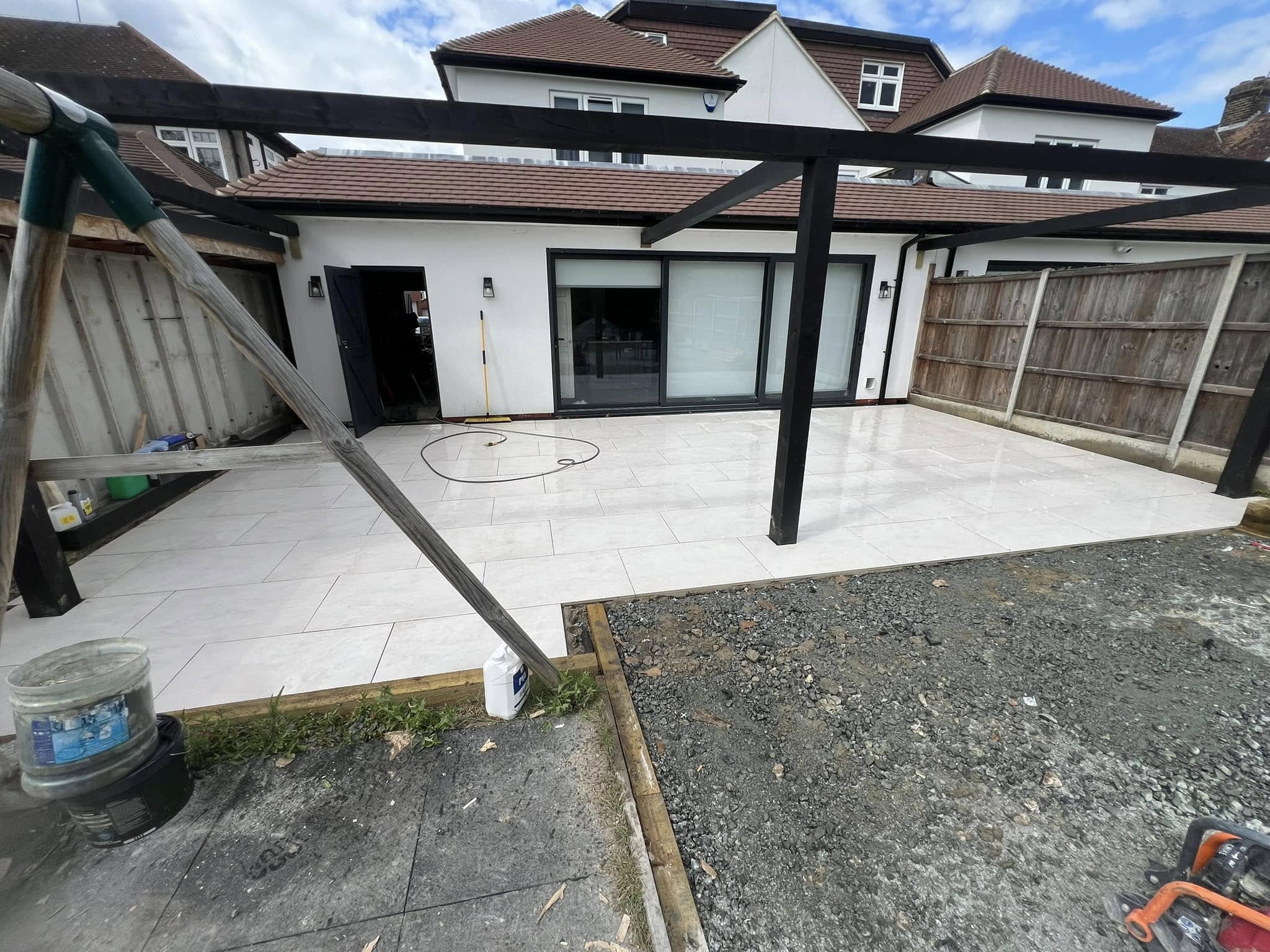
Every outdoor construction question answered — driveways, patios, brickwork, extensions, planning permission and choosing a builder in Kent. Complete 2026 FAQ guide.
Every homeowner planning an outdoor construction project has questions. Some are practical — how long will it take, do I need planning permission, what materials last longest in Kent's climate. Some are technical — what sub-base depth do I need, what is the difference between lime and cement mortar, how do I know if my brickwork needs repointing. Some are about the process — how do I choose the right contractor, what should a good quote contain, what happens if something goes wrong.
This guide answers all of them. It is the most comprehensive collection of outdoor construction questions and honest answers produced for Kent homeowners — covering every major service, every common material, and every stage of the process from first enquiry to completed project.
MB Construction Group — Marshall Brickwork & Construction has been answering these questions on site visits across Kent for fifteen years. The answers here are the same ones the team gives in person — specific, honest, and informed by the specific conditions of Kent's ground, climate, housing stock, and planning environment.
General Construction Questions
What is the difference between a builder and a brickwork contractor?
A builder is a general term for anyone who constructs or renovates buildings and structures. A brickwork contractor is a specialist whose primary expertise is in masonry — the craft of laying and working with brick, stone, and mortar. Many builders can do basic brickwork; a brickwork contractor does it to a higher technical standard because it is their core discipline rather than one of many services they offer.
For projects involving period property repointing, structural garden walls, extension brickwork that must match an existing house, or any work where mortar specification is critical — a brickwork specialist consistently produces better results than a general builder working outside their core expertise.
Do I need to be home when construction work is being done?
Not necessarily, but certain stages benefit from your presence. The site visit and consultation should involve you directly — the design decisions made at this stage affect everything that follows. The start of the project is worth attending — confirming the layout, the level relationships, and any final specification decisions before they are committed in concrete. The completion walkthrough should involve you — a thorough inspection of finished work before you sign off and before the contractor leaves site.
For the working days in between, access arrangements can be made by agreement. Many clients are not present during the working day and the project proceeds without issue.
How long do construction projects typically take in Kent?
Timelines vary significantly by scope. A standard driveway of 40m² typically takes three to five days including groundworks. A rear garden patio of similar size takes the same. A complete garden transformation — patio, raised borders, artificial grass, fencing — typically takes one to two weeks. A single-storey rear extension takes twelve to twenty weeks on site from groundworks to completion. Repointing a typical two-storey semi-detached front elevation takes two to three days.
Weather affects programme more for some project types than others. Mortar work cannot proceed in freezing conditions. Resin bound surfaces cannot be installed in rain or below 5°C. Tarmac requires appropriate temperature for laying and compaction. Marshall manages weather risk by monitoring forecasts and scheduling work to avoid conditions that would compromise quality.
What should I do if I am not happy with the work once it is complete?
Raise it immediately and directly with the contractor. A reputable contractor will want to know about any concerns and will address legitimate snagging points promptly. Document your concerns in writing — email is ideal — so there is a clear record of what was raised and when. Give the contractor a reasonable opportunity to remedy the issue before escalating.
If the contractor does not address legitimate concerns, escalate through any trade association they belong to (FMB, TrustMark, Checkatrade). For disputes that cannot be resolved directly, the Construction Industry Training Board Adjudication Service provides an alternative dispute resolution route. Small claims court is the legal avenue for disputes below £10,000.
The best protection against disputes is a detailed written contract that specifies exactly what is being built, to what specification, in what timeline, at what price, with what guarantee. Marshall provides this as standard. The complete guide to choosing a builder in Kent covers exactly what a contract should contain.
Driveway Questions
What is the best driveway surface for a Kent property?
There is no single best surface — the right choice depends on the property type, the ground conditions, the front garden area, planning compliance requirements, budget, and maintenance appetite.
Block paving offers the widest design range and the best repairability — individual blocks can be lifted for service access and relaid without visible evidence. It is the most popular choice across Kent and performs well for twenty-five years or more on a correct sub-base.
Resin bound gravel is inherently permeable — making it the simplest planning-compliant solution for front garden driveways — and requires minimal maintenance. It performs best when installed by an experienced contractor who understands the weather and temperature requirements.
Tarmac is the most durable and most cost-efficient surface over a long lifespan. Particularly strong on large driveways and on clay-bearing sites where its flexibility accommodates ground movement better than rigid surfaces.
Natural stone — Indian sandstone, granite setts, limestone — adds the most character and the best kerb appeal on period properties. Requires the most skilled installation and the most ongoing maintenance.
The complete driveway cost guide covers all surface types in full detail.
How deep should a driveway sub-base be in Kent?
On stable, well-draining ground: 100mm of compacted Type 1 MOT limestone hardcore is a minimum. On the London Clay and Wealden Clay that underlies most of the Medway towns, Sittingbourne, and significant parts of west Kent: 150mm minimum, with 200mm on sites with high clay activity near established trees.
This is the most important specification decision in any driveway project. A sub-base that is too shallow on Kent clay will transmit seasonal ground movement to the surface — causing rocking, sinking, and cracking within a few years. The surface looks identical on day one regardless of sub-base depth. The consequences are visible in years two to five.
Do I need planning permission for a new driveway in Medway?
For most front garden driveway installations in Medway, the answer depends on the surface material. Permeable surfaces — resin bound gravel, permeable block paving on a permeable sub-base — are permitted development without size restriction. Impermeable surfaces — standard block paving, tarmac, concrete — over 5m² require either drainage provision directing surface water to a permeable area, or a planning application.
The dropped kerb (vehicle crossover at the highway boundary) requires separate approval from Medway Council, which manages highway authority functions for the Medway area. This is required regardless of whether the driveway surface needs planning permission. The complete planning permission guide covers all driveway planning rules in full.
How long does a driveway installation take?
A standard residential driveway of 40m² in block paving takes three to five days including groundworks, sub-base, edging, surface laying, and jointing. Tarmac installations are typically faster — one to two days for the surface once the base is prepared. Resin bound on an existing base takes one to two days. Natural stone takes three to five days due to the full mortar bed requirement and individual slab levelling.
How do I maintain a block paving driveway in Kent?
Annually in spring: apply a biocide to kill biological growth, allow it to work for two weeks, then pressure wash. Once clean and dry, brush kiln-dried polymeric jointing sand into the joints. Every three to five years: reseal with a penetrating sealer to restore stain resistance. Address rocking blocks promptly — lift, rebed, and rejoint before the movement causes cracking. The complete driveway maintenance guide covers every surface type across all four seasons.
Patio Questions
What patio surface lasts longest in Kent's climate?
Porcelain, when correctly installed, is effectively permanent. Its vitrified, non-porous surface is impervious to the freeze-thaw cycling that damages porous stones, does not support biological growth, and does not fade under UV exposure. The sub-base and the flexible jointing compound between slabs need periodic attention; the porcelain itself does not degrade.
Indian sandstone, correctly sealed and maintained, lasts fifteen to thirty years or more. Limestone and granite setts are similarly durable when specified and maintained correctly.
Concrete paving has a service life of twenty-plus years with minimal maintenance. Brick paving is essentially permanent — brick is one of the most durable masonry materials available and can outlast the house it serves if correctly maintained.
What is the difference between porcelain and Indian sandstone for a patio?
Porcelain is manufactured — fired at extremely high temperature to create a vitrified, non-porous surface. It is consistent in colour and size, requires no sealing, and is essentially maintenance-free. Indian sandstone is natural — quarried stone with inherent variation in colour and texture that no manufactured material fully replicates. It requires sealing every two to three years and annual biocide treatment.
Porcelain suits contemporary properties and homeowners who want the lowest possible maintenance commitment. Indian sandstone suits period properties and homeowners who value the organic character of natural materials. The complete comparison guide covers every variable — R-ratings, maintenance schedules, Kent clay sub-base requirements, and lifespan data.
How do I know if my patio needs professional repair or just maintenance?
Maintenance: biological growth on a surface that is otherwise level and structurally sound, failed jointing in isolated sections, surface staining, minor edge damage.
Professional assessment needed: multiple adjacent slabs that rock or have moved relative to each other (indicating sub-base movement rather than individual bedding failure), water pooling in locations that were previously well-drained (indicating level changes from ground movement), cracks running linearly across multiple slabs (indicating sub-base settlement), or persistent damp on interior walls adjacent to the patio (indicating water entry through the patio/wall junction).
The patio maintenance guide covers the full diagnostic framework for distinguishing maintenance from structural issues.
Can a patio be installed in any garden in Kent?
Virtually any garden can accommodate a patio, but the specification varies significantly with the site conditions. Very sloped gardens require level changes managed through steps, retaining walls, or terracing — construction elements that are as much brickwork projects as landscaping ones. Gardens with restricted access require manual material delivery rather than mechanical, which affects programme and cost. Gardens on active London Clay require more conservative sub-base specification.
Marshall's groundworks assessment on every site visit identifies any specific site challenges before the quote is produced — so the specification reflects the actual conditions rather than an assumed standard.
Brickwork and Repointing Questions
How do I know if my brickwork needs repointing?
Run a key or screwdriver tip along the mortar joint. Mortar in good condition is firm and resistant — the implement skates across the surface. Mortar that is failing crumbles or powders under light pressure. Mortar that has already failed comes away in fragments.
Visually: joints that are recessed more than 5mm below the brick face, visible cracks running through mortar joints, and open gaps between mortar and brick edge all indicate repointing is needed. White powdery deposits (efflorescence) in new locations indicate active water movement through failing joints. Any of these signs on the north or west facing elevations of a Kent property should be addressed before winter.
What is the difference between lime mortar and cement mortar for repointing?
Lime mortar is the original and correct mortar for any property built before approximately 1930. It is softer than the brick, flexible enough to accommodate seasonal movement without cracking, and breathable — moisture can pass through the joint rather than through the brick. When it reaches the end of its service life, it crumbles harmlessly and can be replaced. The complete repointing guide covers mortar specification in depth.
Cement mortar is harder than most Victorian and Edwardian bricks. Movement and moisture that cannot escape through the rigid cement joint go through the brick face instead, causing spalling — the progressive detachment of the brick face. Using cement mortar on period brickwork causes exactly the damage it was intended to prevent. It is one of the most common and most consequential specification errors in Kent's residential brickwork market.
How long does repointing last?
Correctly specified repointing on a well-protected elevation — a sheltered south or east-facing wall on a well-maintained property — should last thirty to forty years before it needs redoing. On exposed north or west-facing elevations in Kent's coastal-influenced climate, twenty to twenty-five years is more realistic. Chimney repointing, which is fully exposed on all four faces, typically needs attention every fifteen to twenty years.
The quality of the original repointing is the primary determinant of longevity. Correctly specified mortar at the right strength for the brick type, raked to adequate depth (15-20mm minimum), and finished in a weather-shedding profile — this work lasts. Thin, shallow, hard cement pointing on soft Victorian brick — this fails within a decade.
Can I repoint my own brickwork?
For a small area of modern brickwork in good condition, DIY repointing is achievable with care and the right materials. For Victorian or Edwardian brickwork requiring lime mortar, conservation area properties, chimney stacks, or any significant area of elevation, professional repointing is strongly recommended. Incorrect mortar specification causes damage that is expensive to remedy. Incorrect raking technique damages brick arris edges that cannot be restored. The investment in professional work protects the building; the saving on DIY frequently costs more in repair within a few years.
What causes brickwork to crack?
Brickwork cracks have several distinct causes that require different responses:
Thermal movement — small hairline cracks that open and close seasonally, typically in mortar joints. Normal behaviour in large masonry structures; managed with correctly specified mortar joints.
Settlement — cracks that appeared in the first few years after construction as the building found its final position. Typically stable and often repointed successfully.
Foundation movement — diagonal or stepped cracks from corners of openings, often on properties sitting on active London Clay. Requires structural assessment before repointing, as the cause must be established before the symptom is treated.
Previous incorrect mortar — spalling around cement repointing joints, with brick faces breaking away. The brick repair guide covers diagnosis and repair in full.
Landscaping and Garden Questions
What is the best lawn option for a Kent family garden?
For families with children and dogs, premium artificial grass is the most practical choice in Kent's climate. It is year-round usable regardless of weather, requires no mowing programme, develops no mud patches under heavy traffic, and maintains a consistent appearance across all seasons and use levels.
Natural grass performs well in Kent on south-facing, open gardens with good drainage and moderate use. It struggles in north-facing gardens, under tree canopy, in heavy-use family gardens, and on clay-heavy Medway sites where winter wet makes it impractical for most of the year.
How do I create an outdoor living room in my Kent garden?
The four elements that turn a patio into an outdoor living room: definition (walls, fencing, or planting that creates a sense of enclosure), a quality floor (correctly specified patio surface that is level, well-drained, and chosen for character), a focal point (fire feature, feature wall, or specimen planting that anchors the space), and shelter (pergola, planted windbreak, or wall that makes the space usable beyond perfect summer days).
The complete outdoor living room guide covers every element of creating a genuinely usable outdoor space in Kent.
Does artificial grass need planning permission in Kent?
Artificial grass in a rear garden is generally permitted development — no planning permission required for most standard residential properties. Front garden artificial grass falls under the same rules as other front garden hard surfacing: it is permeable (water drains through the backing), so it does not trigger the 2008 impermeable surfacing planning requirement. Conservation area properties and listed buildings may have additional restrictions. Always check with the relevant local planning authority if there is any doubt.
What landscaping improvements add the most value to a Kent property?
In order of consistent return on investment: a quality patio that extends usable outdoor living space, a front garden transformation including driveway that improves kerb appeal, artificial grass in a garden where natural lawn struggles, and raised planting borders that give structure and year-round interest to an otherwise unresolved garden.
The complete guide to adding value to a Kent property covers the full return-on-investment picture for every outdoor construction improvement.
Extensions and New Build Questions
Do I need planning permission for a rear extension in Kent?
Most single-storey rear extensions within the permitted development limits do not require planning permission. The limits: up to 4 metres depth from the original rear wall for detached houses, 3 metres for semi-detached and terraced properties. Larger extensions (up to 8 metres for detached, 6 metres for semis and terraces) are possible under the Prior Approval scheme, which requires notification and neighbour consultation but not full planning permission.
Extensions in conservation areas, on listed buildings, or beyond these limits require full planning permission. The complete planning permission guide covers all extension planning rules in detail.
Why do extensions on Kent clay need deeper foundations?
London Clay — the geological formation underlying most of the Medway towns, Sittingbourne, and much of north Kent — expands when wet and contracts when dry. This seasonal volumetric change can be several centimetres in depth, and it is most active in the upper 750mm-1000mm of ground. Foundation strip trenches that do not go below this zone will transmit the clay's seasonal movement to the walls above — causing cracking that progressively worsens.
On London Clay, extension foundations typically need to reach 750mm-1000mm minimum depth to reach stable, less active clay. Near established trees, where root systems extract moisture over a wide radius and cause localised enhanced clay shrinkage, depths of 1 metre or more are common. The complete home extensions guide covers foundation specification for Kent's ground conditions in full.
How do I match extension brickwork to my existing house in Kent?
Brick matching for Kent period properties requires identifying the original brick type — handmade or machine-made, the firing temperature that determined the colour and texture, and the local brick tradition (the warm reds of Medway, the lighter stocks of east Kent, the multi-coloured handmade bricks of the Weald).
For post-1970 properties, brick manufacturers can often be identified and current production sourced in compatible colours. For Victorian and Edwardian properties, matching requires sourcing from reclamation yards where period bricks from sympathetic demolitions are available in the correct regional character.
Marshall's established relationships with Kent's brick merchants and reclamation suppliers are a practical advantage in extension brick matching — a task that requires both knowledge of what is available and the experience to know what will weather compatibly over time.
Planning and Regulations Questions
What outdoor construction work requires planning permission in a conservation area in Kent?
In conservation areas, permitted development rights are more restricted than elsewhere. Works that are permitted development outside a conservation area may require planning permission within one — including some boundary wall changes, extensions visible from the street, and alterations to the character of the exterior.
Kent has extensive conservation area coverage: Rochester city centre, Canterbury's inner city, Tunbridge Wells's Victorian core, Faversham town centre, and many village conservation areas across the county. An Article 4 Direction can remove permitted development rights entirely in specific areas.
Always check the conservation area status of your property and the relevant Article 4 Directions before commissioning any external work. Marshall raises conservation area implications proactively at every initial consultation.
What is the difference between planning permission and building regulations?
Planning permission is consent from the local planning authority for development to take place — it concerns what is built and its visual and environmental impact. Building regulations are technical standards — for structure, fire safety, thermal performance, drainage, ventilation, and accessibility — that govern how construction is carried out.
A project can require one, both, or neither. A small rear patio typically requires neither. A home extension typically requires building regulations but may not require planning permission if within permitted development limits. A new dwelling requires both.
Do I need to tell anyone before I start building work in my garden?
For most garden construction work — patios, driveways, garden walls within permitted development limits, fencing within height limits, landscaping — no formal notification is required before starting. You do not notify the council, no permission is needed, work can begin immediately.
The exceptions: dropped kerb applications (required before any new vehicle access to the highway), prior approval notifications for larger home extensions, and planning applications for work that exceeds permitted development limits. Building regulations approval should be obtained before structural work begins on extensions and new builds.
Choosing a Contractor Questions
What questions should I ask a brickwork contractor before hiring them?
Five questions that reveal genuine expertise: What mortar specification are you using and why? (For period properties, lime mortar should be the answer.) What sub-base depth are you specifying? (Should be site-specific, not a standard figure.) How are you managing drainage? (Should describe designed falls and discharge point.) Can I see examples of completed work with addresses I can verify? (Real local projects, not portfolio images.) What workmanship guarantee do you provide in writing? The complete guide to choosing a builder in Kent covers the full evaluation framework.
What should a professional construction quote include?
Every professional quote should include: specific scope with itemised elements (not "driveway as discussed"), sub-base depth and material specification, drainage provision, programme (start date and duration), payment terms tied to milestones, and a written workmanship guarantee. A quote that says only "patio installation including materials and labour" is not a quote — it is a number without a commitment. Any contractor unwilling to provide a fully itemised written quote is protecting their ability to deliver less than the homeowner expects.
How do I verify a builder's credentials in Kent?
Check: Companies House registration (confirms the business is legally constituted), public liability insurance certificate (ask for a copy, not just verbal confirmation), trade association membership if claimed (FMB, TrustMark, Checkatrade all have verification mechanisms), and reviews on Google Business Profile (check the pattern across multiple reviews and over time, not just recent five-stars).
For projects involving building regulations work — extensions, structural work — ask specifically about their building control experience and how they manage the inspection process. For conservation area or listed building work, ask about their experience with the relevant planning authority and any listed building consent requirements.
Is the cheapest quote usually the worst quality?
Not always — but a quote significantly below others for what appears to be the same scope almost always reflects a different, lesser scope. The differences are almost never in profit margin; they are in sub-base depth, material specification, drainage provision, and the invisible groundworks elements that determine longevity.
Ask every contractor what their sub-base depth specification is for your specific site conditions. The contractor who specifies 150mm of compacted Type 1 on a Medway clay site is providing more value at a higher price than the contractor who specifies 100mm at a lower price. The difference in the quote reflects the difference in what you receive — you just cannot see it on installation day.
Maintenance Questions
How often should I maintain my brickwork?
Annual inspection is the minimum — ideally in spring after winter has revealed any new damage. The specific maintenance tasks depend on the condition found at inspection rather than a fixed schedule, but as a guide: repointing sections of failed mortar as they are identified (rather than waiting for a large area to fail), annual biocide treatment on north-facing elevations that are prone to biological growth, and chimney assessment every five to seven years.
Brickwork that is correctly maintained — failed joints addressed promptly, biological growth treated annually, coping and DPC details kept sound — should not require major intervention for decades. The complete brickwork maintenance guide covers the full seasonal programme.
How do I prevent weeds growing in my block paving?
Correctly applied kiln-dried polymeric jointing sand is the most effective long-term weed prevention — the setting agent in polymeric sand inhibits weed germination within the joint. Annual autumn application of a path weedkiller before the winter growing season prevents establishment. Where weeds have established, removing them before they reach seed-setting stage prevents the multiplication that makes the problem self-perpetuating in subsequent seasons.
How do I get rid of moss on my patio or driveway in Kent?
Apply a proprietary path and patio biocide rated as safe for the specific surface material (not bleach, which damages natural stone and resin surfaces). Allow two weeks for the biocide to kill the growth — do not wash immediately, as washing living biological growth disperses viable spores. After the biocide has worked and the growth has died back, pressure wash at appropriate pressure for the surface type to remove the dead material. A pre-treatment biocide application in late autumn prevents significant establishment through winter.
MB Construction Group — The Kent Outdoor Construction Authority
Every question in this guide has a practical answer that informs better commissioning decisions. And every answer reflects the knowledge that Marshall Brickwork & Construction applies to every project across Kent — from the groundworks specification that determines whether a driveway or patio lasts five years or twenty-five, to the mortar specification that protects period brickwork rather than damaging it, to the planning knowledge that prevents expensive enforcement problems.
If your question is not answered here — or if you want a site-specific answer that reflects the particular conditions of your Kent property — the starting point is a free site visit.
Browse completed projects across Kent. Explore the full services range. Read the detailed guides for every service — driveways, patios, brickwork, landscaping, extensions, garden walls, fencing.
Phone: 07724 730872 Email: info@mbconstruction.group Contact: mbconstruction.group/contact/
Marshall Brickwork & Construction Ltd | MB Construction Group | 14 Poplar Road, Rochester, ME2 2NR | 07724 730872 | mbconstruction.group