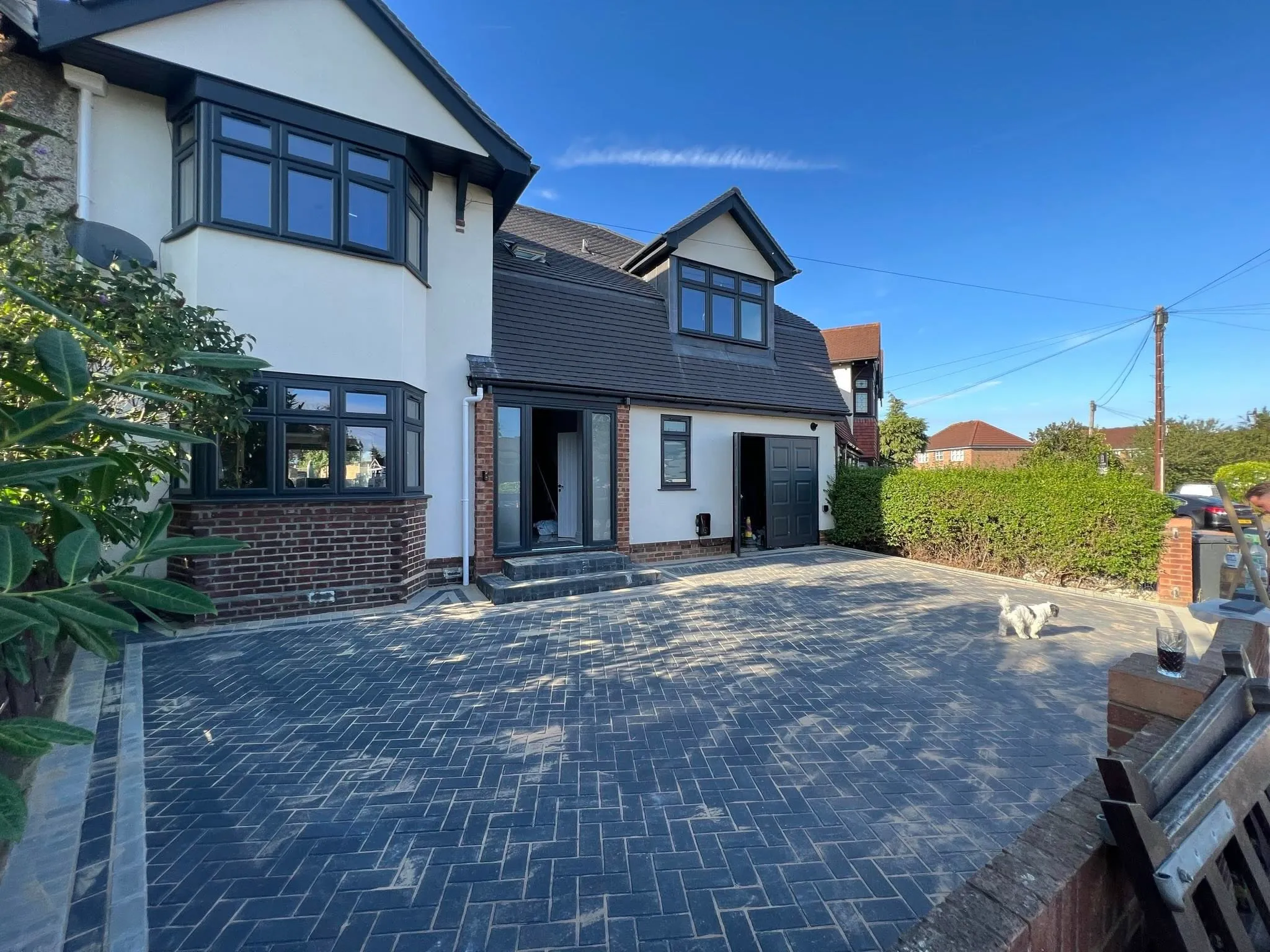
Complete driveway maintenance guide for Kent homeowners — block paving, resin bound, tarmac and natural stone. Seasonal care schedule, cleaning tips and when to call professionals.
How to Maintain Your Driveway in Kent: The Complete Seasonal Guide for Block Paving, Resin Bound, Tarmac, Natural Stone and Gravel
Your driveway was not cheap. Whether you invested in block paving, resin bound gravel, tarmac, natural stone, or a quality gravel installation, the project represented a meaningful investment in your property. The return on that investment — in property value, in daily usability, in kerb appeal — depends entirely on what happens next.
Most Kent homeowners install a new driveway and then do very little until something goes wrong. By that point, what would have been a thirty-minute annual maintenance session has become a repair job. In the worst cases, the neglect that seemed harmless — the joints filling with organic debris, the biological growth colonising the surface, the drainage channel that nobody cleared — has allowed water to penetrate the construction layers and compromise the sub-base. At that point, maintenance has become remediation.
This guide changes that dynamic. It is the complete 2026 maintenance guide for every major driveway surface type installed across Kent — what each surface needs, when it needs it, and what to watch for that signals a problem developing before it becomes expensive. Organised by season, because Kent's specific climate — wet winters, drier summers, the freeze-thaw cycling that makes the county particularly demanding on outdoor surfaces — determines when each maintenance task is most needed and most effective.
MB Construction Group — Marshall Brickwork & Construction has installed and assessed hundreds of driveways across Kent over fifteen years. The maintenance knowledge in this guide comes directly from that experience — what we see when driveways fail, what we see when driveways look as good at year fifteen as they did on installation day, and what the difference between those two outcomes looks like in practice.
Understanding Kent's Climate and Why It Makes Driveway Maintenance Specific
Before the seasonal detail, understanding why Kent creates specific maintenance challenges for driveway surfaces is worth establishing. Kent is not a typical UK county for driveway maintenance purposes.
The freeze-thaw problem. Kent's position on the south-eastern coast means temperatures oscillate around freezing more frequently through winter than in most UK regions. Rather than sustained deep frost, Kent typically experiences repeated dips below 0°C and rises above — the worst possible pattern for any water that has penetrated a driveway surface or its joints. Each cycle expands the water as it freezes, pushing apart whatever it has penetrated, and then contracts as it thaws. Over a winter with thirty or forty such cycles, the cumulative damage to poorly maintained joints, unsealed stone, and cracked surfaces is significant.
The biological growth rate. Kent's combination of mild temperatures and significant annual rainfall — approximately 600mm — creates ideal conditions for moss, algae, and lichen growth on driveway surfaces. North-facing drives, surfaces under tree cover, and any surface where drainage is impaired will develop biological colonisation faster than in drier UK regions. This growth is not just aesthetic — it creates slip hazards and, on porous surfaces, it holds moisture against the surface that accelerates freeze-thaw damage.
The clay movement effect. Much of Kent's residential land — the Medway towns, Sittingbourne and Swale, significant parts of the west Kent area — sits on London Clay or Wealden Clay. These soils expand in wet winters and contract in dry summers. A correctly specified driveway sub-base bridges this movement. A driveway where the sub-base is moving — which maintenance cannot reverse — needs professional assessment before surface maintenance makes any sense.
The seasonal rainfall distribution. Kent's rainfall is relatively evenly distributed but with a concentration through autumn and winter. This means drainage maintenance before the wet season is more critical than in drier regions — a blocked channel drain or failed falls that are merely inconvenient in summer become genuinely damaging through October to February.
Block Paving Maintenance: Season by Season
Block paving is Kent's most popular driveway surface, and it requires the most active maintenance schedule of the common surface types. Done correctly, annual maintenance keeps a block paving driveway performing and looking exceptional for 25–30 years. Done poorly or not at all, biological growth, weed colonisation, joint failure, and edging movement begin within a few seasons.
Spring Block Paving Maintenance (March–May)
Spring is the critical maintenance window for block paving — the season where the damage accumulated over winter is most visible and where proactive intervention prevents it from progressing.
Assessment first. Walk the entire driveway systematically and look for: rocking or sunken blocks (individual blocks that have lost their bedding and moved), failed or missing jointing sand (joints that have opened up and may show the base material beneath), edge restraint movement (any section of edging that has shifted, leaving a gap or a raised lip), and biological growth that has developed on the surface and in the joints through the damp winter months.
Biocide treatment. Apply a proprietary driveway biocide — available from builders merchants and online — across the entire surface, paying particular attention to any areas where moss, algae, or lichen growth is visible. The biocide kills the biological growth rather than simply washing it off. Allow it to work for the period specified on the product — typically one to two weeks — during which the growth will brown and die back. The dead material is then significantly easier to remove in the subsequent cleaning.
Pressure washing. After the biocide has worked, pressure wash the entire surface at medium pressure. The objective is to clean the surface and dislodge dead organic material from the joints without removing the kiln-dried jointing sand. The technique matters: work with the surface, not against it. Hold the lance at an angle rather than directly against the joints. Work in consistent passes rather than holding the lance stationary over a single point, which erodes jointing material. After cleaning, allow the surface to dry completely before proceeding to the jointing step.
Kiln-dried jointing sand. Once the surface is completely dry — a common mistake is to rush this step — broadcast kiln-dried polymeric sand across the entire surface and brush it into the joints. Work the sand in multiple directions to ensure full joint penetration. A leaf blower on low setting can help distribute the sand evenly. The polymeric sand sets on contact with moisture, forming a stable, weed-resistant joint that inhibits future biological growth. This is the single most effective maintenance action for block paving longevity.
Rocking and sunken blocks. Individually rocking blocks — ones that move when stepped on — need lifting, the bed beneath them relevelled, and the block relaid and re-jointed. A rocking block that is left creates a stress concentration point that eventually cracks the block or the adjacent block under vehicle loading. It also allows water to channel directly into the sub-base at that point, potentially undermining a wider area.
Sealing (every 3–5 years). If the last seal application was three or more years ago, spring is the best time to apply a new coat — temperatures are rising, the surface is dry after winter cleaning, and the seal has the whole summer to cure before the next wet season. Block paving sealers are available in natural-finish (enhancing the colour slightly without gloss) and wet-look (adding a sheen) formulations. Penetrating sealers perform better and last longer than surface film sealers.
Summer Block Paving Maintenance (June–August)
Summer is the easiest season for block paving and requires the least intervention.
Weed management. Despite correctly applied jointing sand, persistent weeds may appear in joints during the growing season. Address these promptly — roots allowed to develop fully in a joint significantly degrade the jointing material and create a channel for water ingress. A proprietary path and drive weedkiller applied in dry conditions is effective. Physical removal of small weeds prevents them from reaching the root system maturity where chemical treatment becomes necessary.
Oil and fuel stain treatment. Summer is when barbecues and vehicle maintenance create oil and fuel stains on driveways. Treat oil stains promptly with a degreaser or absorbent material — oil left on block paving surface-seeps into the paving material and becomes progressively harder to remove. A proprietary driveway degreaser, applied and scrubbed with a stiff brush, followed by a hose rinse, addresses most fresh oil stains effectively.
General cleaning. A hose-down or low-pressure wash removes summer dust, pollen, and general traffic soiling. Keep drainage channels clear of debris that accumulates during high-growth months.
Autumn Block Paving Maintenance (September–November)
Autumn is the preparatory season — getting the driveway ready for the demands that Kent's wet winter season places on it.
Leaf and organic debris removal. This is the most time-critical autumn task for block paving. Fallen leaves that remain on the surface through damp autumn conditions create two problems: they decompose and leave organic staining on the block surface, and they block drainage channels. A weekly sweep or blower pass through leaf-fall season — typically October and November in Kent — prevents accumulation. Blocked drainage channels are a winter flood risk.
Drainage channel inspection. Check that all channel drains are clear, that the drainage falls still function correctly (no standing water after rain is the test), and that there are no sections where the surface has settled enough to reverse the intended drainage direction. Small settlements that pool water in summer are insignificant inconveniences; the same settlement pooling water in winter can hold ice against the surface for extended periods, causing joint damage and surface staining.
Biocide pre-treatment. A second biocide application in late autumn — before winter rather than after it — significantly reduces the biological colonisation that develops through the wet winter months. The biocide creates an inhospitable surface for moss and algae spores through the most conducive growth period.
Winter Block Paving Maintenance (December–February)
Winter maintenance for block paving is primarily about avoiding damage rather than active treatment.
De-icing correctly. Standard rock salt is effective for preventing ice formation on block paving but should be used sparingly. Excessive salt application over years can discolour some block types and, more importantly, accelerate the degradation of jointing material. Sand spread as a grit is safer for the surface. Avoid metal-bladed snow shovels that can chip block edges — plastic-bladed tools are safer. Never use hot water to clear ice — the thermal shock damages jointing material and can crack blocks.
Drainage after snow melt. The period after a snow melt event is when drainage failures become most apparent. Snow sitting on a surface where the drainage channel is blocked or the falls are impaired creates extended water pooling as it melts. Check drainage points are clear before significant snowfall and after it.
Resin Bound Driveway Maintenance: Season by Season
Resin bound driveways are the lowest-maintenance hard driveway surface in common use, but "lowest maintenance" does not mean "no maintenance." Understanding what the surface needs — and crucially, what it does not need — prevents both the neglect that shortens service life and the inappropriate maintenance actions that damage it.
Spring Resin Bound Maintenance
Surface assessment. Look for any aggregate shedding — areas where individual stones have come loose from the resin matrix and are sitting on the surface or have been swept away. Minor aggregate shedding in the first year is sometimes seen as the resin matrix fully cures; significant or progressive aggregate shedding after the first year indicates a resin quality issue or an installation temperature problem that should be assessed.
Edge inspection. The perimeter of the resin bound surface — where it meets the adjacent kerb, lawn, or step — is the most vulnerable point for lifting and separation. Check that the edge is secure throughout. Any lifting at the edge allows water to track beneath the surface and undermine the bond between the resin and the substrate.
Spring clean. A medium-pressure wash — not high pressure, which can dislodge aggregate — removes the accumulation of winter dirt, dust, and residual organic material. Work from the highest point of the drainage gradient to the lowest, ensuring water is directed away from the perimeter. A pH-neutral cleaning solution can be added for areas with significant organic staining. Avoid harsh alkaline or acid-based cleaners that degrade the resin binder.
Biological growth check. Although resin bound surfaces are significantly less susceptible to biological growth than block paving or natural stone — the non-porous resin matrix does not provide the foothold that porous materials do — surfaces in heavy shade or with poor drainage can develop surface algae. A proprietary path and patio biocide, applied according to label instructions, addresses this without damaging the resin surface. Avoid bleach-based products on resin surfaces.
Summer Resin Bound Maintenance
Stain treatment. Oil and fuel stains sit on the resin surface rather than penetrating it — the non-porous surface prevents ingress. Fresh stains are removed with absorbent material and a gentle degrease. Established stains may require a proprietary resin-safe solvent cleaner.
Aggregate check. After a summer with significant traffic, walk the surface and check for any areas of progressive aggregate loss or surface irregularity that were not present in spring. These should be assessed professionally rather than treated with DIY patch products — resin patching is visible and should be done by someone with the correct materials and colour-matched aggregate.
Heat effects. Premium UV-stable resin bound surfaces are resistant to the heat exposure Kent's summer sun creates. Budget installations using UV-unstable resins will show yellowing or colour shift in the resin binder under prolonged summer UV exposure — this is irreversible and a sign of incorrect product specification at installation. If colour shift is occurring, the installation should be documented and the contractor engaged.
Autumn Resin Bound Maintenance
Leaf and debris removal. The same principle as block paving — regular removal of organic material prevents surface staining and drainage issues. Resin bound is self-cleaning to a degree (rain passes through rather than pooling, carrying some debris with it), but leaf accumulation on a flatter area will still stain over time.
Drainage verification. The permeability of the resin surface means that drainage testing is straightforward — water should pass through the surface and not pool on it under any normal rainfall event. If pooling is occurring, either the surface has become compacted (uncommon in quality installations) or the sub-base drainage is no longer functioning correctly.
Winter Resin Bound Maintenance
De-icing. Resin bound surfaces can be treated with standard road salt in modest quantities. Avoid excessive salt that can affect the appearance of lighter aggregate colours. Sand as a grit is the safest option for maintaining pedestrian safety on resin surfaces without any risk to the surface or colour.
No scraping. The aggregate surface of resin bound provides good natural grip in most conditions, but if ice forms, avoid any scraping with metal tools. A plastic ice scraper or the natural melt from a light application of salt is appropriate.
Tarmac Driveway Maintenance: Season by Season
Tarmac is the most forgiving driveway surface from a maintenance perspective — its flexibility accommodates minor ground movement, its dark colour absorbs heat and accelerates snow melt, and its smooth surface sheds organic debris easily. The maintenance requirements are modest but specific.
Spring Tarmac Maintenance
Winter damage assessment. Spring reveals any freeze-thaw damage that developed over winter — surface cracking, pothole formation at any existing surface cracks, and edge deterioration. Early identification and repair of developing cracks prevents the much more expensive consequence of water ingress through the crack compromising the sub-base beneath.
Crack sealing. Small surface cracks — hairline cracks up to 5mm wide — should be treated with a proprietary tarmac crack filler before they develop further. Clean the crack of any debris, apply the filler to slightly overfill, and allow to cure. Larger cracks or any crack with visible sub-base movement beneath it should be assessed professionally — these indicate sub-base rather than surface issues and require groundworks assessment before surface repair.
General cleaning. Tarmac cleans well under pressure washing — unlike natural stone or resin bound, tarmac is robust enough to handle higher pressure without surface damage. Proprietary tarmac cleaner products address oil staining, biological growth, and general soiling effectively.
Biocide for biological growth. North-facing or shaded tarmac surfaces develop biological growth similarly to other surfaces. A proprietary path biocide addresses this — tarmac's dark surface absorbs heat that inhibits growth compared to lighter surfaces, but in very shaded positions this thermal advantage is reduced.
Summer Tarmac Maintenance
Heat awareness. Fresh tarmac — in the first two years after installation — can be susceptible to surface softening in extreme heat. Sustained temperatures above 30°C can cause the bituminous surface to become temporarily soft and mark under heavy vehicles or point loads (car jacks, motorbike stands, heavy plant pots). Avoid placing point loads on fresh tarmac during heat waves. Older, fully cured tarmac is significantly more resistant to heat softening.
Oil stain treatment. Oil and fuel on tarmac surfaces should be treated promptly — petroleum-based solvents can soften and penetrate the bituminous binder if left in contact for extended periods. Absorbent material first, then a proprietary degreaser or hot water with washing-up liquid, scrubbed and rinsed.
Seal coat application (every 3–5 years). Tarmac sealers — proprietary bituminous emulsion products — protect the surface from oxidation (the gradual hardening and brittling of the bitumen binder under UV and oxygen exposure), improve weather resistance, and restore the dark colour that weathers to grey over time. Application in summer conditions — warm, dry, minimum 10°C — achieves the best penetration and cure. Follow the manufacturer's application rate carefully; over-application creates a surface film that peels.
Autumn and Winter Tarmac Maintenance
Edge maintenance. The edges of tarmac installations — where the surface meets the adjacent kerb, lawn, or boundary — are the most common failure initiation points. Any edge deterioration visible in autumn should be repaired before winter frost cycling worsens it. Proprietary cold-lay tarmac repair material addresses minor edge deterioration effectively when the sub-base beneath is sound.
Drainage. Tarmac is impermeable — all surface water must exit via the designed drainage falls and channel drains. Autumn blockage of channel drains is the most common cause of water pooling against tarmac surfaces. Clear drainage channels before the autumn rainfall peak.
Winter de-icing. Tarmac handles salt and grit de-icing well. The main caution is avoiding metal-bladed snow removal tools that can scratch or chip the surface — plastic-bladed tools or rubber-edged squeegees are appropriate for snow removal.
Natural Stone Driveway Maintenance: Season by Season
Natural stone driveways — Indian sandstone, granite setts, limestone, slate — require the most attentive maintenance schedule of any driveway surface. The effort is real and ongoing. The return is a surface whose character improves with careful maintenance in a way that no manufactured surface replicates.
Spring Natural Stone Maintenance
The post-winter clean. Natural stone accumulates a combination of winter dirt, salt residue, and biological growth through the Kent winter that is most effectively addressed in spring. The cleaning sequence matters: biocide treatment first, then pressure washing after the biocide has worked, then the surface is clean and dry enough for assessment and sealing.
Sealing — the critical spring task for sandstone and limestone. Porous stone — Indian sandstone and limestone in particular — must be sealed to maintain stain resistance and biological growth inhibition. If the last seal was applied more than two years ago, spring resealing is the priority maintenance action. The correct product is a penetrating impregnating sealer — not a surface film sealer, which peels — applied to a completely clean, completely dry surface. Apply according to manufacturer instructions, allow to penetrate, and remove any excess before it surface-cures.
Pointing inspection and repair. The mortar joints between stone slabs are the most maintenance-intensive element of natural stone driveways. Winter freeze-thaw cycling degrades pointing mortar progressively — particularly any sections where water was able to enter through a surface crack or the top of a joint before winter. Failed pointing is the primary water ingress pathway to the stone bed and the sub-base beneath. Rake out failed sections to 15–20mm depth and regrout with a matching mortar or proprietary flexible pointing compound.
Slab movement and lippage. Walk the surface and feel for any slabs that have moved relative to their neighbours — a raised edge that creates a trip hazard or a slab that rocks when stepped on. These need lifting and relevelling. A rocking slab indicates a void in the mortar bed beneath it — the full mortar bed support that vehicle-bearing stone requires is no longer present, and the slab will crack under vehicle loading if not corrected.
Summer Natural Stone Maintenance
Stain management. The porous nature of Indian sandstone and limestone makes prompt stain treatment essential. Fresh oil, wine, plant tannins from leaves or terracotta — any organic material left in contact with unsealed stone will penetrate and stain. Fresh stains: absorb the excess material, apply a proprietary stone-safe cleaner or poultice stain remover, and allow to draw out the stain from the pore structure. Established stains require a poultice applied, covered to extend the draw time, and then removed and rinsed.
Biological growth management. Even correctly sealed stone develops some surface biological growth in shaded positions during Kent's summer damp. Monthly inspection and treatment of developing growth — before it becomes established — is significantly less effort than treating mature biological growth. A proprietary stone-safe biocide, diluted to the manufacturer's specification, applied to dry stone, addresses developing growth effectively.
Granite setts — minimal summer maintenance. Granite's density and low porosity makes it the most summer-maintenance-free natural stone. A low-pressure wash and check of joint stability is typically all that summer demands of granite sett driveways.
Autumn and Winter Natural Stone Maintenance
Autumn sealing consideration. If spring resealing was missed, autumn is the last effective sealing window before winter — apply sealer before temperatures drop below 5°C consistently, as cold temperatures inhibit penetrating sealer cure.
Leaf management. Organic material from trees sitting on sandstone or limestone in damp autumn conditions stains. The tannins in oak leaves are particularly aggressive stain agents on pale stone — Kandla Grey and Fossil Mint are most vulnerable. Weekly removal of organic debris through leaf-fall season is the most effective prevention.
Winter caution — no salt on limestone. Road salt is mildly acidic and reacts with calcium carbonate — the mineral that limestone is composed of. Salt de-icing on limestone driveways causes surface pitting and erosion over time. Sand as a grit is the appropriate de-icing method for limestone. Sandstone is more acid-resistant than limestone but benefits from the same caution.
Gravel Driveway Maintenance: Practical Annual Tasks
Gravel driveways are the simplest to maintain but require the most frequent attention to appearance.
Regular raking. Gravel distributes unevenly under vehicle and foot traffic — tyre tracks compress and displace gravel, creating bare areas and migration toward the edges and beyond. A monthly rake during high-use periods redistributes the aggregate and restores an even surface.
Weed management. The most important long-term maintenance task for gravel is weed suppression. A correctly installed geotextile membrane under the aggregate significantly reduces weed establishment, but persistent perennial weeds — particularly in the areas receiving most light — require treatment. A proprietary path weedkiller applied in dry conditions prevents establishment. Never allow weeds to reach seed-setting stage on a gravel driveway — once seeded, the problem multiplies significantly.
Gravel top-up. Gravel is gradually displaced — some by vehicle tracking onto adjacent surfaces, some by wind, some absorbed into the membrane layer. An annual top-up of 10–15mm of aggregate maintains the surface appearance and depth that prevents the bare spots and muddy patches that develop on under-supplied gravel drives.
Edge containment. The edge restraint — typically aluminium edge strip, timber board, or brick soldier course — that contains the gravel must be inspected annually. Failed edge containment allows gravel to migrate onto adjacent lawns, paths, and the highway, which is both a nuisance and, if onto a public road, a potential safety and liability concern.
The Maintenance Questions That Reveal a Driveway Sub-Base Problem
Some driveway deterioration cannot be resolved by surface maintenance — it originates in the sub-base and requires professional assessment before any surface intervention makes sense. These are the signs that the problem is below the surface:
Progressive, not static, unevenness. A single sunken area that has been the same for years may be a surface issue. An area of unevenness that is growing — increasing in severity each year — indicates progressive sub-base movement that no surface maintenance will arrest.
Water pooling in new locations. If water pools in a location that was previously well-drained, the drainage falls have changed — which means the surface or sub-base has moved. This is not a maintenance issue; it is a sub-base assessment issue.
Multiple rocking slabs or blocks in proximity. A single rocking block is a bedding issue. Multiple adjacent rocking blocks indicate a void or soft spot in the sub-base beneath them. Relevelling individual units without addressing the sub-base beneath is a temporary fix that will require repetition.
Cracking in a linear pattern across the driveway. Cracking that follows a straight line — particularly one that aligns with an underground service, a drainage run, or the boundary between excavated and undisturbed ground — suggests differential settlement between two areas rather than surface wear. This needs investigation.
When any of these patterns are present, the correct first step is a professional assessment — not surface maintenance. The groundworks specialists at Marshall can assess whether deterioration is a surface maintenance issue or a sub-base issue, and recommend the appropriate intervention.
Choosing the Right Maintenance Products for Kent Driveways
The product choices for driveway maintenance matter more than most homeowners realise. Using the wrong cleaner, sealer, or biocide on a specific surface type can cause damage that the maintenance was intended to prevent.
Biocides: Choose a product rated for the specific surface. Some biocides contain active ingredients that discolour resin surfaces or react with limestone. Products rated for "all hard surfaces" including resin, stone, and tarmac are the safest choice for mixed-surface maintenance programmes.
Sealers for natural stone: Penetrating impregnating sealers are the correct product — they enter the stone pore structure without creating a surface film. Surface film sealers peel, trap moisture beneath them, and create maintenance problems significantly worse than no sealer at all. The sealer specification must match the stone type — limestone-specific sealers have different chemistry from sandstone sealers.
Jointing materials for block paving: Kiln-dried polymeric sand — which sets on contact with moisture and inhibits weed germination — is significantly better than standard kiln-dried sand for maintenance applications. The additional setting agent in polymeric sand creates a joint that remains stable for multiple seasons rather than washing out with the first heavy rain.
Degreasers: Use products specifically rated for the surface type. Some alkaline degreasers that are safe on tarmac will damage resin surfaces. Some acidic stone cleaners that work on sandstone will etch limestone. Check product compatibility before applying to any surface.
When to Call Marshall — What Maintenance Cannot Fix
Maintenance extends driveway life dramatically. But there are conditions that exceed what maintenance can resolve:
Complete joint failure across a block paving surface — where the entire drive needs the jointing sand removed and replaced — is a professional restoration job, not a DIY maintenance task. The process involves pressure washing, allowing full drying, and reapplying polymeric jointing sand consistently across the full surface.
Significant resin surface failure — progressive aggregate shedding, cracking across the surface, or debonding from the substrate — requires professional assessment of whether the installation failure is repairable or requires full reinstatement.
Sub-base failure beneath any surface — indicated by the progressive deterioration patterns described above — requires groundworks intervention. This is a reconstruction job, not a maintenance job.
Mortar bed failure under natural stone — where multiple slabs are loose, rocking, or cracked across a significant area — requires lifting the affected area, assessing the bed condition, and reinstating to the correct specification.
Marshall Brickwork & Construction provides professional driveway assessment across Kent — identifying whether deterioration is maintenance-level or requires more significant intervention, and carrying out the appropriate work to the correct standard.
Getting Professional Driveway Maintenance and Assessment Across Kent
Whether you have a driveway that needs professional restoration work beyond the scope of DIY maintenance, or you're planning a new installation and want to understand the maintenance commitment before you choose a surface, Marshall Brickwork & Construction is the team to speak to.
The complete driveway services Marshall provides across Kent cover block paving, resin bound, tarmac, natural stone, and gravel — installation and ongoing support.
Explore the complete driveway cost guide for investment context across all surface types. Read the full driveway construction guide for everything about specification and installation standards. Browse completed driveway projects across Rochester and Medway, Sittingbourne, Chatham and Gillingham, and Tonbridge, Tunbridge Wells and Sevenoaks.
Phone: 07724 730872 Email: info@mbconstruction.group Contact: mbconstruction.group/contact/
The driveway you invested in deserves the maintenance that protects that investment. This guide gives you everything you need to deliver it — season by season, surface by surface, year after year.
Marshall Brickwork & Construction Ltd | MB Construction Group | 14 Poplar Road, Rochester, ME2 2NR | 07724 730872 | mbconstruction.group