Create your outdoor living room in Kent — complete 2026 guide to patio design, brickwork features, shelter, focal points and materials. Garden spaces built to last.
There is a moment most Kent homeowners recognise. You open the back door on a warm May evening, look out at the garden, and think — this should be where we spend tonight. Not inside. Out here, where the light is doing something extraordinary and the air smells like cut grass and possibility.
Then you look at what is actually out there. A patio that is too small. Furniture that has seen better days. No shelter from the breeze that arrives at seven. Nowhere comfortable to sit that is not directly in front of the kitchen window. And so you go back inside, to the sofa and the television, and the garden waits for another evening that never quite arrives.
The outdoor living room solves this. Not a patio. Not a garden. An outdoor room — a space as deliberately designed, as genuinely comfortable, and as carefully specified as any room inside the house. A space that is used from the first warm week in March through to the last mild evening in October. A space that changes how your family lives in your home.
This guide covers everything involved in creating a genuine outdoor living room in Kent in 2026 — from the design principles that make an outdoor space feel like a room rather than just an outdoor area, through the specific construction elements that make it last and perform in Kent's climate, to the materials, surfaces, and features that the most successful Kent outdoor living rooms have in common.
MB Construction Group — Marshall Brickwork & Construction creates outdoor living spaces across Kent — from complete garden transformations incorporating every element described in this guide, through individual components like patios, brickwork features, landscaping, and fencing. The approach is always the same: build it as you would build a room — with structure, with intention, and with materials that perform as well in year fifteen as they do on the day they are completed.
What Makes an Outdoor Space Feel Like a Living Room
The difference between a patio and an outdoor living room is not size. It is not budget. It is not even the quality of the furniture. It is the presence of the four elements that make any room feel like a room rather than just a space.
Definition. A room has walls, or at least the suggestion of walls — boundaries that separate it from the surrounding environment and give it a sense of enclosure. An outdoor living room creates the same sense of definition through fencing, garden walls, planted hedges, raised borders, or pergola structures that frame the space without closing it off entirely.
A floor that deserves the name. The surface underfoot is as important outdoors as it is inside. A cracked, uneven, moss-covered patio communicates neglect and discomfort in the same way that threadbare carpet does indoors. The floor of an outdoor living room — whether Indian sandstone, large-format porcelain, or quality brick — is specified to the same standard as interior flooring. It is level, correctly drained, and chosen for the character it contributes to the space rather than simply as the cheapest hard surface available.
A focal point. Every room that works has something that anchors it — a fireplace, a window with a view, a piece of furniture that is clearly the heart of the space. Outdoor living rooms that feel resolved have the same: a fire pit, a built-in barbecue structure, a feature wall in facing brick, a specimen tree or planting feature, or the view to a carefully designed garden beyond. The focal point tells you where to sit and what the room is for.
Shelter. The single most underestimated element of outdoor living in Kent. A space with no protection from the wind, rain, or the overhead glare of a July afternoon is a space you will use on perfect days only. A space with considered shelter — a pergola that provides partial overhead cover, planting that breaks the prevailing wind, a wall that creates a microclimate within the garden — is a space that is genuinely usable across the full seven-month Kent outdoor season.
When all four elements are present — definition, floor quality, focal point, shelter — an outdoor space stops being a patio with furniture on it and becomes a room. The distinction sounds subtle. In practice, it is the difference between a space you visit and a space you live in.
The Foundation: Getting the Surface Right
The floor of your outdoor living room is the element that determines everything that sits above it. Its level, its drainage, its material quality, and its relationship to the house threshold are the technical variables that determine whether the finished space is genuinely usable or merely presentable.
Choosing the Right Surface for Your Outdoor Living Room
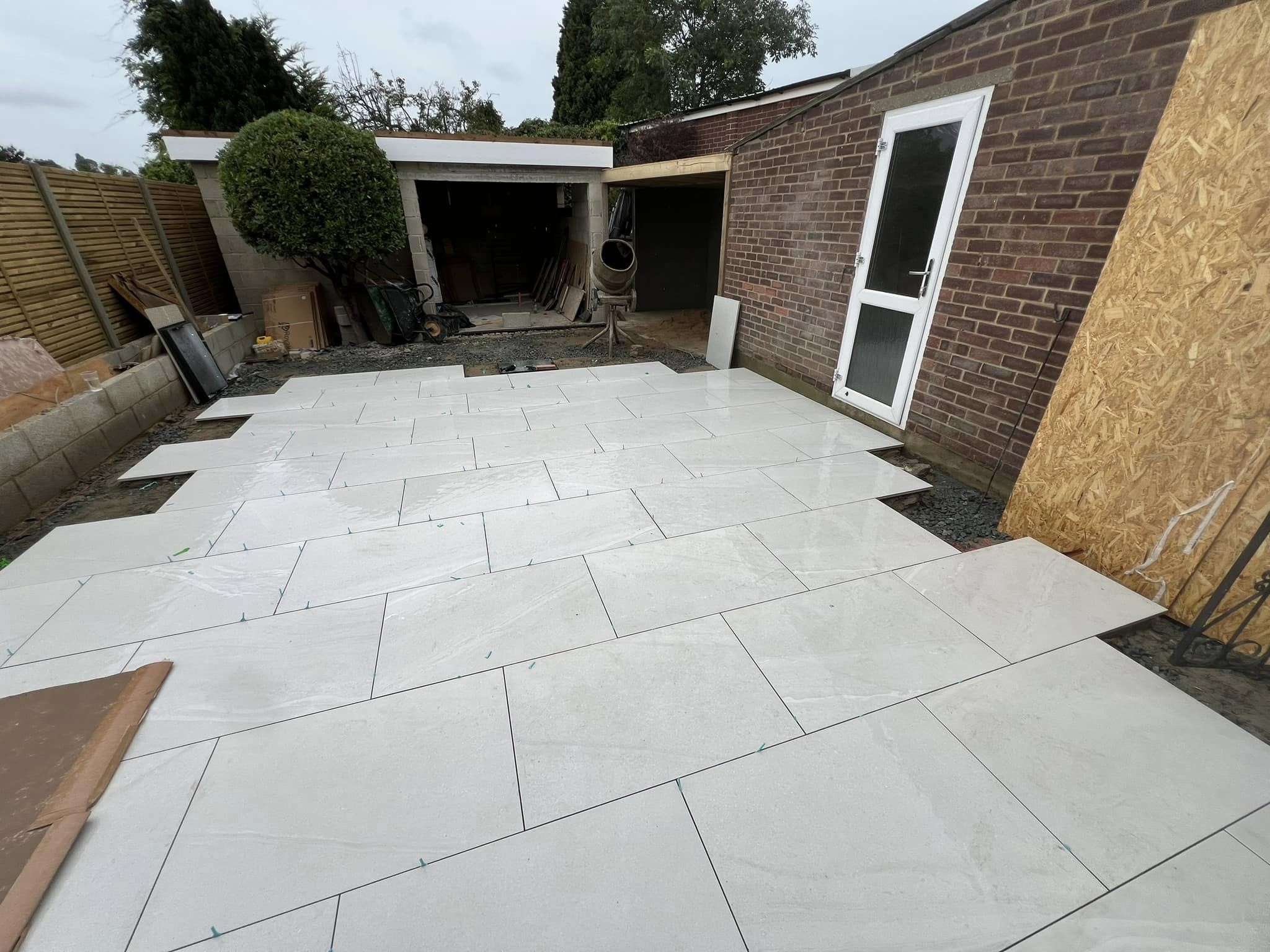
Large-format porcelain is the dominant surface choice for Kent's outdoor living rooms in 2026, and the reasons go beyond aesthetics. Porcelain's near-zero porosity means it never develops the biological growth that makes natural stone surfaces progressively less pleasant — and less safe — over time. Its colour stability under Kent's UV exposure means it looks as fresh in year ten as it did on installation. And its ability to create visual continuity with interior flooring — the same large-format tile running through bi-fold doors from inside to outside — achieves the indoor-outdoor blur that the outdoor living room concept is designed to create.
The specific formats gaining the most traction in Kent's outdoor living rooms in 2026: 900×600mm and 1200×600mm slabs in light grey, warm white, and natural stone effects. Large format reads as generous, as architectural, as designed. Small format reads as utilitarian. For an outdoor space that is meant to function as a room, large format is the correct choice.
Indian sandstone remains the material of choice for Kent's period properties — Victorian and Edwardian houses where the warm, varied natural palette of Kandla Grey or Raj Green complements the brick character of the building in ways that manufactured materials do not replicate. A well-maintained sandstone outdoor living room on a period Rochester or Canterbury property has a character that is simultaneously traditional and contemporary — the organic variation of natural stone given a clean, contemporary edge through large calibrated formats and fine pointing.
Brick paving for outdoor living rooms draws directly on Marshall's core identity and produces results that are uniquely appropriate for Kent's brick-dominant housing character. A brick-paved outdoor room on a Victorian terrace in Chatham, matched in brick to the house elevation, with raised brick planting borders on two sides and a brick built-in seating wall at the garden edge — this is an outdoor space that looks as though it was always there, always intended, always part of the house's design language.
For detailed material comparison and specification guidance, the complete porcelain vs Indian sandstone guide and the patio cost guide cover every variable in depth.
Size: The Most Common Mistake in Outdoor Living Room Design
The most consistently observed mistake in Kent garden projects is undersizing the main patio area. A table and four chairs requires a minimum of 3 by 3 metres to be functional — to allow chairs to be pulled out and people to walk around the seated configuration without squeezing. Add a sofa and coffee table alongside, and the useful space requirement rises to 5 by 4 metres minimum.
The typical Kent single-storey rear extension generates a patio brief for the outdoor space outside the new kitchen's bi-fold doors. That space, if specified at 3 by 3 metres, will feel cramped from day one. Specified at 5 by 4 metres or beyond, it delivers on the potential the extension created.
The calculation to run before specifying patio size: how many people will use this space simultaneously at peak use? Add a table and dining seating for that number. Add the lounging zone alongside or at the edge. Add circulation paths around and through the furniture configuration. Work backward from that programme to the minimum useful area. Then add 20% for the space to breathe.
The Threshold Detail That Makes or Breaks Indoor-Outdoor Flow
If the outdoor living room is connected to the house through bi-fold or sliding doors — as most contemporary Kent garden room briefs are — the threshold detail is the most technically important element in the entire project.
The finished patio surface must sit at a level that allows easy step-over access from inside (or no step at all in level threshold designs), must be below the damp-proof course of the house wall to prevent moisture bridging, and must drain away from the building rather than toward it. These three requirements pull in different directions and require specific engineering rather than improvised specification.
Marshall's patio construction expertise includes the threshold detail as a core design element — specified from the formation level up, not solved with a strip of drainage channel at the last moment.
The Walls and Enclosure: Making the Space Feel Like a Room
The sense of enclosure that makes an outdoor space feel like a room rather than just an outdoor area comes from the elements that define its boundaries. These can be hard boundaries — walls and fencing — or soft ones — planting and hedges — or a combination of both.
Garden Walls as Room-Making Elements
In the outdoor living room context, garden walls serve a function beyond boundary definition. They create the sense of containment and enclosure that makes a space feel intimate and intentional rather than exposed and arbitrary.
A low seating wall at the garden edge of the patio — typically 450–600mm high, built in facing brick matched to the house or garden wall brick — simultaneously defines the boundary of the patio zone, provides informal seating for larger gatherings, and creates a visual frame that makes the space feel designed. This is one of the most frequently used elements in Marshall's Kent outdoor living room projects, and one of the most immediately effective.
Raised planting borders built in brick alongside the patio create the same sense of enclosure while introducing a vertical planted layer that softens the architectural elements and introduces seasonal change. The contrast between the warm texture of quality brickwork and the softness of planting is one of the defining aesthetic qualities of the best Kent outdoor living rooms.
Boundary walls at 1.2–1.5m height on the exposed sides of a garden reduce wind speed within the enclosed space significantly. Kent's prevailing south-westerly winds, which arrive with real energy across open suburban gardens, are the most common reason an outdoor space that should be pleasant is actually uncomfortable for much of the year. Correctly placed walls and planted screening create the microclimate that makes long evening use possible when the wind would otherwise drive everyone inside.
Fencing That Frames Without Closing
Contemporary garden fencing in the outdoor living room context is increasingly specified for its design contribution rather than merely its security function. Dark-painted closeboard fencing — anthracite or near-black in contemporary gardens — creates a background that recedes visually, making the garden space feel larger and allowing planting and furniture to read against it with clarity. Horizontal slatted fencing creates the same enclosure with a lighter, more architectural character that suits the contemporary extension aesthetic particularly well.
The fence as backdrop for planted climbers — climbing roses, clematis, or wall-trained fruit trees — softens the hard edge of the boundary and introduces the layered quality that makes outdoor rooms feel lived-in rather than newly installed. The boundary is there for structure and privacy; the planting is what gives it character.
The Focal Point: What Every Outdoor Living Room Needs
Every successful outdoor living room has a focal point — the element that anchors the space, that people orient toward when they sit down, and that gives the space its purpose and its character.
Fire Features
The fire pit or fire table is the single most transformative focal point element in the Kent outdoor living room market. It extends the outdoor season by two to three months on either side — the fire pit that makes a cool April evening comfortable, the warmth that makes October outdoor dining possible. It creates the draw toward the outdoor space in the evening hours when the garden is at its most beautiful and the pressure to go inside is greatest.
Fire pit surrounds built in brick or natural stone — the structural surround that houses the fire element safely and creates the architectural anchor for the seating zone — are brickwork projects that draw directly on Marshall's craft expertise. A brick-built fire surround, specified in facing brick matched to the garden wall, with a correctly proportioned opening and a flagstone or porcelain hearth to match the main patio surface, is one of the most satisfying and most consistently used garden features in the company's completed project portfolio.
Built-In Seating Structures
The seating wall described above is the most practical built-in seating solution. But for outdoor living rooms where the ambition is higher — the full garden room with defined zones for dining and lounging — built-in seating structures in brick, rendered blockwork, or natural stone create the permanent furniture that makes an outdoor space feel as resolved as an indoor room.
A built-in L-shaped seating structure at the garden end of the patio, topped with weatherproof cushions, defines the lounging zone without the visual clutter of free-standing seating. It creates a level surface for cushion storage when not in use. It can incorporate integrated planters at its ends that introduce planting directly into the seating zone. And it is made of materials that are genuinely permanent — not furniture that will need replacing every seven years.
The View to the Lawn and Garden Beyond
In gardens where the outdoor living room occupies the area immediately outside the house and a lawn or garden area extends beyond it, the view from the seating zone toward the garden is itself a focal point. Designing the outdoor living room with this view in mind — so that the eye is drawn from the patio across a quality artificial grass or planted lawn to a garden boundary that is planted or treated as a destination rather than just an edge — gives the outdoor space a sense of depth and generosity that a walled courtyard, however beautifully finished, cannot replicate.
The Outdoor Living Room for Every Kent Property Type
Victorian and Edwardian Terraces — Compact Spaces, Maximum Character
The rear gardens of Kent's Victorian terraces — the dense housing of Rochester, Chatham, Sittingbourne, and Canterbury — are typically modest in area. The outdoor living room brief for these properties is about quality and character within a compact footprint rather than scale.
The most effective approach: treat the entire rear garden as the room. A quality patio surface across the full usable area — perhaps 25–35 square metres — in Indian sandstone or brick that connects to the kitchen through well-maintained rear access. Raised brick borders along both side boundaries, planted for year-round structure. A wall-mounted fire feature or fire basket that does not consume floor space. Boundary fencing in dark anthracite that makes the space feel larger. And the view through the back gate to the alleyway beyond managed with planting that creates a green termination to the space rather than a view of a fence.
In these gardens, the outdoor living room is not a large-scale installation — it is a quality small-scale one. The materials, the detailing, and the relationship between hard and soft elements determine whether a 25m² rear terrace garden feels like a cramped afterthought or a genuine outdoor room.
Semi-Detached and Detached Family Houses — The Multi-Zone Opportunity
The medium to larger rear gardens of Kent's interwar semis and post-war detached houses — widespread across Maidstone, Tonbridge, Tunbridge Wells, Sevenoaks, and the commuter villages surrounding them — offer the space for the full multi-zone outdoor living room brief.
A dining zone of 25–35m² directly outside the kitchen or dining room doors, in porcelain or Indian sandstone, large enough for a table that seats eight comfortably with room for a free-standing plancha or grill alongside. A transition step or level change marking the edge of the dining zone and the beginning of the lawn area. A lawn in premium artificial grass — usable year-round, in consistent condition regardless of weather or heavy use. And at the far end of the garden, a secondary zone: a fire pit area, a kitchen garden with raised brick beds, or a sheltered corner planted for atmosphere that becomes the evening destination as the sun moves around.
This is the brief that Marshall delivers most frequently across Kent's family housing market — and it is the one that produces the most consistent client feedback: not just that the garden looks better, but that the family actually uses it differently. More often. More evenings. Further into autumn than ever before.
Period Properties in Conservation Areas — Natural Materials, Period Sensitivity
For Kent's period properties in conservation areas — Rochester's historic core, Tunbridge Wells's Victorian residential streets, Canterbury's inner suburbs — the outdoor living room brief carries a material sensitivity that suburban properties do not face.
Natural materials — Indian sandstone or limestone for paving, facing brick matched to the house for raised features and walls, timber for pergola structures and fencing — sit more comfortably in the period garden context than contemporary manufactured materials. Not because manufactured materials are inferior, but because the visual relationship between the outdoor space and the building it serves is part of what makes a period property garden feel right or wrong.
A Kandla Grey sandstone patio with brick seating walls in stock brick matched to the house elevation, a fire pit in natural stone, and a pergola in stained hardwood timber — this is the outdoor living room that belongs to its period property setting. The same brief executed in large-format porcelain with concrete-effect finish and powder-coated steel pergola would be technically better-specified but aesthetically discordant in a Victorian garden.
Shelter: Making the Space Usable in Every Season
This is the element most often missed from outdoor living room briefs. A beautifully specified patio with quality furniture and a fire pit is still unused on the seven out of ten Kent evenings where a breeze, a light shower, or the angle of the setting sun makes it genuinely uncomfortable.
Overhead Coverage
A pergola — whether free-standing or fixed to the house wall — provides the partial overhead coverage that transforms an outdoor space's usability. Solid pergola roofing with a polycarbonate or glass panel insert keeps rain off without creating the dark, enclosed feeling of a full roof. A retractable canopy provides weather protection on demand. Even a simple timber-framed pergola with climbing plants growing across it creates a sense of overhead shelter that makes sitting beneath it feel contained and comfortable in a way that open sky does not.
The relationship between the pergola and the house is the first structural question. A lean-to pergola fixed to the house wall creates the outdoor room that flows directly from the interior — the most seamless extension of the living space. A free-standing pergola in the middle of the garden creates a destination rather than an extension — equally valid for a multi-zone design where the pergola marks the secondary lounge zone.
Wind Shelter
The microclimate within a Kent garden is determined by the relationship between the prevailing wind direction, the orientation of the garden, and the height and porosity of the boundary treatment. South-westerly prevailing winds — the dominant direction across most of Kent — enter the garden over the south-west boundary and cross the space with real energy on windy days.
Solid walls at the south-west boundary create a wind shadow that extends approximately six times the wall height into the garden. A 1.5m wall creates a protected zone of approximately 9 metres. Combined with planted screening — hedging, tall ornamental grasses, or bamboo — at the garden edges, the microclimate within the outdoor living zone can be dramatically improved compared to an open garden.
Garden walls and fencing specified with their microclimate function in mind — as well as their visual and security functions — are the construction elements that make Kent outdoor living rooms genuinely usable across the full outdoor season.
Lighting: The Element That Extends the Day
The outdoor living room that is only usable in daylight is a space that misses the best hours. Long summer evenings, the theatrical quality of garden light after dark, the warmth that outdoor lighting adds to any space — these are the qualities that make a garden genuinely special and that the best outdoor living room designs capture deliberately.
Lighting for outdoor living rooms falls into three layers that, when combined, create the flexibility for every mood and every use.
Ambient lighting provides the baseline illumination — enough to move through the space, to find the wine, to see the faces of the people you are with. Soffit lights on a pergola overhead, recessed lights in a garden wall, or festoon lights strung above the dining zone all achieve this without the harsh directional quality of a spotlight.
Feature lighting draws attention to the elements that define the space — uplighting a specimen tree, grazing a brick wall with a narrow beam to reveal its texture, lighting a planted border from below to create drama and depth.
Functional lighting serves specific tasks — a light over the outdoor kitchen, a light beside the gate, path lighting that makes the garden safe to move through after dark.
The installation of outdoor lighting is most efficiently handled as part of the patio and garden construction project — cables installed in conduit beneath the patio surface before slabs go down, junction boxes positioned in the correct locations, and the surface finished cleanly without the retrospective disturbance that post-installation lighting always involves.
Connecting the Outdoor Living Room to the Rest of the Garden
The outdoor living room is the primary outdoor space — the heart of the garden experience. But the garden beyond it matters too, and how it connects to the living zone determines whether the outdoor space feels like a complete environment or a destination isolated from its setting.
The transition from patio to lawn. A single step down from the patio surface to the lawn level — whether natural grass or artificial — creates a legible boundary between the room and the garden beyond it. The step is both a practical level change and a visual threshold that tells you you are moving from one zone to another.
Path connections to the rest of the garden. A path from the patio edge to the rear boundary — whether in matching paving material, stepping stones across the lawn, or a gravelled route through the planting — creates the invitation to move through the garden and experience it as more than the view from a seat.
The driveway connection. For properties where the outdoor living room design is part of a broader project that includes a new driveway at the front of the house, the material and design language established for the rear garden can be carried through to the front approach. The same stone, the same brick, the same palette — creating the sense that the property has been considered as a whole rather than improved in disconnected episodes.
The Construction Process: What Building Your Outdoor Living Room Involves
An outdoor living room project of meaningful scale — patio, raised features, fencing, planting zones, and lighting — is a construction project. It follows the same process as any professional construction commission.
Site survey and design brief. Marshall's site visit process for outdoor living room projects includes ground conditions assessment, drainage evaluation, level survey, and the design conversation that translates the homeowner's vision into a specific, buildable brief. Planning implications are addressed at this stage — the complete planning permission guide covers what requires consent and what is permitted development.
Groundworks first. Formation levels, drainage falls, and service routes (for lighting cables, outdoor tap connections, and any other services being integrated) are all established in the groundworks phase — before any surface material goes down. This is the correct sequence. Services and drainage specified after the patio is built require surface disruption to install. Getting it right before the first slab is laid is how it should be done.
Structure before surface. Garden walls, raised borders, seating walls, and step structures are built before the primary patio surface is laid around them. This allows the patio level to be set correctly relative to the structural features and ensures that the surface joints between the patio and the structural elements are clean and correctly detailed.
Surface last. The patio surface goes down last — after all structural work and services are in place and confirmed at the correct level and drainage. This is also the stage that is most visible and most satisfying — the moment when the outdoor living room takes its finished form.
Ready to Create Yours?
The outdoor living room you have been thinking about — the space that turns the garden from somewhere you walk through into somewhere you live — is a construction project with a precise starting point: a conversation with a contractor who understands every element of what you want to build.
Marshall Brickwork & Construction delivers complete outdoor living room projects across Kent — from the patio surface and the brickwork features through to the fencing, the landscaping, and the artificial grass that makes the garden beyond the room as usable as the room itself. One team. One vision. Every element coordinated.
Browse the completed project gallery to see outdoor living rooms across Kent — from compact terrace gardens in Rochester and Chatham through to large family garden transformations in Maidstone, Sevenoaks, and Tonbridge.
For the specific technical guides: patio construction, outdoor landscaping services, brickwork features, adding value to your property.
Phone: 07724 730872 Email: info@mbconstruction.group Contact: mbconstruction.group/contact/
Your outdoor living room is not a future project. It is a this-summer project. The conversation starts with a free site visit and an honest assessment of what is possible for your specific garden, your specific property, and your specific vision.
The door is open. Step outside.
Marshall Brickwork & Construction Ltd | MB Construction Group | 14 Poplar Road, Rochester, ME2 2NR | 07724 730872 | mbconstruction.group