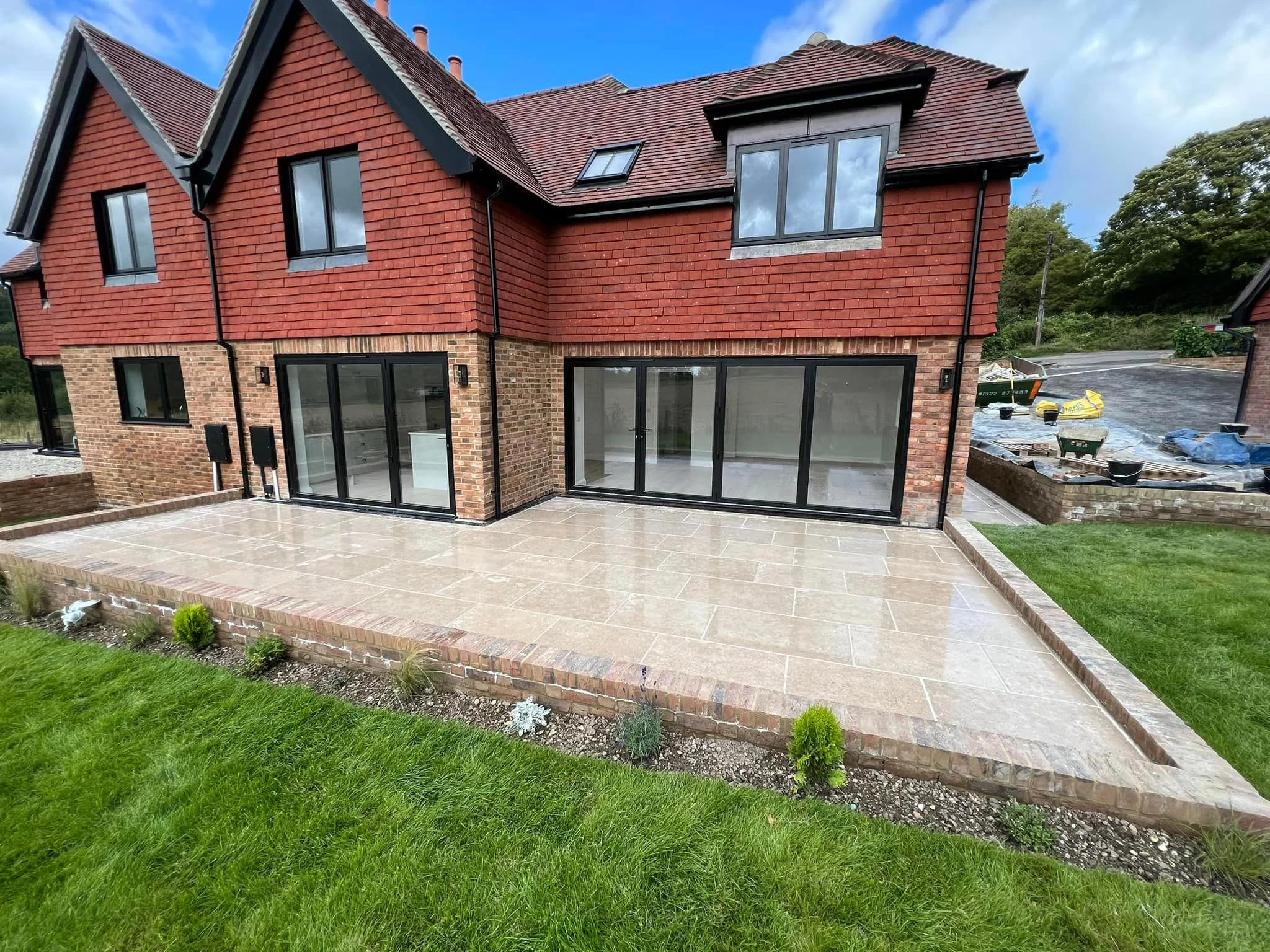
Complete patio maintenance guide for Kent — Indian sandstone, porcelain, limestone and brick. Seasonal care, sealing, cleaning, pointing repair and when to call professionals.
How to Maintain Your Patio in Kent: The Complete Seasonal Guide for Indian Sandstone, Porcelain, Limestone, Concrete and Brick
Your patio represents one of the most significant outdoor investments a Kent homeowner makes. It changes how you use your home across eight or nine months of the year. It adds measurable value when the property is sold. And like every meaningful investment, it rewards maintenance and punishes neglect.
The challenge most homeowners face is not a lack of willingness to maintain their patio — it is a lack of specific, honest information about what each surface type actually needs, when it needs it, and what the warning signs of developing problems look like before those problems become expensive. Generic advice to "clean regularly and seal every few years" does not tell a Maidstone homeowner what to do about the efflorescence appearing on their Indian sandstone in February, or help a Rochester family understand whether the white powdery deposit on their limestone patio is a maintenance issue or a sign of something structural.
This guide is the specific, technical, locally informed answer to those questions. It covers every major patio surface type installed across Kent in 2026 — Indian sandstone, porcelain, limestone, concrete paving, and brick — organised by season and by material, with honest detail about the correct products, the correct techniques, and the situations where a professional assessment is the right answer rather than continued DIY treatment.
MB Construction Group — Marshall Brickwork & Construction has installed and assessed patios across Kent for over fifteen years. The knowledge in this guide comes from that accumulated experience — from completing patio installations across the county's varied ground conditions and assessing surfaces that have failed, surfaces that have thrived, and the maintenance decisions that determined which outcome followed.
Why Kent Creates Specific Patio Maintenance Challenges
Before the material-specific detail, understanding why Kent's specific climate and ground conditions create patio maintenance challenges that differ from the national average is worth establishing. Maintenance advice that works in the drier East Midlands or the frost-free south-west coast is not always the right advice for Kent.
Biological growth rates in Kent. Kent's combination of mild temperatures, approximately 600mm of annual rainfall distributed across most months, and the county's varied aspect — from south-facing coastal gardens to north-facing hill gardens behind the North Downs — creates conditions where moss, algae, and lichen colonise patio surfaces faster than in most UK regions. A patio that receives minimal biological growth in Birmingham or Brighton may become significantly green in a Kent garden with any north-facing aspect or tree canopy. This is not a maintenance failure — it is a climate reality that determines how frequently biocide treatment is needed to stay ahead of established growth.
Freeze-thaw cycling. Kent's coastal position means it experiences more frequent oscillations through freezing and thawing than inland regions. Rather than sustained deep frost, Kent typically sees repeated temperature movements across 0°C through winter — the most damaging possible pattern for any porous material. Each freeze-thaw cycle expands any water held within the pore structure of natural stone or within a joint, pushes the material apart, and then contracts as the temperature rises. Over a Kent winter with forty or fifty such cycles, the cumulative effect on unsealed porous stone and failing pointing joints is significant and progressive.
The clay sub-base reality. Most patio surfaces in Rochester, Chatham and Gillingham, Sittingbourne, and much of mid-Kent sit on London Clay. This clay expands in wet winters and contracts in dry summers. A correctly specified sub-base bridges this movement. A sub-base that was inadequate from the start — or that has been undermined by drainage failure — will transmit clay movement to the surface above it. When that happens, maintenance cannot solve the problem. A professional structural assessment is required before any surface restoration work makes sense.
UV intensity. Kent's south-eastern position delivers more annual sunshine hours than most of the UK. This is pleasant for outdoor living but accelerating for the UV-related degradation of resin-based jointing compounds, sealers, and the surface character of some natural stones. Sealer reapplication intervals that might be three years in Yorkshire may be closer to two years in a south-facing Kent garden.
The Maintenance Principle That Changes Everything
Before the seasonal and material-specific detail, one principle shapes everything that follows. It is this: the most expensive patio maintenance is the maintenance that was not done when it should have been.
Failed pointing that allows water to undermine the mortar bed beneath a stone slab is the product of pointing that was not inspected and repaired when it first showed hairline cracking. Staining that has permanently etched limestone is the product of a spill that was not treated promptly. Biological growth that has colonised the pore structure of unsealed sandstone to the point where it cannot be removed without high-pressure erosion of the surface is the product of three years of no treatment rather than three months.
The maintenance schedule in this guide is weighted toward prevention — the tasks that stop problems from developing — rather than remediation. Prevention takes thirty minutes per season. Remediation takes a professional, a day on site, and the cost of materials and labour.
Indian Sandstone Patio Maintenance: The Complete Seasonal Programme
Indian sandstone is Kent's most popular natural stone patio surface and its most maintenance-intensive. The warm, organic character that makes it so appealing — the varied colour, the natural texture, the way it weathers to an ever-more-interesting surface over time — is inseparable from the porous material structure that demands attentive care.
Spring Indian Sandstone Maintenance (March–May)
Spring is the critical window for sandstone — the period where the damage accumulated through a Kent winter becomes visible and where intervention before the growth season prevents the biological colonisation that the damp, warming months of spring and summer will otherwise accelerate.
Full assessment first. Walk the entire patio surface systematically and note: any areas of surface spalling where the stone face has broken away; any slabs that rock when stepped on or that have visible lippage (one edge higher than the adjacent slab, creating a trip hazard); any sections where the pointing mortar has failed, cracked, or receded below the slab face; and the extent and location of biological growth — whether moss (soft, green), algae (black or dark green surface film), or lichen (grey-white, tightly bonded to the surface). The assessment determines which interventions are required before any cleaning begins.
Biocide treatment before pressure washing — always. The sequence matters enormously for sandstone. Applying a biocide to the surface before any pressure washing kills the biological growth before the washing disrupts it. Pressure washing living moss and algae without prior biocide treatment splashes living spores across the entire surface and adjacent garden — effectively spreading the problem while removing the visible evidence temporarily. Apply a proprietary path and patio biocide rated as safe for natural stone (never bleach, never acid-based products, never fungicides containing iron — which reacts with the iron content of many sandstones to create orange staining). Allow the biocide to work for ten to fourteen days as specified by the product instructions. The biological growth will die back and brown during this period.
Pressure washing after biocide cure. Once the biocide has done its work, pressure wash the surface at medium pressure — a maximum of 1,200 PSI at the nozzle, held at a 45-degree angle to the surface rather than directly perpendicular. Never use a rotary or turbo head on sandstone — the concentrated rotating jet erodes the surface texture and exposes the less weathered stone beneath, leaving circular marks that are permanent. Work in consistent passes along the slab length, not across joints. Allow the surface to dry completely — typically two to three dry days — before any sealer is applied.
Sealing — the most important spring task. If the last sealer application was more than two years ago, or if the surface no longer beads water (the simple test: sprinkle water on the stone and observe whether it beads on the surface or soaks in immediately), resealing is required before the growth season begins.
The sealer specification is the most consequential product decision in sandstone maintenance. A penetrating impregnating sealer — one that enters the pore structure of the stone rather than forming a film on the surface — is the only correct choice for Indian sandstone patios. Surface film sealers appear cheaper and create an initially satisfying wet-look appearance, but they peel, they trap moisture beneath them, they prevent the stone from breathing naturally, and they create a maintenance problem significantly worse than unsealed stone. Penetrating sealers are invisible, breathable, and provide three to four years of stain resistance and biological growth inhibition when applied correctly to clean, dry stone.
Application: the stone must be completely dry — damp stone will not accept sealer correctly. Apply with a roller or lambswool applicator in even, overlapping passes. Do not over-apply — excess sealer that cannot be absorbed by the stone must be removed before it surface-cures, or it will leave a patchy, cloudy film. Apply in conditions above 5°C with no rain forecast for forty-eight hours.
Pointing repair. After cleaning and before sealing, inspect every pointing joint. Use a thin tool — a screwdriver tip or a pointing rake — to probe the integrity of mortar at the joint base. Mortar that crumbles, that is recessed more than 3mm below the slab face, or that has visible cracking needs raking out and repointing before the sealer application seals any failed joint in place.
For sandstone patios, the pointing options are: traditional cement and sand pointing mortar (matched in colour to the existing joint), proprietary flexible jointing compound (better freeze-thaw performance than rigid mortar), or kiln-dried polymeric jointing sand (for wider joints between naturally separated slabs). Match the pointing material to what is already in the majority of joints for visual consistency.
Summer Indian Sandstone Maintenance (June–August)
Stain treatment within 24 hours. The porous structure of sandstone means that stains left in contact with the surface penetrate progressively into the stone body — becoming exponentially harder to remove with every hour they remain. Red wine, cooking oil, tomato sauce, rust from garden furniture — all should be addressed within twenty-four hours. Absorb the excess with paper towel or cat litter. Then apply a proprietary stone-safe stain remover or a poultice product — a paste that draws the stain out of the pore structure as it dries — cover with cling film to extend the draw time, remove after twenty-four hours, and rinse.
Rust stains — the specific sandstone problem. Indian sandstone contains iron mineral inclusions that, when exposed to moisture and oxygen, create rust staining from within the stone. This is separate from rust transferred from metal garden furniture — it is an inherent characteristic of some sandstone batches. Rust stains from internal iron cannot be prevented, but proprietary rust-removing stone cleaners (never household rust removers, which are acidic and will etch the stone) can reduce their prominence. Do not use acidic products on sandstone under any circumstances.
Check slab edges for chipping. Summer is the time to inspect slab edges — the arris, the sharp 90-degree edge of each slab — for chipping damage. Chips from dropped tools, mower contact, or vehicle overhang damage the edge and create points of stress concentration. Minor edge chips are an aesthetic issue; larger chips that expose the stone interior need assessment to ensure they are not the leading edge of slab delamination.
Autumn Indian Sandstone Maintenance (September–November)
Leaf management — the priority autumn task for sandstone. Fallen leaves on Indian sandstone are a specific threat. The tannins in decaying leaves — particularly oak, walnut, and chestnut, all common in Kent's residential areas — are acidic organic compounds that penetrate the surface of unsealed or under-sealed stone and create permanent brown or black staining. A weekly leaf removal through the October–November leaf-fall period is the most effective prevention. Where leaves have already sat on the surface for several days in damp conditions, treat any discolouration promptly with a proprietary stone tannin stain remover.
Second biocide application. A light biocide application in late October — before the wet winter season rather than after it — significantly reduces the biological colonisation that Kent's damp autumn and winter conditions promote. The biocide creates an inhospitable surface through the winter growth period, substantially reducing the spring clean-up burden.
Drainage verification. Check that the drainage falls are still directing water away from the house and toward the intended discharge point. After a Kent summer with the clay shrinkage that recent dry seasons have produced, minor surface settlement can reverse intended falls in localised areas. Any pooling of water against the house wall in autumn rain events requires assessment — standing water against a building threshold is a damp risk, not merely a patio maintenance issue.
Winter Indian Sandstone Maintenance (December–February)
No rock salt on Indian sandstone. Road salt is mildly acidic — sodium chloride in solution creates hydrochloric acid at very low concentration, but at concentrations that are aggressive enough to etch some sandstone surfaces and accelerate the iron reaction described above. Use sand as a grit on icy sandstone patios. Where salt has been applied inadvertently, rinse thoroughly with clean water as soon as conditions allow.
Efflorescence — understanding the white powder. Many Kent homeowners discover white powdery deposits on their sandstone patio through winter and spring. This is efflorescence — mineral salts dissolved in groundwater that travel up through the slab, evaporate at the surface, and leave mineral deposits behind. Efflorescence is normal and common, particularly in the first few years after installation, and it does not indicate a fault in the stone. It is removed by dry brushing (not wet washing, which can wash the salts back into the stone). Persistent or increasing efflorescence may indicate a drainage or sub-base moisture problem worth investigating.
Porcelain Patio Maintenance: The Honest Low-Maintenance Reality
Porcelain paving is the material that has most significantly changed Kent's patio market in the past five years. Its dominance is partly aesthetic fashion and partly a genuine performance story: porcelain's near-zero porosity eliminates most of the maintenance demands that porous natural stone creates.
The maintenance schedule for porcelain is genuinely shorter than for sandstone — but "low maintenance" is not "no maintenance."
Spring Porcelain Maintenance
Assessment: the jointing focus. Porcelain slabs do not crack under normal freeze-thaw cycling (the surface is non-porous, so no water enters to freeze within the slab). The maintenance focus for porcelain is almost entirely on the jointing compound between slabs and the perimeter edge detail.
Inspect every joint. The flexible jointing compound used between porcelain slabs — not traditional rigid cement mortar, which would crack under the minimal thermal movement of porcelain — has a service life of approximately seven to ten years before it hardens, cracks, or begins to separate from the slab edges. Failed jointing allows water to track beneath the slabs at the joint location, potentially undermining the mortar bed and causing slab movement or debonding.
Any joint where the compound has cracked, recessed significantly, or lost adhesion to the slab edge should be raked out and repointed with fresh flexible compound in the correct colour. This is the single most important annual maintenance task for a porcelain patio.
Spring clean. Porcelain responds well to pressure washing — the non-porous surface withstands higher pressure than natural stone without surface erosion. A medium to high pressure wash removes the winter accumulation of dirt, algae, and organic material effectively. A pH-neutral patio cleaner added to the wash water accelerates the removal of organic surface staining.
Porcelain does not require sealing — the surface is vitrified and the pore structure is effectively absent. Any product marketed as a "porcelain sealer" is a surface coating, not a penetrating sealer, and it creates a film that can become slippery, discolour under UV, and peel at the edges. Do not seal porcelain.
Slip resistance check. Porcelain specified for outdoor use should have a minimum R11 slip resistance rating. This rating is achieved through the texture of the surface, not through any applied coating. Check that the surface texture is still intact — any polishing or erosion of the surface texture through abrasive cleaning or heavy furniture dragging will reduce the slip resistance below the intended specification. Correct-specification outdoor porcelain maintains its texture indefinitely under normal use; damage to the surface texture is typically caused by inappropriate cleaning methods.
Summer Porcelain Maintenance
Stain removal — straightforward. The non-porous surface of porcelain means stains sit on the surface rather than penetrating it. Fresh spills — oil, wine, food — are removed with absorbent material and a wipe with a damp cloth. Established surface staining — oil from a BBQ that has carbonised over summer heat, rust from furniture feet — responds to a proprietary patio degreaser or a dilute solution of alkaline cleaner. Never use acidic cleaners on porcelain — hydrofluoric acid is used in some tile cleaners and will permanently etch the surface.
Check for slab movement. Walk the patio surface and feel for any slabs that have moved relative to their neighbours — even a millimetre of lippage that was not present at installation indicates slab movement at the bedding level. A slab that has lifted or settled is typically caused by a void developing in the mortar bed beneath, often at a location where the initial mortar bed coverage was less than 100%. Any slab movement should be assessed and rectified — a moving porcelain slab will crack under point loading if not corrected.
Autumn and Winter Porcelain Maintenance
Leaf removal. Organic debris on porcelain causes surface staining even on the non-porous surface — tannins from leaves stain the joint compound and can leave surface marks on lighter-coloured porcelain. Regular removal through the leaf-fall season prevents this.
Joint inspection before winter. Any joint failures identified in the autumn assessment should be repaired before winter. Failed joints in winter allow water to freeze within the joint channel, accelerating joint deterioration and eventually allowing water to reach the mortar bed.
De-icing safely. Porcelain handles salt de-icing without the damage concerns relevant to natural stone — the surface does not react with sodium chloride and the surface is not porous. Sand as grit is still the preferred option for avoiding salt tracking into the house on shoes, but salt is technically safe on porcelain surfaces.
Limestone Patio Maintenance: The Acid Sensitivity Question
Limestone is one of the most beautiful and most chemically sensitive patio materials installed across Kent. Understanding the acid sensitivity — which is inherent to limestone's calcium carbonate composition and not a quality failing — is the foundation for maintaining it correctly.
The Acid Rule for Limestone
This is non-negotiable: never use acidic cleaners on limestone. Calcium carbonate reacts with acid — any acid, including mild household acids like vinegar and citrus-based cleaners — to produce a visible etching reaction. The stone surface dissolves where the acid contacts it, leaving permanent dull patches that no amount of cleaning or polishing will restore. The same reaction occurs with fizzy drinks, wine, and fruit juice spilled on the surface and left for any significant time.
The practical implication: every cleaning product used on a limestone patio must be confirmed as pH-neutral or mildly alkaline before application. This rules out most standard patio cleaning products, which are acidic. Use only products specifically rated as safe for calcium-carbonate based stone — limestone, marble, travertine. When in doubt, test on an inconspicuous area before full application.
Spring Limestone Maintenance
Biocide and clean — with the correct products. Apply a stone-safe, pH-neutral biocide and follow with a medium-pressure wash using a pH-neutral stone cleaner. The biological growth removal sequence is the same as for sandstone — biocide first, wash after the biocide has worked, allow to dry completely before any sealer application.
Sealing limestone. Limestone is generally more porous than Indian sandstone and benefits strongly from penetrating sealer application. The sealing schedule for Kent's climate — every two years for south-facing open patios, annually for north-facing or heavily shaded surfaces — is more frequent than the sandstone recommendation due to limestone's higher baseline porosity.
Lichen on limestone — the patient removal. Lichen is the maintenance challenge most specific to limestone patios in Kent. The slow-growing grey-white biological crust that forms on natural stone in moist, shaded conditions is more difficult to remove from limestone than from harder stones because the aggressive mechanical treatments that would shift lichen from granite are too damaging for the softer limestone surface. Multiple applications of a proprietary lichen-specific stone cleaner, over several months, achieve progressive improvement. Do not attempt mechanical removal with wire brushes or abrasive tools on limestone.
Concrete Paving Slab Maintenance: Robust but Specific
Concrete paving — the high-quality, high-density concrete paving slabs now available in natural stone effects and large formats — is significantly less maintenance-intensive than natural stone but has its own specific maintenance considerations.
Spring Concrete Slab Maintenance
Pressure washing. Concrete paving handles robust pressure washing without the surface sensitivity of natural stone. A high-pressure wash in spring removes the accumulation of winter biological growth, traffic soiling, and organic staining effectively. A proprietary patio cleaner added to the wash water enhances the cleaning effect on any areas of established biological growth.
Efflorescence on concrete. New concrete paving commonly develops white efflorescence through the first two to three years as the curing process continues and soluble lime minerals migrate to the surface. This is normal and reduces progressively. Dry brushing removes the surface deposit; wet washing can temporarily increase it by reintroducing the mineral to the surface. Proprietary efflorescence removers — acid-based products that react with calcium carbonate — are used for stubborn deposits on concrete (unlike limestone, concrete paving can tolerate mild acid treatment in controlled application).
Sealing concrete paving. High-quality dense concrete paving does not require sealing in the way that natural stone does, but sealing significantly improves stain resistance and reduces biological growth establishment. A penetrating concrete sealer applied after the initial efflorescence period (typically after two years) provides effective long-term protection.
Joint Maintenance for Concrete Paving
Concrete paving is typically laid on a semi-dry mortar bed with either traditional cement pointing or polymeric jointing sand in the joints. The joint maintenance approach follows the same principles as natural stone — inspect annually, repair any failed sections before water ingress to the mortar bed can cause slab movement.
Brick Patio Maintenance: The Brickwork Expertise Advantage
Brick patios — either traditional clay paving bricks or reclaimed brick in a traditional bond pattern — are the surface where Marshall's brickwork expertise is most specifically relevant to patio maintenance.
Brick patios age differently from stone or manufactured surfaces — they weather and develop character in ways that other materials don't. A brick patio that is twenty years old and correctly maintained looks better than a brand-new one. The warm, worn character of aged brick is one of its most appealing qualities. Maintenance preserves and enhances that character rather than fighting it.
Repointing brick patios. The mortar joints in a brick patio are subject to the same freeze-thaw degradation as any exterior pointing — and the approach is the same as for brickwork repointing on buildings. The mortar specification must be appropriate for the brick type. Victorian and reclaimed handmade bricks require lime-based mortar; modern hard-fired bricks can use cement mortar. Matching the joint colour and profile to the original work is a craft skill — the pointing is as visible as the brick, and mismatched mortar turns a characterful brick patio into an assembly of repairs.
Weed management. The open joints of a brick patio — particularly older installations where the joint mortar has receded — create ideal conditions for weed establishment. Regular application of a path weedkiller in growing season, plus mechanical removal before weed roots penetrate deeply into joint mortar, is the maintenance approach. Once weed roots penetrate pointing mortar at depth, joint repair rather than weed treatment is the correct remedy.
Biological growth. Brick patios in shaded Kent gardens develop moss particularly readily — the textured brick surface and open mortar joints provide excellent substrate for moss establishment. The same biocide treatment approach as for natural stone applies: treatment before mechanical removal, annual spring application, autumn pre-treatment before the wet season.
Universal Patio Maintenance Tasks: Across All Surface Types
Regardless of material, every patio in Kent benefits from these universal maintenance practices.
Furniture feet protection. Metal and hard plastic furniture feet are among the most common sources of surface damage on patio paving. Rubber or felt feet protectors prevent the scratching of porcelain, the staining of sandstone from corroding metal, and the chipping of stone edges from repeated contact with hard feet. Replace worn furniture feet protectors annually — worn protectors are often worse than bare metal.
Drainage maintenance. The drainage falls and channel drains that were designed into the patio installation are the most important structural maintenance consideration after the pointing joints. Check after every significant rainfall that water is draining as intended — no pooling, no water tracking toward the house threshold, no standing water at the base of steps. Clear any channel drain grates of debris at least twice per year: spring and late autumn.
Step and threshold safety. If the patio includes steps — either single steps at the back door threshold or steps connecting different garden levels — check the step nosing condition annually. A worn or damaged nosing is a trip and fall hazard. Check that step slabs are secure in their bedding — a rocking step slab is a safety hazard and indicates mortar bed failure beneath. Marshall's garden wall and step construction expertise covers step assessment and repair.
Expansion joint inspection. Large patios typically have expansion joints — planned gaps filled with flexible material that accommodate thermal movement without cracking the rigid surface layers. These joints must remain flexible — if the flexible filler has hardened and cracked, the expansion joint is no longer functioning and the thermal movement it was designed to accommodate will cause cracking elsewhere in the surface.
Warning Signs That Require Professional Assessment
Patio maintenance is what an informed homeowner can and should manage. But there are specific conditions that indicate structural issues requiring professional assessment — where continued surface maintenance will not address the underlying problem.
Progressive slab rocking across multiple adjacent slabs. A single rocking slab indicates a local bedding failure — it is lifted, the bed is reformed, and the slab is relaid. Multiple adjacent rocking slabs in a growing area indicate sub-base movement or failure beneath, not bedding failure at slab level. The groundworks beneath the surface need assessment.
Persistent water pooling in locations that were previously well-drained. Changed drainage behaviour indicates that surface or sub-base levels have changed. Clay sub-base movement — particularly following an exceptionally dry summer in the Medway area or Sittingbourne, where London Clay contracts significantly — can alter surface levels enough to reverse intended drainage falls. This is a structural assessment issue, not a maintenance issue.
Cracking that appears linear, progressive, or follows a consistent pattern. Random surface cracking in a single slab from a point impact is a surface repair. Linear cracking that extends across multiple slabs in a consistent direction, or cracking that has appeared and is growing, indicates sub-base movement or settlement. Pointing over structural cracks treats the symptom; the cause needs investigation.
Staining that reappears rapidly after cleaning. Staining that returns within weeks of cleaning — particularly green or brown biological staining on a sealed surface that should be resistant — may indicate moisture rising through the slab from beneath. A failed or absent damp-proof membrane in the sub-base construction can allow sub-surface moisture to migrate through the slab and bring dissolved minerals and biological nutrients to the surface. This is a construction issue, not a cleaning issue.
When any of these conditions are present, the correct first step is a professional assessment. Marshall Brickwork & Construction provides patio and outdoor surface assessments across Kent — identifying whether deterioration is maintenance-level or requires structural intervention, and carrying out the appropriate remediation to the correct standard.
Patio Restoration vs Replacement: Making the Right Decision
After ten or fifteen years, many Kent homeowners face a decision about their patio: restore or replace? The answer depends on what is actually wrong.
Restore when: The sub-base is sound (no progressive movement, no drainage failure), the slabs are intact (no significant cracking or delamination), the issues are primarily surface-level — biological growth, staining, failed pointing, weathered appearance. Restoration — professional cleaning, full repointing, sealing — can return a well-constructed but neglected patio to excellent condition at a fraction of replacement cost.
Replace when: The sub-base has failed — progressive movement, persistent drainage problems, clay heave or settlement — and restoration of the surface would be built on a compromised foundation. Also replace when the surface material itself has reached the end of its physical life — significant delamination of sandstone, widespread cracking of porcelain from mortar bed failure, or brick paving that has fragmented beyond individual repair.
The judgement between these two options requires professional assessment. Marshall's patio construction expertise across the full material range means the assessment is based on genuine knowledge of what the construction beneath the surface should look like and what a correctly specified replacement involves.
Patio Maintenance and the Wider Garden Picture
Patio maintenance does not exist in isolation. The patio sits within a garden environment — adjacent to fencing, garden walls, artificial grass, and planting areas — and the maintenance of these surrounding elements affects the patio's condition.
Fence posts that have moved or failed can allow water to track along the base of the fence line and toward the patio edge. Garden walls with failed copings allow water to saturate the soil against the patio perimeter. Overhanging trees drop organic debris, tannin-rich leaves, and fruit onto patio surfaces. Artificial grass adjacent to a patio, if improperly edged, allows sand infill and organic debris to migrate onto the patio surface.
Thinking about patio maintenance within the context of the whole garden — rather than as an isolated surface task — produces better long-term outcomes and often reveals the source of problems that seem to be in the patio surface but originate elsewhere in the garden.
For homeowners in Rochester and Medway, Sittingbourne, Tonbridge, Tunbridge Wells and Sevenoaks, and Canterbury who are planning a complete outdoor refresh rather than ongoing maintenance of an existing surface, the complete landscaping services guide covers the full picture of what a coordinated garden transformation involves. The patio cost guide provides the investment context for new patio installation. And for homeowners simultaneously managing driveway and patio maintenance, the complete driveway maintenance guide for Kent covers the equivalent seasonal programme for all driveway surface types.
Getting Professional Patio Maintenance and Assessment Across Kent
Marshall Brickwork & Construction provides professional patio assessment, restoration, repointing, and replacement across the full Kent coverage area. Whether the issue is biological growth requiring professional treatment, pointing failure requiring skilled repointing, structural movement requiring sub-base investigation, or the full restoration of a neglected surface, the team brings the brickwork expertise and groundworks knowledge to assess and resolve it correctly.
Browse completed patio projects across Kent. Explore the full outdoor construction services. Read the complete guide to home extensions if the patio project is part of a wider property improvement programme.
Phone: 07724 730872 Email: info@mbconstruction.group Contact: mbconstruction.group/contact/
The patio you invested in deserves the maintenance that protects that investment — and the expert assessment when maintenance is no longer sufficient. That is what Marshall delivers, across Kent, season by season.
Marshall Brickwork & Construction Ltd | MB Construction Group | 14 Poplar Road, Rochester, ME2 2NR | 07724 730872 | mbconstruction.group