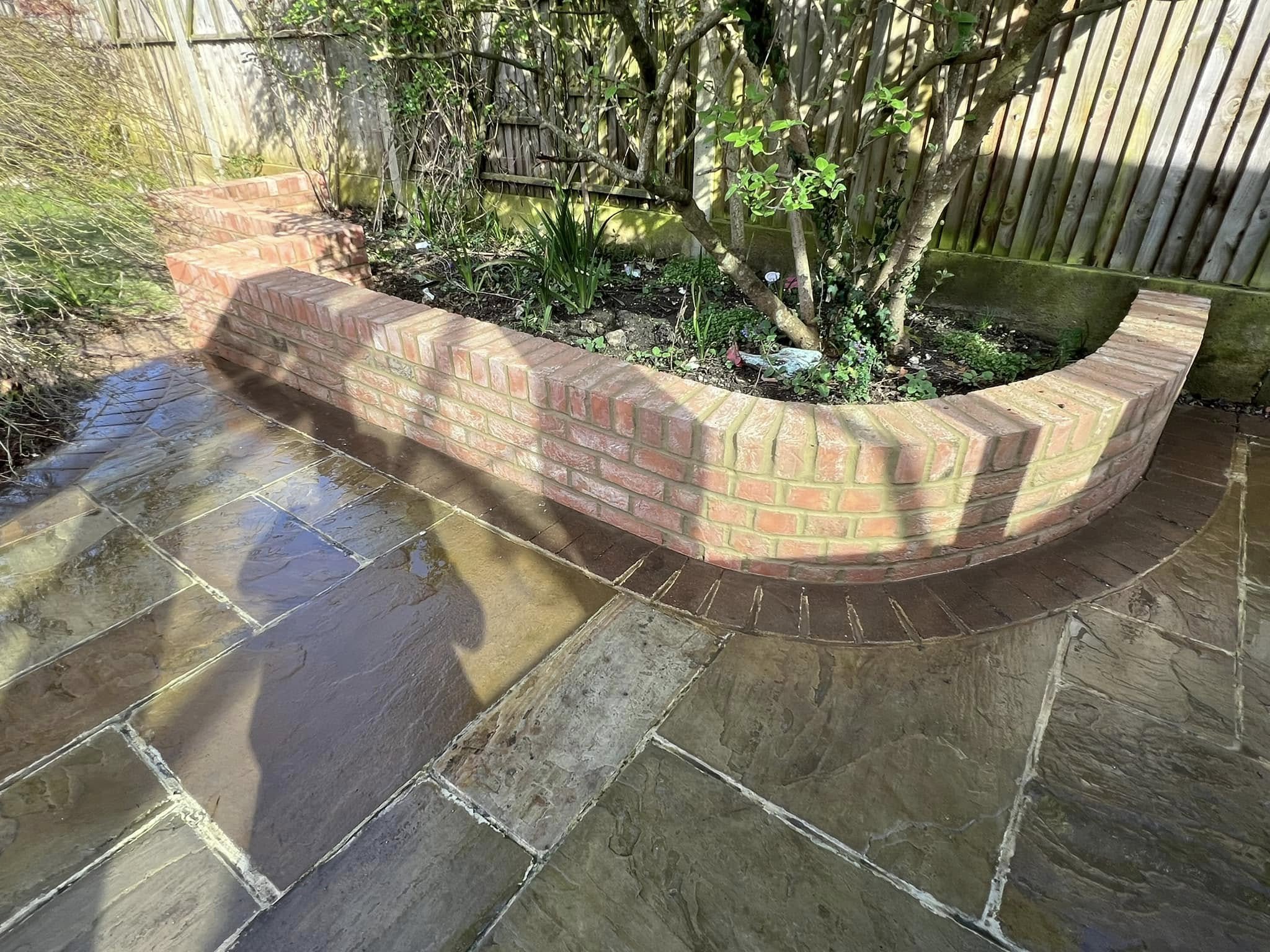
Retaining walls in Kent — complete 2026 guide to engineering, drainage, materials, clay ground conditions, building regulations and long-term performance. Free site visits.
A retaining wall is one of the most technically demanding structures in residential construction — and one of the most frequently under-engineered. It looks, from the outside, like a wall. Four courses of brick, or a stack of concrete blocks, or a line of railway sleepers at the garden edge. But a retaining wall is not a wall in the conventional sense. It is a structural element under continuous load — the passive pressure of the earth it holds back, the hydrostatic pressure of any water that builds behind it, and the surcharge loading of anything above the retained area. A wall that looks fine on the day it is built can fail catastrophically within a few years if those forces were not understood and addressed at the design stage.
This guide covers everything Kent homeowners, property developers, and anyone commissioning retaining wall construction needs to know in 2026. The structural principles that govern design. The specific drainage requirements that determine whether a wall holds or fails. The ground conditions across Kent that create the most demanding retaining wall environments. The materials available and what each delivers. The building regulations that apply and when structural engineering input is required. And the questions that reveal, in any conversation with any contractor, whether they genuinely understand what they are proposing to build.
MB Construction Group — Marshall Brickwork & Construction builds retaining walls across Kent — from garden-scale brick retaining features to structural terracing walls on sloped sites — combining the brickwork craftsmanship that is the company's core identity with the groundworks and drainage engineering that makes retaining walls work. This guide reflects fifteen years of retaining wall assessment, design, and construction across the county's varied ground conditions and site types.
What a Retaining Wall Actually Does — The Engineering Principle
Understanding why retaining walls fail is the foundation for understanding how to build them correctly.
Soil has weight. A cubic metre of typical garden soil weighs approximately 1,500 kilograms. When that soil is held at an elevated level — by a slope, a bank, or a terrace — the earth exerts horizontal pressure on any structure at the boundary between the two levels. This horizontal pressure — called active earth pressure in structural engineering — increases with the height of the retained soil and with the density and moisture content of the soil being retained.
A retaining wall must resist this horizontal pressure without tipping forward (overturning), without sliding along its base (sliding failure), without the base failing in the supporting soil beneath it (bearing failure), and without the wall material itself being overstressed (structural failure). Every retaining wall design must address all four failure modes simultaneously.
For small-scale garden retaining walls — up to 600mm of retained height on stable, well-drained ground — the engineering requirements are relatively modest and can be addressed through correct proportioning of the wall's mass and base width. For walls retaining more than 600mm of earth, or for walls on problematic ground conditions, or for walls with significant surcharge loading above the retained area (a driveway, a path, a structure), the engineering becomes more complex and structural engineering input becomes appropriate.
Kent's specific ground conditions make this engineering question more consequential than it would be on stable, free-draining ground. The London Clay that underlies most of the Medway towns, Sittingbourne and Swale, and much of mid-Kent is a high-plasticity soil that generates significant active earth pressure and — critically — holds water. Saturated clay behind a retaining wall generates both the earth pressure from the soil mass and the hydrostatic pressure from the water within it. A wall designed only for dry earth pressure and built on Kent clay that is allowed to become saturated is a wall that is working at double the load it was designed for.
Drainage: The Element That Determines Whether a Retaining Wall Lasts or Fails
This is the most important section of this guide. The majority of retaining wall failures — and retaining walls do fail regularly, in gardens across Kent every year — trace directly to inadequate drainage provision rather than to structural weakness in the wall itself.
Water behind a retaining wall does two things that progressively destroy it. The hydrostatic pressure it generates pushes horizontally against the wall face with force that increases with the depth of the water behind the wall. And the freeze-thaw cycling of water held against the wall in winter — water that freezes and expands within the soil voids, within any crack in the wall face, and within any failing mortar joint — physically breaks the wall material apart.
The Correct Drainage Approach for Kent Retaining Walls
Weep holes at the base course. The most fundamental drainage provision — holes through the wall face at its lowest course, positioned every 600–900mm along the wall length, allowing water that accumulates behind the wall to exit freely rather than building up hydrostatic pressure. Weep holes are not optional on any wall retaining more than 300mm of earth. Their absence is the single most common cause of retaining wall failure in Kent residential gardens.
Weep holes can be created by leaving a perpend joint unmortared at the base course (for brick or block walls), by inserting plastic or clay drainage inserts through the wall thickness, or by forming holes in concrete or rendered walls before the surface sets. The exit point of each weep hole must discharge freely — not into a channel drain that could back up, not onto a patio surface without a clear route to a drain.
Granular backfill directly behind the wall. Instead of placing the existing clay soil directly against the back face of the wall, a layer of free-draining granular material — clean crushed stone or angular gravel — is placed in the first 300–500mm of material behind the wall before the soil or growing medium fill begins. This granular layer collects water from the retained soil above it and channels it toward the weep holes rather than allowing it to pond against the wall.
On Kent's clay-heavy sites — where the existing soil has very low permeability and holds water for extended periods — this granular drainage layer is critical. Clay soil directly against the back face of a wall creates persistent saturation in winter and generates maximum hydrostatic pressure against the wall. Granular backfill eliminates this.
Perforated pipe at the wall base. For larger walls or sites where the volume of water moving through the retained area is significant — sloped sites that collect runoff from a wide upslope catchment area, sites with naturally high groundwater — a perforated pipe in the granular backfill layer at the wall base, connected to a suitable discharge point, provides active drainage that supplements the passive weep hole system.
Surface drainage above the wall. The ground surface above the retained area should be graded to direct surface water away from the wall rather than toward it. Water falling on an impermeable surface — a driveway, a path, a terrace — directly above a retaining wall and draining toward it concentrates the water exactly where the wall is most vulnerable. Designing the surface drainage above the wall as part of the retaining wall design — not as an afterthought — is part of the complete specification approach Marshall applies to every retaining wall project.
Types of Retaining Wall: Materials, Structure and Where Each Is Right
Brick Retaining Walls
Brick is the most contextually appropriate retaining wall material for the vast majority of Kent residential gardens — the material whose character suits the county's brick-dominated housing stock, whose craft demands reflect Marshall's core identity, and whose correctly built form is one of the most permanent and most beautiful retaining structures available.
A brick retaining wall is a gravity wall in structural terms — it relies on its own mass and the width of its base to resist the overturning moment created by the earth pressure behind it. For this reason, brick retaining walls require greater width than a purely decorative garden wall of the same height. A 450mm retained height in stable ground: a single-skin (102mm) brick wall with adequate foundation is typically sufficient. A 600–750mm retained height: a one-brick wide (215mm) wall on an adequate foundation. Above 750mm: engineering input should determine the wall thickness, tie-back requirements, and foundation specification.
The mortar specification for brick retaining walls is the same consideration as for any other brickwork application — and for period property contexts, the lime mortar requirement applies. Additionally, the back face of a retaining wall is in continuous contact with moist soil, which means the mortar on the retained face is permanently wet. This exposure condition is more aggressive than a standard external wall and should be factored into the mortar specification — a slightly richer mix that provides better water resistance on the back face, while maintaining the flexibility appropriate to the brick type.
Facing brick selection for retaining walls should consider durability as well as appearance. Engineering bricks (Class A or Class B) have the lowest water absorption of any brick type and the best frost resistance — making them the appropriate choice for the base courses of any retaining wall, where they are subject to maximum moisture exposure and to wicking from the base. Quality facing bricks with good frost resistance are appropriate for the visible upper courses.
Natural Stone Retaining Walls
Natural stone — Kent ragstone, flint, limestone, sandstone, and granite — produces retaining walls of exceptional character and appropriateness for the rural, coastal, and period property contexts where stone is the vernacular material.
Stone retaining walls are typically built as gravity walls or as dry-stone structures. Dry-stone retaining walls — built without mortar, relying on the interlocking of the stones and the slight backward lean (batter) of the wall face for stability — are traditional throughout the areas of Kent where ragstone or flint are the historic building materials. They are inherently self-draining (water passes freely through the voids between stones) and highly durable when built correctly by someone who understands the craft of dry-stone construction.
Mortared natural stone retaining walls provide greater strength and are more appropriate for walls retaining significant heights or for sites where the aesthetic of flush, finished joints is required. Mortar specification for natural stone retaining walls must account for the freeze-thaw conditions — lime mortar in most period and rural contexts, a carefully specified cement:lime:sand mix where harder, less absorbent stone is used.
Concrete Block Retaining Walls
Concrete block retaining walls — either plain concrete block rendered and finished, or purpose-made interlocking concrete retaining wall blocks — are the most cost-efficient approach for larger-scale retaining requirements where the visual context does not demand the character of brick or stone.
Interlocking concrete retaining wall systems — such as Tegula, Legato, or similar proprietary systems — use the geometry of the individual block to create a structural wall without mortar. The blocks stack with a slight backward lean (batter) that improves stability. Drainage provision through the block system is critical — most proprietary systems include drainage recommendations that should be followed.
For rendered concrete block retaining walls — block construction finished with a render coat and painted or textured — the drainage provision is more critical because the rendered face is essentially impermeable, concentrating any drainage failure at the weep holes. These walls are appropriate for contemporary garden designs and are often used as the structural base for a rendered garden wall aesthetic.
Timber and Sleeper Retaining Walls
Railway sleeper retaining walls are popular in the domestic garden market because they are accessible to confident DIYers and because their informal, naturalistic character suits cottage garden and wildlife garden contexts. They are not, however, a permanent retaining structure.
New oak or hardwood sleepers, correctly installed on concrete pads with adequate drainage behind them and through-bolted at each tier for taller walls, have a realistic lifespan of fifteen to twenty years in Kent's damp climate. At the lower end of this range, the timber at ground contact is actively rotting and the structural integrity of the wall is progressively compromised. Maintenance — preservative treatment of accessible faces — extends this, but does not eliminate the fundamental limitation.
Reclaimed railway sleepers — the heavily creosoted oak sleepers from Victorian-era railway construction — are genuinely long-lived and are still performing in gardens where they were installed thirty or forty years ago. New timber sleepers, without the deep creosote treatment that is no longer available, do not perform to the same standard.
The practical implication for Kent homeowners: timber sleeper retaining walls are an appropriate choice for garden terracing features where replacement in fifteen to twenty years is accepted as part of the cost model, and where the character and naturalistic quality of the material is the priority. They are not appropriate where permanence is the requirement.
Building Regulations and Structural Engineering: When They Apply
This is the area where homeowners most consistently receive inadequate guidance from contractors who do not fully understand the regulatory framework.
The Building Regulations Position
Retaining walls associated with residential garden terracing — walls that are not part of a building structure, are not adjacent to a highway, and are not supporting a structure — are generally not subject to Building Regulations approval requirements for walls up to approximately 1 metre in retained height on stable ground.
However, this does not mean structural engineering is unnecessary. The absence of a Building Regulations requirement is not the same as the absence of engineering requirements. A wall that is structurally inadequate for its retained height and ground conditions will fail regardless of whether Building Regulations applied to it.
When Structural Engineering Input Is Required
Walls retaining more than 600mm of earth on problematic ground (Kent clay sites): Clay's high active earth pressure and water-holding characteristics mean that walls on Medway, Sittingbourne, and mid-Kent clay sites require more conservative structural design than the same wall height on stable, free-draining ground. Structural engineering input ensures the wall thickness, foundation, and tie-back (if required) are proportioned correctly for the specific ground conditions.
Walls adjacent to structures: A retaining wall adjacent to a building foundation, below a driveway that carries vehicle loading, or below any structure whose stability depends on the retained ground must be designed with the surcharge load from that structure included in the earth pressure calculation. This is a structural engineering question, not a rule of thumb.
Walls adjacent to highways: Retaining walls adjacent to public highways, footpaths, or rights of way are subject to highway authority requirements and may require structural design sign-off. Failure of a retaining wall adjacent to a highway has public safety implications and is treated accordingly.
Walls exceeding 1 metre retained height: At this height, the engineering forces become significant enough to justify structural engineering input on most sites, regardless of ground conditions.
Marshall engages structural engineers on retaining wall projects where the retained height, surcharge loading, ground conditions, or proximity to structures makes engineering input appropriate. This is not an additional burden — it is the professional approach that protects the homeowner from building an inadequate structure and protects Marshall from carrying responsibility for a wall that was never properly designed.
Retaining Walls and Kent's Ground Conditions
The ground conditions across Kent create retaining wall environments that vary significantly by location — and experienced contractors who have worked extensively across the county understand these variations from direct experience.
Medway Towns — London Clay
Rochester, Chatham, Gillingham, Strood and the wider Medway area sit predominantly on London Clay — a high-plasticity soil with high active earth pressure characteristics and very low permeability. Retaining walls on Medway clay sites face two specific challenges that walls on other soils do not:
Clay heave. London Clay that becomes saturated — or that was previously dry and is then rewetted — can expand volumetrically, pushing against the back face of the wall from below as well as horizontally. Foundation design must account for heave potential, particularly in the first winter after construction when freshly disturbed clay adjusts to new moisture conditions.
Persistent saturation. London Clay's low permeability means water that reaches the backfill area stays there for extended periods rather than draining away. The granular drainage layer behind the wall — and the weep holes that provide its exit route — are therefore more critical on Medway clay sites than on any other ground condition in Kent.
Sittingbourne and Swale — Clay with Coastal Influence
Sittingbourne and the Swale district share the London Clay challenge of the Medway area, with the additional consideration of coastal proximity. Salt in groundwater — particularly in the lower-lying coastal areas of Swale — is mildly aggressive to mortar and concrete, and facing brick selection for retaining walls in these locations should prioritise low water absorption to resist salt-induced spalling.
West Kent — Wealden Clay and Variable Greensand
Tonbridge, Tunbridge Wells, and the surrounding High Weald present the most varied retaining wall ground conditions in Kent. The Wealden Clay of the valley floors has similar characteristics to London Clay — high active earth pressure, low permeability. The greensand ridges above the valleys are significantly more stable and free-draining. A retaining wall at the junction of these two geological formations — a common scenario on the steeply sloped gardens of the High Weald — requires assessment of both soil types and their differing drainage characteristics.
The sloped topography of west Kent creates more retaining wall briefs than any other part of the county. Gardens in Tunbridge Wells, in particular, frequently have significant level changes that require retaining structures to create usable terraced areas. The combination of Wealden Clay ground conditions, significant retained heights, and the premium residential context that demands quality construction and quality appearance makes west Kent retaining wall projects among the most technically demanding and most specification-sensitive that Marshall delivers.
Canterbury and East Kent — Chalk
The chalk geology that underlies much of the Canterbury area and east Kent provides the most favourable retaining wall ground conditions in the county. Chalk is well-draining, relatively stable, and generates lower active earth pressure than clay soils. Retaining wall specification on chalk sites can be less conservative than on clay sites, though the site-specific assessment always determines the correct approach rather than a standard formula.
Retaining Walls in Garden Design: Creating Beautiful Terraced Spaces
The technical engineering of retaining walls is the foundation — what makes them safe and permanent. The design contribution of retaining walls is what makes them valuable beyond their structural function.
Creating Level Terraces
The primary garden design application of retaining walls across Kent is the creation of level terraced areas from sloped or uneven ground. A garden that slopes away from the house at a gradient that makes it unusable — where furniture slides, where children cannot play safely, where a patio would need to be steeply ramped to connect to the lawn — is transformed by a single retaining wall that creates a level patio zone at the top and a lower level garden area below.
The design of the retained terrace — the relationship between the patio level and the house threshold, the height of the retaining wall face visible from the patio, and the material of the wall that is seen from the main outdoor living area — determines the aesthetic quality of the finished space. A brick retaining wall in facing brick matched to the house elevation, with a coped top and a planted border above, is a designed feature rather than a structural necessity. A rendered concrete block wall with weep holes and no coping reads as engineering rather than design.
The complete guide to outdoor living rooms in Kent covers how retaining walls function as room-making elements in the multi-zone garden — the structural background to the planted terraces and level transitions that give a sloped garden its character.
Integrating Retaining Walls with Patios
The junction between a retaining wall and the patio surface it retains is one of the most technically demanding details in garden construction. The patio drainage falls must direct water away from the wall rather than toward it. The patio edge must be defined cleanly against the wall face. And the level relationship between the patio surface and the top of the retaining wall must be designed from the outset — the patio and the wall designed together — rather than specified independently.
When Marshall delivers retaining wall and patio as a combined commission, these design decisions are made once, correctly, before any construction begins. The groundworks phase establishes the formation levels that make both elements work — the patio draining correctly, the wall drainage functioning correctly, and the visual relationship between them as intended.
Retaining Walls and Raised Flower Beds
Retaining walls and raised flower beds share structural principles but serve different primary functions. A retaining wall holds back a significant level change — it is a structural solution to a topographic challenge. A raised flower bed creates a contained growing environment at an elevated level — it is a garden feature that may also perform a retaining function on a gently sloped site.
Where these two elements are designed together — a raised bed that simultaneously retains the slope and provides a planted border alongside the patio — the structural engineering of the retaining function and the horticultural design of the planted function must both be addressed. The drainage from the raised bed's growing medium must exit through correctly positioned weep holes; the growing medium itself must be free-draining rather than the heavy clay that would generate maximum hydrostatic pressure against the wall; and the planting must be selected for the exposure and drainage conditions of a raised bed on a sloped site.
Steps and Level Transitions
Every retaining wall that creates a level change requires steps — the physical connection between the lower and upper levels. The design of the steps is as important as the design of the wall itself — in structural terms (the steps must be stable, non-slip, and correctly proportioned for comfortable use) and in aesthetic terms (the steps should be in materials that connect visually with both the wall and the adjacent patio surface).
Brick steps in facing brick matching the retaining wall, with a natural stone or porcelain tread that connects to the patio material — this combination produces the most coherent level transition. Steps with correctly proportioned rise (typically 150–175mm) and going (typically 280–300mm) that is comfortable to use by all members of the household, including older family members and children.
The structural detail of the step — the concrete pad or haunched concrete base that supports each step riser — is the same engineering care that the retaining wall itself requires. A step that is not adequately supported beneath will settle, crack at the riser joint, and become a trip hazard within a few years. Marshall's brickwork and groundworks expertise applies as directly to step construction as to the main retaining wall.
Retaining Wall Maintenance: Keeping a Permanent Structure Performing
A correctly built brick retaining wall requires minimal maintenance — but that minimal maintenance is important and should not be neglected.
Annual inspection: Check the face of the wall for any new cracking, any evidence of forward movement (a lean that was not previously present), any mortar joint failure, and any blockage of the weep holes. A wall that has moved — even fractionally — since the previous inspection needs professional assessment before the movement progresses.
Weep hole maintenance: Ensure weep holes remain clear. Organic material — decomposing roots, accumulated debris — can block these holes over time. Clear with a thin tool if needed. A weep hole that is not functioning is a drainage failure waiting to develop into a structural problem.
Mortar joint condition: The mortar joints on the face of the retaining wall are subject to weather exposure and biological growth in the same way as any external brickwork. Annual biocide treatment on north-facing walls with biological growth, and prompt repointing of any failed joint sections, prevents water ingress at the joint locations. The brickwork maintenance guide covers the full mortar joint inspection and maintenance programme.
Vegetation management: Plants growing in or against the mortar joints of a retaining wall can cause progressive joint damage as root systems develop. Remove vegetation from joints promptly and apply a path weedkiller to prevent re-establishment. This is particularly important for retaining walls with planting immediately above them — seeds from plants above the wall find their way into joints regularly.
Drainage above the wall: Keep the surface drainage above the retaining wall functioning correctly. A drainage channel or gully that is blocked and causing water to pond above the wall base is creating exactly the saturated conditions behind the wall that the original drainage specification was designed to prevent.
Frequently Asked Questions About Retaining Walls in Kent
Do I need planning permission to build a retaining wall in my Kent garden?
In most cases, no — garden retaining walls are permitted development. However, retaining walls adjacent to a highway are subject to height restrictions (1 metre maximum without planning permission). Walls in conservation areas may require consent if they materially alter the garden's character. Walls associated with a change in ground level that constitutes engineering operations (significant ground movement over a wide area) may require planning consideration. The complete planning permission guide covers all relevant rules.
How do I know if my existing retaining wall is failing?
The warning signs: forward lean that increases over time (sight along the top of the wall to check); horizontal or diagonal cracking in the wall face that was not previously present; mortar joints that are opening rather than simply weathering; pooling of water at the base of the wall face that indicates blocked weep holes; soil movement or slumping above the wall. Any of these signs warrants professional assessment before the failure progresses.
Can I build a retaining wall myself?
For low retaining walls — up to 300mm of retained height on stable, free-draining ground — confident DIYers can build a simple brick or block retaining wall with careful attention to drainage provision and foundation depth. For anything above 450mm of retained height, on clay ground (which includes most of Medway and Sittingbourne), or adjacent to any structure, professional construction is strongly recommended. The engineering forces involved are real and the consequences of inadequate design are expensive.
How long does a retaining wall last?
A brick retaining wall on correct foundations, with correct drainage provision, correctly built and maintained — essentially indefinitely. The wall itself does not have a service life limitation. The mortar joints need periodic attention, and the drainage provision needs maintenance to remain functional, but the structure is permanent.
Timber retaining walls: fifteen to twenty years for new timber, potentially thirty to forty years for genuinely old creosoted railway sleepers.
Concrete retaining walls: effectively permanent if correctly specified and built.
What is the most important thing to get right when building a retaining wall?
Drainage. Without exception. A wall that is structurally adequate but has no weep holes or inadequate backfill drainage will be working against increasing hydrostatic pressure through every Kent winter. The drainage provision — granular backfill, weep holes at the correct spacing, surface drainage above the wall directed away from the retained area — is what makes the difference between a wall that performs for decades and one that fails within five years.
How much soil can a single-skin brick wall retain?
A single-skin brick wall (102mm wide) on a correct strip foundation can typically retain up to 450mm of earth on stable ground. Above this height, or on clay sites, the wall needs to be wider — one-brick (215mm) or one-and-a-half brick (327mm) — to resist the increased earth pressure. The specific proportions should be verified by a structural engineer for any wall above 600mm of retained height or on problematic ground conditions.
Getting Your Retaining Wall Built in Kent
Whether you need a simple brick-faced terrace wall to create a level patio area, a substantial terracing wall to transform a steeply sloped garden, structural retaining walls as part of a home extension groundworks brief, or the assessment and repair of an existing wall that is showing signs of failure — Marshall Brickwork & Construction brings the combined brickwork expertise and groundworks engineering that retaining wall construction demands.
Every retaining wall commission begins with a site visit: ground conditions assessed, retained height and surcharge loading determined, drainage requirements understood, and the structural approach specified before any quote is produced. The written quote includes the foundation specification, the drainage provision, the wall construction approach, and the programme — nothing vague, nothing discovered on site.
Explore completed retaining wall and garden terracing projects across Kent. Read the garden walls guide for the complete specification picture for all freestanding and retaining masonry features. Browse the landscaping services guide for the full context of retaining walls within complete garden transformation projects.
Marshall covers all of Kent — Rochester and Medway, Chatham and Gillingham, Sittingbourne and Swale, Tonbridge, Tunbridge Wells and Sevenoaks, Canterbury, and the wider county — with free site visits, no travel premium, and no obligation.
Phone: 07724 730872 Email: info@mbconstruction.group Contact: mbconstruction.group/contact/
Retaining walls built to the standard that fifteen years of Kent garden construction demands — with the engineering thinking, the drainage specification, and the brickwork quality that makes the difference between a wall that performs and one that fails.
Marshall Brickwork & Construction Ltd | MB Construction Group | 14 Poplar Road, Rochester, ME2 2NR | 07724 730872 | mbconstruction.group