Outdoor living trends Kent 2026 — porcelain patios, multi-zone gardens, artificial grass, outdoor kitchens and driveways. What Kent homeowners are building this summer.
Something changed in the way Kent homeowners think about their outdoor spaces. The pandemic-era shift — the realisation that a usable, beautiful garden is not a luxury but a genuine extension of the home — has not reversed. If anything, it has deepened. The outdoor room is now a permanent feature of how people in Kent design and invest in their properties, and what they are commissioning in 2026 reflects that permanence.
This is not a guide to following trends for the sake of it. It is a practical account of what Kent homeowners are building in 2026, why those choices make sense for Kent's specific climate and housing stock, how they translate into real construction briefs, and what they look like when delivered by a contractor who understands the materials, the ground conditions, and the craft required to make them last.
MB Construction Group — Marshall Brickwork & Construction works across Kent delivering every element of the outdoor living picture — driveways, patios, landscaping, brickwork features, garden walls, fencing, extensions, and groundworks. The trends described in this guide are not theoretical — they are the briefs arriving in our consultations every week across the county.
Why 2026 Is the Year to Act on Your Outdoor Space
The outdoor construction market in Kent has specific seasonal dynamics that make 2026 — and specifically the window from now through September — the most important commissioning window of the year.
The booking season is real and it fills quickly. Quality outdoor construction contractors in Kent — the ones with genuine brickwork expertise, correct groundworks specification, and verifiable track records — fill their summer schedules between February and May. Homeowners who start the conversation in June are commissioning September and October starts. Homeowners who wait until August are booking next spring. The projects being built this summer were commissioned months ago.
Property values and the outdoor investment equation. UK estate agent data consistently shows that quality outdoor spaces add measurable value to Kent properties — particularly in the county's commuter markets where buyers are paying a premium for liveable space and appreciate any home that offers more of it. A well-specified porcelain patio with correct drainage and proper sub-base is an asset that survives a surveyor's inspection and adds to the comparable analysis of a property's market value.
The cost of waiting. Materials costs across the outdoor construction sector have been consistently upward in recent years — quality facing brick, natural stone, porcelain large-format paving, and premium artificial grass all cost more per unit than they did three years ago. Commissioning in 2026 is commissioning at today's material costs. The value of the completed project grows with property values; the cost of building it does not go backward.
Trend 1: The Porcelain Revolution — Large Format, Low Maintenance, Year-Round
No single material has changed the Kent patio market more dramatically than large-format porcelain, and in 2026 it is the dominant choice across the county's premium residential sector.
The reasons are practical, not merely aesthetic. Porcelain's near-zero porosity eliminates the biological growth, staining, and freeze-thaw damage that Kent's wet winters inflict on porous natural stone. The large-format slabs — 900x600mm, 1200x600mm, and larger — create a clean, refined surface that reads as genuinely contemporary and connects visually with the large-format tiles increasingly specified for interior floors. When bi-fold or sliding doors open between the kitchen and the garden, the visual continuity between inside and outside — the same tile running through — creates the indoor-outdoor blur that 2026 outdoor design consistently pursues.
The specific finishes gaining the most traction across Kent in 2026: concrete-effect porcelain in light grey and off-white tones for contemporary new build gardens; stone-effect porcelain in warm buff and sandstone colours for period property gardens where the manufactured precision of a smooth concrete effect would feel incongruous; and dark charcoal and anthracite finishes for gardens where drama and contrast with pale rendered walls is the design intent.
What is also changing is where porcelain is being specified. Five years ago it was primarily for rear garden patios. Now the largest growth in porcelain specification across Kent is for driveways — front-of-house approaches where the impact on kerb appeal is immediate and the low-maintenance argument is compelling for homeowners who do not want to seal or treat their driveway annually.
For everything on porcelain performance, specification, and how it compares to natural stone, the complete porcelain vs Indian sandstone guide covers every variable in depth.
Trend 2: Indian Sandstone — The Natural Stone Revival
Against the backdrop of porcelain's dominance, Indian sandstone is experiencing a renaissance — and for reasons that make sense for Kent's specific housing character.
The county's housing stock is predominantly Victorian and Edwardian brick. The warm, varied palette of Indian sandstone — the ochres, silvers, greens, and rusts of Kandla Grey, Raj Green, Fossil Mint, and Autumn Brown — sits in natural relationship with period brick in a way that no manufactured material fully replicates. As Kent homeowners become more attuned to the material character of their period properties, the contextual appropriateness of natural stone is becoming a conscious design choice rather than a default.
The specific shift in how sandstone is being specified in 2026 is toward larger formats and calibrated thickness. The tumbled, irregular-edge sandstone of the early 2000s — laid in mixed sizes with wide mortar joints — is giving way to sawn-edge, calibrated sandstone in consistent large formats that read as considered and precise while retaining the organic colour variation that makes natural stone irreplaceable. Paired with fine, colour-matched pointing and clean edge detail, this contemporary approach to sandstone produces results that are simultaneously period-appropriate and 2026-current.
The complete guide to Indian sandstone and natural stone patios and driveways covers specification, sealing, maintenance, and the specific considerations for Kent's climate.
Trend 3: The Multi-Zone Garden — Designing for How You Actually Live
The most significant conceptual shift in Kent garden design in 2026 is the movement away from the single-use outdoor space toward the multi-zone garden — a design approach that creates distinct areas for different activities within a single coherent design.
A typical multi-zone brief in Kent in 2026 looks something like this: a main patio zone directly outside the back door, where the primary outdoor dining and socialising happens; a secondary lounging zone further into the garden, perhaps more sheltered or at a different level, where evening relaxation and quieter use happens; a lawn or artificial grass zone for children or dogs; a kitchen garden or planting zone at the rear boundary; and the paths and transitions that connect all of these elements into a legible whole.
This approach requires more planning upfront — the levels, the drainage, the structural elements that create the transitions between zones, and the materials that carry coherently through different areas of the garden — but it produces a result that is used more intensively and valued more highly than the simple rectangular patio-plus-lawn arrangement that it replaces.
The structural brickwork elements — the retaining walls that create level changes between zones, the raised planters that frame the kitchen garden area, the garden walls that define boundaries between different zones — are where Marshall's craft brickwork expertise is most directly relevant to 2026's most popular garden design approach. These are structural elements that must be built to brickwork standards to perform over the decades the garden will be used.
Trend 4: Artificial Grass — Now Premium, Always Practical
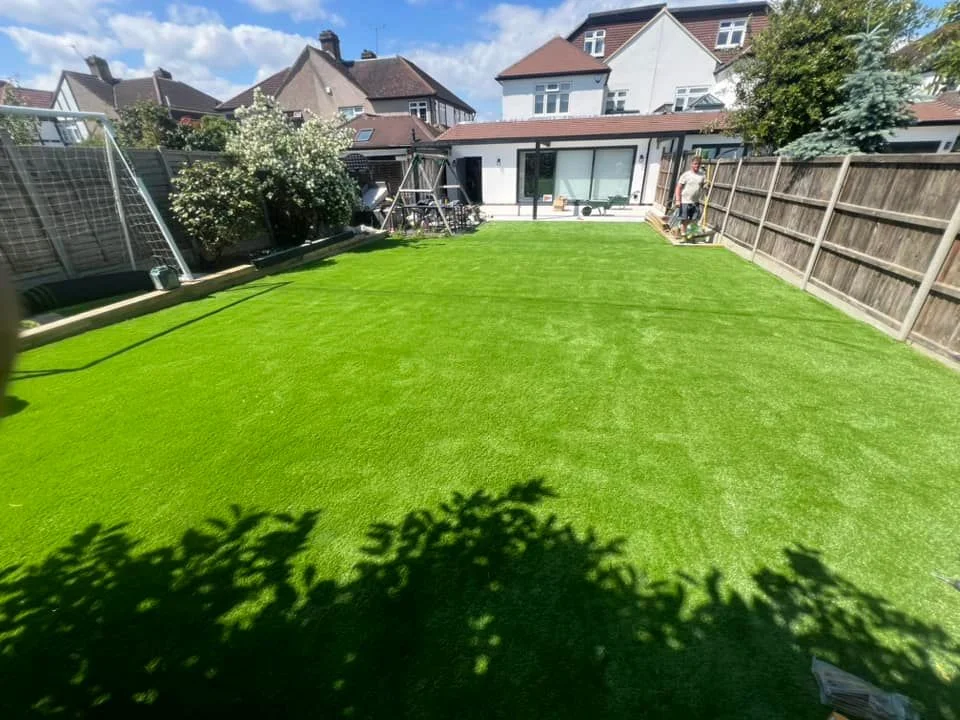
Artificial grass has completed its transition from compromise choice to confident design statement. The product has improved dramatically — premium 2026 specification artificial grass with correct pile height, realistic thatch layers, UV-stable fibres, and adequate drainage backing is genuinely difficult to distinguish from a well-maintained natural lawn at normal viewing distances. And its practical advantages in Kent's climate — year-round usability regardless of rain, no mud in wet winters, no mowing programme, consistent appearance regardless of sun or shade — make the maintenance argument increasingly compelling.
What has changed most in 2026 is the design context in which artificial grass is appearing. It is no longer primarily a children's garden choice. It is increasingly the garden floor of sophisticated multi-zone outdoor spaces where the lawn area is designed to contrast with adjacent hard surfaces and planting areas as a considered design element — not a default.
The combination that is appearing most frequently in Marshall's Kent project portfolio in 2026: large-format porcelain patio transitioning to premium artificial grass, framed by raised brick planting beds along the boundaries and closeboard fencing in a matching contemporary colour. Every element contributing to a coherent, low-maintenance outdoor environment that looks as good in November as in July.
The correct installation of artificial grass — geotextile membrane, compacted aggregate base to the correct depth for Kent's clay ground conditions, properly draped and fixed — is where most artificial grass failures begin and end. The complete artificial grass installation guide covers everything the specification and installation involves.
Trend 5: The Driveway as Design Feature
The front approach to a Kent property has never been more important as a design consideration. The combination of rising property values, the importance of kerb appeal in a competitive sales market, and the growing awareness that a quality driveway is a visible, lasting statement about a property's overall standard — all of these have elevated driveway specification from a practical decision to a design one.
In 2026, the most significant shift is toward driveways that are designed rather than simply installed. This means:
Material choices that reference the property's character. A Victorian terrace in Rochester with warm red stock brick is not best served by a pale concrete block paving driveway that creates a colour and texture mismatch with the building. Natural stone — Indian sandstone or granite setts — in warm tones complements the brick. Resin bound gravel in a warm amber aggregate creates a contemporary surface that sits respectfully alongside the period character.
Border and feature detail. A tarmac driveway with a granite sett border and brick pillar detailing looks designed. The same tarmac without the border looks utilitarian. The border costs a fraction of the total project value and transforms the visual impact entirely.
The front-of-house composition. The driveway does not exist in isolation — it is part of a composition that includes the boundary wall, the gate, the front garden planting, the path to the front door, and the entrance step. Commissioning all of these elements as a single coordinated project — rather than the driveway from one contractor and the pillar from another — produces a result where every element is designed to work with every other.
For the full picture on block paving versus resin bound, the complete driveway construction guide covers every surface type in technical depth.
Trend 6: The Outdoor Kitchen and Dining Zone
The outdoor kitchen is 2026's most aspirational garden feature — and, when built correctly, one of the most practical. The shift from the standalone BBQ on a plain patio to a dedicated, weather-resistant outdoor cooking and dining zone has been gradual, but the scale of demand in Kent's premium residential market is now significant.
In practical terms, an outdoor kitchen in a Kent garden involves construction elements that draw directly on brickwork and hard landscaping expertise:
The structural base. Outdoor kitchen units are typically built on a concrete or block-built base — a structural element that must be level, durable, and properly drained. This is brickwork and groundworks work, not kitchen fitting. The base specification determines whether the finished kitchen looks permanent and considered or temporary and improvised.
The patio surface beneath it. The outdoor kitchen zone requires a hard, level, well-drained surface beneath it — typically an extension of, or integrated with, the main patio surface. The drainage from an outdoor kitchen zone — where water from cooking, cleaning, and rainfall needs to move away from the structure — requires careful design, not assumption.
The brickwork surround. For built-in BBQ and pizza oven installations, the structural surround — the brick or stone-built housing that frames the appliance — is brickwork. Done well, in facing brick matched to the garden wall brick or the house brick, it looks permanent and purposeful. Done poorly, it looks like an afterthought.
Integration with the wider garden design. The outdoor kitchen zone works best when it is designed as part of the multi-zone garden layout from the outset — not retrofitted to a completed patio. Level, drainage, power supply, and orientation toward the dining area and toward the house all need to be considered in the design before the first groundwork is done.
Marshall's landscaping services cover the construction elements of outdoor kitchen zones across Kent — the groundworks, the brickwork base and surround, the patio surface, and the drainage integration that makes an outdoor kitchen genuinely functional.
Trend 7: The Extension-Garden Connection
One of the most powerful transformations available to a Kent homeowner is the combination of a rear kitchen extension with a new patio that connects visually and physically to the extended space. The bi-fold or sliding doors that are now standard on single-storey rear kitchen extensions create an architectural opportunity — the junction between inside and outside — that a correctly specified patio exploits to maximum effect.
When the interior floor tile continues as the exterior patio surface — the same large-format porcelain running through the bi-fold doors — the living space effectively doubles. The perception of size is dramatically altered. The kitchen no longer stops at the back wall; it extends into the garden.
This integration requires coordination between the extension design and the patio specification that is most naturally achieved when both are commissioned through the same contractor, or when both are designed simultaneously with the level relationship between interior floor, threshold, and exterior patio level explicitly managed.
The threshold detail — how the extension floor connects to the patio surface across the bi-fold door threshold — is the most technically demanding junction in this type of project. The finished patio level must be below the DPC level of the extension wall, must be below the finished interior floor level to prevent water ingress, and must step down or transition in a way that is both weather-resistant and visually resolved. Getting this detail right is the difference between a seamless indoor-outdoor connection and a junction that leaks.
Trend 8: Fencing That Frames Rather Than Just Enclosing
Garden fencing in 2026 has moved from pure utility toward considered design. The closeboard panels that have defined Kent rear garden boundaries for decades remain the most popular choice — and rightly so, for their structural performance and their privacy delivery — but how they are finished and what surrounds them has become significantly more considered.
The shifts happening in Kent fencing specification in 2026:
Colour. Dark grey, anthracite, and near-black fence colours are replacing the natural brown of pressure-treated timber as the dominant choice in contemporary gardens. The dark colour recedes visually, making the garden feel larger and allowing planting to read against it with more impact.
Horizontal slatted fencing continues to grow as an alternative to vertical closeboard for gardens where contemporary design is the intent. The horizontal lines read as modern and architectural, and the deliberate gaps between slats allow wind through rather than catching it — a genuine structural advantage in exposed Kent gardens.
The fence as background. The best fencing installations in 2026 treat the fence not as the endpoint of the garden design but as the background for it — the canvas against which planting, raised beds, and garden furniture read. A fence that is correctly designed and installed to last twenty years provides that background reliably. The complete fencing guide covers specification, planning rules, and installation in full.
Trend 9: The Low-Maintenance Garden — Designed for Real Life
The most consistent theme across 2026 garden consultations across Kent is the desire for a beautiful outdoor space that does not generate a demanding maintenance programme. Families with young children, time-poor commuters, older homeowners for whom intensive garden maintenance is becoming difficult, property investors who need outdoor spaces that stay presentable without management — all of them are asking the same thing: make it look good without making it hard work.
The low-maintenance garden in 2026 is not a compromise. It is a design philosophy that selects materials, surfaces, and planting for performance over time rather than appearance on day one:
Porcelain rather than sandstone for the patio — the maintenance equation for porcelain is genuinely close to zero, where sandstone requires sealing every two to three years and biocide treatment annually.
Artificial grass rather than natural lawn for the main garden area — the maintenance-free outdoor floor that stays green and usable year-round without mowing, feeding, or managing.
Structural planting rather than high-maintenance perennial beds — evergreen shrubs, ornamental grasses, and architectural plants that look considered in every season without requiring the intensive seasonal attention that a traditional herbaceous border demands.
Resin bound rather than block paving for the driveway — no moss treatment, no jointing sand replacement, no annual sealing. A hose and a sweep twice a year.
Concrete posts rather than timber for fencing — the post that never rots, never leans, and never needs replacing, at a modest additional cost over timber that is recovered multiple times over the fence's service life.
Each of these choices is covered in depth across the specific service guides on this site — patio maintenance, driveway maintenance, and brickwork maintenance — for homeowners who want to understand the realistic ongoing commitment of each choice before commissioning.
Trend 10: The Complete Outdoor Project — One Contractor, One Vision
The trend that Marshall most directly represents in the 2026 Kent construction market is the complete outdoor project — a single commission that covers every element of the outdoor environment, delivered by one team with one design vision, rather than a sequence of separate specialist commissions that never quite add up to a coherent whole.
The driveway, the front boundary wall, the front garden planting. The rear patio, the raised beds, the artificial grass, the fencing. The extension brickwork matched to the garden wall. The steps that connect the patio to the lower garden level, built in matching brick to the raised planters that frame them.
When all of these elements are specified and built together — with consistent materials, coordinated levels, shared drainage design, and a programme sequenced to avoid the damage to finished work that separate commissions inevitably create — the result is a garden that was designed, not assembled.
This is what Marshall's complete outdoor construction capability delivers across Kent. Not a driveway company that also does patios. Not a landscaping company that also does fencing. A construction team whose identity is brickwork — the most demanding craft skill in outdoor construction — that also has the full range of outdoor construction capability that the complete project requires.
Where to Start: Turning 2026 Inspiration Into a Real Project
The gap between inspiration and commission is where most outdoor projects stall. The brief is not clear enough. The budget is not defined. The planning position is not understood. The contractor has not been identified. And another season passes without the transformation happening.
Here is the practical starting point for any 2026 outdoor project in Kent:
Define the outcome, not the specification. "I want a garden where we can eat outside from March to October, where the children can play safely year-round, and that requires less maintenance than what we have now" is more useful as a starting brief than a list of materials. The contractor's job is to translate that outcome into a specification — including the planning considerations, as the complete planning permission guide covers for every project type.
Browse completed work. The Marshall projects gallery shows completed outdoor transformations across Kent — driveways, patios, landscaping, brickwork, fencing, extensions. The gallery is the most direct evidence of what the team delivers and how the finished work looks in Kent's residential context.
Book a free site visit. The conversation that happens on site — where the specific ground conditions, the drainage characteristics, the planning context, and the practical constraints of the project can all be assessed honestly — is the foundation for a quote that is specific, realistic, and accurate.
Marshall covers all of Kent — Rochester and Medway, Maidstone, Sittingbourne, Canterbury, Tonbridge, Tunbridge Wells and Sevenoaks, and beyond — with free site visits, no travel surcharge, and no obligation.
Phone: 07724 730872 Email: info@mbconstruction.group Contact: mbconstruction.group/contact/
2026 is the year. The outdoor space you have been thinking about commissioning — patio, driveway, garden transformation, extension — is the project that will change how you use your home for the next twenty years. Start the conversation now and have it built before summer is over.
Marshall Brickwork & Construction Ltd | MB Construction Group | 14 Poplar Road, Rochester, ME2 2NR | 07724 730872 | mbconstruction.group