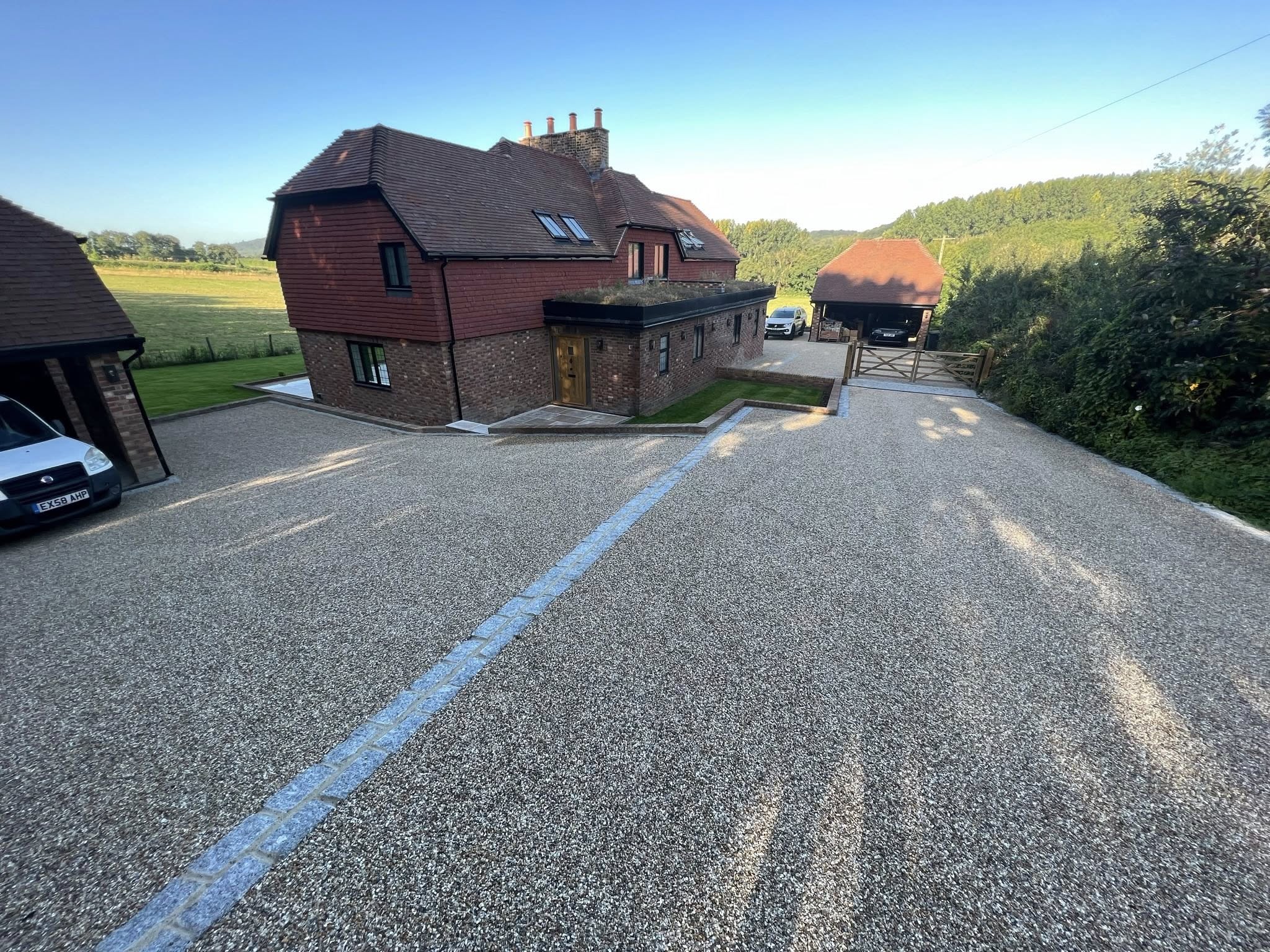
Resin bound driveways in Kent — every question answered before you commission. Sub-base specification, UV-stable resin, Kent clay conditions, common failures and free visits.
Resin bound driveways generate more homeowner questions than almost any other outdoor construction product. Not because the product is complicated — it is not. But because the gap between a correctly installed resin bound driveway and a poorly installed one is enormous, the failures are highly visible, the industry is largely unregulated, and the questions that matter most are the ones most homeowners do not know to ask until after something has gone wrong.
This guide is the answer to all of them. Every question a Kent homeowner should ask before commissioning a resin bound driveway, every answer that reveals whether a contractor knows what they are doing, every warning sign that something is being built incorrectly, and every specification detail that determines whether a resin bound driveway in Kent looks beautiful and performs correctly for twenty years — or starts disappointing within two.
MB Construction Group — Marshall Brickwork & Construction installs resin bound driveways across Kent as part of a full driveway service that covers every major surface type. This guide reflects the installation knowledge and the assessment experience — including the assessment of resin bound installations that have failed — that fifteen years of driveway work across the county provides.
What Resin Bound Is — And What It Is Not
What exactly is a resin bound driveway?
Resin bound is a mixture of natural aggregate and UV-stable polyurethane resin, combined in a forced action mixer and laid as a smooth, permeable surface of consistent depth — typically 15–18mm. The aggregate is fully encapsulated within the resin matrix. The result is a surface that is smooth to walk and drive on, fully permeable (water passes through into the sub-base beneath), and — when correctly specified — very low maintenance.
The critical word is correctly. Performance depends entirely on correct installation and structural preparation. More than any other driveway surface, resin bound is a product where the installation quality determines the outcome. The material itself is reliable. The installation is where the variation — and the failure — occurs.
What is the difference between resin bound and resin bonded?
There are two main types of driveway that contain resin — resin bound and resin bonded. They can look similar in photos but the build and performance are different.
Resin bound: the resin and aggregate are mixed together before laying. Every stone is fully coated with resin within the matrix. The result is a smooth, structural, permeable surface.
Resin bonded: resin adhesive is applied to an existing surface, and loose aggregate is scattered and pressed onto it. The result is a textured surface dressing — not structural, not permeable, and subject to aggregate loss over time.
Every reference to resin driveways in this guide means resin bound. Before accepting any quote for a resin driveway, confirm in writing that the contractor means resin bound — not resin bonded applied over the existing surface.
Is resin bound or block paving better for a Kent driveway?
Neither is universally better — each has genuine advantages for specific situations. The detailed comparison between the two is covered in the complete block paving vs resin bound guide.
The key differences: resin bound is inherently permeable (no drainage engineering needed for planning compliance), requires less ongoing maintenance than block paving (no jointing sand, no moss treatment), and has a cleaner contemporary aesthetic. Block paving is more tolerant of sub-base movement (individual units flex rather than cracking), can be lifted and relaid for service access without visible evidence, and offers more design variety in pattern and colour.
For Kent properties on London Clay — where seasonal ground movement is a genuine specification consideration — block paving's flexibility advantage is meaningful. For front garden planning compliance, resin bound's permeability is the simplest solution. For contemporary design contexts where the smooth aggregate aesthetic is the priority, resin bound is the natural choice.
The Installation Questions That Reveal Everything
These are the questions that separate contractors who understand resin bound from those who do not. Ask all of them before accepting any quote.
What base are you installing onto, and how are you preparing it?
This is the most important question. Cracking is almost always a sub-base issue rather than a surface failure. If the base beneath the resin is weak, poorly compacted, or uneven, the top layer will inevitably reflect that movement.
There are two legitimate base approaches for resin bound installation in Kent:
New construction base: Excavate the existing surface, install geotextile membrane, compact Type 1 MOT hardcore sub-base to the correct depth for the ground conditions, then apply a 40–50mm layer of porous macadam or open-graded asphalt as the immediate substrate for the resin. This is the correct approach for new installations on Kent clay sites — the Medway towns, Sittingbourne and Swale, and mid-Kent where London Clay is the dominant ground condition.
Overlay installation: Applying resin bound over an existing concrete or tarmac base that is structurally sound. Faster and less disruptive than full excavation, but only appropriate where the existing surface has no cracking, no sub-base failure, adequate drainage falls, and sufficient structural integrity to support the new surface without differential movement.
A contractor who proposes to overlay an existing cracked or failing surface — on the basis that the resin will cover the cracks — is proposing work that will fail. Installing resin over unstable soil or an old driveway without a structural assessment increases risk. The resin surface will reflect any movement in the substrate beneath it, and cracks will reappear at the same locations within a season.
What sub-base depth are you specifying for this Kent site?
For resin bound on new construction bases across Kent's clay-bearing sites — Rochester and Medway, Chatham and Gillingham, Sittingbourne — the minimum sub-base depth of compacted Type 1 MOT limestone hardcore is 150mm. On sites with high clay activity near established trees, or on low-lying ground with elevated groundwater, 200mm is the conservative and correct specification.
Resin bound is a rigid surface — unlike block paving, which has individual units that can accommodate minor sub-base movement by shifting fractionally relative to each other, resin bound transfers any sub-base movement directly to the surface as stress. On Kent clay, this makes sub-base depth the most critical specification variable in the entire project. A contractor who specifies 100mm on Medway clay is specifying inadequately.
The complete groundworks guide covers the Kent clay ground conditions and their implications for sub-base specification in depth.
What resin product are you using, and is it UV-stable?
High-quality resin bound services ensure durability by using UV-stable resin and strong sub-bases. This is non-negotiable. Non-UV-stable resins yellow and degrade under sunlight exposure — and Kent's south-eastern position delivers more annual sunshine hours than most of the UK. A resin bound driveway installed with a non-UV-stable resin will show colour change within two to three summers. The degradation is irreversible.
Ask for the resin product by manufacturer name and product reference. A contractor who cannot or will not specify this is either using an unbranded product or unwilling to be held to a quality commitment. Walk away.
What mixing equipment are you using?
Correct mixing equipment and ratios are essential to get a consistent finish and reliable performance. Consistent mixing is one of the biggest quality drivers in resin bound installation.
The correct equipment is a forced action mixer — a machine that positively agitates the resin and aggregate mixture to ensure every stone is fully coated before laying. Hand mixing of resin bound aggregate is not acceptable for any quality installation. It produces inconsistently coated aggregate, weak spots in the matrix, and premature aggregate shedding.
If the resin doesn't fully coat the stones, they will eventually come loose under pressure. Ask specifically whether a forced action mixer is being used. A contractor mixing in a standard drum mixer or by hand is not following correct installation practice.
What weather conditions will you install in, and what happens if the forecast changes?
Resin bound has specific installation weather requirements: minimum ambient temperature of 5°C and rising, dry conditions during laying and throughout the curing period. If the driveway is installed in damp or cold conditions, the resin may not cure properly, weakening the bond.
A contractor who is unconcerned about weather conditions — who proposes to install in marginal conditions rather than rescheduling — is prioritising their programme over the quality of your driveway. The cost of a failed installation from incorrect curing conditions far exceeds the inconvenience of rescheduling.
The Kent-Specific Questions
How does Kent's clay soil affect resin bound driveway installation?
More than any other single factor. Resin bound is rigid — it has very low tolerance for sub-base movement. London Clay, which underlies most of the Medway towns, much of Sittingbourne, and significant parts of mid-Kent, is a high-plasticity soil that expands in wet winters and contracts in dry summers. This seasonal volumetric change is the most aggressive ground condition for any rigid surface in the county.
On chalk-based ground — parts of the Sevenoaks and Tunbridge Wells area, parts of Canterbury and east Kent — the ground conditions are more stable and resin bound performs without the same level of conservative sub-base specification required on clay.
Marshall's site assessment on every resin bound project determines which ground conditions are present and adjusts the specification accordingly. This is not a standard formula — it is a site-specific engineering decision.
Does resin bound need planning permission for a Kent front driveway?
No — this is one of resin bound's most practical planning advantages. The 2008 regulations governing front garden hard surfacing require that impermeable surfaces over 5m² must incorporate drainage provision or use a permeable surface. Resin bound is inherently permeable — water passes through the surface and into the sub-base — making it fully compliant without separate drainage engineering.
This contrasts with tarmac and standard block paving, which are impermeable and require either drainage provision or a planning application for front garden installations over 5m². For many Kent homeowners, resin bound's permeability is the simplest route to planning compliance.
The complete planning permission guide for Kent covers all driveway planning rules in detail including conservation area implications.
How does resin bound perform in Kent winters?
Well — when correctly installed. The non-porous resin surface does not absorb water, so freeze-thaw damage through water penetrating the surface and freezing does not occur. This is a genuine advantage over porous natural stone surfaces where freeze-thaw cycling is a significant degradation mechanism.
The vulnerability is the sub-base and the joints at edges and drainage features. A sub-base that has been inadequately specified for Kent clay conditions may experience movement in severe winter conditions that cracks the surface above it. Edge joints where the resin meets adjacent kerbing or channel drains are the most likely points of early failure — typically from thermal movement at the junction rather than from frost damage to the resin itself.
Can resin bound be installed on a sloped driveway in Kent?
Yes, but slopes require specific consideration. Slopes require careful consideration of grip, drainage, and detailing at edges. The aggregate selection matters on slopes — larger aggregate (3–6mm rather than 1–3mm) provides better grip on gradients. The drainage design must prevent surface water from channelling at the edges rather than dispersing across the surface. And the edge detailing at the bottom of the slope must accommodate any concentration of surface water that the gradient creates.
For very steep gradients — above approximately 1 in 8 — resin bound becomes impractical and alternative surfaces should be considered.
Common Resin Bound Problems in Kent — And How to Avoid Them
Understanding the failure modes of resin bound driveways helps Kent homeowners identify whether a quote is specifying correctly — and helps assess an existing installation that is showing problems.
Cracking
Cracking is almost always a sub-base issue rather than a surface failure. A crack in a resin bound surface traces to one of three causes: inadequate sub-base depth for the ground conditions (the most common cause on Kent clay sites), installation over an existing surface that has cracked (the crack reflects through the new layer), or a cold joint where two pours of resin met without adequate blending (visible as a straight line across the surface).
All three causes are installation failures, not product failures. A crack in a resin bound surface that is properly installed on a correctly specified sub-base does not occur under normal residential loading conditions.
Aggregate Loss
Individual stones coming loose from the resin matrix — particularly at high-traffic areas and at edges — indicates one of two problems. Incorrect mixing ratios (too little resin relative to aggregate, leaving stones inadequately coated) or installation in unsuitable conditions (rain or temperature below the minimum causing incomplete curing of the resin bond).
In many resin bound driveways, this issue occurs due to rushed installation or lack of expertise. Aggregate loss is a quality failure that reflects the installation approach rather than the product itself.
Yellowing or Colour Change
UV degradation of the resin binder produces progressive yellowing or browning of the resin matrix — typically visible first in the lightest aggregate colours, where the colour change of the resin is most apparent against the pale stone. This is entirely caused by non-UV-stable resin specification. Premium UV-stable resins from established manufacturers do not yellow under Kent's UV conditions within their warranted service life.
If a resin bound driveway is yellowing within three years, the installation used an inadequate resin product. There is no maintenance remedy — the surface needs replacement with correctly specified material.
Drainage Failure
A resin bound surface that pools water rather than draining through it has a blocked or inadequate sub-base beneath it. The most common cause: the sub-base was too fine or too compacted to allow water to pass through at adequate rate. The porous macadam or open-graded asphalt layer that should sit immediately beneath the resin — providing a freely draining surface for the water that passes through the resin to flow across — was either specified incorrectly or omitted.
If the base layer is not permeable, water cannot drain through the surface. This leads to pooling or puddles, defeating the purpose of resin systems.
Aggregate Selection: Making the Right Choice for Your Kent Property
The aggregate in a resin bound driveway is the element the homeowner sees and lives with every day. Getting it right for the specific property and context matters.
What aggregates work best in Kent?
Natural quartz and quartzite aggregates — available in pale champagne, warm gold, silver grey, and deep charcoal — are the most popular choices across Kent's residential market. They are hard, UV-stable (the aggregate colour does not change), and available in a range of sizes that suit different traffic levels.
For Kent's period properties — the Victorian and Edwardian brick of Rochester, Sittingbourne, and Canterbury — warm amber and honey-toned aggregates sit more comfortably alongside the warm brick palette than cool grey options. For contemporary new builds and rendered properties, cool grey and graphite aggregates create the clean, minimal aesthetic that contemporary design demands.
For coastal-exposed positions in Swale — where the aggregate will be subject to salt air — natural quartz aggregates with high silica content are the most resistant to surface dulling from salt deposition over time.
What aggregate size should I choose?
1–3mm aggregate: the finest available, producing the smoothest, most refined surface finish. Best suited to lightly trafficked areas and positions where the highest-quality appearance is the priority. Slightly lower grip on gradients.
3–6mm aggregate: the most popular size for residential driveways across Kent. Good balance of appearance and grip. Suitable for all standard residential traffic including regular vehicle use.
6–10mm aggregate: the most robust option, with excellent grip and durability under heavy traffic. The surface texture is more pronounced — less refined than smaller aggregates, but more functional for areas with high use or gradient.
How Resin Bound Integrates with the Complete Driveway and Garden Design
Can resin bound work alongside block paving on the same driveway?
Yes — and the combination is one of the most effective design approaches available for Kent front gardens. A block paving border or threshold in matching or complementary colours frames the resin bound field — giving the driveway defined edges, breaking up what might otherwise be a uniform aggregate surface, and providing a design feature at the key arrival points (the entrance and the garage threshold).
This combination is covered in the block paving vs resin bound comparison guide alongside the full performance comparison.
How does resin bound connect to a natural stone or porcelain patio?
The driveway-to-patio connection — from the front resin bound approach, through the gate, to the rear garden patio surface — is the visual journey that determines the overall character of a property's outdoor spaces. Coordinating the aggregate colour of the resin bound driveway with the colour palette of the patio surface creates a coherent material language across the property.
Warm amber resin bound alongside Indian sandstone patio: the warmth of both materials creates continuity across front and rear. Silver grey resin bound alongside grey large-format porcelain: the cool, contemporary palette is consistent throughout. These connections are most easily designed when the driveway and patio are commissioned together — one team, one material specification, one design vision.
What about the front garden area around the driveway?
A resin bound driveway covering the full front garden area is planning-compliant (permeable surface, no drainage engineering required) and practical. A front garden that retains some planting alongside the driveway — a planted border at the boundary, a tree pit within the driveway area — is more visually rich and more contextually appropriate for most Kent residential streets.
Raised planted borders in brick alongside a resin bound driveway create a front garden composition that has both the practical benefits of hard surfacing and the character of planting. The resin bound surface can be laid around brick raised bed features with clean junctions — a detail that requires careful installation but produces excellent results.
Maintenance: What a Resin Bound Driveway in Kent Actually Needs
How do I maintain a resin bound driveway?
The maintenance requirements are genuinely minimal — one of the genuine advantages of resin bound over other surface types. A complete annual maintenance programme for a typical Kent resin bound driveway involves:
Sweeping regularly to remove leaf litter and organic debris. Organic material sitting on the surface for extended periods can cause surface staining — not penetration of the resin matrix, but surface discolouration that is harder to remove the longer it remains. Autumn leaf fall in Kent gardens requires particular attention.
Occasional washing with a hose or low-pressure wash. A garden hose with good pressure is sufficient for routine cleaning. A medium-pressure washer (below 1,500 PSI) for more thorough periodic cleaning. High-pressure washing is not recommended — it can dislodge aggregate from the surface edges where the resin matrix is thinnest.
Checking the perimeter edge annually. The junction between the resin bound surface and adjacent kerbing, channel drains, or boundary walls is the most vulnerable point. Any lifting or separation at the edge should be addressed promptly.
What should not be done to a resin bound driveway?
No solvents or acid-based cleaning products — these attack the resin binder. No high-pressure rotary or turbo washing heads — the concentrated impact can dislodge surface aggregate. No resurfacing or sealing products applied to the surface — resin bound does not need sealing and topical treatments can affect the surface character and drainage performance.
Does resin bound fade over time?
Quality UV-stable resin bound does not fade — the aggregate colour is inherent to the stone and is UV-stable. The resin matrix colour is consistent because it is manufactured to UV-stable specification. The natural weathering of a quality resin bound surface over time produces a slight greying — the same patination that affects most outdoor surfaces — rather than any colour loss or yellowing.
The maintenance guide for all driveway surfaces, including the seasonal care programme for resin bound, is covered in the complete driveway maintenance guide for Kent.
Resin Bound Across Kent: Location by Location
Resin Bound in Medway — Rochester, Chatham, Gillingham, Strood
The London Clay sub-base specification is the dominant consideration across the Medway area. New construction base with minimum 150mm compacted Type 1 MOT is the standard for most Medway residential sites. The period housing stock of Rochester in particular responds well to warm amber or honey aggregate that complements the warm brick character of the Victorian and Edwardian elevations.
Resin Bound in Sittingbourne and Swale
The same clay specification applies as in Medway, with the additional coastal exposure consideration for sites in the more exposed Swale positions. Quartz aggregate with high silica content is the most resistant choice for coastal-adjacent locations. The Sittingbourne market shows strong demand for resin bound as a planning-compliant front garden solution on the area's predominantly suburban housing stock.
Resin Bound in Tonbridge, Tunbridge Wells and Sevenoaks
The premium residential character of west Kent drives demand for the highest specification resin bound products — premium aggregate blends, the most refined surface finishes, and the complete front garden design approach that combines resin bound with natural stone threshold features and brick entrance pillars. The west Kent guide covers the area's specific character and construction context.
Resin Bound in Canterbury and East Kent
The chalk geology of much of the Canterbury area provides the most favourable ground conditions for resin bound in Kent — stable, free-draining, with good natural drainage that complements resin bound's permeability. Conservation area implications in Canterbury's designated zones affect material choice and approach for some properties — Marshall advises on these as part of every site consultation in the Canterbury area.
The Quote Evaluation Checklist
Before accepting any resin bound driveway quote in Kent, confirm in writing that every item below is addressed. A quote that does not address all of them has not thought about all of them.
Base specification: New construction base or overlay? If overlay, what assessment of the existing surface has been carried out? If new construction, what depth of Type 1 MOT hardcore is specified? What is the immediate substrate specification (porous macadam or open-graded asphalt)?
Resin product: Manufacturer name and product reference. UV stability confirmed. Warranty period.
Aggregate specification: Type, source, and size. Sample to be provided and approved before ordering.
Mixing methodology: Forced action mixer confirmed.
Weather policy: Minimum installation temperature, rain policy, and rescheduling approach.
Edge detail: How is the perimeter edge finished and fixed against adjacent surfaces?
Drainage: What are the designed drainage falls, where does surface water discharge, and is a channel drain included?
Programme: Start date, duration, and curing period before vehicle use.
Workmanship guarantee: Duration and scope confirmed in writing.
Getting Your Resin Bound Driveway Right in Kent
Not all resin driveways are the same, and a lot of the results come down to how they're installed and what they're laid onto. The quote evaluation checklist above, combined with the questions in this guide, gives any Kent homeowner the knowledge to commission resin bound correctly — and to identify immediately whether a contractor is specifying to the standard that produces a driveway worth having.
Marshall Brickwork & Construction installs resin bound driveways across Kent to the specification that this guide describes. Every project begins with a site assessment — ground conditions evaluated, drainage designed, aggregate options discussed with physical samples. The written quote covers every element of the specification. Nothing vague, nothing discovered on site.
For the full picture on driveway options across all surface types, browse the complete driveway construction guide, the driveway cost guide, and the natural stone driveways guide for the premium end of the market. For the adding value context, the property value guide covers what driveway improvements return in Kent's 2026 market.
Browse completed driveway projects across Kent. Explore the full outdoor construction services.
Phone: 07724 730872 Email: info@mbconstruction.group Contact: mbconstruction.group/contact/
Resin bound done right is one of the most attractive and most durable driveway surfaces available for a Kent property. Resin bound done wrong is one of the most visible and most expensive mistakes a homeowner can make in their outdoor space. The difference is in the specification, the installation conditions, and the contractor who delivers it.
Marshall delivers the right one.
Marshall Brickwork & Construction Ltd | MB Construction Group | 14 Poplar Road, Rochester, ME2 2NR | 07724 730872 | mbconstruction.group