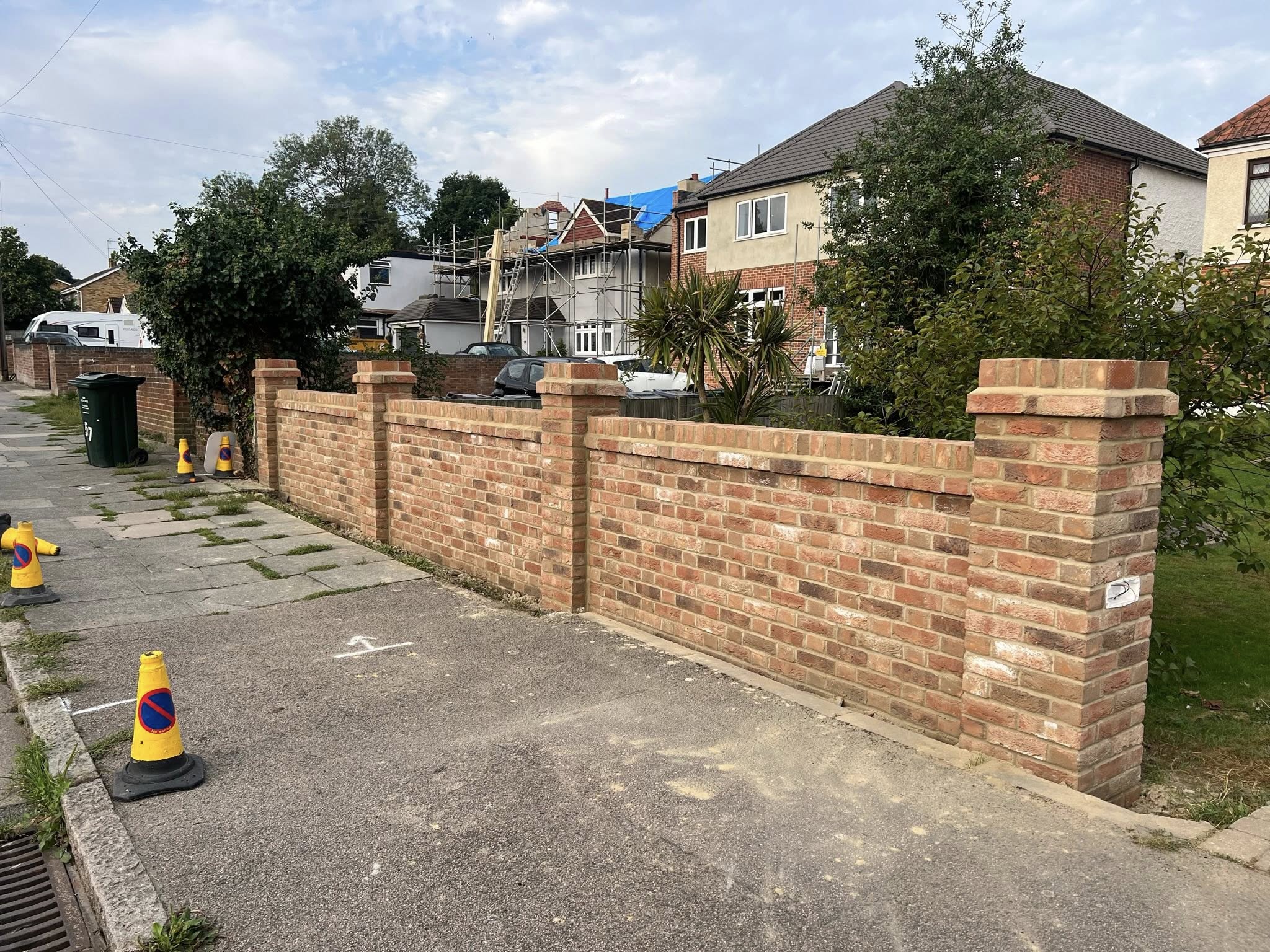
Why Marshall Brickwork is Kent's lime mortar specialist — the complete guide to period brickwork, correct mortar specification and brick repair done right first time.
There is a question that reveals more about a brickwork contractor's knowledge than almost any other. Ask it before commissioning any repointing or brick repair on a Victorian or Edwardian property in Kent, and the answer will tell you immediately whether the contractor in front of you understands what they are about to work on.
The question is: what mortar specification are you using, and why?
For any property built before 1930 — the Victorian and Edwardian housing that makes up the majority of Kent's period residential stock in Rochester, Chatham and Gillingham, Sittingbourne, Faversham, Canterbury, and across the county — the correct answer is lime mortar. Not Portland cement. Not a cement-heavy sand and cement mix. Lime mortar.
A contractor who answers "standard sand and cement" for a Victorian terrace does not understand period brickwork. A contractor who answers "lime mortar" but cannot explain why is repeating knowledge without understanding it. A contractor who answers with a specific lime:sand ratio, explains why that ratio suits this particular brick and this particular exposure condition, and can show you examples of previous lime mortar work across Kent — that contractor understands what they are proposing to do to your building.
Marshall Brickwork & Construction — Marshall Construction Kent — is that contractor. Lime mortar specification and application is not an optional upgrade that Marshall Brickwork offers for an additional charge. It is the baseline standard applied to every period property brickwork commission across Kent, because it is the only correct approach and Marshall Construction does not knowingly use incorrect approaches on buildings that deserve better.
What Lime Mortar Is and Why It Matters
Before the specific expertise Marshall Brickwork & Construction brings to lime mortar work across Kent, understanding what lime mortar actually is — and why it behaves so differently from the cement mortars that became standard through most of the twentieth century — is essential.
Lime mortar is made from three ingredients: lime (calcium oxide or calcium hydroxide, derived from burning limestone), aggregate (typically sand, selected for the particle size and colour appropriate to the specific application), and water. The proportions of these three ingredients — the mix ratio — determine the strength, flexibility, and workability of the finished mortar.
The critical property of lime mortar is its strength relative to the bricks it bonds. Correctly specified lime mortar for period brickwork is softer than the bricks. This is not a weakness — it is a design feature.
When a brick wall experiences stress — from thermal expansion and contraction, from the seasonal movement of the clay soils beneath it, from the slight settlement that all buildings experience over decades — that stress must go somewhere. In a lime mortar wall, the stress travels to the mortar joint, which is the designed weak point. The joint may crack. It may crumble slightly at its face over time. And when it does, the remedy is repointing — removing the old mortar and replacing it with new lime mortar. The bricks, protected by the sacrificial joint, remain intact.
In a Portland cement mortar wall, the stress has nowhere to go via the joint, because the cement mortar is harder than the surrounding Victorian brick. The stress goes into the brick face instead. The brick face detaches — this is spalling. The exposed inner brick absorbs moisture, which freezes in winter and expands, detaching more of the face. Progressively, brick faces break away across the elevation, exposing the softer interior brick that was never designed to be on the surface.
This is not theory. This is the pattern of damage that Marshall Brickwork & Construction diagnoses and remedies on period properties across Kent every month — the legacy of the cement repointing that was applied to Victorian and Edwardian houses through the 1970s, 1980s, and 1990s when lime mortar had largely fallen out of use and Portland cement was considered the universal mortar solution.
The History of Lime Mortar in Kent's Housing Stock
Understanding why lime mortar was used, why it fell out of use, and why its correct application is now so important for brick repair in Kent requires a brief account of the materials history.
Before 1900: All mortar was lime-based. Portland cement had been invented in 1824 but was used primarily in concrete construction rather than masonry mortar. The handmade and early machine-made bricks of Victorian construction were mixed with lime mortars in proportions that the builders of each era understood instinctively — the mortar would be softer than the brick, would absorb movement, and would eventually need replacement, which was considered normal maintenance.
1900–1950: Portland cement began to be added to lime mortars in increasing proportions, creating the cement:lime:sand mixes that are still in use for appropriate applications today. These mixes are stronger than pure lime mortars and were perceived as an improvement — stronger mortar, stronger wall. The problem — that these mixes were now stronger than many of the soft Victorian bricks they were being applied to — was not yet understood.
1950–1990: Portland cement mortar largely displaced lime mortar in residential construction and maintenance. Convenience, speed, and the availability of pre-mixed cement products made cement mortar the default choice for the majority of Kent contractors. Lime mortar was considered old-fashioned and lime mortars themselves became harder to source.
1990–present: The damage caused by cement repointing on period brickwork became increasingly apparent and increasingly documented. Architectural conservation bodies, English Heritage, and the professional surveying community began to understand and articulate the damage mechanism. Lime mortar has progressively returned to correct specification for period property work, is now standard practice for any heritage-aware contractor, and is required by planning authorities for listed building and conservation area work.
Marshall Brickwork & Construction has applied lime mortar as the standard for period property work for over fifteen years — through the period when lime mortar was returning to professional awareness, and throughout the period since when it has become standard for any contractor who understands what they are working on.
The Marshall Brickwork Lime Mortar Process: How It Works in Practice
The application of lime mortar in a brick repair Kent or repointing context is more involved than the application of Portland cement mortar — which is part of why less knowledgeable contractors avoid it. Here is exactly what Marshall Construction's lime mortar process involves, stage by stage.
Stage One: Mortar Assessment
Before any lime mortar mix is specified, Marshall Brickwork assesses the existing mortar — where any original or period mortar survives — to understand the baseline composition. This assessment looks at:
Colour and aggregate character. The colour of the existing mortar is determined primarily by the sand aggregate used in the original mix. Understanding whether the sand was a local river sand, a pit sand, or a dune sand — each of which has different colour, texture, and particle size characteristics — informs the selection of the replacement aggregate for colour matching.
Mortar strength. The hardness of the existing mortar — assessed by the scratch test and by visual observation of how the mortar has weathered relative to the brick — indicates the original lime:sand ratio and the type of lime used. A mortar that has weathered evenly with the brick, neither harder nor softer, is a correctly specified original mortar. A mortar that has dissolved into the joint while the bricks remain sharp-edged is too soft. A mortar that has caused spalling at the brick face is too hard.
Joint profile. The original joint profile — whether the mortar was finished flush, slightly recessed, struck to a weatherstruck profile, or finished to a bucket handle — informs the specification for the new mortar finishing, which should match the existing where possible.
Stage Two: Mix Specification
Based on the mortar assessment, Marshall Brickwork specifies the lime mortar mix for the specific project. The variables are:
Lime type. Non-hydraulic lime (NHL 0, air lime, lime putty) is the softest and most flexible — appropriate for the softest, most absorbent bricks and for applications where maximum flexibility is required. Hydraulic lime (NHL 2, NHL 3.5, NHL 5) sets through a hydraulic reaction in addition to the carbonation reaction that hardens all lime mortars — it is stronger and faster-setting than non-hydraulic lime, and is appropriate for more exposed positions and for bricks with moderate strength. The correct lime type for each application is determined by the brick strength and the exposure conditions at that specific site.
Aggregate selection. The sand aggregate is the primary determinant of the mortar colour. Marshall Brickwork selects aggregate from the range of sands available — silver sand, building sand, washed pit sand in various colours, crushed stone aggregate — to achieve the closest match to the existing mortar colour when dry. For Kent's varied brick traditions — the warm sands of Medway, the buff stocks of east Kent — the aggregate selection is specific to the location and the existing brick character.
Mix ratio. The lime:aggregate ratio determines the mortar strength and working properties. A richer mix (more lime, less aggregate) is stronger and more waterproof; a leaner mix is softer and more flexible. For most Kent period brick applications, a ratio of 1:2.5 to 1:3 (lime:aggregate by volume) is appropriate — producing a mortar that is softer than the brick and provides adequate weather resistance for external wall applications.
Stage Three: Sample and Approval
Before any full-scale lime mortar application, Marshall Construction applies a sample section in a small, inconspicuous area of the wall. The sample is allowed to dry fully — typically three to seven days — before it is assessed against the existing mortar for colour match.
This step is essential and non-negotiable. Lime mortar changes colour significantly between wet and dry states — typically lightening by one to two shades as it dries. A mortar that matches perfectly when wet can be noticeably lighter when dry. Only by viewing the dry sample alongside the existing mortar can the colour match be confirmed with confidence.
If the dry sample does not match adequately, the aggregate proportions or composition are adjusted and a new sample applied. This iterative process continues until a satisfactory match is achieved. Only then does the full application proceed.
Contractors who skip the sample stage — who proceed directly from mix specification to full-scale application — are either experienced enough to have extremely reliable colour intuition (uncommon) or unconcerned about the colour result (more common). Marshall Brickwork does not skip the sample stage.
Stage Four: Joint Preparation
Old mortar must be removed to adequate depth before new mortar is applied. The minimum depth is 15–20mm — the depth needed to provide adequate key for the new mortar and to ensure the full thickness of new material that weather resistance requires.
Removal is done by hand — plugging chisel and hammer, or proprietary mortar raking tools — rather than by angle grinder. The angle grinder, which some contractors use to speed up joint preparation, has a margin for error that is insufficient for work adjacent to brick arris edges. Brick arris damage from angle grinder slip is irreversible, and any contractor proposing to use an angle grinder for lime mortar joint preparation on period brickwork should be approached with caution.
After raking, all dust and loose material is removed. The joint is dampened — not saturated — before mortar application to reduce suction from the brick face, which would draw moisture from the lime mortar too rapidly and prevent adequate curing.
Stage Five: Application and Curing
Lime mortar is applied in layers — a backing coat filling the joint to within 5–6mm of the face, allowed to stiffen before a finishing coat brings the joint to the intended profile. This layered approach prevents shrinkage cracking in deep joints and produces a better-consolidated finished joint than a single-pass application.
The curing period for lime mortar is significantly longer than for Portland cement mortar. Lime mortar cures through a process of carbonation — the absorption of carbon dioxide from the air, which converts the calcium hydroxide in the mortar back to calcium carbonate. This process takes weeks to months for full carbonation, during which time the mortar should be protected from frost (new lime mortar that freezes before full carbonation fails) and, in very hot or dry conditions, should be lightly misted to prevent the surface from drying too rapidly.
Marshall Brickwork manages curing conditions as part of every lime mortar commission — scheduling work to avoid frost forecast windows, protecting freshly applied mortar in hot dry conditions, and confirming that the mortar has reached adequate early strength before any loading or cleaning of the adjacent surface.
Where Lime Mortar Expertise Matters Most Across Kent
Marshall Construction's lime mortar expertise is relevant across Kent wherever Victorian and Edwardian housing exists — which means across the full county coverage area. But certain locations and property types make this expertise most immediately valuable.
Rochester, Chatham and Gillingham — The Medway Core
The dense Victorian residential streets of the Medway towns contain the highest concentration of soft period brick in Kent. The handmade and early machine-made bricks of these properties — the warm reds and multi-colours of the Medway brick tradition — are precisely the materials that require lime mortar for any repointing or brick repair in Kent work. The Rochester and Medway guide covers the specific character of this market.
The scale of cement repointing damage across the Medway area's Victorian housing stock — the legacy of thirty years of incorrect specification from the 1970s through the 1990s — means that the demand for correct lime mortar brick repair and repointing in Rochester, Chatham, and Gillingham is substantial and ongoing.
Faversham — Historic Core and Listed Buildings
Faversham's 500+ listed buildings and extensive conservation area make it the location where lime mortar expertise is most emphatically required — not merely as best practice but as a planning compliance requirement. Canterbury City Council's conservation officers, who manage Faversham's listed buildings and conservation areas, require lime mortar for any brickwork work on designated properties. Marshall Brickwork's lime mortar expertise and the company's understanding of the planning process in the Canterbury City Council area make it the natural partner for Faversham period property brickwork.
Whitstable — Coastal Exposure Adds Urgency
Whitstable's coastal exposure — the salt air, the persistent moisture, the freeze-thaw cycling intensified by the marine climate — makes the mortar specification question more consequential than in sheltered inland positions. A lime mortar that is correctly specified for the specific coastal exposure conditions provides adequate weather resistance while remaining soft enough to protect the brick. An incorrectly specified cement mortar causes spalling on Whitstable's period brickwork at an accelerated rate compared to inland sites.
Tonbridge, Tunbridge Wells and Sevenoaks — Period Property Sensitivity
The premium residential market of west Kent brings period properties of high value and high architectural character — the Edwardian and Victorian houses of Tunbridge Wells's residential streets, the conservation area properties of Sevenoaks's historic core. For these properties, the lime mortar question is a quality expectation as much as a technical requirement. Homeowners in this market are typically informed, research their contractors carefully, and expect the correct approach. Marshall Brickwork's lime mortar expertise meets that expectation.
The Consequences of Getting It Wrong: What Incorrect Mortar Does to Kent Brickwork
The damage that Portland cement mortar causes on period brickwork in Kent is not hypothetical — it is visible on countless properties across the county and represents the most common form of avoidable brickwork damage that Marshall Construction assesses in its site visits.
The typical progression on a Victorian Medway terrace: Cement repointing applied, the elevation appears well-maintained. Within five years, hairline cracks appear at the junction between cement mortar and brick face — the differential movement between the rigid cement and the flexible brick creating stress at the interface. Within ten years, small chips of brick face begin to detach at the most exposed positions — corners, copings, north-facing elevations. Within twenty years, significant spalling has occurred across multiple elevations, with brick face loss of 20–30mm depth in the most affected areas. The remaining mortar, still firmly bonded to the wall, now protrudes proud of the receded brick faces — a pattern that reads as dramatic deterioration even to a casual observer.
The remedy at this stage is no longer straightforward repointing. It is: removal of all cement mortar (itself damaging to brick arris edges if not done with extreme care), replacement of all spalled bricks with compatible reclaimed material, and repointing throughout in lime mortar. The cost is significantly greater than the original lime mortar repointing would have been. The disruption is significantly greater. And the result — while correct — cannot fully restore brick faces that have already been lost.
Marshall Brickwork sees this progression regularly across Kent. The assessment and brick repair service that Marshall Construction delivers includes honest advice about what the damage has been caused by, what the correct remedy is, and how to prevent the same damage from recurring — by specifying lime mortar correctly the first time and maintaining it as the routine maintenance programme the brickwork maintenance guide describes.
Frequently Asked Questions: Lime Mortar and Marshall Brickwork
Why does Marshall Brickwork use lime mortar when most contractors use cement? Because lime mortar is the correct specification for Victorian and Edwardian brickwork — and Marshall Construction does not use incorrect specifications on buildings that deserve better. The lime mortar knowledge that Marshall Brickwork applies is the product of fifteen years of period property brickwork across Kent, supported by training in heritage construction and the accumulated experience of diagnosing and remedying the damage that cement mortar causes.
Is lime mortar more expensive than cement mortar? The materials cost of a correctly specified lime mortar is broadly comparable to a quality cement:lime:sand mix. The additional cost in Marshall Brickwork's lime mortar commissions comes from the sample and approval stage, the longer application time that layered lime mortar application requires, and the curing management that correct lime mortar work demands. These additional time inputs represent the difference between work done correctly and work done quickly.
How long does lime mortar repointing last? A correctly specified lime mortar repointing job, on a well-maintained elevation with sound brickwork beneath it, should last 25–40 years on a sheltered internal elevation and 20–30 years on an exposed north or west-facing Kent elevation. Coastal positions, as at Whitstable and Gravesend, may require repointing at shorter intervals due to enhanced exposure.
Can Marshall Brickwork work on listed buildings in Kent? Yes, subject to the appropriate Listed Building Consent being obtained from the relevant planning authority. Marshall Construction advises on the consent requirements at every initial consultation for listed building work and coordinates with the planning authority's conservation officer as part of the project management process.
What areas does Marshall Brickwork cover for lime mortar work? The full Kent coverage area — from Rochester and Medway in the west through Faversham, Canterbury, Whitstable, and the east Kent coast, through Maidstone and mid-Kent, through Tonbridge, Tunbridge Wells and Sevenoaks in west Kent, and into Greater London. Free site visits across the full coverage area. No travel surcharge.
Commission Marshall Brickwork for Lime Mortar Work in Kent
Marshall Brickwork & Construction — Marshall Construction Kent — delivers lime mortar repointing and brick repair in Kent to the standard that period brickwork deserves. Free site assessment. Correct mortar specification. Sample and approval before full application. Craft execution throughout. Work guaranteed.
Read the complete repointing guide for the full technical picture. Browse the expert brickwork guide for the craft standards Marshall Brickwork applies to every commission. See completed period property brickwork projects at mbconstruction.group/projects/.
For the full Marshall Construction service range beyond brickwork — driveways, patios, landscaping, extensions, groundworks — explore the complete services range.
Phone: 07724 730872 Email: info@mbconstruction.group Contact: mbconstruction.group/contact/
Marshall Brickwork & Construction. Marshall Construction Kent. The lime mortar specialist that Kent's period properties deserve.
Marshall Brickwork & Construction Ltd | MB Construction Group | 14 Poplar Road, Rochester, ME2 2NR | 07724 730872 | mbconstruction.group