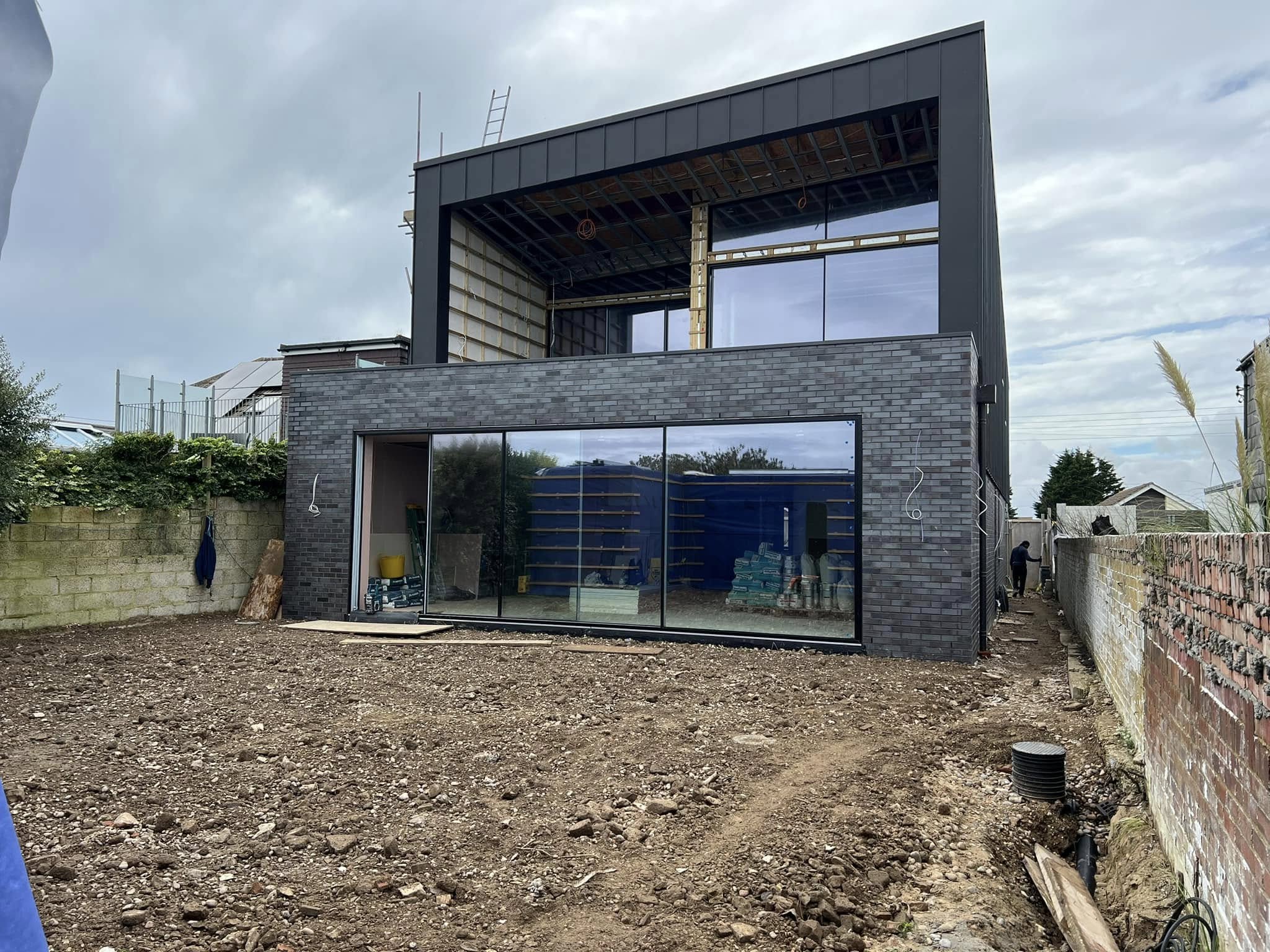
Garage conversions in Kent — complete 2026 guide. Building regulations, planning permission, floor insulation, wall spec, home office, bedroom and annexe options.
The garage conversion is the most cost-efficient way to add usable living space to a Kent home. Not the most dramatic — that distinction belongs to the rear extension with bi-fold doors and a porcelain patio connection. Not the most complex — the loft conversion with dormer and en-suite requires more structural engineering. But for the ratio of additional living space delivered against investment made, the garage conversion is consistently the most financially efficient home improvement available to Kent homeowners in 2026.
The reason is simple. The space already exists. The walls, the roof, the foundation — all of it is already built. The conversion transforms dead storage space into habitable living space using the existing structure rather than creating new structure from scratch. The work is less extensive than a full extension, less invasive than a loft conversion, and the result — a new bedroom, a home office, a playroom, a gym, a utility room, or any other habitable room the household needs — delivers the same functional benefit as if the room had been built new.
This guide covers everything Kent homeowners need to know about garage conversions in 2026. What is involved in a correct conversion. What the building regulations require. When planning permission is needed and when it is not. What the specific challenges of Kent's housing stock and ground conditions create. How to specify the conversion correctly so that the result is genuinely habitable — properly insulated, properly ventilated, properly drained — rather than simply a garage that has been fitted out.
MB Construction Group — Marshall Brickwork & Construction delivers garage conversions across Kent as part of a comprehensive construction service that encompasses home extensions, new builds, and all associated groundworks and brickwork. The same craft knowledge and technical precision that defines every Marshall project applies to garage conversions — because a garage conversion done correctly is a construction project, not a fit-out exercise.
Why Garage Conversions Make Financial Sense in Kent in 2026
The financial case for garage conversion in Kent's 2026 property market is more compelling than at any previous point. Three converging factors are driving demand.
The cost of moving has become prohibitive. A Kent family in a three-bedroom semi-detached who needs a fourth bedroom — for a new child, for a parent moving in, for a home office that cannot share space with a bedroom any longer — faces a stark choice. Move to a larger property, with all the friction costs that involves: stamp duty on the new purchase, estate agent fees on the sale, solicitor costs both ways, removal costs, and the practical disruption of the move itself. In Kent's current market, this total friction cost easily reaches £30,000–£50,000 before any improvement to the actual living space is achieved.
Or convert the garage. One project, one team, one programme, and a new room is available without leaving the home, the neighbourhood, the school catchment, or the community that the family has built around its current address.
Home working has made additional space non-negotiable for many households. The permanent shift toward hybrid working that followed the pandemic has not reversed. Many Kent households now need a dedicated home office — a room with a door that closes, soundproofing from the rest of the house, its own heating and lighting, and enough space to work professionally. The garage conversion is the most natural solution: a space that is already structurally separate from the main house, with its own access independent of the family's living areas.
Property values in Kent reward correctly converted garages. UK estate agent data consistently shows that an additional habitable room adds meaningfully to residential property value — particularly in the commuter markets of Tonbridge, Tunbridge Wells, and Sevenoaks and the family markets of Maidstone and the Medway towns where four-bedroom properties command significantly higher values than three-bedroom equivalents. The complete guide to adding value to a Kent property covers the investment and return picture in detail.
The critical qualifier: the value is added by a correctly executed, building regulations compliant garage conversion — not by a garage that has been fitted out without the insulation, ventilation, and structural work that compliance requires. A non-compliant conversion is a liability at the point of sale; a compliant one is an asset.
What a Garage Conversion Actually Involves: The Full Scope
This is where most homeowners underestimate garage conversions. It looks simple from the outside — close the garage door opening, put a floor down, put heating in, and you have a room. In reality, a garage conversion that meets building regulations for habitable space requires substantially more than this. Here is the complete scope of work.
Structural Assessment and Floor
The garage floor is almost always a concrete slab on the ground — not the suspended timber floor that the rest of the house typically has. This slab is not insulated, is likely to be damp-proof membrane-free or have only a basic DPC, and sits at a level that may be below the adjacent house floor level.
The structural assessment determines: whether the existing slab can be retained (it typically can if structurally sound) or needs to be replaced; what the level relationship is between the garage floor and the adjacent house floor; and what insulation system is required to bring the floor thermal performance to the current building regulations standard.
Floor insulation options for garage conversions: rigid insulation board laid over the existing slab (adds height, requires careful management of the level relationship with the adjacent floor); underfloor heating system with integrated insulation (the most comfortable option where floor height allows); or a suspended timber floor over the existing slab (allows insulation in the void, creates a floor that is acoustically superior and thermally performant).
The damp-proof membrane question is critical. A concrete garage slab without an adequate DPM allows moisture to rise through the floor — a room built on a damp slab is a damp room, regardless of how well everything above it is constructed. Any garage conversion on a Kent property must address the DPM as part of the floor specification.
Walls: Insulation and Finishing
Garage walls in the UK are typically built in facing brick or concrete block — suitable structural walls but typically single-skin (no cavity) and without insulation. Building regulations for habitable rooms require wall thermal performance that a single-skin uninsulated garage wall does not achieve.
Insulation options: internal insulated dry lining (the most common approach — a framework of insulated panels fixed to the inside face of the existing wall, reducing the internal floor area by approximately 100mm on each insulated wall); external wall insulation (uncommon for garages as it changes the external appearance significantly); or cavity insulation where the wall is already cavity-built (uncommon in attached garages).
The internal dry lining approach requires careful detailing at junctions — between the insulated wall and the uninsulated wall of the adjacent house (which may require a thermal break), between the wall insulation and the floor insulation, and at window and door reveals where the insulation thickness creates deeper reveals than the original single-skin wall.
For attached garages where one or more walls are shared with the main house, those shared walls may already be insulated as part of the house structure. The detached element walls require insulation; the party walls between the garage and house may not — but they do require assessment for acoustic performance, since the conversion creates a room adjacent to a living space of the main house.
The Garage Door Opening
The most visible transformation in any garage conversion is the replacement of the garage door with a window and wall, or with a glazed or solid door arrangement that provides the access and light the new room requires.
The structural element: the garage door opening is typically spanned by a lintel — either a concrete boot lintel, a steel angle, or a reinforced concrete element — that carries the brickwork above the opening. This lintel must be assessed for its capacity to carry whatever new load is placed above the opening in the new design. Where the opening is to be reduced in size, new masonry is built up within the existing opening on a suitably specified sub-base.
The infill specification for the garage door opening — the new wall, the window, and any step or threshold detail — must match the existing external elevation in brick type and mortar specification. For period properties in Rochester, Chatham, and across Kent's Victorian and Edwardian housing stock, this means sourcing compatible facing brick — not the easiest match — and specifying lime mortar for the new brickwork that integrates with the existing structure. Marshall Brickwork's material sourcing capability and period property expertise is directly relevant here.
Roof Insulation
Garage roofs are typically flat (for most modern attached garages) or pitched (for older or detached garages). Neither provides the thermal performance that building regulations for habitable rooms require without additional insulation.
Flat roof insulation for garage conversions: insulation can be added above the existing roof deck (warm roof construction — the preferred approach) or below it (cold roof construction — acceptable but creates condensation management requirements). Warm roof construction adds depth to the roof and may affect the appearance from outside; cold roof construction maintains the existing roof profile but requires careful vapour control layer specification to prevent interstitial condensation.
Pitched roof insulation depends on whether the roof space is to be used. For a simple room below a pitched roof without use of the roof space, insulation at ceiling level (between and over the ceiling joists) is the standard approach.
Heating and Ventilation
A habitable room requires heating — building regulations require that the room can be heated to a minimum temperature — and adequate ventilation. Both require design from the outset of the project.
Heating options: extension of the existing wet central heating system (radiators connected to the existing boiler — the most common approach, requiring assessment of boiler capacity and pipe routing); underfloor heating (requires the floor specification to accommodate the heating element — best designed as part of the floor specification from the start); or standalone electric heating (the simplest to install, with higher running costs).
Ventilation requirements for habitable rooms are specified in building regulations Part F. Background ventilation (trickle vents in windows) provides the minimum; extract ventilation for any wet rooms (a converted garage with an en-suite) requires mechanical extract fans with appropriate airflow rates.
Services: Electrics and Plumbing
The electrical installation for the converted garage must be to Part P building regulations standard — either carried out by a Part P registered electrician or approved by building control. The installation typically includes lighting circuits, power circuits, a consumer unit connection (may require upgrade of the main consumer unit in the house), and any specific circuits for the room's intended use (data points for a home office, circuits for gym equipment, etc.).
Plumbing for any wet room element — a WC, a sink, an en-suite — requires waste drainage connection to the existing foul drainage system. This routing is best planned at the start of the project; retrofitting drainage through finished floors and walls is significantly more expensive than installing it before floors and walls are closed.
Building Regulations for Garage Conversions in Kent
Building regulations approval is required for all garage conversions in England. There are no exemptions. This is the most commonly overlooked requirement and the most consequential — a garage conversion carried out without building regulations approval creates a title defect that affects mortgage, sale, and insurance, and is not remedied retrospectively without significant cost and disruption.
The building regulations that apply to garage conversions: Part A (structure), Part B (fire safety), Part C (resistance to contaminants and moisture), Part F (ventilation), Part L (energy efficiency), and Part P (electrical safety). Each specifies requirements that the conversion must demonstrate compliance with before a completion certificate is issued.
The Building Control Process for Garage Conversions
Building control approval can be obtained through the local authority (Medway Council for Medway area properties, Kent County Council for county areas, the relevant district or borough council elsewhere) or through an Approved Inspector — a private building control body that can carry out the same approval and inspection function.
Full Plans Approval — submitting detailed drawings and specifications before work starts — is the recommended approach for garage conversions. It confirms the design compliance before construction begins and reduces the risk of discovering compliance issues during the work. The application fee is modest; the protection it provides is significant.
Site inspections at specified stages — typically at foundation/floor level, at wall insulation stage, and before any ceilings are closed — allow the building control officer to confirm compliance as the work progresses. The completion certificate issued at the end of this process is the document that confirms the conversion is a compliant habitable room.
Marshall Construction manages the building control process for every garage conversion as standard — submitting the application, scheduling inspections, maintaining the compliance records, and ensuring the completion certificate is issued. This is professional project management, not an optional extra.
Planning Permission for Garage Conversions in Kent
Most garage conversions do not require planning permission. Converting an existing garage to habitable use is generally permitted development — the external appearance of the building changes minimally (the garage door is replaced with a window and wall) and the use remains residential.
The exceptions that require planning permission:
Conservation area properties. In Canterbury's conservation areas, Rochester's historic designations, Faversham's extensive conservation coverage, and numerous other designated areas across Kent — changes to the external appearance of buildings (including replacement of a garage door with a window and wall) may require planning consent even where permitted development rights would apply elsewhere.
Properties with planning conditions removing permitted development rights. Some properties have Article 4 Directions or specific planning conditions attached to previous permissions that restrict or remove permitted development rights. These appear on the planning register for the property and should be checked before any conversion is assumed to be permitted development.
Detached garages in the garden. Converting a detached garage at the bottom of the garden into a separate dwelling (rather than habitable space linked to the main house) requires planning permission as a change of use. Converting it into an annexe that is not self-contained and does not constitute a separate dwelling may be permitted development, but the distinction can be fine and is worth confirming with the local planning authority.
The complete planning permission guide for Kent covers all relevant rules for every type of conversion and project.
Garage Conversion Options: What Can the Space Become?
Home Office
The most frequently commissioned garage conversion use in 2026. The permanent shift toward hybrid working has created genuine demand for a room that functions as a professional workspace — soundproofed from the rest of the house, with its own heating and lighting independent of the family's living schedule, and with data connectivity for video calling and file transfer.
The home office conversion brief typically requires: good natural light (a new window in the garage door opening); adequate heating; data points for multiple devices; appropriate lighting circuits including task lighting over the desk area; and acoustic separation from the adjacent house.
Bedroom — Including En-Suite
A new bedroom, complete with an en-suite bathroom, is the highest-value use of a converted garage in the family buyer market. Adding a bedroom to a three-bedroom Kent property — converting it to a four-bedroom — typically adds 10–15% to property value in the current market. The building regulations requirements for a bedroom with en-suite include adequate ceiling height (minimum 2.1m recommended), ventilation for the wet room, plumbing for the en-suite, and the thermal performance requirements for all elements.
Playroom or Games Room
A conversion dedicated to children's use — with rubber or foam flooring, appropriate electrical points for entertainment systems, and sound insulation that protects the rest of the house from the noise generated — is a popular family brief across Kent's residential market. The specification can be simpler than a bedroom conversion in some respects (the flooring, for example, may tolerate a slightly different specification than carpet-over-screed), but the building regulations requirements remain identical.
Gym or Wellness Space
The home gym conversion is growing rapidly across Kent's more affluent residential markets. The specification considerations include: floor loading (gym equipment is heavy — the floor specification must account for point and distributed loads beyond normal residential use); rubber or sport flooring; enhanced ventilation for the higher humidity and airborne particulates that a gym generates; and adequate electrical circuits for equipment.
Annexe or Granny Flat
A garage converted into an annexe — self-contained accommodation for a family member — requires particular care around planning and building regulations. If the annexe is truly self-contained (its own kitchen, its own bathroom, its own entrance independent of the main house), it may constitute a new dwelling requiring planning permission for a change of use. If it is an annexe with dependency on the main house (shared access, no independent kitchen, clearly ancillary to the main dwelling), it is more likely to be permitted development. The distinction is worth confirming with the relevant planning authority before the design is committed.
Garage Conversions Across Kent
Medway Towns — Attached Garages on Clay
The most common garage type across the Medway towns — Rochester, Chatham, Gillingham, Strood — is the single-skin brick integral garage, typically attached to the side or front of an interwar or post-war semi-detached or detached house. The London Clay that underlies most of these sites creates the floor damp-proof membrane question in its most acute form — London Clay holds water, and a garage slab without an adequate DPM on London Clay is a damp slab.
Marshall's groundworks expertise and the accumulated knowledge of Kent's clay ground conditions that fifteen years of projects across the Medway area has produced inform every garage conversion floor specification in this area.
Sittingbourne — Similar Clay Conditions
Sittingbourne and Swale share the London Clay ground conditions of the Medway area. The garage conversion specification approach is the same — DPM attention, adequate floor insulation, careful wall insulation detailing on the single-skin brick structures that characterise the area's garage stock.
West Kent — Larger Garages, Higher Specification
The Tonbridge, Tunbridge Wells, and Sevenoaks market brings garage conversions of larger scale — double garages on detached properties, garages with existing storage above that create additional conversion potential, and the higher specification expectations of the premium residential market. The home office and annexe conversion types are most frequently commissioned here.
Frequently Asked Questions: Garage Conversions in Kent
Does a garage conversion need building regulations approval? Yes — always. There are no exemptions. Building regulations approval is required for all garage conversions in England. Failure to obtain approval creates a title defect that affects mortgage, sale, and insurance. Marshall manages the building control process for every garage conversion as standard.
Does a garage conversion need planning permission? Usually not — most garage conversions are permitted development. Exceptions include conservation area properties, listed buildings, and properties with planning conditions removing permitted development rights. Check before assuming. Marshall advises on planning requirements at every initial consultation.
Will a garage conversion add value to my Kent property? Yes, if correctly executed and building regulations compliant. A non-compliant conversion is a liability; a compliant conversion adding a habitable room adds measurably to property value — particularly where it converts a three-bedroom property to a four-bedroom equivalent in Kent's family buyer market.
How long does a garage conversion take? A standard single garage conversion — floor, wall insulation, roof insulation, new window and door to the garage opening, heating, electrical installation — typically takes two to four weeks depending on scope. A conversion including an en-suite bathroom, complex heating design, or significant structural work at the garage door opening takes longer.
Can I convert a detached garage? Yes — with the same building regulations requirements as an integral garage. Planning permission considerations may be different for a detached garage, particularly if it is remote from the main house or if the intended use creates questions about whether it constitutes a separate dwelling. Marshall advises on the specific planning position for every detached garage conversion enquiry.
What ceiling height is needed for a habitable room? Building regulations do not specify a minimum ceiling height for habitable rooms, but industry guidance recommends 2.1m minimum, with 2.4m more comfortable and 2.7m preferred for the most usable space. Many integral garage slab-to-ceiling heights fall within the 2.1–2.4m range; garages with flat roofs at the lower end of this range may require careful consideration of floor buildup depth when specifying insulation systems.
Getting Your Garage Conversion Quoted in Kent
Marshall Brickwork & Construction delivers garage conversions across Kent — from the Rochester and Medway home base through Chatham and Gillingham, Gravesend, Maidstone, Canterbury, and across the county.
Free site visit. Building regulations approach confirmed. Planning position assessed. Detailed written quote covering every element of the conversion scope. Work guaranteed.
Read the complete home extensions guide for the related extension option. Browse completed construction projects across Kent. Explore the full construction services range.
Phone: 07724 730872 Email: info@mbconstruction.group Contact: mbconstruction.group/contact/
The garage you are parking nothing in, or storing things you never use, is a room waiting to happen. Marshall Brickwork & Construction makes it happen correctly — to building regulations, to a craft standard, and with the brickwork quality at the garage door opening that means the conversion reads as designed rather than improvised.
Marshall Brickwork & Construction Ltd | MB Construction Group | 14 Poplar Road, Rochester, ME2 2NR | 07724 730872 | mbconstruction.group