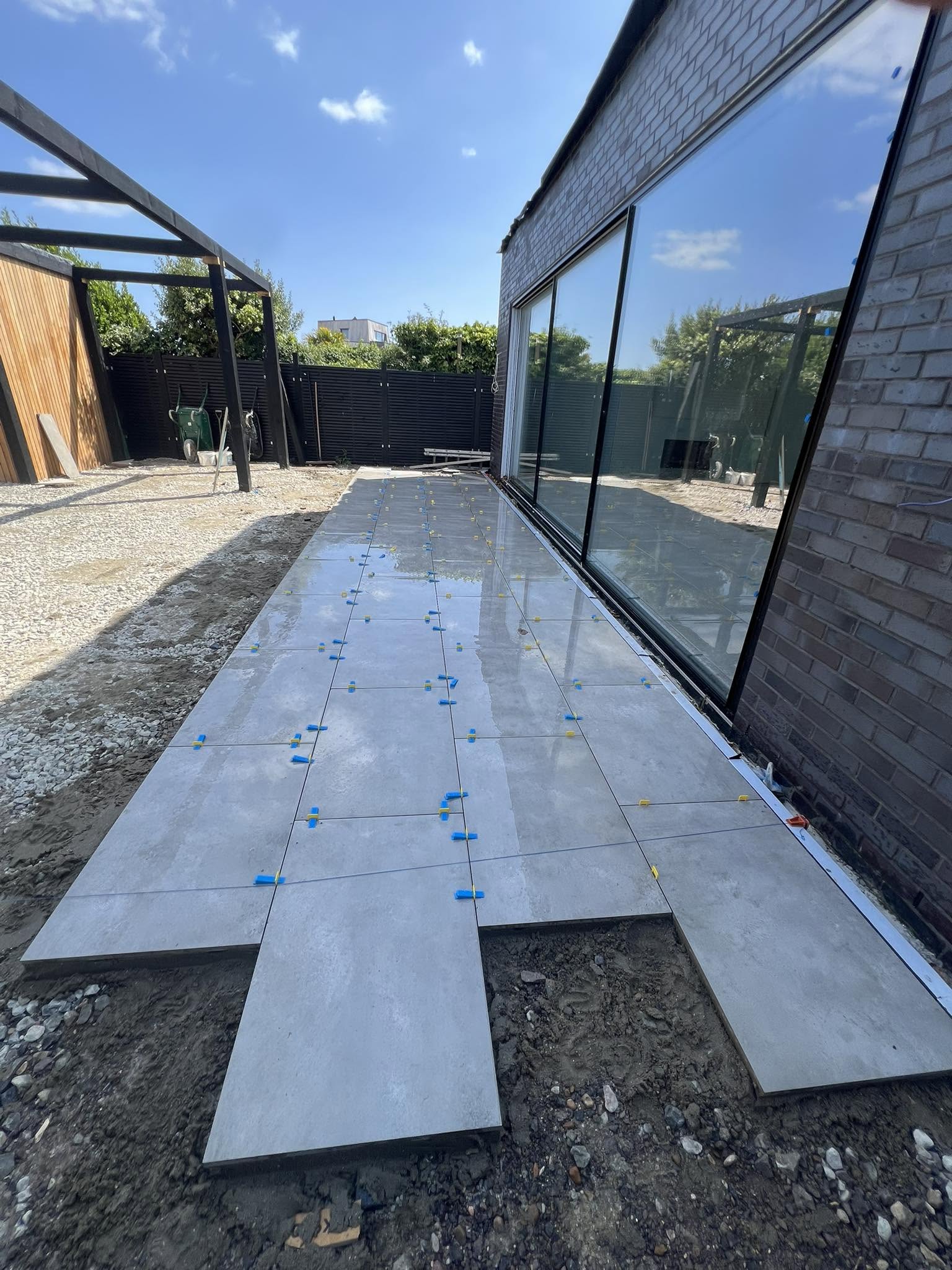
Master the technical standards of external landscape engineering, sub-grade preparation, SBR slurry chemical bonding, and SuDS compliance.
The execution of premium external hardscaping requires the same degree of civil engineering rigor as the construction of primary building superstructures. External paved platforms are subjected to continuous environmental, thermal, and mechanical loading stresses. Whether developing a high-traffic commercial plaza or a luxury domestic terrace, failure to address subterranean load distribution, material chemistry, and fluid dynamics will culminate in rapid systemic failure, surface rutting, or pavement shearing.
Vitrified porcelain has established itself as the premier surfacing material across modern landscape architecture due to its exceptional density and minimal maintenance profile. However, its non-porous composition demands precise execution parameters during installation. This comprehensive engineering manual details the exact technical specifications, sub-surface mechanical treatments, and material sciences required to construct highly durable external paved structures that fully clear modern algorithmic quality standards for patios and slabbing.
1. Civil Engineering Foundations and Sub-Grade Mechanics
Every high-performance hardscape asset is ultimately supported by the underlying natural earth, known as the sub-grade. Pavement failure is almost exclusively caused by inadequate preparation of this foundational layer rather than surface component deficiencies.
Bulk Excavation and Structural Soil Stabilization
The first phase of execution requires bulk excavation down to a stable, completely undisturbed sub-grade stratum. All organic topsoil, root networks, vegetation, and loosely compacted made-ground must be completely extracted from the site footprint. Organic elements decompose over time, creating unpredictable subterranean voids that trigger localized structural sagging across the finished surface.
Once the design formation depth is achieved, the raw sub-grade must be mechanically analyzed for load-bearing capacity. Cohesive soils, such as the expansive clays common throughout the South East, must be compacted at their optimum moisture content using heavy mechanical rollers or tracked vibratory compactors. If the sub-grade exhibits high moisture retention or low structural shear strength, soil stabilization methods must be deployed. This can involve the uniform mechanical incorporation of lime or cement stabilization pastes into the upper one hundred and fifty millimeters of the subgrade to chemically modify the clay particles, drastically increasing their California Bearing Ratio (CBR) profile.
Geotextile Segregation Membranes and Sub-Surface Stress Reduction
Directly over the freshly compacted subgrade, a high-performance, woven geotextile segregation membrane must be deployed across the entire footprint. This civil engineering layer performs two critical structural roles:
- Subgrade Interlocking Prevention: It establishes an absolute physical barrier that prevents fine, soft subgrade soil particles from migrating upward into the clean, engineered aggregate sub-base when subjected to cyclic loading or groundwater pressure. Without this membrane, the subgrade clay will slowly pump upward under traffic loads, filling the interstitial voids between the sub-base aggregates, liquefying the stone matrix, and causing catastrophic surface rutting.
- Tensile Load Distribution: The high tensile strength of the woven geotextile fabric acts as a structural stress-reduction layer. It catches downward vertical load vectors and dissipates them horizontally across a wider subterranean expanse, neutralizing localized soft spots in the subgrade earth.
2. Granular Base Engineering: MOT Type 1 Infrastructure and Compaction Metrics
The primary load-bearing engine of the hardscape asset is the engineered aggregate sub-base. This layer must absorb all downward vertical compression forces and dissipate them safely down to the sub-grade.
Sizing Profiles and Material Consistency
The specified aggregate base material must conform strictly to the Department for Transport Specification for Highway Works, Clause 803, universally classified as MOT Type 1. This engineered aggregate consists of a tightly graded matrix of crushed stone, ranging from forty-millimeter angular chunks down to fine dust particles.
The mechanical strength of MOT Type 1 relies completely on particle interlocking:
+-----------------------------------------------------------------------+
|                    MOT TYPE 1 AGGREGATE INTERLOCKING                  |
+-----------------------------------------------------------------------+
|                                                                       |
|      [40mm Angular Stone] <---> [20mm Stone] <---> [10mm Stone]       |
|               ^                      ^                 ^              |
|               |                      |                 |              |
|               v                      v                 v              |
|         [Crushed Fine Dust Particles Filling Interstitial Voids]       |
|                                                                       |
+-----------------------------------------------------------------------+
The larger angular stone chunks provide a high-friction structural framework that resists lateral shifting under load, while the intermediate and fine dust particles fill the interstitial voids completely. This complete particle distribution locks the matrix into a dense, solid, unyielding structural platform that retains high load capacities while remaining stable under moisture shifts.
Sequential Lift Compaction Protocols
The aggregate sub-base must be installed in sequential lifts, with no single layer exceeding a compacted thickness of seventy-five millimeters. Attempting to place and compact a single, thick, one-hundred-and-fifty-millimeter layer in a single pass is an engineering failure vector; the mechanical energy generated by standard compaction equipment cannot penetrate the full depth of the aggregate column, leaving the lower section loosely packed and highly vulnerable to future settlement.
Each lift must be thoroughly processed using heavy-duty mechanical vibrating plate compactors or twin-drum vibratory rollers. The plate compactor must execute a minimum of four to six systematic passes across the entire surface area, moving in alternating perpendicular paths. The moisture content of the aggregate must be monitored continuously during compaction; if the mix is too dry, the fine particles will not slide into the voids smoothly, and if it is too wet, hydrostatic water pressure will push the stone chunks apart, preventing ultimate structural density from being achieved. For pedestrian patios, a minimum final compacted depth of one hundred millimeters is mandatory, whereas areas interfacing with passenger vehicles or high-load driveways require a minimum compacted depth of one hundred and fifty to two hundred millimeters of MOT Type 1 infrastructure.
3. Material Science of Vitrified Porcelain: The Modern Format Benchmarks
The integration of vitrified porcelain into modern landscape engineering represents a major technological leap forward in external finishing materials. Understanding the physical and chemical characteristics of this material is essential for correct structural deployment.
Porosity Boundaries and Microscopic Density
Vitrified porcelain tiles are manufactured by blending highly refined refined clays, quartz sands, and feldspars, which are subjected to extreme hydraulic pressing forces and fired in industrial kilns at temperatures exceeding twelve hundred degrees Celsius. This intense manufacturing process induces complete vitrification, transforming the raw minerals into a dense, glassy, highly crystalline structural matrix.
The primary mechanical advantage of vitrified porcelain is its near-zero water absorption threshold, engineered to stay below zero point five percent under international standards. This ultra-low porosity boundary renders the material completely immune to frost spalling and structural cracking during extreme winter freeze-thaw cycles. Because water cannot penetrate the closed pore network, there is no fluid to expand when transitioning to ice. Furthermore, this absolute density prevents organic staining, oil absorption, and algae colonization, allowing the surface to maintain its original structural integrity with minimal maintenance compared to highly porous natural limestones or concrete blocks.
The 2026 Format Benchmarks and Dimensional Stability
As landscape architecture has advanced into 2026, the standard format expectations for premium external installations have undergone a distinct evolutionary shift. While the legacy six-hundred-by-six-hundred-millimeter tiles remain common for smaller pedestrian pathways, large-format slabs measuring nine hundred by six hundred millimeters at a calibrated thickness of twenty millimeters have become the definitive industry standard.
+-----------------------------------------------------------------------+
|                    THE 2026 LARGE-FORMAT ADVANTAGE                    |
+-----------------------------------------------------------------------+
|                                                                       |
|   [ LEGACY FORMAT: 600x600mm ]        [ MODERN BENCHMARK: 900x600mm ] |
|   +--------------+--------------+     +-------------------------------+ |
|   |              |              |     |                               | |
|   |              |              |     |                               | |
|   +--------------+--------------+     |          20mm THICK           | |
|   |              |              |     |       VITRIFIED TILE          | |
|   |              |              |     |                               | |
|   +--------------+--------------+     +-------------------------------+ |
|   === High Joint Density Line ==     === Reduced Structural Joints == |
|                                                                       |
+-----------------------------------------------------------------------+
This large-format structural configuration delivers major architectural and mechanical benefits. By increasing the surface area of the individual paving units, the overall density of joints across the pavement is reduced. This minimizes the number of potential entry routes for water ingress into the underlying bedding layer.
Furthermore, these large-format units feature exact rectifying edge trims, delivering tight dimensional tolerances of plus or minus zero point five millimeters. This accuracy allows for the execution of incredibly tight, linear joint arrays that distribute thermal expansion stresses evenly across the hardscape layout. For external safety compliance, the tiles must exhibit a high slip resistance rating, clearing the R11 pendulum test standard to guarantee high frictional grip for users under wet conditions.
4. Interfacial Chemical Bonding: The SBR Priming Slurry Protocol
The ultra-dense, non-porous nature of vitrified porcelain introduces a significant installation challenge. Traditional natural stones feature highly porous back faces that absorb the cement paste from wet mortar beds, creating a physical mechanical interlock as the concrete cures. Porcelain lacks this open pore network; placing a raw porcelain tile directly onto a standard sand and cement mortar bed will result in zero structural adhesion, causing the tile to detach cleanly under minimal thermal or physical stress.
The Failure Vector of Spot-Bedding
Before detailing the correct bonding protocol, the common structural failure vector known as spot-bedding—historically called "dot and dab" or five-dot placement—must be explicitly exposed. Low-quality contractors frequently place individual mounds of mortar under the corners and center of a tile rather than constructing a continuous bedding layer.
+-----------------------------------------------------------------------+
|                    THE CATASTROPHIC SPOT-BEDDING HOLLOW               |
+-----------------------------------------------------------------------+
|                                                                       |
|     [ ======= NON-POROUS VITRIFIED PORCELAIN TILE ======= ]           |
|     -------   -------------   -------------   -------------   ------- |
|    [Mortar]   [HOLLOW VOID]   [Mortar Mound]  [HOLLOW VOID]   [Mortar]|
|   ................................................................... |
|   ===================== MOT TYPE 1 SUB-BASE ========================= |
|                                                                       |
+-----------------------------------------------------------------------+
This execution error creates massive hollow structural voids beneath the surface. When a vehicle drives over a spot-bedded tile, or when a heavy point load from a scaffold standard is applied, the tile lacks underlying support and fractures cleanly across the void.
More destructively, rainwater migrates through the joints and collects within these subterranean hollows. During winter freeze-thaw cycles, this trapped water expands volumetrically, exerting intense upward pressure that shears the tile completely away from its mortar mounds. Spot-bedding is a severe technical violation; porcelain must be laid on a full, uninterrupted wet mortar bed.
The Chemistry of Styrene-Butadiene Rubber (SBR) Priming Slurries
To achieve a permanent, unyielding bond between vitrified porcelain and a wet mortar bed, an interfacial chemical bonding bridge must be applied. The industry standard mandates the application of a high-performance Styrene-Butadiene Rubber priming slurry.
SBR is a specialized liquid polymer emulsion that exhibits exceptional water resistance, high chemical bonding adhesion, and elastic flexibility. The priming slurry is mixed by blending pure SBR liquid with Ordinary Portland Cement to create a thick, paint-like cream consistency.
Immediately prior to placing the porcelain slab onto the wet mortar bed, the clean underside of the tile must be completely coated with a two-millimeter layer of this SBR slurry using a masonry brush or structured notch trowel. The slurry must be applied wet-on-wet; it cannot be allowed to dry before the tile is pressed into the mortar.
When the tile is laid, a dual-action bonding process occurs:
- Chemical Adhesion: The SBR polymer molecules cross-link and form an intense chemical bond with the dense, vitrified silica molecules on the back face of the porcelain.
- Hydration Interlock: Concurrently, the cement particles inside the slurry interlace with the hydration crystals of the curing wet mortar bed beneath.
This chemical bridge fuses the porcelain tile directly to the mortar bed, creating a single structural composite unit. The resulting bond strength exceeds the internal cohesive strength of the mortar itself, ensuring the tiles remain anchored flat under extreme vehicle braking loads and intense thermal changes, matching the same rigorous standards applied to commercial structural groundworks.
5. Hydraulic Architecture and SuDS-Compliant Surface Water Engineering
No hardscape structure can be allowed to act as an unmanaged dam or accumulate standing water. Every paved platform must be engineered as an active hydraulic network that controls surface runoff and integrates cleanly with subterranean drainage infrastructure.
The Mathematics of Gradient Falls
To prevent water collection and eliminate hydroplaning or ice sheet hazards, the surface of the paving must incorporate continuous drainage gradients, known as falls. The civil engineering standard for external paving requires a minimum cross-fall or longitudinal gradient of 1 in 60 to 1 in 80. This means that for every sixty to eighty units of horizontal length, the surface level must drop by one unit vertically toward a designated drainage discharge node.
+-----------------------------------------------------------------------+
|                    SURFACE RUNOFF GRADIENT PROFILE                    |
+-----------------------------------------------------------------------+
|                                                                       |
|   High Level (0.00m)                                                  |
|   +---------------------------\                                       |
|   |  VITRIFIED PORCELAIN SLAB  \  Continuous 1 in 60 Fall Gradient     |
|   +-----------------------------\=============>                       |
|   ===========================================   Low Level (-0.10m)    |
|   =============== MOT TYPE 1 SUB-BASE =======   +-----------------+   |
|   ...........................................   |  SLOT DRAINAGE  |   |
|                                                 +-----------------+   |
|                                                                       |
+-----------------------------------------------------------------------+
These falls must be carefully calculated using optical dumpy levels or rotating construction lasers before any slabs are laid. The drainage paths must always route surface water cleanly away from primary building envelopes, structural extensions, and boundary retaining walls. Allowing water to shed toward a building facade will saturate the external masonry leaf, bridging the damp proof course and triggering severe damp penetration inside nearby home extensions.
Sustainable Drainage Systems (SuDS) Compliance
Modern national building standards legally restrict the un-attenuated discharge of surface water into public sewer networks to prevent flash flooding across regional catchments. Landscape transformations must incorporate Sustainable Drainage Systems (SuDS) to capture and manage rainwater within the asset boundary.
- Subterranean Attenuation Crates: Runoff captured by surface falls must be directed into heavy-duty modular attenuation crates wrapped in permeable geotextile membranes. These subterranean structural cells act as clean stormwater storage nodes, holding peak rainfall volumes during extreme weather events and allowing the water to slowly percolate back into the natural sub-grade table at a controlled flow rate.
- Linear Slot Channels and Silt Traps: Heavy-duty, narrow linear slot drains must be integrated along the lower boundaries of the paving run. These channels capture immediate surface water sheets. The slot layout must feature inline sediment collect boxes, known as silt traps, which intercept sand dust, leaves, and surface debris before the water enters the core drainage pipelines, preventing pipe blockages and preserving the efficiency of the drainage system indefinitely.
6. Jointing Polymer Engineering and Perimeter Expansion Borders
The spaces between individual porcelain slabs are not mere cosmetic lines; they function as active structural stress relief paths that manage thermal movement and block water ingress.
Polymeric Sand and Resin-Based Jointing Compounds
Once the porcelain slabs have bonded securely to the curing mortar bed (typically requiring a minimum forty-eight-hour stabilization window), the joints must be completely sealed. Traditional sand and cement joint mixes must be avoided; they cure into a highly brittle, rigid state that lacks flexibility and breaks away from the smooth tile edges under minor thermal movements.
Modern hardscaping demands the deployment of advanced polymeric sand or resin-based jointing compounds. These engineered compounds consist of precisely graded quartz sands coated with specialty polyurethane or epoxy resin binders. The material is swept dry into the joints and compacted deep into the voids before being lightly misted with water to activate the chemical binders.
The compound cures into a tough, semi-flexible matrix that tightly grips the rectified edges of the porcelain. This flexible joint acts as a structural bumper, absorbing horizontal expansion forces without cracking, while forming a weather-sealed barrier that prevents surface water from washing away the underlying bedding course.
Joint Width Designations and Contrast Border Aesthetics
Due to the thermal expansion characteristics of vitrified porcelain, tiles must never be butt-jointed tightly together. The minimal allowable joint width for an external twenty-millimeter porcelain installation is three to five millimeters. This joint width provides the physical volume necessary for the polymeric compound to flex and absorb structural shifts.
As paving trends have evolved, these structural joints and perimeter layouts have transitioned into key architectural design features across modern developments. Rather than attempting to hide the boundaries, modern layouts utilize contrasting perimeter borders to create clean visual zoning:
+-----------------------------------------------------------------------+
|                    CONTRAST EXT. EDGING MATRIX                        |
+-----------------------------------------------------------------------+
|                                                                       |
|   +---------------------------------------+   +-------------------+   |
|   |                                       |   |  DARK ANTHRACITE  |   |
|   |         LIGHT GREY PORCELAIN          |   |  BULLNOSE COPING  |   |
|   |             MAIN TERRACE              | m |   EDGING SLAB     |   |
|   |              CORE ZONE                | m |   BORDER RESTRAINT|   |
|   |                                       |   |                   |   |
|   +---------------------------------------+   +-------------------+   |
|                                                                       |
+-----------------------------------------------------------------------+
Using a dark anthracite or charcoal grey bullnose coping stone as a continuous perimeter border around a light silver-grey main patio body creates a bold design feature while performing an important structural role. The outer border tiles are installed on a reinforced concrete structural haunching bed, acting as a rigid perimeter restraint that permanently contains the main paving field, preventing lateral joint opening under dynamic traffic stresses.
7. Pre-Commencement Site Logistics and Transformation Management Workflow
The successful deployment of a comprehensive landscape transformation demands a rigorous, phased project management workflow to ensure that all civil engineering, structural, and material phases interface seamlessly without errors.
Phase 1: Pre-Commencement Mapping, Utilities Auditing, and Statutory Clearance
Before any mechanical excavator tracks onto the work site, the structural layout must be completely surveyed and legally cleared.
- Statutory Approvals and SuDS Verification: Review local planning provisions to confirm compliance with Permitted Development guidelines. If the intended hardscape conversion exceeds five square meters and utilizes a non-porous surface routing directly to public sewers, a formal planning application and full hydraulic engineering plans showing SuDS attenuation compliance must be submitted and approved by the local planning authority.
- Subterranean Utility Mapping: Execute detailed ground penetrating radar (GPR) scans or consult national utility mapping registers to plot the exact paths of all incoming underground water mains, gas supply lines, high-voltage electrical conduits, and telecommunication feeds. All identified service lines must be physically marked at surface level, and manual hand-digging protocols must be enforced within one meter of these corridors to eliminate the risk of catastrophic utility strikes.
Phase 2: Bulk Earthworks, Subgrade Stabilization, and Drainage Routing
This phase manages the heavy civil manipulation of the site terrain, moving from structural demolition to the creation of the core sub-surface levels.
- Site Demolition and Clearing: Mechanically break out and remove all redundant masonry structures, old asphalt runways, failing concrete slabs, and organic materials. All excavated materials must be sorted into distinct recycling categories and routed away from the site via certified muck-away transport systems.
- Forming the Design Levels: Execute bulk earthworks to cut the terrain down to the precise design formation level, building the mandatory 1 in 60 drainage fall profiles directly into the raw sub-grade soil bed.
- Drainage Infrastructure Placement: Lay all primary underground drainage runs, install modular attenuation crates, set concrete bases for silt traps, and route linear slot channels along the boundary vectors, ensuring all components are safely encased in pea shingle gravel to distribute soil weight evenly.
Phase 3: Sub-Base Densification and Core Structural Layer Placement
This phase establishes the structural engine of the hardscape asset, building up the layers that support the finished surface.
- Geotextile Deployment: Lay out the woven geotextile segregation membrane across the compacted sub-grade, ensuring a minimum overlap of three hundred millimeters at all structural joint seams to guarantee complete layer separation.
- MOT Type 1 Compaction: Introduce the crushed aggregate in controlled seventy-five-millimeter lifts, applying mechanical plate compaction passes after each lift to eliminate internal voids and verify density.
- Perimeter Restraint Construction: Build the solid concrete haunching beds along all external boundaries and set the perimeter edging tiles or granite setts into position to lock the structural footprint before the inner field is laid.
Phase 4: Interfacial Wet Bedding, SBR Slurry Bonding, and Finishing
The final technical phase where the vitrified porcelain slabs are chemically bonded to the structural base and detailed for final handover.
- Full Mortar Bed Preparation: Mix and lay out the continuous wet mortar bedding course (1:4 cement to sand ratio), screeding it flat to a uniform depth of forty to fifty millimeters.
- SBR Application and Slab Placement: Back-coat every individual vitrified porcelain slabbing unit with a fresh two-millimeter layer of SBR chemical priming slurry and carefully lower it onto the wet bed. Beat the tile down uniformly using non-marking heavy rubber mallets until it aligns perfectly with the multi-axis laser design level lines, maintaining a consistent four-millimeter joint gap using temporary structural spacers.
- Polymeric Jointing and Handover: After a forty-eight-hour structural stabilization window, remove the spacers, sweep the resin-based jointing compound deep into the joint channels, compact it thoroughly, and mist it with water to activate the polymers. Execute a comprehensive final cleanup, check all surface water drainage pathways, and carry out a formal structural inspection before handing over the completed high-performance outdoor living asset to the client manager.