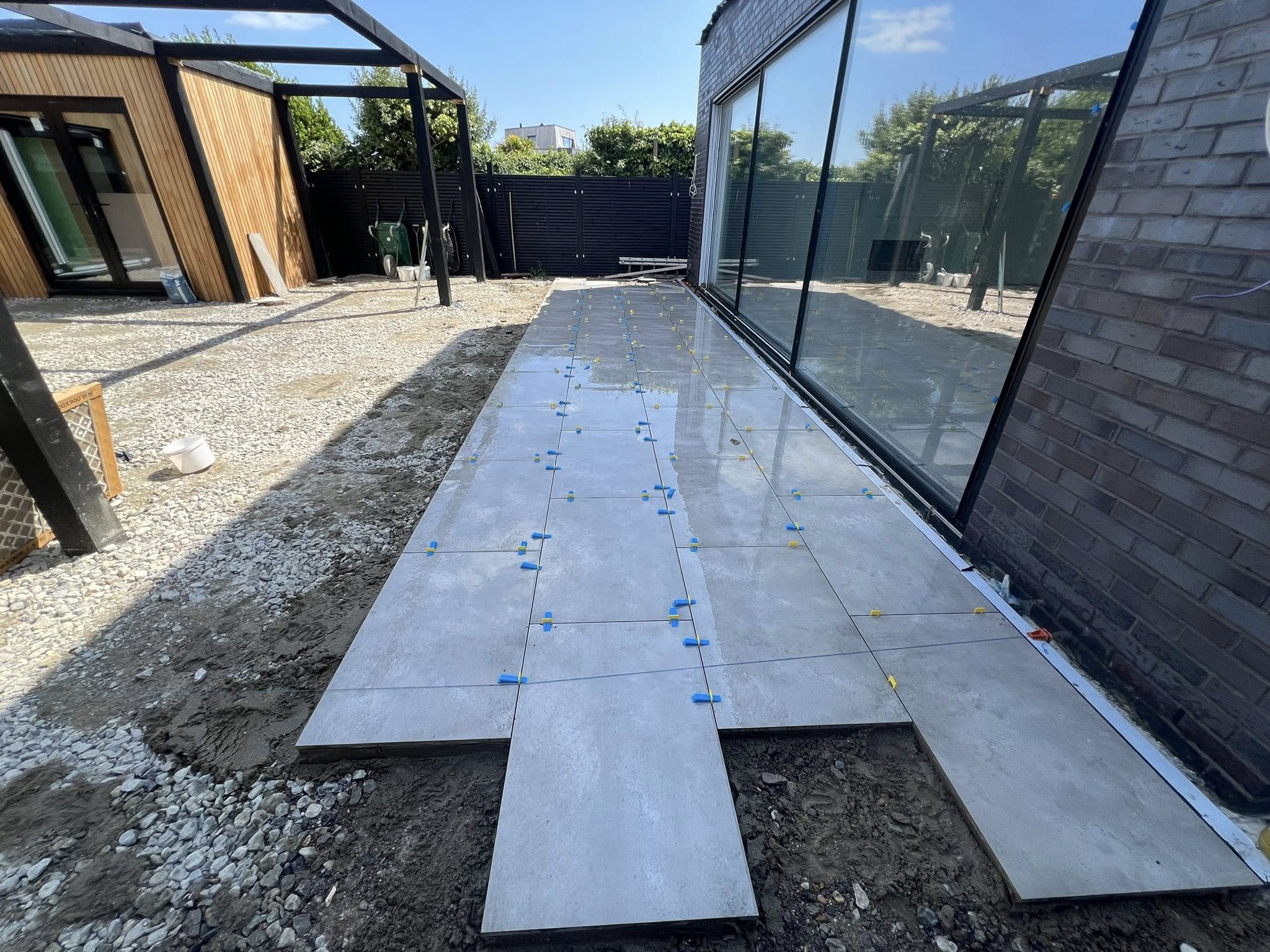
Master the technical engineering standards of luxury porcelain slabbing in Kent: rigid sub-base design, SBR slurry bonding, and SuDS compliance.
The execution of a high-end external porcelain terrace requires a complete pivot from legacy paving practices toward advanced civil installation mechanics. Calibrated vitrified porcelain tiles represent an elite architectural finish, possessing an ultra-low water absorption profile of less than zero point five percent. While this vitrified density makes porcelain structurally impervious to deep frost cracking, algae stains, and chemical erosion, it presents a significant installation challenge: standard sand and cement mortar mixes cannot form a natural material bond with the vitrified tile backing.
Across residential landscapes, treating porcelain paving like standard porous concrete slabs or soft sandstone flags will lead to late-stage failure. Without a chemically engineered mechanical adhesion interface, seasonal temperature fluctuations will cause the tiles to completely delaminate from their base plates, resulting in rocking slabs, cracked grout lines, and structural surface failure.
This comprehensive technical manual details the rigid sub-base engineering, polymer-modified slurry bonding systems, and execution protocols required to deliver pristine luxury porcelain slabbing kent assets.
1. Subgrade Management and Granular Sub-Base Stabilization
A premium porcelain surface is only as unyielding as the subterranean civil foundation layers supporting it. Porcelain tiles possess immense tensile compressive strength but have zero structural flexibility; any minor movement within the underlying ground strata will immediately translate upward, fracturing the surface joints.
Navigating Highly Expansive Subgrade Clays
Constructing hardscape terraces across regional gardens frequently requires interfacing with challenging ground profiles, particularly the heavy, over-consolidated Wealden and London clay shelves. Clay strata possess highly volatile volumetric expansion indexes, expanding during wet winter months and shrinking during summer dry spells.
To decouple the finished patio plate from these ground movements, the excavation phase must strip away all soft, organic topsoils until exposing a stable subgrade soil table.
The excavation footprint is treated with a heavy-duty, non-woven geotextile membrane sheet to prevent the natural clay from migrating upward into the clean aggregates. Directly over this barrier, a minimum of one hundred and fifty millimeters of tightly graded Type 1 Granular Sub-Base aggregate is deposited and processed using heavy mechanical vibrating plate compactors until achieving maximum dry density. This compacted stone matrix creates an unyielding sub-base platform that distributes load paths uniformly across the earth.
2. The Rigid Bedding Matrix and Wet Mortar Calibrations
Porcelain paving must never be laid using a legacy spot-bedding technique—often referred to as the "dot and dab" method. Leaving open air voids beneath a vitrified porcelain tile creates concentrated stress hotspots.
When heavy patio furniture or structural maintenance ladders are placed over these hollow zones, the tile will instantly crack under point-load tension forces. Furthermore, subsurface water pools inside these voids during autumn rain events; when a winter freeze hits, the trapped water expands, applying massive upward hydraulic pressure that shears the tile from its bedding layer.
Calibrating the Full-Contact Support Bed
The porcelain units must be laid on a continuous, full-contact supporting mortar bed with a uniform thickness ranging between thirty-five millimeters and fifty millimeters. The structural bedding mixture must be specified as a semi-wet, high-permeability sand and cement matrix mixed to a strict four-to-one ratio using washed sharp sand and high-grade Portland cement.
The moisture content of the mortar must be carefully managed on site: it must hold sufficient hydration to trigger full chemical curing while remaining dry enough to prevent excessive shrinking or slump displacement during initial leveling passes.
This rigid mortar configuration provides complete, uniform contact across the base of the tile, eliminating point-load vulnerabilities and ensuring absolute surface flatness.
3. SBR Slurry Bonding Mechanics and Chemical Adhesion Interfaces
Because vitrified porcelain tiles are fired at extreme temperatures exceeding twelve hundred degrees Celsius, their mineral structure fuses into a smooth, glass-like composite. This process eliminates internal capillaries, meaning the tile cannot absorb water or draw raw cement pastes into its rear face. If a tile is laid straight onto a standard sand and cement mortar bed, it will fail to bond, separating cleanly the moment the mortar dries.
The Styrene-Butadiene Rubber Mechanical Shield
To bridge this adhesion gap, installers must apply a specialized polymer-modified bonding interface, universally known as an SBR slurry primer. Styrene-Butadiene Rubber is a high-performance liquid polymer emulsion that exhibits extreme water resistance, chemical stability, and exceptional adhesive properties.
+-----------------------------------------------------------------------+
|                    THE SBR ADHESION MOLECULAR INTERFACE               |
+-----------------------------------------------------------------------+
|                                                                       |
|   [ VITRIFIED PORCELAIN TILE ASSET ]                                  |
|   =================================================================   |
|   [ POLYMER-MODIFIED SBR SLURRY COATING: 1mm to 2mm Film Shield ]      |
|   =================================================================   |
|   [ HIGH-DENSITY FOUR-TO-ONE SHARP SAND MORTAR BEDDING PLATFORM ]     |
|   +---------------------------------------------------------------+   |
|                                                                       |
+-----------------------------------------------------------------------+
The primer is prepared by blending pure liquid SBR latex with neat Portland cement powder until achieving a thick, paint-like consistency. Immediately before setting a tile down onto the fresh mortar bed, this slurry mixture is applied across the entire rear face of the porcelain unit using a heavy-bristle brush or notched trowel to form a continuous one-to-two-millimeter film layer.
The tile must be laid while the slurry coating is wet. The SBR polymers chemically lock into the cement crystals of both the slurry layer and the wet bedding mortar simultaneously, creating an unbreakable mechanical bond that anchors the vitrified tile permanently to the rigid base platform, resisting severe thermal shear stresses.
4. Grouting Systems and Geometric Expansion Joint Profiles
The spacing and selection of grouting compounds between luxury porcelain tiles are critical to accommodate the natural thermodynamic expansion profiles of the finished platform.
High-Performance Polymeric Joint Enclosures
Porcelain tiles must never be butt-jointed—laid tight against one another with zero joint gap. Even the most highly calibrated tiles exhibit micro-dimensional variances, and laying them without joints will result in chipped tile edges as the slabs press together under solar heat loads.
The structural design requires a continuous, uniform joint profile with a minimum width of three millimeters to five millimeters, maintained using precision plastic spacers throughout the laying phase.
+-------------------------------------------------------------------------+
|                  GROUTING & HARDSCAPE SPECIFICATION PROFILE             |
+-------------------------------------------------------------------------+
| Joint Compound Class| Water Permeability Index | Optimal Hardscape Zone |
+---------------------+--------------------------+------------------------|
| Resin Polymeric Sand| High Permeability Flows  | Standard Garden Paths  |
| Cementitious Resin  | Absolute Impermeable Shield| Luxury High-Load Patios|
| Two-Part Epoxy Core | Ultimate Chemical Block  | Commercial Plazas      |
+---------------------+--------------------------+------------------------+
For luxury domestic hardscapes, the joints should be sealed using high-performance polymer-modified cementitious grouts or structural two-part epoxy compounds. These materials cure into an impermeable, high-density matrix that repels surface water ingress, prevents weed root development, and withstands modern heavy-duty pressure washing equipment without eroding.
Setting the Structural Expansion Bounds
A common mistake across large-scale hardscape plans is constructing expansive tile runs without localized stress-relief zones. During summer peaks, a large porcelain patio platform absorbs immense solar heat loads, experiencing significant lateral thermal expansion.
To prevent the patio from buckling or lifting, the layout must incorporate continuous expansion joints at maximum horizontal intervals of six meters. These movement joints must cut completely through both the tile layer and the underlying mortar bed, sealed with high-flexibility polyurethane or structural silicone compounds to absorb lateral shifting and protect the global landscaping kent framework from structural damage.
5. Civil Hydraulic Routing and SuDS Compliance Frameworks
Every high-end hardscape transformation must balance surface aesthetics with advanced drainage engineering. Because porcelain surfaces are completely non-porous, one hundred percent of the rainwater hitting the patio turns into immediate surface water sheets that must be managed to protect nearby residential structures.
Calibrating Surface Gradients and Fall Lines
To prevent unmanaged surface flooding and dangerous standing water hazards, the porcelain terrace must be designed with a continuous, precise drainage fall gradient. The platform must drop at a minimum slope profile of one in eighty—equal to twelve point five millimeters of vertical fall for every one meter of horizontal length.
This drainage fall must always be angled to route water sheets completely away from primary house walls, structural structural brickwork kent extensions, and neighboring boundaries.
+-----------------------------------------------------------------------+
|                    FLUSH THRESHOLD DRAINAGE INTEGRATION               |
+-----------------------------------------------------------------------+
|                                                                       |
|     [ ROOF RUNOFF FLUID ] ===> [ FLUSH PORCELAIN PATIO PLATFORM ]     |
|                                                    ||                 |
|                                                    v  1:80 Fall Slope |
|                                      +--------------------------+     |
|                                      | LINEAR SLOT CHANNELS     |     |
|                                      +--------------------------+     |
|                                                    ||                 |
|                                                    v                  |
|                              +----------------------------------+     |
|                              | SUBTERRANEAN ATTENUATION CRATE   |     |
|                              | RESERVOIR CELLS (SuDS COMPLIANT) |     |
|                              +----------------------------------+     |
|                                                                       |
+-----------------------------------------------------------------------+
Implementing SuDS Stormwater Management Arrays
To comply with Sustainable Drainage Systems (SuDS) planning mandates, surface water runoff must be handled within the boundaries of the home asset rather than discharging into overloaded public sewer networks.
At the low end of the patio fall line, the layout must incorporate high-capacity stainless steel linear slot drainage channels running parallel to the edge. These slot drains collect immediate surface water sheets and route them downward into subterranean stormwater attenuation crate arrays wrapped in permeable geotextile filtration fabrics.
These underground collection cells temporarily hold high water volumes during intense storm events, letting the fluid slowly soak back into the natural ground table at a controlled pace, protecting nearby high-load driveways and structural foundations from hydrostatic water pressures.
6. Comprehensive Operational Phased Lifecycle for Porcelain Slabbing
To ensure that every material check, sub-base compaction pass, and SBR slurry bond interfaces flawlessly throughout the project timeline, site management teams must execute a highly structured, phased construction framework.
Phase 1: Site Geotechnical Surveys, Volumetric Digs, and Layout Checks
Before any tools arrive on site, the structural ground parameters and layout dimensions must be fully checked and verified.
- Subgrade Assessment: Audit the raw soil parameters to confirm the target excavation depths required to completely bypass soft organic topsoils and expose stable subgrade clay strata.
- Volumetric Ground Excavations: Deploy compact excavators to cut out the design footprint, creating a uniform excavation depth to accommodate the multi-layer stone base, and route all waste soil away via certified muck-away loops.
- Laser Slope Calibrations: Establish precision multi-axis laser lines across the footprint to map the exact one-in-eighty drainage fall lines away from structural wall boundaries.
Phase 2: Geotextile Placement, Aggregates Compaction, and Drainage Setups
This phase constructs the unyielding subterranean foundation base and integrates primary water management tracks.
- Geotextile Membrane Layout: Lay out the non-woven geotextile membrane sheets across the leveled earth bed, overlapping all seams by a minimum of three hundred millimeters to isolate the subgrade soils.
- Type 1 Base Compaction: Deposit the granular sub-base aggregate in controlled seventy-five-millimeter layers, using heavy mechanical vibrating plates to compact the stone matrix into an unyielding platform.
- Linear Slot Drain Intersections: Position the high-capacity stainless steel linear slot drainage channels along the low end of the fall lines, linking the tracks directly to subterranean SuDS attenuation crate cells.
Phase 3: Mortar Balancing, SBR Slurry Application, and Tile Setting
The core installation phase where the rigid bedding matrix and chemical slurry bonding coatings are executed.
- Mortar Mix Balancing: Mix the semi-wet four-to-one sharp sand and cement structural bedding mortar, distributing the paste evenly over the stone base to a uniform thickness of forty millimeters.
- Executing the SBR Slurry Bond: Blend pure liquid SBR latex with neat Portland cement to a thick consistency, coating the entire rear face of every porcelain tile with an absolute one-to-two-millimeter film shield immediately prior to laying.
- Precision Tile Setting: Position the coated porcelain tile onto the wet mortar bed, using heavy rubber mallets and mechanical tile leveling clip systems to tap the unit to absolute flat coordinates, keeping joint lines locked via plastic spacers.
Phase 4: Shutter Striking, Joint Grouting, and Handover Protection Protocols
The final technical phase where structural frames are locked, joints are sealed, and surfaces are protected for formal handover.
- Leveling Clip Extractions: Allow the structural bedding matrix to cure undisturbed for a full twenty-four to forty-eight hours before striking temporary edge shuttering frames and extracting the plastic leveling clips.
- Joint Grouting Execution: Pack the open joint gaps completely with high-density polymer-modified cementitious grout matrices, forcing the compound deep into the joints and cleaning away all surface residues before curing.
- Surface Cleansing and Handover Protection: Wash the finished porcelain platform with mild acid cleaner treatments to remove invisible cement films, and cover the entire terrace with thick impact-protection mats to safeguard the pristine asset until final handover.