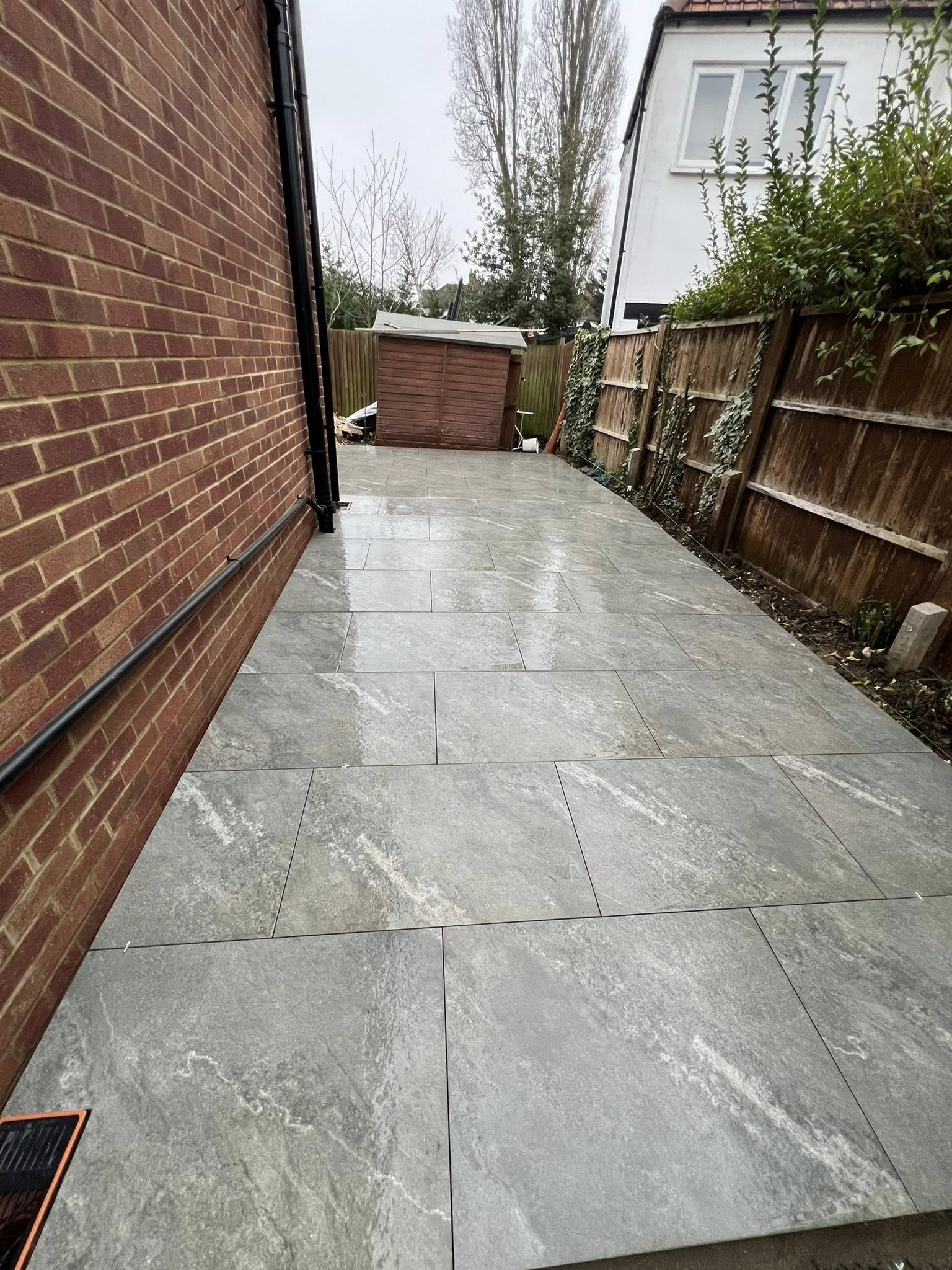
Master the technical engineering standards of natural stone slabbing in Kent: sawn sandstone calibrations, SBR priming, and permeable grouting.
The specification and installation of premium natural stone slabbing across high-end exterior landscapes require a deep understanding of geology, material porosity, and architectural masonry. Unlike factory-manufactured vitrified porcelain, natural stone modules—such as diamond-sawn Indian sandstone, Yorkstone flags, and metamorphic granite setts—are physically dynamic, open-textured materials. Natural stone possesses an interconnected network of internal capillaries that allow the material to breathe, absorb ambient moisture, and interact directly with the underlying chemistry of the bedding plane.
Across residential installations, treating natural stone paving exactly like an engineered porcelain tile or a basic concrete slab will cause catastrophic structural and aesthetic defects. Failing to neutralize subgrade minerals, apply protective rear-face block primers, or deploy vapor-permeable jointing matrices will lead to irreversible "picture-framing" moisture stains, subsurface iron oxidation (rust tracking), and frost-shattered pavement profiles. This technical manual details the foundational engineering, capillary containment mechanics, and structural execution workflows required to deliver unyielding natural stone slabbing kent assets.
1. Subgrade Profiling and Capillary Moisture Isolation Across regional Clays
A high-performance natural stone terrace depends on the load-bearing capacity and stability of the subterranean civil foundations supporting it. Because natural stone flags possess variable tensile flexural strengths compared to uniform vitrified materials, any uneven shifting within the underlying ground layers will quickly cause the flags to rock, drop, or snap under load.
Mitigating Groundwater capillary Action in Volatile Soils
Civil crews across the South East routinely build over highly volatile, high-plasticity clay tables, such as the regional Wealden and London Clay beds. Clay formations act as massive moisture reservoirs, retaining high water volumes during wet winter months and shrinking aggressively during dry summer spells.
When a natural stone terrace is positioned over these clay zones, groundwater tries to migrate upward through capillary action. If this moisture carries dissolved alkalis and mineral salts from the clay subgrade up into the porous stone body, it triggers efflorescence—leaving heavy white salt crusts on the stone face that spoil the luxury architecture.
To isolate this moisture path, the bulk excavation phase must cut back all soft topsoils to establish a stable subgrade table. The raw earth footprint is lined with a heavy-duty, needle-punched non-woven geotextile segregation membrane to prevent fine clay particles from tracking upward into the clean aggregates.
Directly over this barrier, a minimum of one hundred and fifty millimeters of tightly graded Type 1 Granular Sub-Base stone is deposited and compacted using heavy mechanical vibrating plates until maximum dry density is achieved. This compacted granular matrix creates an unyielding foundation cushion that evenly distributes downward vehicle or foot traffic loads while interrupting upward capillary pathways.
2. Bedding Sand Chemistry and Rear-Face Polymer Priming Arrays
Natural stone flags feature natural thickness variations, even when specified as calibrated stone runs. To accommodate these dimensional variances and ensure a perfectly flat final surface, the stone must be laid over a full-contact, continuous wet mortar bedding layer with a uniform thickness ranging between thirty-five millimeters and fifty millimeters.
Defeating the "Picture-Framing" Staining Anomaly
The composition of the structural bedding mortar must be precisely calibrated. The mix must consist of a semi-wet, high-permeability sand and cement matrix mixed to a strict four-to-one or five-to-one ratio using clean, washed sharp sand and high-grade Portland cement.
Low-tier builders frequently use unwashed building sands or add random dabs of mortar to the stone corners. This must be strictly rejected; building sand contains high silt and iron contents that leach upward into the porous stone, creating a dark, oily perimeter stain around every flagstone edge—a structural defect known as picture-framing that cannot be chemically removed.
+-----------------------------------------------------------------------+
|                    THE NATURAL STONE PICTURE-FRAMING PROTECTION LAYER |
+-----------------------------------------------------------------------+
|                                                                       |
|   [ OPEN-TEXTURED POROUS NATURAL STONE FLAG ]                         |
|   =================================================================   |
|   [ POLYMER-MODIFIED SBR EXTRACT BARRIER: 2mm PRIMER COATING ]        |
|   =================================================================   |
|   [ CALIBRATED WASHED SHARP SAND STRUCTURAL BEDDING MORTAR ]          |
|   +---------------------------------------------------------------+   |
|                                                                       |
+-----------------------------------------------------------------------+
To permanently seal out mineral staining vectors, every natural stone unit must have a specialized polymer-modified Styrene-Butadiene Rubber (SBR) slurry primer coat applied across its entire rear face immediately before being set down onto the wet mortar bed.
The SBR latex forms an absolute barrier layer across the stone's base capillaries. This primer block prevents the porous stone from sucking up staining alkalis, water-soluble iron compounds, and moisture lines from the curing bedding mortar below, ensuring the natural stone preserves its authentic mineral tones across its entire life cycle.
3. Sawn Sandstone Calibrations, Granite Sett Edge Bounds, and Masonry Alignments
The structural durability of a natural stone layout relies heavily on the geometric cutting profiles specified and the mechanical stability of its perimeter edge restraints.
Diamond-Sawn Edge Calibrations vs. Hand-Riven Flags
Modern luxury hardscaping frequently specifies six-side diamond-sawn natural stone flags. Sawn stone features perfectly straight, crisp rectangular edge lines cut with millimeter precision at the quarry, allowing the paving team to construct ultra-tight joint fields of three millimeters to five millimeters.
Hand-riven flags, by comparison, carry natural hand-tapered edges that require wider joint fields of ten millimeters to fifteen millimeters to manage edge variances. Regardless of the stone type, the flags must be laid across a strict staggered brick-bond or random multi-size layout pattern, ensuring that no continuous straight joint lines cross through the platform to prevent lateral structural shifting.
+-------------------------------------------------------------------------+
|                  NATURAL STONE SELECTION & PERFORMANCE PROFILE          |
+-------------------------------------------------------------------------+
| Mineral Variant    | Core Porosity Index Rating | Primary Hardscape Zone|
+--------------------+----------------------------+-----------------------|
| Sawn Sandstone     | High Capillary Porosity     | Premium Garden Patios |
| English Yorkstone  | Medium Structural Density  | Historic Courtyards   |
| Metamorphic Granite| Ultra-Low Porosity Matrix  | Heavy Vehicular Lanes |
| Calibrated Limestone| High Calcium Carbonate Base| Shaded Courtyards     |
+--------------------+----------------------------+-----------------------+
Locking Boundaries with Granite Sett Edgings
A flexible or semi-rigid natural stone platform will fall apart rapidly if its boundaries are allowed to spread laterally under foot or vehicle loads. Where the stone slabbing borders open turf grass lawns or soft flowerbeds, the perimeters must be locked using heavy-duty metamorphic granite setts or structural stone kerbs.
The boundary setts must be bedded onto a continuous reinforced concrete foundation haunching base using high-strength C20 concrete mixes. This perimeter haunch acts as a structural anchor that holds the stone field tight, resisting lateral forces from heavy winter frosts and ensuring the integrity of the global landscaping kent profile.
4. Permeable Polymeric Grouting vs. Dense Cementitious Joint Enclosures
Because natural stone is a porous geological asset that absorbs rain water, the joints separating the flags must be engineered to match the natural breathing characteristics of the stone body.
The Advantage of Permeable Polymeric Sands
Sealing a highly porous sawn sandstone patio with dense, non-permeable Portland cement mortars is an incorrect intervention. A non-porous joint blocks horizontal moisture movement; when rain saturates the patio, water gets trapped beneath the flags with no escape route.
During winter freeze-thaw cycles, this trapped moisture turns to ice and expands, applying intense upward hydraulic pressure that pops the stone cleanly off its bedding matrix.
+-----------------------------------------------------------------------+
|                    PERMEABLE POLYMERIC JOINT VAPOR OUTFLOW            |
+-----------------------------------------------------------------------+
|                                                                       |
|   [ SANDSTONE FLAG ]     | PERMEABLE JOINT |     [ SANDSTONE FLAG ]   |
|   Porous Mineral Core    |  POLYMERIC SAND |     Porous Mineral Core  |
|   ====================>  |  VAPOR CHANNEL  |  <====================   |
|   Absorbs Water Sheets   |                 |     Absorbs Water Sheets |
|                          | (Free Evap Run) |                          |
|                          +-----------------+                          |
|                                                                       |
+-----------------------------------------------------------------------+
To keep water moving freely, natural stone joints should be sealed using high-performance permeable polymeric jointing sands or advanced resin-bound aggregate compounds. These grouting matrices cure into a flexible structure that allows surface water sheets to filter straight through the joints down into the open aggregate base below, while letting subterranean vapor vent safely into the air.
This permeability eliminates hidden water buildup, completely protects the stone from frost-heave delamination, and prevents aggressive weed root development between the flags.
5. Seamless Multi-Surface Interfaces with Retaining Walls and Building Basins
The definitive marker of an elite turnkey installation is how cleanly the natural stone slabbing transitions into adjoining structural masonry and primary residential building assets.
Preventing Moisture Bridging across Residential Brickwork
Where a new natural stone terrace is built flush with the interior floor lines of a home extension, the damp proof course (DPC) connection must be carefully managed. If the stone platform is set too high against an unprotected external brick leaf, rainwater splashing off the terrace will bridge the DPC line, tracking inside to ruin internal plasterboards.
The finished stone surface must maintain a clear vertical drop of at least one hundred and fifty millimeters below the DPC threshold.
Furthermore, the wall base must incorporate heavy-duty linear slot drainage channels connected to active Sustainable Drainage Systems (SuDS) to intercept immediate surface water sheets. Every adjacent brick structure must conform exactly to premium structural brickwork kent standards, ensuring that any adjoining retaining masonry leaves use breathable joints to prevent moisture trapping along the building line.
+-----------------------------------------------------------------------+
|                    NATURAL STONE AND BRICK BOUNDARY HANDSHAKE         |
+-----------------------------------------------------------------------+
|                                                                       |
|   [ STRUCTURAL BRICKWORK ]  |  [ LINEAR SLOT DRAIN ]  | [ STONE PATIO ]|
|   - Breathable Mortar Joint |                         | - Sawn Stone   |
|   - 150mm Clear Drop        |   ===================   | - Permeable G  |
|                             |   |                 |   | - 1:80 Fall    |
|   ==== GROUND LEVEL ========|===|  SLOT CHANNEL   |===|=============   |
|                             |   +-----------------+   |                |
|                             |            ||           |                |
|                             v            v            v                |
|             [ DISCHARGES SAFELY TO SUBTERRANEAN SuDS ATTENUATION ]    |
|                                                                       |
+-----------------------------------------------------------------------+
Eliminating Mortar Staining Risks from Adjacent Brickwork
A primary hazard during large-scale construction transformations is the sloppy management of masonry mortars near premium stone patios. If wet cement pastes from building projects drop onto unsealed sawn sandstone, the stone’s open capillaries will suck the alkaline lime slurry deep into its core.
Once dry, this cement stain forms a permanent chemical bond that dulls the stone's appearance and requires intense acid washing or mechanical grinding to remove, which ruins the stone's surface texture.
To preserve the asset, the entire paving footprint must be fully protected with heavy-duty geotextile sheets throughout any adjacent building work, ensuring the property is handed over in flawless condition, matching the quality standards used across premium driveways and structural landscapes.
6. Comprehensive Operational Phased Lifecycle for Natural Stone Slabbing
To ensure that every subgrade compaction pass, SBR primer application, and jointing sweep matches civil engineering benchmarks, site management must execute a strict, phased construction framework.
Phase 1: Geotechnical Testing, Volumetric Excavations, and Layout Checks
Before any heavy mechanical plant enters the workspace boundary, the site's ground parameters and layout markings must be fully checked and verified.
- Subgrade Soil Assessments: Inspect the raw soil profiles to confirm California Bearing Ratio readings and check localized clay shrinkage ranges.
- Volumetric Earth Extractions: Deploy tracked excavators to clear away topsoils and execute bulk grade cuts, routing all un-useable soil spoils away via certified muck-away transport loops.
- Laser Fall Calibrations: Establish multi-axis laser lines across the terrace footprint to map the exact one-in-eighty drainage fall slope away from structural home frames.
Phase 2: Geotextile Placement, Aggregate Compaction, and Edge Restraints
This phase constructs the unyielding subterranean foundation base and locks the structural boundaries.
- Geotextile Membrane Layout: Lay out the non-woven geotextile segregation sheets across the leveled clay bed, overlapping all seams by a minimum of three hundred millimeters to isolate the earth.
- Type 1 Sub-Base Compaction: Deposit the granular aggregate base in controlled seventy-five-millimeter layers, using heavy mechanical vibrating plates to compact the stone matrix into an unyielding platform.
- Granite Sett Edge Construction: Install the heavy-duty perimeter granite setts along a continuous line of C20 structural concrete haunching to prevent lateral boundary spreading.
Phase 3: Mortar Balancing, SBR Primer Application, and Stone Setting
The core installation phase where the full-contact bedding layer and rear-face polymer priming are executed.
- Mortar Mix Balancing: Mix the semi-wet four-to-one sharp sand and cement structural bedding mortar, distributing the paste evenly over the stone base to a uniform thickness of forty millimeters.
- Executing the SBR Rear Prime: Blend pure liquid SBR latex with neat Portland cement to a thick consistency, coating the entire rear face of every flagstone with an absolute two-millimeter film shield immediately prior to laying.
- Precision Stone Setting: Position the coated flagstone onto the wet mortar bed, using heavy rubber mallets and mechanical alignment bars to tap the unit to flat coordinates, keeping joint lines locked via spacers.
Phase 4: Joint Sealing, Surface Cleansing, and Handover Protection Protocols
The final technical phase where joints are permanently sealed, surfaces are chemically cleaned, and protection systems are deployed for handover.
- Polymeric Joint Grouting: Sweep the high-performance permeable polymeric jointing sand or resin-bound compound deep into the open joint channels, ensuring the gaps are fully packed to eliminate air voids.
- Face Cleansing Treatments: Clean the finished stone platform with specialist natural stone wash treatments to remove trace sand films and highlight the authentic mineral tones of the stone body.
- Handover Surface Protections: Cover the completed terrace with thick impact-protection mats to safeguard the pristine natural stone asset from accidental tool drops or traffic marks until final handover.