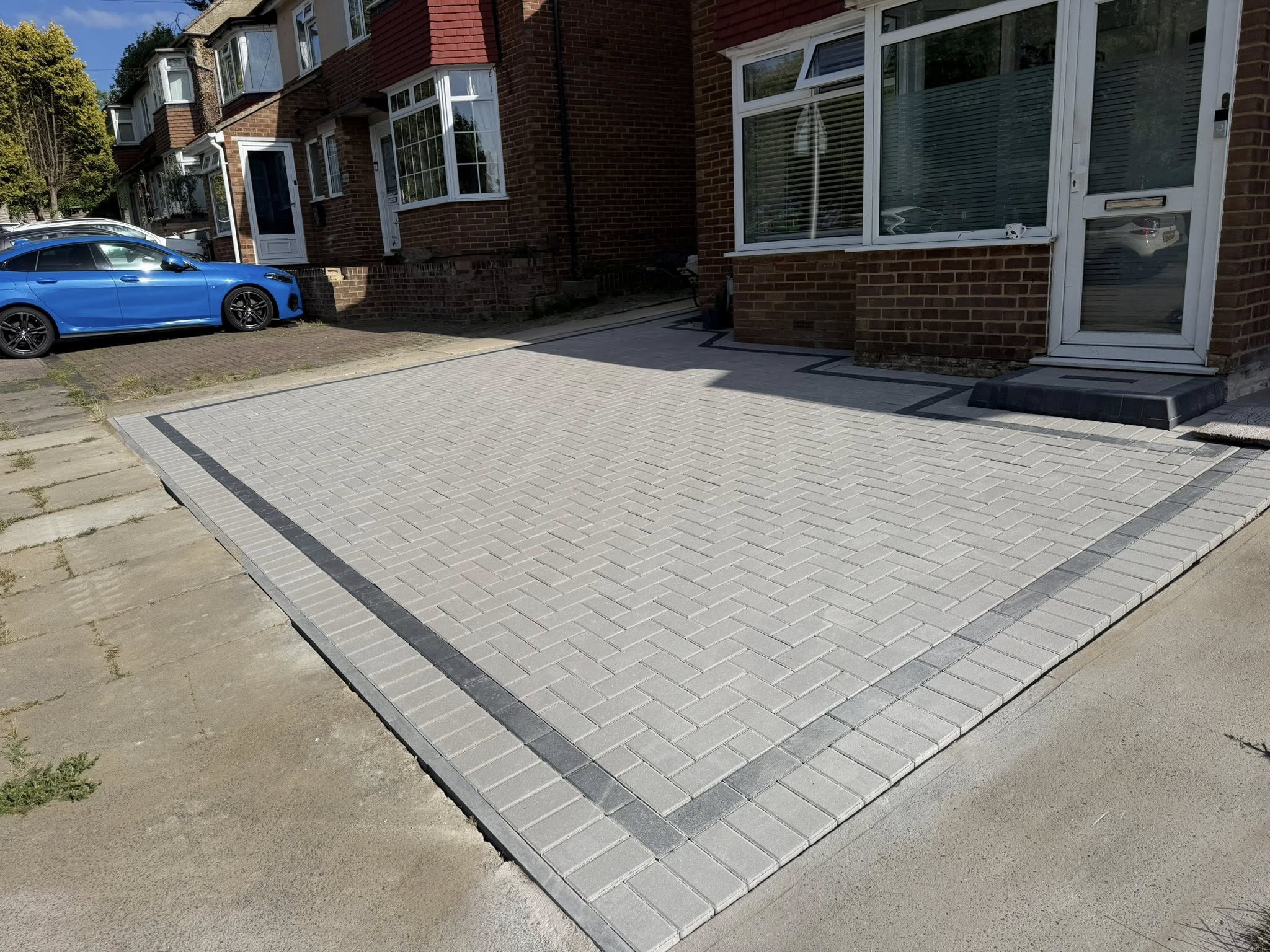
Master the technical engineering standards of flexible block paving driveways in Kent: BS 7533 compliance, open-graded sub-bases, and SuDS codes.
The engineering and construction of high-end domestic driveways and heavy-use vehicular hardscapes require a total shift from standard pedestrian paving methods. A domestic driveway is a structural pavement subject to severe dynamic loading, rotational tire shear stresses, and heavy structural dead loads from passenger vehicles, commercial delivery trucks, and maintenance equipment.
Across Kent and the South East, treating a high-traffic driveway layout as a basic decorative landscape project rather than a load-bearing civil asset will trigger swift structural failure. Without a mathematically calibrated granular foundation matrix, appropriate bedding sand selections, and active drainage controls, the pavement will rapidly succumb to structural rutting (dipping along wheel tracks), block displacement, and edge-restraint blowout.
This technical manual details the rigid sub-base mechanics, BS 7533 compliance criteria, jointing stability profiles, and structural execution workflows required to deliver unyielding permeable block paving driveways kent assets.
1. Structural Pavement Mechanics: The Core Principles of BS 7533
The baseline engineering and material criteria for building durable concrete block driveways are strictly governed by the BS 7533 British Standard series. This civil design code details the exact thickness, layer stratification, and material grading requirements needed to create flexible block pavements capable of distributing heavy structural loads down to the natural ground subgrade without deformation.
The Physics of Flexible Pavement Load Distribution
Unlike rigid reinforced concrete slabs that resist breaking forces through pure tensile bending strength, a concrete block paving driveway operates as a flexible pavement system. The interlocking matrix of individual concrete pavers, jointing sands, and laying beds works collectively to scatter concentrated downward vertical tire loads outward at a wide angle.
+-----------------------------------------------------------------------+
|                    BS 7533 FLEXIBLE PAVEMENT MASS DISPERSION          |
+-----------------------------------------------------------------------+
|                                                                       |
|                     [ CONCENTRATED TIRE POINT LOAD ]                  |
|                                    ||                                 |
|                                    v                                  |
|         +--+--+--+--+--+--+--+--+--+--+--+--+--+--+--+--+             |
|         | INTERLOCKING CONCRETE BLOCK DRIVEWAY MATRIX   |             |
|         +--+--+--+--+--+--+--+--+--+--+--+--+--+--+--+--+             |
|                       /                          \                    |
|                      /                            \  Lateral Load     |
|                     /                              \ Dispersion Cone  |
|         +------------------------------------------------------+      |
|         | COMPACTED OPEN-GRADED AGGREGATE RESERVOIR CORE BASE  |      |
|         +------------------------------------------------------+      |
|                                    ||                                 |
|                                    v Uniformly Attenuated Pressure    |
|         [ STABILIZED UNYIELDING GEOLOGICAL SUBGRADE EARTH ]           |
|                                                                       |
+-----------------------------------------------------------------------+
This load-dispersion cone ensures that by the time the vertical compression force reaches the underlying natural earth table, the pressure intensity has been dramatically reduced below the maximum bearing threshold of the soil.
To maintain this interlock, the paving blocks must be placed with a high-density vertical aspect ratio, specifying a block depth of sixty millimeters for domestic driveways subject to passenger vehicles, or eighty millimeters for heavy commercial access lanes and shared logistics spaces.
2. Navigating Regional Clay tables and Granular Sub-Base Stabilization
The longevity of a flexible vehicular pavement is entirely determined by the structural capacity of the subterranean foundation layers. If the underlying soil mass moves or yields under pressure, the upper paving layer will cave inward along the wheel tracks.
Managing High-Plasticity Wealden and London Clays
Construction teams across Kent frequently interface with challenging geological formations, notably the over-consolidated Wealden and London Clay shelves. Clay profiles present low natural water filtration rates and a high plasticity index, meaning they experience severe volumetric shifts based on seasonal moisture tracking, expanding during wet winters and shrinking into deep cracks during dry summers.
To ensure a permanent subgrade platform, the bulk excavation phase must cut away all soft topsoils, clearing the ground down to a stable subgrade table. The raw earth bed is thoroughly processed with heavy mechanical vibrating compactors to maximize its dry density.
The site team must manually audit the ground stability, performing penetrometer passes to verify that the California Bearing Ratio (CBR) satisfies design requirements before depositing any structural aggregates.
3. Hydrological Engineering and Sustainable Drainage (SuDS) Compliance
Erecting non-porous vehicular driveways that shed heavy rainwater directly onto public highways or into overloaded municipal sewer lines is strictly restricted under current national planning guidelines. All new or replacement front driveways must fully conform to Sustainable Drainage Systems (SuDS) criteria.
The Mechanics of Permeable Granular Reservoir Bases
To satisfy SuDS compliance without requiring expensive, unsightly catch-pits or surface drainage gullies, modern driveways utilize fully permeable infiltration architectures. The structural sub-base is engineered to function as an underground water-retention reservoir cell.
+-------------------------------------------------------------------------+
|                  SUDS PERMEABLE AGGREGATE CORE STRATIFICATION           |
+-------------------------------------------------------------------------+
| Layer Ordering     | Material Metric Formulation    | Civil Function    |
+--------------------+--------------------------------+-------------------|
| 1. Surface Leaf    | 60mm Permeable Concrete Blocks | High-Load Wear Sk |
| 2. Laying Bed      | 4mm to 6mm Washed Angular Grit | Sharp Sand Void F |
| 3. Upper Sub-Base  | 4mm to 20mm Clean Aggregate    | Structural Stabil |
| 4. Reservoir Base  | 40mm to 75mm Clean Granite     | 30% Water Void Ce |
| 5. Isolation Shield| Needle-Punched Geotextile Mat | Restricts Clay Mi |
+--------------------+--------------------------+-------------------------+
Traditional MOT Type 1 aggregate—which contains a dense blend of sand and fine dust particles—must be entirely barred from permeable driveway specifications. The dust fines pack together, sealing the sub-base and blocking water movement. Instead, the foundation core must utilize open-graded aggregates specified as MOT Type 3 or washed angular stones distributed from forty millimeters down to seventy-five millimeters.
This clean aggregate matrix contains zero fine dust particles, leaving open pathways between the interlocking stones. This configuration delivers a continuous thirty percent internal void ratio across the sub-base, creating an invisible subterranean retention tank that captures torrential rainfall sheets, holding the fluid temporarily before letting it slowly percolate back down into the natural subgrade soil table.
4. Bedding Sand Metrics, Layout Configurations, and Interlocking Joint Stability
Once the open-graded aggregate reservoir platform has been mechanically locked via heavy compaction passes, the team constructs the fine upper screed bedding layer to prepare for paver placement.
Calibrating the Grit Bed and 45-Degree Herringbone Layouts
The screed bed must consist of a completely washed four-to-six-millimeter angular grit or coarse sand material, laid to a strict, uniform thickness of thirty millimeters. Fine building sands must be rejected; they turn to a liquid paste when exposed to moisture tracking, resulting in rapid block shifting and under-tile voiding.
For high-load vehicular surfaces, the concrete blocks must be placed in a 45-Degree Herringbone pattern. Running-bond or basic stacked linear patterns look attractive but fail under heavy vehicle traffic.
When a vehicle accelerates, brakes, or turns its steering wheel sharply on a driveway, it applies intense horizontal twisting forces (shear stresses) across the blocks.
+-----------------------------------------------------------------------+
|                    45-DEGREE HERRINGBONE SHEAR DEFENSE VECTOR         |
+-----------------------------------------------------------------------+
|                                                                       |
|          / \       / \       / \       / \   45-Degree Block Angle    |
|         /   \_____/   \_____/   \_____/   \                           |
|         \   /     \   /     \   /     \   /                           |
|          \_/       \_/       \_/       \_/                            |
|             ||                  ||            Interlocking Joints     |
|             ==> VEHICLE TURN    ==> BRAKING   Distribute Forces       |
|                 SHEAR STRESS        FORCE     Multi-Directionally     |
|                                                                       |
+-----------------------------------------------------------------------+
A 45-Degree Herringbone layout ensures that every block is mechanically interlocked along all four edges by adjacent pavers. This multi-directional locking network distributes structural lateral shear stresses uniformly across the entire driveway platform, preventing individual blocks from creeping forward or tilting out of alignment.
Activating the Jointing Lock and Edge Restraints
The gaps between the pavers must be packed tight with clean, dry silica sand, or specialized aggregate jointing grains for permeable blocks. The entire surface is compressed using heavy mechanical vibrating plate compactors fitted with thick rubber protection mats to prevent block face scratching.
The intense vibration forces the jointing sand deep into the gaps, locking the pavers into a single cohesive structural sheet.
Crucially, a flexible block pavement will fall apart instantly if its boundaries are allowed to spread laterally. The entire perimeter of the driveway must be enclosed by heavy-duty concrete kerbs or structural block edgings bedded onto thick, continuous reinforced concrete haunching bases.
These edge restraints act as structural anchors that hold the interlocking block field tight under continuous vehicular load cycles, protecting the global landscaping kent transformation from boundary edge blowout.
5. Seamless Multi-Surface Interfaces with Adjoining Retaining Walls and Porcelain Slabs
The absolute hallmark of an elite turnkey installation is how cleanly the high-load vehicular driveway interfaces with nearby pedestrian terraces and primary structural building lines.
Protecting Adjoining Luxury Porcelain Slabs
Where a heavy-duty permeable driveway borders a delicate pedestrian relaxation terrace, the transition must be engineered to handle water runoff profiles cleanly. Because adjacent luxury porcelain slabbing kent projects are laid over completely impermeable, solid four-to-one sand and cement mortar beds, rainwater sheets off the porcelain surface rapidly.
The edge interface must incorporate continuous linear slot drainage channels parallel to the boundary. These channels capture immediate surface water sheets and route them directly down into the open-graded aggregate reservoir sub-base beneath the permeable driveway, preventing water tracking from building up hydrostatic pressure against the patio edge.
+-----------------------------------------------------------------------+
|                    VEHICULAR DRIVEWAY & PEDESTRIAN TERRACE INTERFACE  |
+-----------------------------------------------------------------------+
|                                                                       |
|   [ PORCELAIN PATIO ]      | LINEAR SLOT DRAIN | [ PERMEABLE DRIVE ]  |
|   - Impermeable 4:1 Bed    |                   | - 60mm Block Matrix  |
|   - 1:80 Fall Slope        |   =============   | - Open Type 3 Base   |
|   ========================>|   |           |   |                      |
|                            |   SLOT DRAIN  |===> WATER RESERVOIR      |
|                            |   +-----------+   |   ATTENUATION CELL   |
|                                                                       |
+-----------------------------------------------------------------------+
Insulating Structural Residential Brickwork
Where block paving installations border existing properties, timber home frames, or newly constructed extensions, the final surface levels must respect statutory moisture thresholds. Laying a high-load block field directly against an unprotected brick leaf will bridge the building's damp proof course (DPC) line, causing immediate rising damp tracking inside the living spaces.
The driveway surface must maintain a clear vertical drop of at least one hundred and fifty millimeters below the DPC line. Every adjacent brick structure must conform exactly to premium structural brickwork kent guidelines, ensuring that any adjoining boundary walls utilize frost-resistant materials and breathable joints to prevent localized salt scaling along the driveway interface.
6. Comprehensive Operational Phased Lifecycle for Permitted Driveways
To ensure every BS 7533 alignment parameter, aggregate compaction lift, and SuDS drainage pathway interfaces flawlessly throughout the project timeline, site management must execute a strict, phased construction framework.
Phase 1: Site Geotechnical Surveys, Volumetric Excavations, and Plan Checks
Before any heavy mechanical equipment enters the site boundary, the subsurface conditions and design prints must be checked and verified.
- Subgrade Structural Testing: Inspect the raw soil profiles to confirm localized clay load-bearing data and ensure correct calibration of the target excavation depths.
- Volumetric Earth Excavations: Deploy tracked compact excavators to cut out the design footprint, creating a uniform excavation profile to clear away soft topsoils, and route all waste soil away via certified muck-away transport loops.
- Utility Infrastructure Scanning: Scan the entire driveway footprint using high-sensitivity Ground Penetrating Radar (GPR) to map all buried service lines, supply conduits, and water pipes, setting up strict mechanical exclusion zones.
Phase 2: Edge Restraint Installation, Geotextile Placement, and Reservoir Base Compaction
This phase constructs the unyielding structural boundaries and locks the subterranean stone retention core.
- Boundary Kerb Construction: Install the heavy-duty concrete edge restraints along the perimeter, bedding the units on a continuous, thick bed of C20 structural concrete haunching to prevent lateral boundary spreading.
- Geotextile Membrane Layout: Lay out the high-strength, needle-punched geotextile segregation sheets across the leveled earth subgrade bed, overlapping all seams by a minimum of three hundred millimeters to isolate volatile clay matrices.
- Open-Graded Base Compaction: Deposit the clean MOT Type 3 aggregate or washed granite base blocks in controlled seventy-five-millimeter layers, using heavy mechanical vibrating plates to compact the stone matrix into an unyielding reservoir platform.
Phase 3: Screed Screed Calibrations, Herringbone Block Setting, and Joint Sanding
The core installation phase where the interlocking block field is laid and locked to handle severe vehicular loads.
- Grit Screed Bed Calibration: Spread and screed the washed four-to-six-millimeter angular grit bedding sand across the stone platform to a uniform thickness of thirty millimeters, keeping the bed entirely uncompacted prior to paver placement.
- Executing the 45-Degree Pattern: Lay the sixty-millimeter concrete paving blocks across a strict 45-Degree Herringbone layout pattern, using multi-axis laser lines to preserve straight joint courses.
- Joint Sanding and Initial Compaction: Scatter dry silica jointing sand across the completed block field, running a heavy vibrating plate compactor fitted with a rubber protection pad across the surface to force the sand grains deep into the joint tracks.
Phase 4: Final Sand Top-Ups, Multi-Axis Laser Audits, and Handover Approvals
The final technical phase where joints are completely filled, surface levels are audited, and the driveway is signed off for vehicle traffic.
- Joint Top-Up Adjustments: Apply a secondary layer of silica jointing sand over the pavers, sweeping the fine grains into any remaining joint tracks to ensure a complete structural interlock.
- Multi-Axis Level Audits: Execute comprehensive level checks using electronic straight-edge indicators across the entire driveway to confirm uniform slope configurations and ensure free surface water infiltration.
- Surface Cleaning and Handover Sign-Off: Clean away all residual sand lines from the finished blocks and formally sign off the high-performance flexible pavement asset for immediate turnkey vehicular occupancy.