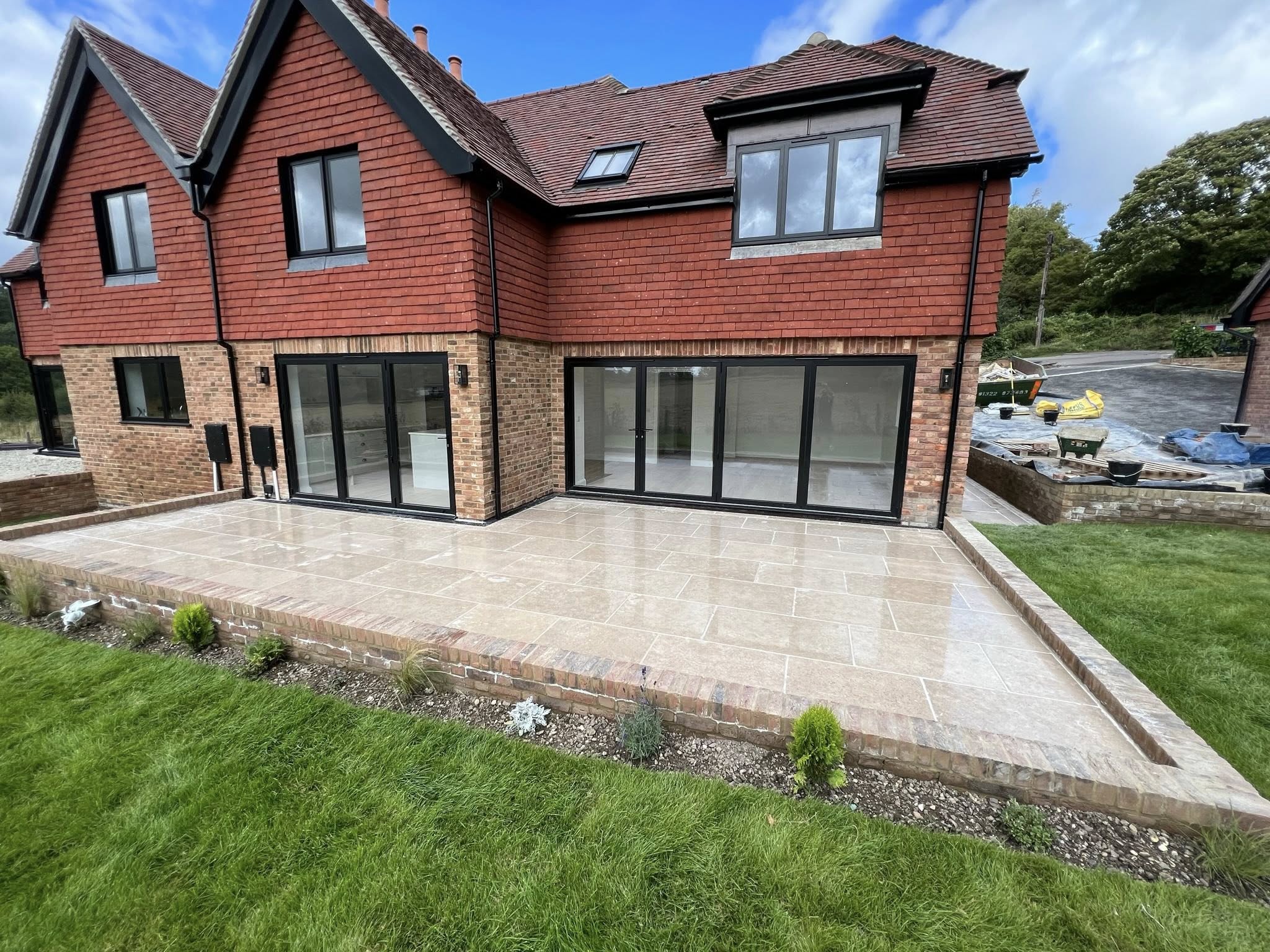
Master the technical standards of residential construction, structural brickwork, foundations, and high-performance property extensions.
The execution of high-caliber residential construction requires absolute precision across multiple engineering and architectural disciplines. Whether embarking on a complex multi-story extension, structural brickwork remediation, or structural hardscaping, the underlying principles of material science, structural mechanics, and legislative compliance remain absolute.
This comprehensive manual serves as a definitive resource for property owners, developers, and asset managers seeking to understand the technical parameters, structural requirements, and best practices that govern high-performance construction across Kent, London, and the wider South East.
1. Structural Brickwork and Masonry Engineering
Masonry remains the foundational element of residential architecture across the United Kingdom. Achieving structural longevity requires an intimate understanding of component materials, thermal movements, and environmental resistance profiles.
Material Selection: Brick Classifications and Performance
The selection of bricks must extend beyond aesthetic consideration to evaluate density, compressive strength, and water absorption rates.
- Facing Bricks: Primarily chosen for external appearance, these units must possess high durability ratings. In the South East, facing bricks are subjected to fluctuating moisture levels and frost cycles. Bricks must be classified as F2 (fully frost resistant) under British Standards to prevent spalling, which is the chipping or flaking of the brick face caused by water freezing within the pore structure.
- Engineering Bricks: These are specialized units manufactured to possess exceptionally high compressive strength and low water absorption characteristics. Class A engineering bricks exhibit a compressive strength greater than 125 Newtons per square millimeter and water absorption below 4.5 percent. Class B engineering bricks present a compressive strength greater than 75 Newtons per square millimeter and water absorption below 7 percent. They are deployed below the damp proof course level, in retaining structures, and across areas exposed to extreme structural loads or hydrostatic pressure.
- Common Bricks: Utilized for internal load-bearing walls where aesthetic finishes are unnecessary, providing excellent structural mass and acoustic insulation.
Mortar Chemistry and Selection Matrices
Mortar binds the masonry units together and acts as a structural buffer to accommodate movement. The use of an incorrect mortar matrix can result in localized stress concentrations, leading to structural cracking or accelerated brick degradation.
- Cement-Based Mortars (OPC): Traditional Ordinary Portland Cement mixes provide high compressive strength and rapid curing times. A standard designation M4 mix (typically a 1 to 4 ratio of cement to sand) is the baseline for general external above-ground masonry. For highly exposed locations or retaining walls below ground level, a designation M12 mix (1 to 3 ratio) is deployed to resist moisture ingress and structural loading.
- Hydraulic Lime Mortars (NHL): For historic properties or structures utilizing softer facing bricks, natural hydraulic lime mortars (specifically NHL 3.5 or NHL 5) are mandatory. Lime mortar is highly vapor-permeable, allowing the building fabric to breathe. It possesses flexible properties that accommodate minor structural settlements without fracturing the brick faces.
Structural Masonry Bonds and Cavity Configurations
The structural integrity of a wall depends on the interlocking arrangement of the bricks, known as the bond pattern.
- Stretcher Bond: The standard configuration for modern cavity walls, where bricks are laid horizontally showing only their long faces. This pattern requires structural wall ties to link the internal and external leafs.
- English Bond: Alternating courses of headers (short faces) and stretchers. This is one of the strongest structural bonds available, frequently utilized in retaining structures, load-bearing solid walls, and decorative structural brickwork.
- Flemish Bond: Alternating headers and stretchers within every single course. This pattern delivers a highly stable structural matrix alongside a traditional architectural appearance.
Modern building envelopes require a dual-leaf cavity wall configuration. The external leaf provides weather protection, the internal leaf handles structural floor and roof loads, and the intervening cavity houses high-performance insulation. This cavity must be bridged by structural stainless steel wall ties conforming to modern performance criteria, spaced at intervals that prevent lateral deflection under extreme wind loads.
Advanced Repointing Techniques and Structural Preservation
Over time, environmental exposure degrades the external mortar matrix, compromising weather proofing and structural load distribution. Repointing is the process of raking out degraded mortar and replacing it with fresh material.
The process demands that existing joints are mechanical cut or hand-raked to a uniform depth, typically twice the width of the joint or a minimum of 15 millimeters. The back of the joint must be left clean and flat to avoid feather-edging, which causes premature mortar failure.
The new mortar must match the compressive strength profile of the original structure; inserting an overly dense cement mortar into an older, softer brick structure forces moisture to escape through the bricks rather than the joints, accelerating frost spalling and structural decay.
2. Foundations, Excavation, and Groundworks Operations
Every structural installation is fundamentally dependent on the quality of its foundation. Groundworks encompass the complex procedures of soil analysis, excavation management, structural concrete pouring, and subterranean moisture management.
Soil Mechanics and Subterranean Profiles in the South East
The geological composition of Kent and London presents distinct challenges to structural engineering. London Clay is highly expansive, meaning it undergoes dramatic volume changes in response to moisture content variations. During wet periods, the clay swells, exerting upward heave forces on foundations; during dry summer months, it shrinks, inducing localized ground settlement.
Before designing a foundation, trial holes or boreholes must be executed to determine the soil plasticity index. Where expansive clay is detected, or where deep-rooting trees are located within proximity to the proposed footprint, foundation depths must be extended significantly—frequently exceeding 1.5 meters—to anchor the structure into stable, non-shifting strata.
Foundation Typologies and Selection Criteria
The selection of the foundation profile is dictated entirely by soil load-bearing capacity, site topography, and the calculated dead and live loads of the proposed building superstructure.
+-------------------------------------------------------------------------+
|                      FOUNDATION SELECTION MATRIX                        |
+-------------------------------------------------------------------------+
| Soil Typology       | Structural Load Profile  | Optimal Foundation     |
+---------------------+--------------------------+------------------------|
| Firm, Stable Clay   | Standard Low-Rise        | Strip Foundation       |
| Low Bearing/Unstable| Concentrated High Loads  | Trench Fill            |
| Variable Strata     | High Uniform Load        | Raft Foundation        |
| Highly Expansive    | Multi-Story Complex      | Piled Foundation       |
+-------------------------------------------------------------------------+
- Strip Foundations: Continuous linear bands of structural concrete cast beneath load-bearing masonry walls. The concrete thickness must be equal to or greater than the projection of the strip past the wall face to ensure uniform distribution of the downward structural forces.
- Trench Fill Foundations: An evolution of the strip foundation where the entire excavated trench is filled with structural mass concrete up to a level just below ground height. This method eliminates the need to work inside deep trenches to lay bricks, providing a rapid structural base in cohesive soils like firm clay.
- Raft Foundations: A continuous, heavily reinforced structural concrete slab that covers the entire footprint of the building asset. The raft distributes the total structural load across a massive surface area, making it highly effective for lower load-bearing soils or areas prone to minor localized subsidence, as it allows the structure to float as a single rigid entity.
- Piled Foundations: Deployed when stable load-bearing strata reside deep beneath the surface, or where access constraints prevent massive excavations. Driven or bored structural piles are sunk vertically into the earth until they reach bedrock or high-friction strata. A structural concrete ring beam or pile cap is then cast over the pile heads to support the superstructure masonry.
Concrete Specification and Compaction
Concrete utilized in subterranean structural foundations must be explicitly specified to withstand aggressive chemical environments, such as sulfates present in natural ground waters. Standard structural concrete mixes must conform to strict water-to-cement ratios and density requirements.
The concrete must be placed carefully from low drop heights to prevent segregation of the aggregate from the cement matrix. Mechanical immersion vibrators must be systematically deployed throughout the pour to eliminate entrapped air pockets, ensuring the cured foundation achieves its ultimate engineered density and compressive strength threshold.
Subterranean Drainage Infrastructure and SuDS Compliance
Sustainable Drainage Systems (SuDS) are legally mandated across modern UK construction developments to mitigate flash flooding risks. Surface water cannot simply be discharged into existing public sewer networks without restriction.
Groundworks must integrate dedicated surface management systems:
- Soakaways: Subterranean modular attenuation crates wrapped in geotextile membranes, designed to collect surface runoff and percolate it slowly back into the natural water table. Soakaways must be structurally positioned a minimum distance of 5 meters away from any structural foundation wall to avoid softening the surrounding load-bearing soils.
- Attenuation Tanks: Utilized on sites with low-permeability soils where natural percolation is impossible. These systems store stormwater during extreme precipitation events, deploying flow control valves to discharge water into public networks at a strictly regulated, safe flow rate.
- Linear Slot Drainage: Heavy-duty, integrated channels installed at surface level along driveways and hardscapes to capture immediate runoff, directing it toward the primary attenuation nodes.
3. Structural Home Extensions and Residential Conversions
Expanding an existing property footprint demands a deep comprehension of the structural interfaces between old and new building fabrics, architectural engineering, and the rigorous statutory requirements of the UK Building Regulations.
Structural Modifications and Load Distribution Mechanics
Creating modern, open-plan living configurations within property extensions invariably requires the removal of existing internal load-bearing masonry partitions. This process alters the load paths of the entire property asset.
Before any structural element is removed, the overhead floor and roof loads must be safely transferred to temporary support structures, such as adjustable steel props and heavy-duty timber needle beams. The permanent structural replacement element typically comprises a structural steel section, such as a Rolled Steel Joist (RSJ) or a Universal Beam (UB).
+-----------------------------------------------------------------------+
|                    STRUCTURAL OPENING LAYOUT                          |
+-----------------------------------------------------------------------+
|                                                                       |
|                     =============================  <--- Timber Joists |
|                     =============================       Overhead      |
|                                                                       |
|             _______________________________________________           |
|            |                                               |          |
|            |             STRUCTURAL STEEL BEAM             |          |
|            |_______________________________________________|          |
|                 ||                                   ||               |
|            +---------+                           +---------+          |
|            | CONCRETE|                           | CONCRETE|          |
|            |PADSTONE |                           |PADSTONE |          |
|            +---------+                           +---------+          |
|            |         |                           |         |          |
|            | EXISTING|                           | EXISTING|          |
|            | MASONRY |                           | MASONRY |          |
|                                                                       |
+-----------------------------------------------------------------------+
The steel beam must not rest directly onto standard internal brickwork, as the highly concentrated point loads would cause the masonry to crush. The beam ends must terminate on engineered precast concrete padstones. The surface area of the padstone distributes the high point load across a broader expanse of the underlying brickwork, bringing the structural stresses safely below the maximum allowable compressive threshold of the wall.
Building Regulations Compliance and Thermal Performance
Any residential extension or modification must comply fully with the statutory requirements of the Building Regulations, with specific emphasis placed on Part A (Structure) and Part L (Conservation of Fuel and Power).
Part L mandates strict limits on thermal transmittance across individual structural elements, quantified as U-values. The lower the calculated U-value, the higher the thermal insulation performance of the structural boundary.
- External Extension Walls: Must incorporate modern thermal design layers. This is typically achieved by installing a 100mm cavity packed with high-performance polyisocyanurate (PIR) rigid foil-faced insulation boards, or by deploying high-performance internal insulated dry-lining frameworks.
- Ground Floor Structures: Must integrate solid concrete floor configurations or suspended beam-and-block layouts protected by continuous layers of underfloor PIR insulation to prevent downward thermal bridging.
- Roof Configurations: Whether a vaulted pitched roof or a contemporary warm-deck flat roof system, insulation layers must be configured to eliminate thermal anomalies and condensation hazards. Warm-deck flat roofs position the rigid insulation entirely above the structural timber deck, keeping the underlying roof joists at internal house temperatures and eliminating the risk of interstitial condensation.
Structural Interface Management: Extension to Host Property
One of the primary failure vectors in poorly executed home extensions is the interface point where the new masonry skin meets the existing host structure. The new extension will inevitably undergo minor initial settlement relative to the established host building.
If the two structures are rigidly bonded together via traditional interlaced brickwork tie-ins, the resulting differential settlement forces will generate severe vertical shear cracking across the junction. To prevent this, structural wall starters must be deployed. These are continuous stainless steel channels anchored mechanically to the existing wall.
The new masonry leaf is built into this profile using flexible, sliding metal ties, creating a weather-sealed structural expansion joint. This joint allows independent vertical movement while providing complete lateral stability against wind pressures.
4. Hardscaping Engineering and Surface Infrastructure
External landscape infrastructure, including heavy-duty driveways, retaining walls, and porcelain patios, requires identical structural engineering consideration to the primary building envelope. Hardscaping failure is almost exclusively caused by inadequate subterranean sub-base preparation rather than surface material deficiencies.
Excavation and Sub-Base Mechanics for Driveways and Patios
The ground area designated for hardscaping must be excavated down to a stable, undisturbed subgrade layer, removing all organic topsoil, root structures, and loose materials. The depth of this excavation is determined by the intended structural load profile of the surface asset.
+-----------------------------------------------------------------------+
|                    PAVING STRUCTURAL CROSS SECTION                    |
+-----------------------------------------------------------------------+
|                                                                       |
|   [=======================================================] Surface   |
|   --------------------------------------------------------- Bedding   |
|   ......................................................... Course    |
|   ========================================================= MOT Type 1|
|   ========================================================= Sub-Base  |
|   --------------------------------------------------------- Geotextile|
|   ~~~~~~~~~~~~~~~~~~~~~~~~~~~~~~~~~~~~~~~~~~~~~~~~~~~~~~~~~ Subgrade  |
|                                                                       |
+-----------------------------------------------------------------------+
- Geotextile Separation Layer: A heavy-duty, woven geotextile membrane must be deployed directly over the excavated subgrade. This membrane allows water to pass through freely while preventing the migration of soft subgrade soils upward into the clean engineered aggregate sub-base, preventing structural rutting under vehicle wheel loads.
- The Sub-Base Layer: The primary load-bearing element of the hardscape. For domestic driveways accommodating passenger vehicles, a minimum thickness of 150 millimeters of compacted MOT Type 1 granular aggregate is mandatory. For pedestrian patios, a minimum compacted depth of 100 millimeters is required. MOT Type 1 consists of a tightly graded mix of crushed stone ranging from 40-millimeter chunks down to fine dust particles.
- Compaction Protocol: The aggregate must be laid in sequential lifts not exceeding 75 millimeters in thickness. Each lift must be processed using a heavy-duty mechanical vibrating plate compactor or mechanical roller. The fine particles fill the interstitial voids between the larger stones, locking the matrix into a highly dense, non-shifting structural platform.
Vitrified Porcelain Slabbing: Installation Standards
Vitrified porcelain is an exceptional external surface material due to its near-zero water absorption characteristics (less than 0.5 percent), frost immunity, and high scratch resistance. However, this dense non-porous composition makes traditional direct cement bedding ineffective.
Porcelain paving slabs must be installed on a full, wet mortar bedding course comprised of a 1 to 4 mix of sharp sand and ordinary Portland cement, laid to a uniform depth of 40 to 50 millimeters. Spot-bedding (placing mortar dots only under the corners or center of the tile) is strictly forbidden. Spot bedding creates hollow structural voids beneath the slab; when subjected to heavy foot traffic or frost cycles, water collects within these voids, freezes, expands, and shears the tile from its base.
To establish a permanent bond, the clean underside of every single porcelain tile must be completely coated with a proprietary SBR (Styrene-Butadiene Rubber) priming slurry immediately prior to placement on the wet mortar bed. This chemical priming agent bridges the non-porous barrier of the porcelain, locking it directly to the curing mortar bed.
Joints between individual slabs must be kept at a minimum width of 3 to 5 millimeters to accommodate thermal expansion, and sealed utilizing high-performance, water-resistant polymeric jointing compounds or resin mortars.
Interlocking Block Paving Systems
For heavy-use driveways, interlocking block paving systems provide excellent structural flexibility and load distribution capabilities.
Over the compacted MOT Type 1 sub-base, a uniform 50mm course of clean, sharply graded sand is applied. This sand course is screeded flat to the exact design levels but left uncompacted. The block paving units are then laid tightly across this sand course in a designated pattern, such as a 45-degree or 90-degree herringbone configuration. The herringbone layout is structurally superior for vehicle traffic because it interlocks the blocks along both axes, distributing braking and acceleration forces evenly, preventing block shifting or joint opening.
Once the blocks are laid, clean, kiln-dried jointing sand is swept across the surface to fill the narrow gaps between the units. A mechanical plate compactor equipped with a protective rubber mat is then passed across the entire installation. This compaction process forces the dry sand up into the joints and pushes the blocks down firmly into the loose sand bedding course below.
The sand particles lock the blocks together via friction, converting individual units into a single cohesive, high-load-bearing structural surface that accommodates minor localized movements without structural fracturing.
Surface Water Gradient Profiles and Retaining Structures
No hardscape installation can be allowed to collect standing water. Every driveway, patio, and walkway must be engineered to possess a continuous drainage fall profile.
The minimum allowable gradient drop for hardscape surfaces is 1 in 60 to 1 in 80. This means for every 60 to 80 units of horizontal run, the surface level must drop by 1 unit vertically toward a drainage discharge point or linear slot channel.
Where significant alterations in ground levels occur across a property landscape, engineered retaining walls must be deployed to stabilize the soil masses. Retaining structures must be explicitly designed to resist massive lateral hydrostatic soil pressures.
- Foundation: Retaining walls require deep, reinforced concrete strip footings designed to prevent overturning or forward sliding of the structure.
- Weep Holes and Sub-Drainage: Water must not be allowed to accumulate behind the retaining wall face. A perforated land-drain pipe wrapped in geo-textile gravel must be installed along the lower internal back of the wall, routing directly to a surface outlet. Concurrently, vertical weep holes must be left at regular intervals through the front masonry face to relieve hydrostatic pressures immediately.
- Waterproofing: The internal rear face of the masonry in direct contact with the soil mass must be coated with heavy-duty bituminous waterproofing membranes to prevent lateral damp penetration from defacing the external facing brickwork with efflorescence salts.
5. Comprehensive Property Transformations Management
Successfully executing a comprehensive property transformation—incorporating major extensions, structural structural alterations, structural hardscaping, and total aesthetic updates—demands rigorous phased management, structural monitoring, and strict material logistics.
Phase 1: Pre-Commencement Engineering, Statutory Approvals, and Site Setup
Before any machinery arrives on site, the legal and structural planning baseline must be fully established.
- Statutory Clearances: Confirm whether the intended modifications fall under the Town and Country Planning (General Permitted Development) Order or require explicit Full Planning Permission. Concurrently, full technical building designs must be submitted to Building Control for initial Plan Check approval.
- Party Wall Act Compliance: If any structural works or excavations are located within 3 or 6 meters of an adjoining boundary structure, formal Party Wall Notices must be served under the Party Wall etc. Act 1996. Works cannot legally commence until formal Party Wall Awards are executed by appointed structural surveyors.
- Site Layout Logistics: Establish clean delivery loading bays, heavy machinery transit routes, and dedicated dry storage facilities for sensitive materials such as cement bags, insulation boards, and timber components.
Phase 2: Demolition, Site Clearance, and Subterranean Stabilization
This phase manages the safe removal of redundant structures and prepares the core ground layout.
- Structural Demolition: Safely isolate all incoming utility lines (gas, water, electricity, telecommunications). Deploy temporary structural shoring protocols across any structural masonry zones scheduled for modification.
- Bulk Excavation: Deploy tracked excavators to clear out all surface materials, routing soil wastes via certified muck-away transport systems.
- Subterranean Services Route Mapping: Install all core underground drainage lines, soil vent pipe connections, and service ducting conduits for incoming water and electricity. Encase all subterranean PVC pipes in clean pea shingle gravel to protect them from future soil movement or concentrated localized pressures.
Phase 3: Structural Superstructure Erection
The phase where the extension envelope takes form, establishing the weather-tight boundary of the project asset.
- Foundation Concrete Pour: Execute the pouring of structural foundation concrete, verifying exact levels and depth metrics against architectural plans.
- Sub-Floor Assembly: Construct the solid or suspended ground floor platform, incorporating damp proof membranes (DPM) linked seamlessly to the perimeter wall damp proof courses (DPC).
- Masonry Superstructure Erection: Construct the internal and external masonry walls, ensuring strict horizontal and vertical alignment using laser levels and structural plumb lines. Install cavity insulation, structural lintels, weep holes, and cavity trays above all door and window openings.
- Roof Structural Frame and Covering: Erect the timber or steel roof framing matrix, apply breathable modern roofing underlay felt, install structural battening grids, and complete the installation of slate, clay tiles, or high-performance flat roof membranes. Once windows and external doors are fitted, the extension achieves its dry, weather-tight milestone.
Phase 4: Infrastructure Interfacing, Internal Fit-Out, and Structural Snagging
With the structural envelope secured, operations transition to internal configurations and the detailed integration of external hardscaping.
- First Fix Infrastructure: Route all internal electrical distribution circuits, structural plumbing lines, space heating pipe networks, and ventilation ductwork inside the newly created room layouts.
- Plastering and Insulation Closures: Install internal plasterboard lining systems or traditional multi-coat backing plasters, ensuring absolute continuity across all thermal insulation boundaries to prevent air leakage gaps.
- Hardscape Surface Execution: Synchronized with internal drying phases, site teams execute external ground leveling, MOT Type 1 sub-base installations, linear slot drainage routing, block paving driveway layouts, and vitrified porcelain slabbing arrays.
- Final Snagging Inspection: A comprehensive structural and aesthetic audit conducted across every single square meter of the property transformation. This ensures every mortar joint, structural connection, drainage fall profile, and surface finish meets or exceeds current British Standards and structural specifications before final sign-off and structural handover to the client asset manager.
6. Preventative Maintenance and Structural Longevity Operations
To maximize the operational lifespan of a residential construction asset, ongoing preventative asset maintenance must be executed systematically.
Managing Masonry Efflorescence and Lime Leaching
Efflorescence manifests as a powdery white salt deposit across newly completed structural brickwork. It occurs when soluble salts within the brick or mortar matrix are drawn to the surface by evaporating construction moisture.
Efflorescence is typically a transient cosmetic condition that should be allowed to brush off naturally using dry stiff-bristled brushes. Applying water or harsh acid cleaners to early efflorescence is counterproductive, as it drives the salts back down into the porous body of the brick, only for them to re-emerge during the next drying cycle.
Conversely, lime leaching manifests as hard, white carbonate deposits running down from mortar joints. This occurs when free calcium hydroxide within a curing mortar mix reacts with carbon dioxide in rainwater.
If discovered, lime leaching must be carefully removed mechanically or treated using carefully controlled solutions of sulfamic or diluted phosphoric acid formulations, applied by skilled operators to avoid etching the facing surfaces of the surrounding masonry units.
Subterranean Drainage Infrastructure Maintenance
The integrity of subterranean foundations is fundamentally linked to the optimal performance of the surrounding drainage infrastructure. Silted attenuation crates, blocked land drains, or collapsed soakaways can lead to localized ground water accumulation, which softens load-bearing soils and increases the risk of structural subsidence.
All linear slot drains, silt traps, and inspection chambers must be checked and cleared of debris bi-annually. High-pressure water jetting should be deployed through land drainage networks at regular intervals to clear fine root ingress and compacted silts, ensuring the site's surface water management assets perform to their design parameters indefinitely.
Managing Structural Hardscape Expansion and Jointing Degradation
External pavings undergo significant thermal movements throughout the year. Freezing winter temperatures cause contraction, while high summer thermal loads generate expansion forces across large vitrified porcelain or block paving layouts.
The jointing compounds deployed between paving slabs must be systematically inspected for signs of cracking or erosion. Missing jointing material allows surface water to infiltrate directly down into the bedding course.
During seasonal frost cycles, this trapped moisture undergoes volumetric expansion, generating high hydraulic forces that break the bond between the paving slab and the mortar bed, leading to loose, unstable surfaces.
Damaged joints must be immediately raked out to their full depth and refilled with high-grade, flexible polymeric sand or resin-based compounds to preserve the watertight integrity of the hardscape platform.
7. Strategic Local Environmental Adaptations in Construction
Deploying high-performance residential assets across the South East requires targeted adaptations to accommodate localized microclimates, urban micro-environments, and shifting coastal conditions.
Coastal Atmospheric Engineering in Kent Coastal Zones
Properties constructed along the extensive coastlines of Kent encounter extreme environmental pressures, primarily driven by high atmospheric salt concentrations and wind-driven rain vectors.
- Sulfate and Chloride Mitigation: Airborne marine salts penetrate standard porous masonry, where they crystallize within the internal pore networks. This crystallization exerts high internal pressures, fracturing weak bricks and breaking down low-density mortar joints. In these zones, facing bricks must possess the highest density classifications, and mortars must utilize sulfate-resisting Portland cements blended with sharp, washed sands that are entirely free of natural organic salts.
- Fixings and Structural Metals: All structural fixings, wall ties, cavity lintels, and structural timber connectors installed within 5 kilometers of the coastline must be manufactured from Marine Grade 316 Stainless Steel. Traditional galvanized steels degrade rapidly when exposed to salt-laden coastal air, leading to hidden structural degradation within cavity wall zones.
Micro-Urban Structural Engineering across London Enclaves
Urban construction within high-density London environments introduces unique space constraints, structural interface challenges, and subterranean structural complications.
- Vibration Mitigation and Shoring: Executing excavations or driving structural foundation piles next to historic London terrace properties requires careful management of structural vibrations. Contractors must deploy non-disruptive foundation methods, such as bored auger piling or continuous flight auger (CFA) piling, which extract soil smoothly rather than hammering through dense ground strata. This prevents the transmission of structural shockwaves that could crack fragile lime mortar structures on adjacent properties.
- Subterranean Interface Management: High-density urban areas contain dense networks of historical infrastructure, including abandoned brick sewers, redundant water mains, and complex utility lines. Groundworks phases must integrate ground-penetrating radar (GPR) surveys alongside manual hand-digging protocols to map subterranean assets accurately before heavy mechanical excavators are deployed. This minimizes the risk of utility strikes and avoids compromising hidden historic civil structures.