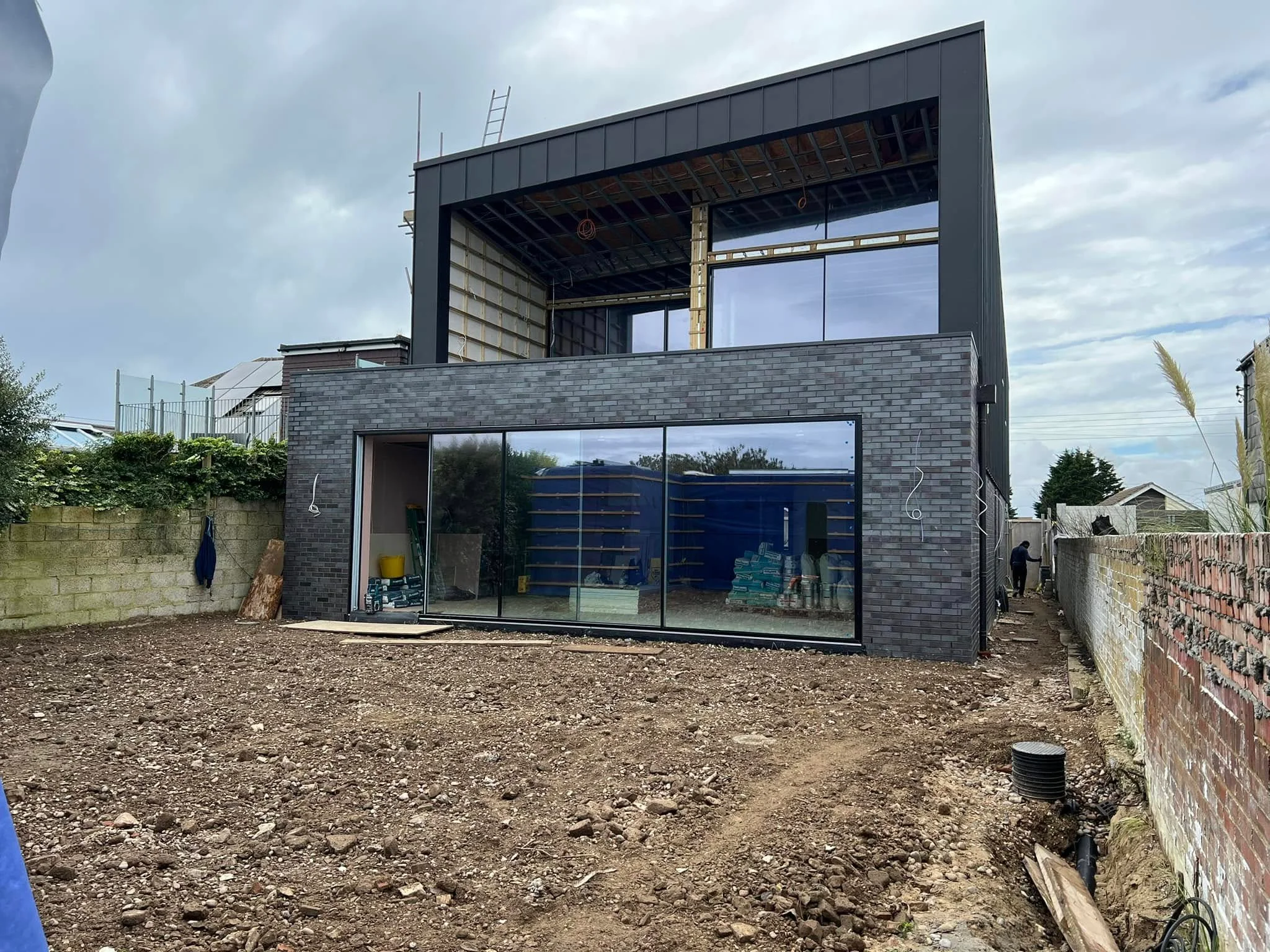
Porcelain vs Indian sandstone — which patio is right for your Kent garden in 2026? R-ratings, maintenance, Kent clay soils, installation timelines and a free site survey.
If you've started researching patio materials for your Kent garden, you've almost certainly arrived at the same crossroads that thousands of homeowners across Rochester, Maidstone, Sittingbourne, and Canterbury reach every spring: porcelain or Indian sandstone?
Both are genuinely excellent materials. Both will transform your outdoor space. Both are installed across Kent's residential properties every week by contractors making very different quality decisions about what goes underneath them. And yet the two materials are fundamentally different in almost every meaningful way — how they look, how they perform in Kent's specific climate, how much maintenance they demand, how they behave on the clay-heavy soils that underlie most of the Medway towns and much of mid-Kent, and what their long-term relationship with your home and garden will actually look like.
This is the guide we wish every Kent homeowner would read before commissioning a patio. Not a manufacturer's brochure, not a surface-level comparison that tells you both materials are "great choices." A genuinely detailed, technically informed, locally specific guide to making the right decision for your property, your garden, and your life.
We are MB Construction Group — Marshall Brickwork & Construction — based in Rochester and working across Kent for over 15 years. We've laid both materials hundreds of times, in every soil condition Kent has to offer, on every property type from Victorian terraces to contemporary new builds. What follows is the knowledge that experience generates.
2026 Trends in Kent Outdoor Living: Why This Decision Matters More Than Ever
The outdoor living market in Kent has changed significantly in the three years since 2023. Several converging trends have made the patio material decision more consequential than it used to be.
The outdoor room has become a permanent feature of Kent home design. The pandemic-era shift toward treating outdoor space as genuinely habitable living space has not reversed. Kent homeowners in 2026 are designing patios with integrated outdoor kitchens, dining areas, and fire pit zones — spaces that are used from March through October rather than just on summer Saturdays. This extended use pattern changes the performance requirements. A patio that's used daily needs to handle traffic, spillages, furniture scuffing, BBQ grease, and frost through the year. The material needs to perform across all of those demands, not just look good in the garden centre photograph.
Kent's climate has become more demanding on patio materials, not less. The last three Kent winters have followed a pattern that is increasingly typical: extended wet periods through November to February, with genuine ground frost occurring in most weeks, followed by the dramatic dry spells of 2022, 2023, and 2025 that shrank Medway clay soils measurably. This freeze-thaw cycling is the enemy of porous paving materials. Water penetrates the surface, expands as it freezes, and forces the stone apart from the inside. The number of frost cycles per year in Kent's climate makes this a genuine performance variable, not an edge case.
The premium patio market has matured. In 2020, porcelain was a relatively niche choice — premium, increasingly available, but not yet mainstream. By 2026, porcelain accounts for a significant proportion of all new patio installations in the South East. Simultaneously, Indian sandstone has remained consistently popular, driven by its natural beauty and its compatibility with the period housing stock that characterises much of Kent. The market is genuinely split, which means the comparison question is more relevant than ever.
Property value calculations have shifted. UK estate agent data consistently shows that a quality outdoor space adds measurable value — but "quality" has become more specifically defined. A poorly installed patio of any material now detracts from a survey. A correctly specified, professionally installed patio — regardless of material — is a positive asset. The installation quality question has become as important as the material question in determining long-term property value impact.
How Kent's Climate Specifically Affects Stone Longevity
Kent sits in a particular meteorological position that shapes paving performance in ways that differ from the national average.
Freeze-thaw cycles. Kent's coastal influence means temperatures oscillate around freezing more frequently than inland areas. Rather than sustained deep frost, Kent typically experiences repeated dips below and rises above 0°C through winter — the worst possible pattern for porous stone. Each freeze-thaw cycle where water has penetrated the surface causes microscopic expansion damage. Over ten to fifteen years, accumulated freeze-thaw damage on unsealed porous stone is significant.
UV exposure. Kent's position in the south-east means it receives more annual sunshine hours than most of the UK. UV exposure affects natural stone pigmentation over time — particularly in sandstone's warmer tones — and affects the UV stability of resin-bound surfaces. This is why specifying UV-stable materials matters specifically in Kent's climate.
The dry-wet cycle. The dramatic soil moisture changes that Kent's clay-heavy areas experience — wet winters, dry summers — affect not just the sub-base but the behaviour of any material laid on top of it. A patio that sits on Medway clay without adequate sub-base depth will move. And a patio material that can't accommodate movement — even fractionally — will show that movement as cracking, lifting, or joint failure.
Understanding these climate-specific factors is the foundation for choosing the right material. Let's look at each option in forensic detail.
Understanding the Materials: What You're Actually Choosing Between
Before the comparison, it's worth establishing what each material actually is — because the physical differences between porcelain and Indian sandstone explain almost everything about how they perform.
What Is Porcelain Paving?
Porcelain paving is a manufactured ceramic product. Clay, sand, feldspar, and minerals are combined and fired at extremely high temperatures — typically 1,200°C or above — for extended periods. This vitrification process fuses the raw materials into a dense, non-porous material with a water absorption rate of less than 0.5%. The resulting slab is uniform in thickness, calibrated in size, consistent in colour, and engineered to precise specifications.
For outdoor use in the UK, porcelain paving is produced at a minimum 20mm thickness. This thickness is important — thinner indoor tiles, sometimes mistakenly specified outdoors, lack the structural depth for external use in ground-bearing applications.
The key physical properties that flow from the manufacturing process:
- Near-zero porosity. Water cannot penetrate the surface. Frost damage through water absorption is essentially eliminated.
- Colour stability. The colour is fired through the body of the material, not just applied to the surface. It does not fade under UV exposure.
- Uniform sizing. Unlike natural stone, which requires skilled selection and cutting to manage natural variation in thickness, porcelain is calibrated to tight tolerances. This makes laying more precise and faster.
- Hardness. Porcelain registers between 7 and 8 on the Mohs hardness scale — harder than most natural stones and extremely resistant to scratching, chipping, and surface wear.
What Is Indian Sandstone?
Indian sandstone is a naturally occurring sedimentary rock, formed over millions of years as layers of sand and mineral deposits were compressed and lithified under geological pressure. It is quarried in India — primarily Rajasthan — cut into slabs, and finished to various surface treatments before export.
The result is a material that is fundamentally different from porcelain in almost every physical characteristic:
Natural variation is the defining quality. No two Indian sandstone slabs are identical. The colour, texture, fossil inclusions, and mineral banding vary slab by slab, batch by batch, and quarry by quarry. This variation is what makes sandstone beautiful. It is also what requires more skill to lay well — managing the variation so the finished surface looks considered rather than random.
Porosity is the defining performance characteristic. Indian sandstone is a porous material — it absorbs water, stains, and cleaning products into its structure. The porosity varies by stone type (Kandla Grey is more porous than Raj Green, for example) but all Indian sandstone is meaningfully porous compared to porcelain. This porosity is what drives the maintenance requirements and the freeze-thaw performance difference.
Surface treatment affects both appearance and performance. Indian sandstone is supplied in several surface treatments: riven (the natural split-face texture), sawn (smooth-sawn from the block), honed (smooth, slightly polished), and brushed (mechanically textured). Each finish has different slip resistance and maintenance characteristics.
The 2026 Deep Comparison: Every Variable That Matters
The following comparison addresses every performance variable that Kent homeowners should consider when choosing between porcelain, Indian sandstone, and resin-bound gravel.
Slip Resistance: The R-Rating Explained
Slip resistance for outdoor paving is measured using the German DIN 51130 standard, which produces an R-rating (R for Ramp) from R9 to R13. The test involves walking on the surface at increasing angles with standardised footwear and oil applied — the angle at which the test operator begins to slip determines the rating.
For outdoor paving in residential settings, R11 is the minimum recommended rating. R9 and R10 are appropriate for dry indoor environments. R12 and R13 are specified for commercial kitchens and food production environments.
Choosing the right surface for your Kent garden means looking past the aesthetics and focusing on the R-Rating. In our local climate—damp, cool, and prone to algae—the slip resistance of your stone is the most important technical factor for long-term safety.
Here is a breakdown of the most popular materials used by MB Construction Group and how they perform:
- Porcelain (Textured, Outdoor-Spec) — [R11] This is the gold standard for modern Kent patios. It provides a consistent slip rating across the entire surface regardless of weather. Because it is non-porous, it prevents algae colonization—the primary cause of slip risks. It dries quickly after rain and offers peace of mind, though you must verify the R11 rating at the point of purchase.
- Indian Sandstone (Riven Finish) — [R11–R12] The natural, rugged texture of riven sandstone provides excellent grip when first installed. However, because it is a porous natural stone, its performance can degrade over time if algae and moss are allowed to settle in. In shaded or north-facing gardens, unsealed sandstone can become hazardous in winter without regular professional maintenance.
- Indian Sandstone (Honed Finish) — [R9–R10] While beautiful, the smooth-honed finish significantly reduces slip resistance. We generally do not recommend this for main patio surfaces in Kent's climate without a specialized anti-slip treatment or sealer. It is much better suited for sheltered, dry environments or indoor-outdoor transition rooms.
- Resin-Bound Gravel — [R11+] Resin-bound surfaces offer consistently high slip resistance that does not degrade. Unlike stone, the aggregate surface doesn't harbor algae, and the "open-void" structure allows water to drain directly through the surface rather than pooling on top. This makes it one of the safest options for driveways and high-traffic pathways.
The critical insight for Kent homeowners: Porcelain's slip resistance advantage over Indian sandstone is not about the material when it is new — it is about the material after five to ten years of Kent weather. A well-maintained, regularly sealed Indian sandstone patio in a sunny, open garden can retain excellent slip resistance indefinitely. A neglected sandstone patio in a north-facing Medway garden, by contrast, can become significantly hazardous. Porcelain's non-porous surface means this degradation pathway doesn't exist.
Maintenance: What Each Material Actually Demands From You
This is the area where the materials diverge most dramatically in practice — and where many homeowners make their decision after considering their realistic maintenance appetite rather than the theoretical ideal.
Porcelain: The Low-Maintenance Reality
Porcelain's non-porous surface is genuinely transformative from a maintenance perspective. Algae cannot colonise the surface because there is no pore structure to root into. Stains — BBQ grease, red wine, plant tannins from leaves — cannot penetrate the surface because there is nowhere for them to go. They sit on top and can be wiped away.
What porcelain maintenance actually involves:
Sweeping to remove leaf litter and debris — this prevents any organic material from sitting long enough to begin composting on the surface (which can cause surface discolouration even without penetration).
Occasional washing with clean water and a mild pH-neutral detergent. A garden hose or low-pressure wash annually is typically sufficient to maintain appearance.
Checking and refreshing the jointing compound every five to seven years. The joint between porcelain slabs is typically filled with a flexible jointing compound (not traditional pointing mortar, which can crack and allow water ingress at the edges). This joint material is the most maintenance-intensive element of a porcelain patio.
What porcelain maintenance does not involve: Sealing. Annual treatment. Specialist cleaning products. Pressure washing at high pressure (which can damage the joint). Moss treatment.
The total annual maintenance time for a typical 30m² porcelain patio in Kent: approximately two to three hours per year, spread across a couple of sessions.
Indian Sandstone: The Honest Maintenance Picture
Indian sandstone is a beautiful material that rewards attentive maintenance and reveals its limitations when maintenance lapses. Understanding this relationship honestly is essential before commissioning a sandstone patio.
Sealing — the non-negotiable starting point:
Quality Indian sandstone should be sealed on installation and re-sealed every two to three years. The sealer penetrates the stone's pore structure and reduces water absorption, stain penetration, and biological growth. It does not eliminate these issues — it mitigates them. The quality of the sealer matters enormously. Cheap surface sealers create a film that peels and discolours. Quality penetrating sealers — impregnating the stone body rather than coating the surface — perform significantly better and last longer.
The implication: every two to three years, a Kent sandstone patio needs to be cleaned back to base condition and re-sealed. This is a day's work for a 30m² patio when done properly — cleaning, allowing to dry fully (ideally in dry warm weather), applying sealer, allowing to cure. Total time commitment every two to three years: six to eight hours plus material costs.
Biological growth management:
Even sealed sandstone in Kent's climate will develop some biological growth — particularly on north-facing sections or areas under tree cover. Moss and algae establish in the texture of the stone surface and in the pointing joints. Annual treatment with a patio biocide in autumn — applied and left to break down the growth over winter, then cleaned in spring — is the recommended maintenance cycle.
Pressure washing:
Sandstone can be pressure-washed, but technique matters. High-pressure washing on porous stone forces water deeper into the structure, potentially dislodging mortar from the joints and accelerating frost damage. A medium-pressure wash with appropriate detergent, working with the surface texture rather than against it, is the correct approach.
Pointing maintenance:
Natural stone patios are typically pointed with a cement:sand mix or a specialist pointing mortar. This pointing is subject to weather attack — freeze-thaw cycling degrades it over time, and organic growth in the joints eventually causes breakdown. Re-pointing sections as required is a realistic maintenance task for any natural stone patio after five to ten years.
The honest summary: Indian sandstone requires genuinely more maintenance than porcelain. For homeowners who enjoy the outdoor maintenance aspect — who find the annual ritual of cleaning and treating their stone a satisfying connection with the garden — this is not a deterrent. For homeowners who want to simply use their patio without maintenance demands, sandstone may be the wrong choice.
Lifespan: What Each Material Can Realistically Deliver
Material Expected Lifespan (Correct Installation) What Limits Lifespan Porcelain 30–50 years; effectively permanent The porcelain slab itself does not degrade. Lifespan is limited by sub-base failure (if incorrectly specified) and joint compound deterioration. A correctly specified porcelain patio on adequate sub-base in Kent can realistically last a lifetime. Indian Sandstone 15–30 years with maintenance; potentially longer Frost damage on unsealed or under-sealed stone. Aggressive pressure washing that erodes the surface. Incorrect mortar specification. Pointing failure that allows water ingress. With excellent maintenance, sandstone can exceed 30 years; without it, significant degradation within 10. Resin-Bound Gravel 15–25 years UV degradation of the resin binder (quality UV-stable resins significantly extend this). Bond failure if installed in unsuitable weather conditions. Aggregate loss in very high-traffic areas. Aesthetic Character: The Honest Visual Comparison
This is perhaps the most personal dimension of the decision, and the one where prescriptive guidance is least appropriate — because aesthetic preference is genuinely subjective. However, we can describe the aesthetic qualities of each material accurately.
Porcelain's aesthetic character: Porcelain has a precision and uniformity that reads as modern, architectural, and intentional. The slabs are perfectly consistent in size, colour range is consistent batch to batch, and the surface has a refined quality that works beautifully in contemporary garden design — particularly where the patio connects visually with modern interior flooring through bi-fold or sliding glass doors.
The design range is genuinely broad: from light grey and off-white that creates a Scandi-minimal aesthetic, through warm stone-effect finishes that sit comfortably with period properties, to dark charcoal and slate-effect options for dramatic contemporary schemes. Large-format slabs (900x600mm and larger) create a particularly striking visual impact that cannot be replicated with natural stone of variable thickness.
What porcelain cannot replicate: The organic, living quality of natural stone. The way each slab in a sandstone patio tells its own geological story. The warmth of natural mineral variation. For some homeowners, this organic quality is exactly what they want — and no amount of technical performance advantage will compensate for the absence of it.
Indian Sandstone's aesthetic character: The defining quality is natural variation — of colour, texture, fossil inclusions, and mineral banding. This variation is what makes sandstone feel alive. A Kandla Grey patio has a quiet, sophisticated palette of greys and silvers that weathers beautifully with Kent's seasons. Raj Green brings warm ochres, greens, and rusts that complement planting and brickwork. Mint Fossil and Autumn Brown bring their own distinctive character.
Indian sandstone sits comfortably with Kent's period housing stock in a way that manufactured materials often don't. The warm, textured, slightly irregular surface has a relationship with Victorian and Edwardian brick and garden walls that feels natural rather than imposed. For period property owners in Rochester, Sittingbourne, and Maidstone, this compatibility can be the deciding factor.
The Kent Soil Factor: Why Groundworks Determine Whether Your Patio Lasts
This is the section of the guide that separates genuinely experienced Kent contractors from those who are merely technically competent at laying surfaces.
The material you choose for your patio surface — whether porcelain, sandstone, or resin — is a secondary factor in determining whether your patio performs well over fifteen to twenty years. The primary factor is what goes underneath it.
Understanding Rochester and Medway Clay Soils
The London Clay formation that underlies much of the Medway towns — Rochester, Chatham, Gillingham, Strood, and surrounding areas — is one of the most challenging substrates for residential construction in the South East. The clay has specific physical properties that directly affect every outdoor construction project built on top of it.
Volumetric instability. London Clay expands when it absorbs water and contracts when it dries out. This volumetric change is seasonal — the clay swells during wet Kent winters and shrinks during dry summers. The magnitude of this movement at the surface can be several centimetres in exceptionally wet or dry years. The drought summers of 2022 and 2025 caused measurable clay shrinkage across much of the Medway area.
Transmissible movement. Any structure built on clay without adequate sub-base depth will experience the effects of this seasonal movement transmitted upward through the sub-base and into the surface. The result — rocking slabs, cracked joints, uneven levels, drainage falls that no longer function correctly — is the most common cause of patio failure we see when we're asked to assess and remediate installations done by other contractors.
Frost heave susceptibility. Saturated clay near the surface is particularly vulnerable to frost heave — the expansion of frozen water within the clay causing upward pressure on whatever sits above. A sub-base that doesn't extend deep enough to isolate the surface construction from this zone of active movement will experience frost heave effects.
The Type 1 MOT Sub-Base Solution
The correct engineering solution for patio and driveway construction on Medway clay is a correctly specified Type 1 MOT limestone hardcore sub-base of adequate depth.
Type 1 MOT limestone hardcore is the standard specification material for load-bearing sub-bases in UK construction. It is a crushed limestone graded to specific particle size distribution that, when correctly compacted, creates a stable, load-distributing layer that bridges across the movement zone of the clay beneath it.
What "correctly specified" means for Medway clay:
On most Kent clay sites, a minimum of 150mm of compacted Type 1 MOT is required for pedestrian patio applications. This is more than the 100mm that might be specified on stable, well-draining ground — the additional depth is specifically to bridge the most active layer of clay movement.
On sites with evidence of significant clay activity — near established trees that extract moisture from the clay, on low-lying ground that stays wet, or on sites where investigation reveals particularly active clay — depth should increase to 200mm or more.
The geotextile membrane. Before the Type 1 is laid, a geotextile separation membrane is placed on the formation level. This membrane performs two functions: it prevents the clay from pumping up into the hardcore over time (which would reduce effective depth), and it provides additional stability to the formation under the compaction process. It is a standard specification element on all clay sites; its absence is a shortcut that compromises long-term performance.
Compaction methodology. The Type 1 must be laid in layers and vibration-compacted with a plate compactor, not simply placed and left. The compaction process is what gives the sub-base its structural properties — uncompacted hardcore is essentially just a pile of stones. Proper compaction in 75mm layers, checking with a straightedge between passes, is what creates the stable platform that the patio surface depends on.
Why This Matters Differently for Porcelain vs. Sandstone
The relationship between sub-base quality and surface performance differs between the two materials — and understanding this difference is important.
Porcelain is unforgiving of sub-base failure. Because porcelain is a rigid, manufactured material with consistent thickness and is bedded on a full mortar or adhesive system, any movement in the sub-base beneath it is transmitted directly to the slab as stress. Porcelain cannot flex to accommodate sub-base movement the way that block paving's individual units can. A porcelain slab over a poorly specified sub-base that experiences clay movement will crack. And a cracked porcelain slab cannot be invisibly repaired — it must be replaced.
This is why the sub-base specification for porcelain is more critical than for any other surface type. We apply the most rigorous assessment of ground conditions before recommending porcelain, and we specify the sub-base depth conservatively rather than optimistically.
Indian sandstone on a bedded system is marginally more tolerant of minor sub-base movement because the individual slabs — bedded in semi-dry mortar on a screeded bed — have a degree of independent movement before failure. However, "marginally more tolerant" should not be read as "tolerant enough to accept a poor sub-base." Natural stone on inadequate sub-base on Medway clay will still fail — it just fails more gradually, through joint breakdown and level changes rather than through cracking.
The correct answer is the same for both materials: specify the sub-base correctly for the specific site conditions, and do not compromise on depth or compaction. We carry out a ground conditions assessment at every site visit — reading the ground, considering the drainage, assessing proximity to trees and their root systems — before committing to a specification.
The MB Construction Process: How We Deliver Patios That Last
This section describes our installation methodology — not as a marketing exercise, but as an honest account of what quality installation involves so that you can evaluate any contractor you speak to.
Stage 1: Site and Soil Survey
Before we quote a single material or commit to a single specification, we visit your property. A thorough site assessment includes:
Ground investigation. We assess the ground conditions visually and, where relevant, by probing — checking the depth to stable formation, identifying any soft spots or areas of differential settlement, and considering drainage patterns. On sites adjacent to mature trees, we consider root system extent and its implications for the clay moisture profile.
Drainage assessment. Where does the water go when it rains? What is the relationship between the proposed patio level, the house threshold, the surrounding garden levels, and any drainage infrastructure? We design drainage into every patio from this baseline understanding — never as an afterthought.
Planning review. In Rochester's conservation area, in Chatham, in Maidstone's designated zones, and across Kent's many other conservation areas, there may be material restrictions or consent requirements that affect the specification. We advise on these proactively.
Existing surface assessment. If there is an existing patio or hardstanding, we assess whether it can be used as a base element or whether full excavation and reconstruction is required. Laying over an existing surface saves cost but is only appropriate where the existing construction is sound and the additional height can be accommodated without causing threshold or drainage problems.
Stage 2: Sub-Base Construction
Following excavation to the correct formation depth, our sub-base construction process follows this sequence:
Formation preparation. Any soft or unstable material is removed and replaced with compacted fill. The formation is shaped to achieve the intended final drainage gradient — we do this at the bottom rather than trying to correct falls in the surface layers.
Geotextile membrane installation. The separation membrane is placed, lapped at joints, and fixed at edges to prevent movement during the compaction process.
Type 1 MOT placement and compaction. Hardcore is placed in layers not exceeding 75mm loose depth. Each layer is compacted with a vibrating plate compactor in overlapping passes until the surface is firm and stable. A straightedge check confirms level before the next layer is added.
Formation inspection. Before any bedding layer or surface material is placed, the compacted sub-base is inspected for flatness, gradient, and stability. This is the last opportunity to correct any issues before they are buried under the finished surface.
Stage 3: Drainage and Edge Course Detailing
Edge courses are one of the most visible indicators of installation quality — and one of the most frequently shortcut elements on budget installations.
For porcelain patios, we install haunched concrete edging around the perimeter before any surface material is laid. This edging is set to the finished level on the outside face and haunched back into the sub-base at the appropriate angle. Its function is to provide lateral restraint — preventing the surface material from spreading outward under load and thermal movement. Without adequate edge restraint, porcelain patios in particular can develop gaps at perimeter joints as the slabs push outward over time.
For natural stone patios, perimeter edging may be in the same stone species as the patio surface, in brick, or in concrete depending on the design brief. The structural function is the same — lateral containment of the surface construction.
Drainage detailing:
Every patio we install is designed with a minimum drainage fall of 1:60 away from any structure. This fall — typically achieved at the sub-base formation level and maintained through the construction layers — ensures that surface water moves away from the building rather than collecting against the wall line.
Where the patio is enclosed or where the natural topography makes surface water management more complex, we specify and install channel drainage — linear drain channels set flush with the surface that collect surface water and direct it to the drainage system or a soakaway. Channel selection, placement, and connection to the drainage run are all specified in our quote and documented in the project drawings.
Step detailing:
Where the patio involves level changes — steps connecting the patio to the garden, or raised sections — we specify step construction in materials and to standards that match the patio surface. For porcelain patios, porcelain-faced steps on a concrete core. For sandstone patios, matching stone steps on haunched concrete. Every step is checked for level, slip resistance, and correct nosing detail.
Stage 4: Surface Laying
Porcelain installation methodology:
Porcelain cannot be laid in the same way as natural stone. The non-porous surface does not bond to conventional mortar without preparation. Our process:
Each slab is cleaned on the back face and a slurry primer (SBR-based bonding agent mixed to a slurry consistency) is applied and allowed to become touch-dry before laying. This primer creates the chemical bond between the porcelain and the mortar bed that the non-porous surface alone cannot achieve.
A full mortar bed — no spot bedding, no voids — is prepared at the correct depth, with the upper surface floated to a consistent level. The primed slab is placed and tapped to level with a rubber mallet. Every slab is checked with a spirit level in both axes and against adjacent slabs with a straightedge. Any slab that is not within tolerance is lifted and the bed adjusted.
Jointing is completed with a flexible jointing compound (not rigid pointing mortar) after the mortar bed has cured. This flexible joint accommodates the very minor thermal movement of the porcelain without cracking.
Indian sandstone installation methodology:
Natural stone laying has its own craft requirements that differ from porcelain's precision demands.
Stone selection during laying is a skill in itself. Managing the natural variation in colour and thickness across a batch of sandstone — distributing tones evenly, matching thicknesses within rows, positioning the most visually interesting slabs in the most prominent positions — is what distinguishes a professional installation from an amateur one.
Semi-dry mortar bedding is the standard for natural stone. The consistency — enough cement to achieve good bond when compressed, dry enough not to mark the stone surface — is calibrated by experienced hands and adjusted for temperature and stone porosity. Each slab is bedded, levelled, and checked in all axes.
Pointing is typically completed after the mortar has cured, using a pointing mortar mixed to colour-match the stone. The pointing profile — slightly recessed flush or weatherstruck — is consistent throughout. Any mortar smear on the stone face is cleaned immediately; dried mortar on sandstone is extremely difficult to remove without surface damage.
Choosing for Your Property Type: A Practical Framework
Different property types in Kent often have different optimal material choices, based on the relationship between the material's aesthetic character and the building's character.
Victorian and Edwardian Properties (Rochester, Chatham, Maidstone)
The warm, textured, organic character of Indian sandstone sits naturally with the hand-made brick, lime mortar, and period detailing of Victorian and Edwardian properties. The natural variation in sandstone echoes the natural variation in period brickwork in a way that porcelain's precision often does not.
Our recommendation for period properties: Indian sandstone is often the more contextually appropriate choice for the main patio area. If low maintenance is a priority, consider porcelain for areas of highest use (directly outside the back door, barbecue zone) with sandstone for the wider garden areas. This hybrid approach captures the best of both materials.
Modern and Contemporary Properties (New Builds Across Kent)
Large-format porcelain in a stone-effect or concrete-effect finish is the natural companion to the clean lines, large glazing, and contemporary material palette of modern Kent housing. The visual continuity between indoor and outdoor flooring — the same large-format tile inside and out, creating the illusion of a single extended space — is one of the most compelling design moves in contemporary outdoor living design.
Our recommendation for contemporary properties: Porcelain, in a large format (minimum 600x900mm), in a colour and finish that connects with the interior flooring scheme. The investment in correct installation is justified by the exceptional longevity and the design impact.
Interwar and Post-War Properties (Gillingham, Sittingbourne, Parts of Maidstone)
The interwar semi-detached and post-war estate housing that makes up a significant proportion of Kent's residential stock occupies a stylistic middle ground. Both materials can work well depending on the specific design of the property and the garden.
Our recommendation: Consider the finish level of the property overall. If the garden has a traditional character — established planting, mature trees, period-appropriate boundaries — sandstone tends to sit more comfortably. If the property has been updated with a contemporary kitchen extension and modern interior design, porcelain's clean aesthetic may be the better fit.
Long-Tail FAQ: Your Questions Answered
Do I Need Planning Permission for a New Patio in Medway?
For most rear garden patio installations in Medway, the answer is no — the work falls under permitted development rights.
Specifically, garden patio construction is generally permitted development when it does not involve a raised platform (over 300mm above ground level) and is within the curtilage of the dwelling. There is no size limit for patio construction within the garden.
The situations where planning permission may be required:
If the patio incorporates a raised platform, terrace, or decking over 300mm above the adjacent ground level, planning permission is typically required.
Conservation areas in Medway — including parts of Rochester and designated zones in Chatham — may have additional restrictions on hard surfacing, materials, and the removal of garden features. We advise on these as part of every site visit in conservation area locations.
Listed buildings require Listed Building Consent for any external works, including patio construction, regardless of whether the work also requires planning permission.
Front garden hard surfacing is governed by the 2008 rules that apply nationally — impermeable surfacing of front gardens over 5m² requires drainage provision or a permeable surface. This rule applies to front garden patios and driveways, not typically to rear gardens.
When in doubt, a Pre-Application Enquiry to Medway Council is a low-cost way to confirm the position before commissioning work.
Is Porcelain Too Slippery for Kids and Pets?
This is one of the most common questions we receive, and the answer is nuanced but ultimately reassuring.
Smooth, polished porcelain is not appropriate for outdoor use — it lacks the surface texture required for safe external slip resistance and would typically achieve only an R9 rating, which is below the R11 minimum recommended for outdoor applications. Never specify interior-grade or polished-finish porcelain for an outdoor patio.
Outdoor-specification porcelain with an R11 rating is safe for children and pets. The R11 rating means the surface has been tested and verified to provide adequate slip resistance for external use, including in wet conditions. The DIN 51130 test that produces the R-rating is specifically designed to simulate real-world slip conditions.
Furthermore, porcelain's non-porous surface means that algae cannot colonise the surface — the primary cause of patio slip hazard in Kent's climate. Indian sandstone, over time, can develop algae in its pores that makes it genuinely dangerous when wet, particularly in north-facing or shaded gardens. Porcelain does not have this degradation pathway.
Our specification standard for all outdoor porcelain installations is a minimum R11 rating. We do not install porcelain with a lower rating outdoors, regardless of aesthetic preference. Every material we specify is confirmed to meet this standard before ordering.
For households with dogs, porcelain has additional advantages: claw scratch resistance is exceptional, and cleaning away muddy paw prints from a non-porous surface is far easier than from sandstone's textured, porous face.
How Long Does a 50m² Patio Installation Take in 2026?
A 50m² patio is a substantial residential project, and realistic timeline expectations are important for planning. Here is an honest breakdown for a 50m² rear garden patio in 2026, covering both material types.
Indian Sandstone — 50m² typical timeline:
Day 1: Groundworks — excavation, removal, sub-base preparation. Excavation of existing surface, disposal of arisings, formation of the sub-base with geotextile membrane and compacted Type 1 MOT. For a standard Kent garden with reasonable access, this typically takes a full day for a two-person team.
Day 2: Sub-base completion and edging. Completion of sub-base compaction, installation of edge restraints, installation of channel drainage if specified. Concrete for edge haunching is allowed to cure overnight.
Days 3–4: Stone laying. Indian sandstone laying across 50m² for an experienced team typically takes approximately two days — one to one and a half days of actual laying, accounting for stone selection, cutting, levelling, and checking.
Day 5: Pointing. After the mortar bed has achieved sufficient cure (minimum 24 hours in typical Kent conditions, longer in cold weather), pointing is completed across the whole surface. This typically takes a full day for 50m².
Day 6: Cleaning and sealing (if specified). Final surface clean, application of penetrating sealer, inspection and snagging.
Total realistic timeline for Indian sandstone, 50m²: 5–6 days on site.
Porcelain — 50m² typical timeline:
The sub-base stages are identical and take the same time. The surface installation differs:
Days 3–5: Porcelain laying. Porcelain takes slightly longer to lay than sandstone for two reasons: the mortar bed is a full wet bed (not semi-dry) and requires more careful preparation; and each slab requires the slurry primer application and flash-off time before laying. The precision requirements for joint alignment in large-format porcelain also increase the time per m². Allow three days for laying 50m² of standard large-format porcelain with a two-person team.
Day 6: Jointing. Flexible jointing compound is applied after full mortar cure (minimum 24 hours). Allow a full day for thorough jointing across 50m².
Day 7: Final inspection and clean. Final checks, grouting clean-up, drainage test, client walkthrough.
Total realistic timeline for porcelain, 50m²: 6–7 days on site.
The weather caveat: Both materials have weather dependencies. Mortar cannot be placed below 5°C without frost protection measures. Porcelain slurry primer has specific temperature and humidity requirements that restrict installation in very cold or very wet conditions. We monitor weather forecasts carefully and plan installation windows accordingly.
The access caveat: Gardens with restricted access — narrow side gates, no vehicle access — take longer because material delivery and waste removal must be done manually. This can add a day to either timeline.
Our Recent Projects: Rochester, Maidstone, and Canterbury
Our completed project portfolio demonstrates the range of both materials across Kent's varied property types. The projects gallery at mbconstruction.group/projects/ gives you the clearest sense of the standard of finish and the diversity of designs we've delivered.
Rochester and Medway — Our home territory, where we have installed both Indian sandstone and porcelain across every housing type from Victorian naval terraces to contemporary new builds. The clay soil conditions here mean our groundworks specification is particularly critical, and our track record of patio longevity in this area is the most robust evidence of correct installation.
Maidstone — Kent's county town combines the period housing of the town centre with the varied residential character of the surrounding borough. We've delivered sandstone installations that complement Maidstone's older Victorian suburbs and porcelain patios on contemporary extensions in the newer parts of the borough.
Canterbury — Canterbury's conservation areas and historic housing stock make material selection particularly important. We've delivered period-appropriate sandstone patios in Canterbury's older residential streets and contemporary porcelain installations on modern properties, always with awareness of the planning context.
Book Your Free Site and Soil Survey
The decision between porcelain and Indian sandstone is one that benefits from professional assessment of your specific site — because the ground conditions under your garden, the drainage characteristics of your specific plot, and the relationship between your patio design and your property's character all affect which material is the right choice for you.
We offer a free Site and Soil Survey for every enquiry — a genuine, thorough assessment of your garden, not a thirty-second kerb-side look. During the survey, we:
- Assess the ground conditions and specify the appropriate sub-base depth for your site
- Evaluate drainage and design the drainage solution into the patio from the outset
- Discuss your material preferences in the context of your property's character and your maintenance appetite
- Review any planning considerations relevant to your specific location
- Provide a detailed, itemised written quote covering every element of the installation
There is no charge and no obligation. The survey is the foundation of a project that lasts.
Phone: 07724 730872 Email: info@mbconstruction.group Contact: mbconstruction.group/contact/
Or explore our recent completed projects in Rochester and Medway, read the complete patio construction guide, understand the full cost picture for 2026, and explore our brickwork and repointing expertise if your project includes any brickwork element alongside the patio.
The Decision Framework: Choosing What's Right for You
After everything in this guide, here is the honest decision framework we share with every Kent homeowner who asks us for a recommendation.
Choose porcelain if: Your garden is shaded, north-facing, or prone to biological growth where maintenance would be a persistent challenge. You want a patio that connects visually with your interior flooring or extension. Your property has a contemporary design character. You want the lowest possible long-term maintenance commitment. You have children or pets and want consistent, reliable slip resistance regardless of maintenance history.
Choose Indian sandstone if: Your property is Victorian, Edwardian, or has a traditional aesthetic where natural stone feels contextually right. You enjoy the outdoor maintenance aspect and find the annual care of natural stone a satisfying garden activity. You prefer the organic warmth of natural material variation over manufactured precision. Your garden is open, sunny, and south-facing — the conditions where sandstone performs and looks its best.
Consider both materials in combination if: You want the warmth of sandstone in the wider garden area with the durability of porcelain in the highest-use zone immediately outside the back door. This hybrid approach is increasingly popular in Kent and delivers the aesthetic benefits of both materials in the positions where each performs best.
Whatever you choose: Invest in the sub-base. It is the foundation of everything, and it is the element most often compromised on budget installations. A correctly specified sub-base on Medway clay is not an upgrade — it is the correct specification for the ground conditions in this specific part of Kent. We will not install a patio on a sub-base that we don't believe is adequate for the site conditions, because our reputation is built on work that lasts.
That is the MB Construction Group commitment. Work that lasts, honestly specified from day one.
Marshall Brickwork & Construction Ltd | 14 Poplar Road, Rochester, ME2 2NR | 07724 730872 | mbconstruction.group