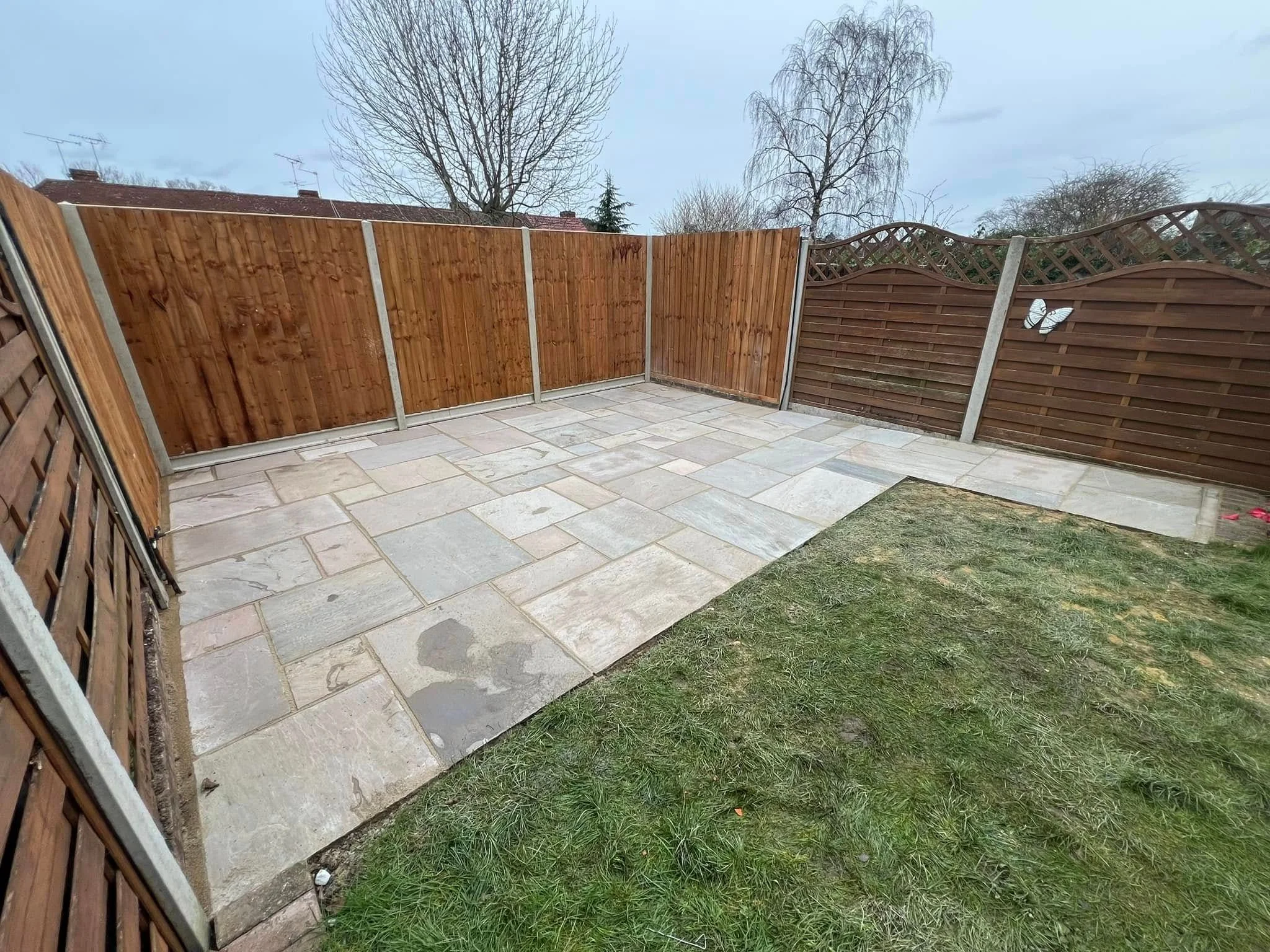
How much does a patio cost in Kent in 2026? Honest installed pricing for Indian sandstone, porcelain, limestone, concrete and granite — plus what every quote should include.
If you're planning a new patio and you've started getting quotes, you've probably noticed something frustrating: the prices vary wildly, the breakdowns are vague, and nobody seems to be comparing the same thing.
A £1,500 quote and a £6,000 quote for what looks like the same patio aren't necessarily a scam on one end — they might genuinely be different specifications, different materials, different sub-base depths, different drainage provision. Or one might be cutting corners that won't be visible for two years.
This guide breaks it all down. Real 2026 Kent pricing for every major patio material, an honest explanation of what drives costs up or down, the questions that reveal whether a quote is genuinely comparable, and the specification details that determine whether your patio is still looking and performing perfectly in fifteen years.
All pricing in this guide reflects projects completed by Marshall Brickwork & Construction across Kent in 2025–2026 — not national averages, not theoretical figures. What quality patio installation actually costs here, in Kent, right now.
The Short Answer: Patio Costs in Kent 2026
Here's the headline pricing before the detail. All figures are fully installed — materials, sub-base, labour, drainage, and waste removal included:
Here is the patio cost information formatted as a clear, easy-to-read list.
Patio Material Cost Breakdown (2026 Estimates)
- Concrete Paving Slabs
- Cost per m²: £65–£95
- Typical 20m² Patio: £1,300–£1,900
- Typical 40m² Patio: £2,600–£3,800
- Indian Sandstone
- Cost per m²: £85–£130
- Typical 20m² Patio: £1,700–£2,600
- Typical 40m² Patio: £3,400–£5,200
- Limestone
- Cost per m²: £90–£140
- Typical 20m² Patio: £1,800–£2,800
- Typical 40m² Patio: £3,600–£5,600
- Porcelain (Standard)
- Cost per m²: £100–£150
- Typical 20m² Patio: £2,000–£3,000
- Typical 40m² Patio: £4,000–£6,000
- Porcelain (Premium Large Format)
- Cost per m²: £130–£175
- Typical 20m² Patio: £2,600–£3,500
- Typical 40m² Patio: £5,200–£7,000
- Granite Setts
- Cost per m²: £110–£160
- Typical 20m² Patio: £2,200–£3,200
- Typical 40m² Patio: £4,400–£6,400
- Brick Paving
- Cost per m²: £80–£120
- Typical 20m² Patio: £1,600–£2,400
- Typical 40m² Patio: £3,200–£4,800
These figures assume a standard residential garden site in Kent with reasonable access, correct sub-base preparation, and basic drainage falls. Additional costs apply for significant ground level changes, restricted access, complex drainage requirements, and additional features like raised borders or steps.
A typical Kent rear garden patio — 20–25m² in Indian sandstone or porcelain — costs £1,700–£3,500 fully installed by a quality contractor in 2026. That's the realistic range for most projects.
What's Actually Included in a Quality Patio Quote
Before comparing quotes, you need to know what should be in them. Here's what a properly specified patio installation includes — and what budget quotes often leave out.
Excavation and Disposal
The existing surface (grass, old paving, concrete) is excavated to the correct depth and removed from site. Excavation depth depends on the patio material and ground conditions — typically 200–280mm total depth below finished surface level. The arisings are loaded and taken away — skip hire or licensed waste disposal is included in a complete quote.
What cheap quotes often do: shallow excavation that leaves organic material in the sub-base (which rots and causes settlement), or quotes that exclude waste disposal and add it back later as a surprise cost.
Sub-Base Construction
The structural foundation of the patio. On most Kent residential sites: geotextile membrane on the formation, then 100–150mm of compacted Type 1 MOT limestone hardcore laid in layers and vibration-compacted. On the clay-heavy soils common across much of the Medway towns and parts of Maidstone, 150mm is the minimum — the seasonal expansion and contraction of clay requires sufficient depth to bridge the most active movement zone.
This is the invisible layer that determines everything. A patio base that's too shallow on Kent clay will move seasonally, causing cracking, joint failure, and level changes within a few years. You cannot see the difference between a correctly specified base and a cut-corner one when the slabs go down. You see it in year two or three.
Bedding Layer
The layer between the sub-base and the surface slabs. For most natural stone and concrete paving: a semi-dry cement:sand mix at 30–50mm depth. For porcelain: either a full wet mortar bed with proprietary primer applied to the back of each slab, or a flexible adhesive system on a concrete base. The bedding specification must match the surface material — using sharp sand bedding under porcelain, for example, is one of the most common patio installation errors.
Drainage Falls
Every patio must drain. Correctly designed drainage falls — a gradient of approximately 1:60 away from the house wall — prevent water from pooling against the building or sitting on the surface. This is not optional. A patio that holds water against your house wall is a damp risk as well as a practical problem.
Designing the falls correctly requires understanding the relationship between the patio level, the house threshold, the garden levels, and where the water needs to go. Marshall's team designs drainage into every installation from the outset — not as an afterthought.
Jointing
The gaps between slabs are filled with either a cement:sand pointing mix (traditional), a specialist jointing compound (flexible, weed-resistant), or kiln-dried polymeric sand for certain applications. The jointing specification affects both appearance and long-term performance — inadequate jointing allows weed growth and surface water ingress.
Edge Details
Where the patio meets the lawn, planted borders, or other surfaces requires a defined edge that contains the patio material and creates a clean visual boundary. Haunched concrete edging, brick soldier courses, or metal edge restraints — the choice depends on the design.
Every Patio Material: Honest Costs and Honest Assessments
Concrete Paving Slabs
Installed cost: £65–£95 per m²
The most affordable patio surface and consistently underestimated. Modern concrete paving has come a long way from the utilitarian grey slabs of 30 years ago — the range now includes convincing natural stone effects, textured finishes, large formats, and a wide colour palette that suits both traditional and contemporary property styles.
What concrete paving does well: reliability (uniform thickness makes installation faster and more precise than irregular natural stone), good frost resistance, no requirement for sealing or specialised maintenance, and the widest range of sizes and formats of any material.
What to watch for: cheaper concrete slabs have lower density and absorb moisture more readily, which affects both frost performance and staining. Specify minimum 35MPa compressive strength for outdoor use in Kent's climate.
Typical project cost: A 20m² concrete paving patio with correct specification: £1,300–£1,900. A 40m² project: £2,600–£3,800.
Indian Sandstone
Installed cost: £85–£130 per m²
Indian sandstone is the most popular natural stone patio material in Kent and has been for a decade. The warm, varied palette — Kandla Grey, Raj Green, Autumn Brown, Fossil Mint — produces surfaces that complement a wide range of property styles from Victorian to contemporary.
The natural variation in colour and texture that makes sandstone beautiful is also what requires skill to install well. Random variation in slab thickness (typically 18–22mm) means each slab needs individual bedding adjustment. Colour and shade variation within a batch means careful selection during laying to distribute tones evenly.
Indian sandstone requires sealing approximately every two to three years to maintain stain resistance and inhibit biological growth. This is a maintenance commitment — neglected sandstone develops a darker, moss-tinged appearance that significantly detracts from its initial appeal.
Typical project cost: A 20m² Indian sandstone patio: £1,700–£2,600. A 40m² project: £3,400–£5,200. The variation within this range reflects stone quality (calibrated vs. uncalibrated, source quarry and slab thickness consistency), pattern complexity, and site conditions.
Limestone
Installed cost: £90–£140 per m²
Limestone offers a cooler, more formal aesthetic than sandstone — lighter tones, tighter grain, a more architectural character. It's particularly well suited to contemporary extensions and minimalist garden designs, and to properties where a pale, refined surface complements the house's character.
The main practical consideration: limestone is more porous than sandstone and more susceptible to acid attack from leaves, wine, and certain cleaning products. Correct sealing on installation, and periodic re-sealing, is essential for maintaining appearance and preventing staining.
Typical project cost: A 20m² limestone patio: £1,800–£2,800. A 40m² project: £3,600–£5,600.
Porcelain Paving
Installed cost: £100–£175 per m²
Porcelain has become the fastest-growing patio material in Kent over the last three years, driven by genuine performance advantages that make the premium price defensible over a ten-year horizon.
Porcelain is vitrified — fired at extreme temperatures to create a surface that is essentially non-porous, frost-proof, slip-resistant (when correctly specified), UV-stable (it won't fade), and impervious to staining, moss growth, and the acid degradation that affects natural stone. It requires no sealing. Maintenance is limited to periodic sweeping and occasional washing with clean water.
The aesthetic range is exceptional. Porcelain is available in finishes that convincingly replicate natural stone, timber, concrete, and abstract designs, at a consistency and scale that genuine natural stone can't match.
The installation requirement is more demanding than natural stone. Porcelain must be laid on a full mortar or adhesive bed on a completely stable base — it has low tolerance for movement, which means the sub-base must be correctly specified and compacted. Every slab requires primer applied to the back to ensure adhesion. Cutting porcelain requires diamond blade equipment. Done correctly by an experienced team, the results are exceptional and permanent. Done incorrectly, porcelain cracks and debonds.
Typical project cost: A 20m² standard porcelain patio: £2,000–£3,000. Premium large-format porcelain (900x600mm or larger): £2,600–£3,500 for 20m². A 40m² premium porcelain project: £5,200–£7,000.
The higher material cost compared to natural stone, combined with the more demanding installation, means porcelain sits at the top of the cost range. The trade-off is a surface that costs essentially nothing to maintain and will look as good in twenty years as it does on day one.
Granite
Installed cost: £110–£160 per m²
Granite setts — cobble-sized units laid in traditional patterns — create a surface that is exceptionally durable, strongly characterful, and particularly well suited to period properties where a modern slab would look incongruous. They're also used for decorative borders and threshold details alongside larger slab patios.
Granite is the hardest of the common patio stones, completely frost-resistant, and essentially permanent. The installation is labour-intensive because the small unit format requires more cutting and individual placement than slab paving.
Typical project cost: A 20m² granite sett patio: £2,200–£3,200. Often used as a feature element rather than the entire surface — a granite sett border around an Indian sandstone or porcelain field is one of the most popular combinations.
Brick Paving
Installed cost: £80–£120 per m²
Clay or concrete paving bricks create a traditional, characterful surface that suits period properties particularly well — the reddish, textured brick aesthetic that complements Victorian and Edwardian housing in Rochester, Chatham, and across Kent.
Brick patio surfaces benefit from Marshall's brickwork expertise in a way that distinguishes them from other surface types. Correct bond pattern selection (herringbone for load-bearing, stretcher bond for more decorative applications), consistent mortar specification throughout, and the craft detail at borders and edges — these are brickwork skills applied to landscaping, and they produce results that general landscaping contractors without brickwork backgrounds typically can't match.
Typical project cost: A 20m² brick patio: £1,600–£2,400. A 40m² project: £3,200–£4,800.
What Drives Patio Costs Up and Down in Kent
Understanding the genuine cost drivers helps you evaluate quotes intelligently and understand why two quotes for the same-sounding project can differ by £2,000.
Factors That Legitimately Increase Cost
Ground conditions. On Kent's clay-heavy soils — widespread across the Medway towns, Sittingbourne, and parts of Maidstone — the sub-base needs to be deeper than on more stable ground to prevent seasonal movement from telegraphing through to the surface. This is not an optional upgrade. It's the correct specification for the specific ground.
Access restrictions. Narrow side access that prevents mechanical delivery of materials means manual barrowing — which adds significant time and therefore cost. If a skip can't be positioned near the work, waste removal takes longer.
Existing surface removal. Removing a solid concrete base costs more than removing lawn. Breaking out concrete and disposing of the hardcore involves more labour and more skip capacity.
Level changes. If your garden slopes significantly, the patio either needs to be cut into the slope (requiring retaining walls or revetment) or built up on one side (requiring a raised structure). Both add structural complexity and cost. Raised patio structures require brickwork retaining elements — Marshall's specific expertise.
Drainage engineering. A standard flat site with good natural drainage needs channel drainage at one edge and correct surface falls — budget cost. A site that's level relative to the house threshold or that drains toward the house needs more engineering.
Additional features. Steps (£150–£400 each depending on material and construction), raised planted borders (£120–£250 per linear metre), seating walls, external lighting, raised beds — all legitimate additions to a patio project.
Red Flags in Cheap Quotes
Vague scope. "Patio installation, Indian sandstone, as discussed" is not a specification. It commits to nothing about sub-base depth, drainage, jointing, or edge treatment. Always ask for these to be itemised in writing.
No mention of sub-base. If a contractor doesn't specify what goes under the slabs, they're either not thinking about it or they're planning to cut corners on the most important element.
No drainage discussion. Where does the water go? If a contractor hasn't raised this question, they're not thinking about it.
Suspiciously low rates. Sub-£70/m² installed for natural stone in Kent in 2026 is below the cost of doing it correctly. The shortcut is almost always the sub-base.
Patio Cost vs. Property Value: The Return on Investment
A quality patio is one of the highest-return garden investments available to Kent homeowners in 2026. UK estate agent surveys consistently indicate that a well-installed patio adds 3–7% to perceived property value — on a £350,000 Kent property, that's potentially £10,500–£24,500 of uplift from a project costing £2,000–£6,000.
The crucial qualifier: quality of installation matters as much as quality of material. A poorly laid patio that's sinking, cracking, or holding water against the house wall is a negative in a buyer's survey — it signals deferred maintenance and potential damp. A perfectly level, well-drained, properly jointed patio with clean edge detail is a positive that experienced buyers and surveyors notice.
The patio that adds property value is the one built on the correct specification. That's the Marshall difference.
Getting a Patio Quote in Kent: The Questions Worth Asking
Before accepting any patio quote in Kent, these questions will tell you whether the contractor knows what they're doing:
"What sub-base depth are you specifying, and what material?" Expect: 100–150mm compacted Type 1 MOT hardcore, with geotextile membrane. More on clay ground. Vagueness here is a red flag.
"How are you handling drainage?" What happens to the water? Is a channel drain included? What is the designed fall and where does it discharge?
"What bedding system are you using for the surface material?" For porcelain: full mortar bed with primer or adhesive system. For natural stone: semi-dry cement:sand. For concrete: semi-dry or sharp sand. The bedding must match the material.
"What jointing are you specifying?" Standard cement:sand pointing, or a specialist flexible jointing compound? The latter costs more and performs significantly better.
"What does your workmanship guarantee cover?" Quality contractors guarantee their work. Get this in writing as part of the quote.
The Marshall Approach to Patio Construction in Kent
Marshall Brickwork & Construction has completed 150+ patio projects across Kent — in Indian sandstone, limestone, porcelain, granite, brick, and concrete, in gardens from small Rochester courtyards to large Tonbridge family spaces.
Every project starts with a free site visit: measuring the space, assessing ground conditions and drainage, discussing material options and budget, and identifying any level change or access challenges. The written quote that follows is itemised — excavation depth, sub-base specification, bedding layer, material specification, drainage provision, edge details, and jointing — so you know exactly what you're paying for before you commit.
Read the complete patio construction guide for everything about material performance, design principles, and what makes a patio last. Browse completed patio projects across Kent. And compare this with the driveway cost guide if you're considering both projects together — combining them into a single commission often delivers better value and a more coherent finished result.
Marshall covers all of Kent — Rochester and Medway, Sittingbourne and Swale, Maidstone, Tonbridge, Tunbridge Wells, Sevenoaks, Faversham, Canterbury, and into Greater London.
Phone: 07724 730872 Email: info@mbconstruction.group Contact: mbconstruction.group/contact/
Frequently Asked Questions
How long does patio installation take? A typical 20–25m² patio takes 3–5 days including groundworks and surface laying. Larger patios or those with significant level change features take longer. Porcelain takes slightly longer than natural stone due to the more demanding bedding requirements. Marshall confirms the timeline in the quote.
Can I have a patio installed in spring or summer 2026? Yes — spring through early autumn is the optimal installation window for all patio materials. Booking ahead is advisable as the season fills quickly. Contact the team now to secure a slot.
Does a patio need planning permission? Most rear garden patio installations are permitted development and don't require planning permission. In conservation areas and for listed buildings, there may be restrictions on materials or extent of hard surfacing. Marshall advises on any planning considerations during the initial consultation.
Can you combine patio installation with other work? Yes. The most common combined commission in Kent is a rear garden patio combined with a new driveway at the front, or a patio with landscaping across the wider garden. Managing all elements as a single project with one contractor delivers better coordination, more coherent results, and often better value.
How long will a patio last? A correctly specified and installed patio should last 20–30+ years with standard maintenance. Porcelain is effectively permanent with zero maintenance beyond cleaning. Natural stone requires periodic sealing (every 2–3 years) to maintain its appearance. The sub-base is the critical factor — a correctly specified sub-base is what makes a patio last. A shallow one on Kent clay will start showing movement within 3–5 years.
What size patio do I need? A useful guide: a table and four chairs requires approximately 3m x 3m (9m²) of patio. Add circulation space around it and you need at least 12–15m² for a functional outdoor dining area. Larger spaces feel more generous and are genuinely more usable. Most Kent family patios are 20–35m² — enough for outdoor dining, lounging, and barbecue space without dominating the garden.
Marshall Brickwork & Construction Ltd | 14 Poplar Road, Rochester, ME2 2NR | 07724 730872 | mbconstruction.group