
How much does a driveway cost in Kent in 2026? Honest, specific pricing for block paving, resin bound, tarmac, porcelain and stone — plus what drives costs up and down.
If you've started researching a new driveway and you're looking for an honest answer to what it actually costs — not a vague range that could mean anything, not a number designed to get you on the phone before you know what you're dealing with — you're in the right place.
This guide gives you real, specific 2026 pricing for every major driveway type installed in Kent. It explains what drives the cost up or down, what a fair quote looks like versus one that's hiding something, and what questions to ask before you sign anything. By the end, you'll know enough to have an informed conversation with any contractor and spot immediately whether they're giving you a fair deal.
The pricing in this guide is based on real projects completed across Kent by Marshall Brickwork & Construction — a Rochester-based family business with 15+ years and 180+ completed driveways across the county. These aren't theoretical estimates. They're what quality driveway installation actually costs in 2026.
The Short Answer: What Does a Driveway Cost in Kent?
Before the detail, here are the headline figures. These are realistic installed costs including all groundworks, materials, and labour:
- Gravel: £25–£55 per m² (Typical 40m² drive: £1,000–£2,200)
- Tarmac / Macadam: £50–£90 per m² (Typical 40m² drive: £2,000–£3,600)
- Resin Bound Gravel: £70–£120 per m² (Typical 40m² drive: £2,800–£4,800)
- Block Paving: £80–£130 per m² (Typical 40m² drive: £3,200–£5,200)
- Natural Stone Slab: £90–£140 per m² (Typical 40m² drive: £3,600–£5,600)
- Porcelain: £100–£160 per m² (Typical 40m² drive: £4,000–£6,400)
These figures assume a standard residential site with reasonable vehicle access, correct sub-base preparation to the appropriate depth, and drainage provision included. Additional costs apply for restricted access, unusual ground conditions, significant level changes, and drainage engineering beyond standard falls.
Now let's go through each surface properly—because the cheapest option in this list isn't always the cheapest over ten years.
Tarmac Driveways: Cost and What You Get
Tarmac (also called macadam or asphalt) is the most cost-effective hard driveway surface and consistently underestimated by homeowners who associate it with motorways rather than attractive residential entrances.
Realistic Kent cost: £50–£90 per m²
A standard double drive of approximately 40m² would typically cost £2,000–£3,600 for a quality two-course tarmac installation.
What goes into that cost: excavation and removal of the existing surface, geotextile membrane, compacted hardcore sub-base (minimum 150mm), binder course tarmac (typically 60mm), and wearing course tarmac (typically 40mm). Edge restraints, channel drain if required, and tidy finishing complete the job.
What affects tarmac pricing: the existing surface condition (a concrete driveway costs more to break out than an old tarmac one), access for the paving machine, and whether decorative elements like block paving edging are included. A tarmac drive with block paving or granite sett border detail — a very popular combination — adds £8–£15 per linear metre for the edging work.
Tarmac's honest strengths: Exceptional durability when properly installed. Resistant to freeze-thaw cycling in a way that rigid surfaces like concrete aren't. Quick to install. The best cost-per-year of any hard driveway surface over a 25-year lifespan. Excellent for large areas where other surface types become expensive.
Tarmac's honest limitations: Less design variety than block paving or stone. Can soften in extreme heat (less common in Kent but worth noting for south-facing drives). Surface marks from oil or fuel need treating promptly.
Gravel Driveways: Cost and What You Get
Gravel is the most affordable driveway surface and suits certain property types — particularly period properties, rural settings, and homes where a relaxed, informal character is appropriate — better than any other material.
Realistic Kent cost: £25–£55 per m²
A 40m² gravel driveway would typically cost £1,000–£2,200 depending on the gravel specification and the extent of edging and containment work required.
What goes into that cost: excavation, geotextile weed membrane (essential — not optional), compacted sub-base, and 50–75mm of gravel in the chosen aggregate. Quality edging restraints around the perimeter prevent migration and define the driveway cleanly.
Important: gravel quality varies enormously. Pea gravel, limestone chippings, golden gravel, slate chippings — each has different character, drainage performance, and cost. Self-binding gravel, which compacts to create a firmer surface than loose aggregate, costs more but significantly reduces migration and tracking into the property.
Gravel's honest strengths: The lowest upfront cost of any driveway surface. Fully permeable — no planning issues for front gardens. The noise of vehicles on gravel provides passive security. A natural, characterful appearance that suits period properties well.
Gravel's honest limitations: Requires periodic raking to maintain even distribution. Gravel tracks into the property and the street. Not ideal on gradients — gravel rolls to the bottom. Doesn't compact underfoot the way paved surfaces do. Budget for top-up gravel every few years.
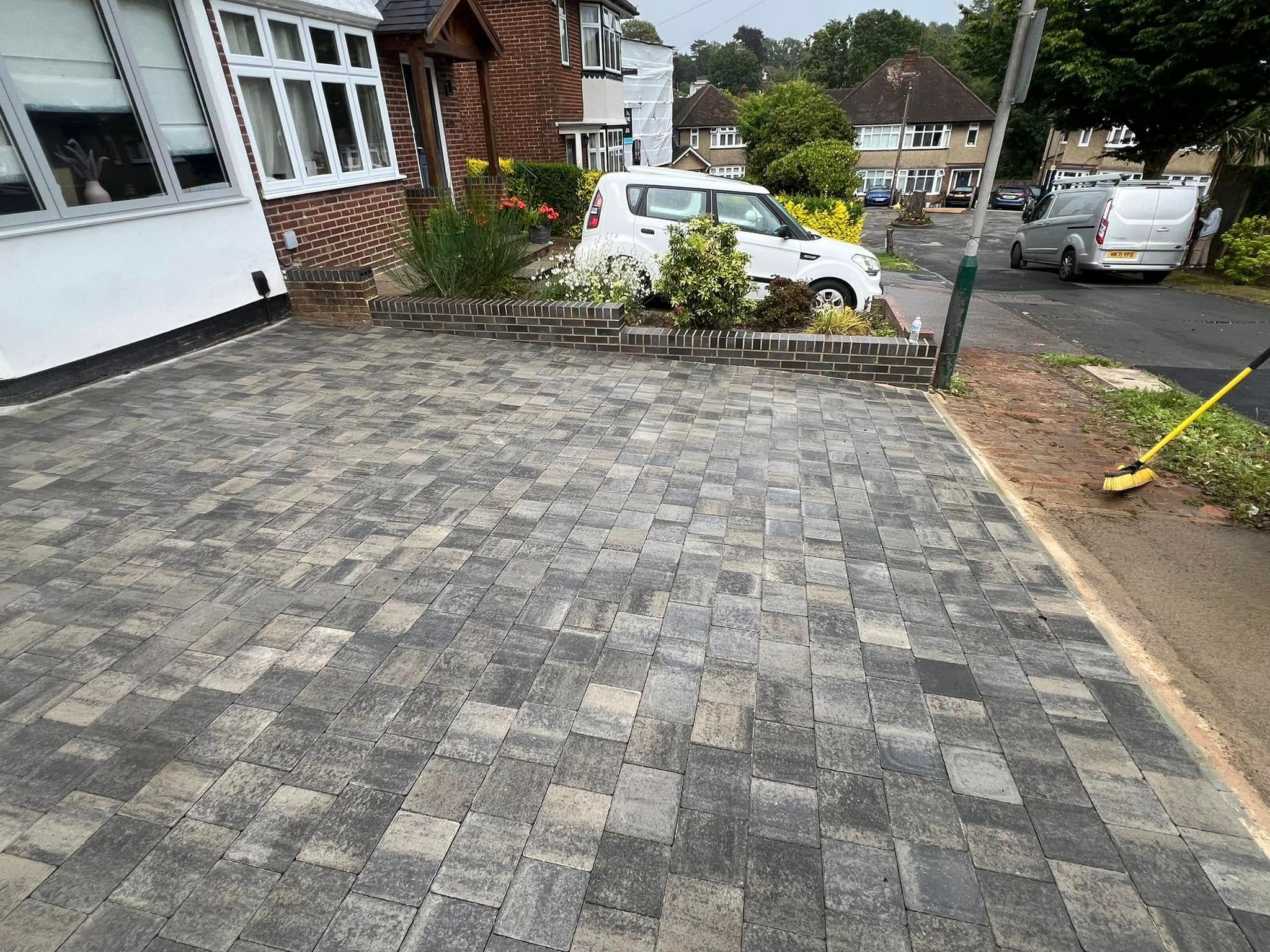
Block Paving Driveways: Cost and What You Get
Block paving is the most popular residential driveway surface in Kent — and has been for decades. That popularity reflects genuine strengths that make it the right choice for a wide range of properties and budgets.
Realistic Kent cost: £80–£130 per m²
A standard double driveway of 40m² would typically cost £3,200–£5,200 for a quality block paving installation. The variation within that range reflects the block specification (concrete blocks at the lower end, premium clay pavers or granite setts at the upper), the bond pattern complexity, and the extent of decorative edging and feature work.
What goes into that cost: excavation (200–250mm depth for a car-bearing drive), geotextile membrane, minimum 150mm compacted Type 1 MOT hardcore, 40mm sharp sand bedding, block laying in the chosen pattern, haunched concrete edge restraints, kiln-dried jointing sand, and a final vibration and inspection. Proper drainage provision — channel drain or designed falls — is included in a complete quote.
Why block paving costs vary so much: The blocks themselves range from £15–£60 per m² for materials alone, depending on whether you're specifying standard concrete, premium concrete, clay paving, or natural stone. The installation labour is similar regardless of block type — so the main cost driver is the material specification.
Block paving's honest strengths: Outstanding design flexibility — herringbone, stretcher bond, basket weave, decorative borders, colour blends. The only surface type where individual units can be lifted and reinstated for access to underground services. Proven 25-30 year lifespan with correct installation. Adds genuine property value and kerb appeal.
Block paving's honest limitations: Requires ongoing maintenance — annual moss/weed treatment, periodic jointing sand top-up. Standard block paving is impermeable, which means drainage provision is required for front gardens over 5m² under the 2008 planning rules (permeable block paving solves this at modest additional cost). Can be undercut by cheap contractors skimping on sub-base depth — always ask for the specification in writing.
Resin Bound Driveways: Cost and What You Get
Resin bound gravel has become one of the most requested driveway surfaces in Kent over the past five years, driven by its contemporary appearance, low maintenance profile, and inherent permeability.
Realistic Kent cost: £70–£120 per m²
A 40m² resin bound driveway would typically cost £2,800–£4,800 depending on the aggregate specification and base preparation required.
What goes into that cost: base preparation (which may be a new tarmac or concrete base, or applied over an existing sound surface), supply and installation of the resin-aggregate mixture at a consistent depth of 15–18mm, and perimeter finishing.
Critical quality warning: The resin bound market has more quality variation than any other driveway surface. UV-unstable resins fade and yellow within two to three years. Aggregate that isn't fully dried before mixing produces a weak, crumbling surface. Installed in unsuitable weather conditions (rain, temperatures below 5°C, high humidity), the surface fails to cure properly. The gap between a quality resin bound installation and a poor one is the largest of any driveway type — and it's invisible on day one.
Always ask for the resin brand and specification. Reputable contractors use UV-stable polyurethane resins from established manufacturers. Avoid quotes that don't specify the product.
Resin bound's honest strengths: Fully permeable — the simplest route to planning compliance for front garden installations. Genuinely low maintenance — no moss treatment, no jointing sand, no weeding. Clean, contemporary appearance that photographs excellently. Available in a wide range of natural aggregate colours.
Resin bound's honest limitations: Cannot be invisibly repaired if drainage work is needed underneath — patched resin shows. Installation is weather and temperature dependent in ways block paving isn't. Quality variation in the market is significant — contractor selection matters more here than with any other surface.
Natural Stone Slab Driveways: Cost and What You Get
Natural stone — Indian sandstone, limestone, granite, slate — brings a premium aesthetic that suits both period properties and contemporary designs.
Realistic Kent cost: £90–£140 per m²
A 40m² natural stone driveway would typically cost £3,600–£5,600 depending on the stone specification and installation method required.
Indian sandstone is the most popular and accessible natural stone option, with a warm, varied palette that suits a wide range of property styles. Limestone offers a cooler, more formal appearance. Granite is the most durable natural stone option and the heaviest and most expensive to work with. All natural stone for driveway applications must be specified at sufficient thickness and correctly installed on a full mortar bed (not sand bedding) to handle vehicle loads without cracking.
Natural stone's honest strengths: Genuinely unique appearance that cannot be replicated by manufactured materials. Good lifespan when correctly sealed and maintained. Natural variation in colour and texture that improves in character over time.
Natural stone's honest limitations: Requires periodic sealing to maintain stain resistance and colour. Some stone types are more porous than others — specify accordingly. Must be installed on a full mortar bed for vehicle-bearing applications, which increases installation cost. Weight and handling make working with large format natural stone more labour-intensive.
Porcelain Driveways: Cost and What You Get
Large-format porcelain is the premium end of the driveway market — genuinely exceptional in appearance and performance, and genuinely demanding in installation requirements.
Realistic Kent cost: £100–£160 per m²
A 40m² porcelain driveway would typically cost £4,000–£6,400, reflecting both the higher material cost and the more skilled installation required.
Porcelain must be laid on a full flexible adhesive bed over a completely stable, rigid base. Any movement in the base telegraphs through as cracking in the tiles. The sub-base specification for porcelain is the most demanding of all driveway types — depth, compaction, and surface flatness must all be correct. The tiles themselves are large, heavy, and unforgiving of cutting errors.
Porcelain's honest strengths: The most durable and lowest maintenance driveway surface available. Completely impermeable — doesn't stain, doesn't support biological growth, doesn't fade. Available in finishes that convincingly replicate natural stone at a consistent scale. If the base is right, it will still look exceptional in twenty-five years.
Porcelain's honest limitations: The most demanding installation of any driveway surface — only experienced teams should attempt it. The most expensive option. Any base movement causes cracking. Slippery when wet if the wrong surface finish is specified (always specify textured or R11-rated slip resistance for external use).
What Actually Drives Driveway Costs Up or Down
Understanding the real cost drivers helps you evaluate quotes intelligently. Here's what genuinely affects the final price — and what shouldn't.
What Legitimately Increases Cost
Ground conditions. Rocky ground requires breaking out equipment. Soft or unstable ground requires additional sub-base depth or ground improvement. Clay soils (common across much of the Medway area and Sittingbourne) need deeper sub-base to manage seasonal movement. A contractor who doesn't mention ground conditions in the quote hasn't assessed them properly.
Access restrictions. Narrow side gates that prevent machinery access mean more manual work — which takes longer and costs more. Skip placement on public highways requires a permit. These are legitimate additional costs.
Existing surface removal. Concrete drives cost significantly more to break out and dispose of than tarmac or block paving. If there's a concrete base underneath the existing surface, expect additional cost.
Drainage engineering. A standard drive on a site with good natural falls may only need channel drainage at the base of the slope. A drive that's level, or slopes toward the house, requires more drainage engineering. This is never a place to cut corners.
Size and complexity. Larger drives cost more in total but less per m². Complex shapes with lots of cuts cost more per m² than simple rectangles. Feature work — decorative borders, entrance pillars, planted areas within the drive — adds cost.
What Should NOT Increase Cost (Red Flags)
Urgency pricing. A legitimate contractor's price doesn't change because you mentioned you want it done quickly. Urgency premiums are a sales tactic, not a reflection of real costs.
Verbal quote inflation. If a contractor's verbal quote is substantially different from their written quote — in either direction — something is wrong.
Material upgrade pressure. You should be presented with options and their price implications clearly. Pressure to upgrade to materials you haven't asked about is a sales tactic.
The Sub-Base Question: The Most Important Thing Nobody Asks
Here's the question that will tell you more about a driveway contractor than any other: what sub-base depth are you specifying, and in what material?
The answer should be specific. For a standard residential driveway on reasonably stable ground: 150mm minimum of compacted Type 1 MOT limestone hardcore, over a geotextile membrane, with excavation to achieve the correct total construction depth of 200–250mm below finished surface level.
On clay soils — widespread across the Medway towns, Sittingbourne, and much of mid-Kent — the specification should be enhanced: deeper excavation, deeper sub-base, and a geotextile membrane that prevents the clay from mixing with the hardcore over time.
A contractor who gives a vague answer, or who doesn't mention sub-base specification until prompted, is telling you something important about their approach to the invisible elements of the job.
Marshall Brickwork & Construction includes the full sub-base specification in every written quote. No vague line items. No post-project surprises.
Getting an Accurate Quote: What to Ask Every Contractor
Use these questions when getting quotes from any driveway contractor in Kent:
1. What depth will you excavate to, and what sub-base material are you specifying? Expect a specific, confident answer. Vagueness here is a red flag.
2. Does this installation require planning permission? Any reputable contractor will know whether the 2008 front garden paving rules apply and will raise this proactively. If they don't know, they haven't thought about compliance.
3. How are you managing drainage? What happens to the surface water? Where does it go? Is a channel drain or soakaway included in the scope?
4. What edge restraints are you using? Haunched concrete edging is standard for block paving. Skimping on edge restraints is one of the most common shortcuts.
5. What workmanship guarantee do you offer? Quality contractors stand behind their work. Ask for this in writing as part of the quote.
6. Can I see examples of similar projects you've completed in Kent? Real photos of real local projects. Not stock images.
Why the Cheapest Quote Is Rarely the Cheapest Driveway
This point is worth making directly, because it's the thing that causes the most frustration for homeowners in the construction market.
The places where costs are cut in driveway installation are almost all invisible at the point the job is done. A sub-base that's 100mm instead of 150mm looks identical to a correctly specified one when the surface material goes down. A geotextile membrane that was skipped looks the same as one that was installed. Edge restraints that were set in a thin screed rather than properly haunched concrete look fine on day one.
Year two or three is when the difference appears. The rocking blocks. The sunken section near the dropped kerb. The crack that appeared after a hard frost. The edge that's started spreading outward because the restraint wasn't adequate.
The mathematics of cutting corners on a driveway spec is brutal for the homeowner: a saving of £400–£800 on the original quote frequently results in £2,000–£5,000 in remediation or full reinstatement within five years.
A quality driveway from a contractor who specifies correctly — like Marshall Brickwork & Construction — is installed once and maintained routinely. That's the actual cost comparison.
What a Marshall Driveway Quote Includes
When you contact Marshall Brickwork & Construction for a free driveway quote across Kent, here's what the process and the quote cover:
A free site visit where the team assesses the existing surface, ground conditions, drainage, access, and any planning considerations. You get honest recommendations on material types based on your property and budget — not on what's easiest to sell.
The written quote itemises: excavation depth and arisings disposal, sub-base material specification and depth, geotextile membrane, bedding layer specification, surface material and pattern, edge restraint detail, drainage provision, and timeline. The price is fixed within the agreed scope.
The team is available across all of Kent — Rochester, Chatham, Gillingham, Sittingbourne, Maidstone, Tonbridge, Tunbridge Wells, Faversham, Canterbury, and into Greater London.
Browse the completed driveway projects gallery. Read the complete technical driveway guide for everything about sub-base specification, drainage, and surface options. Compare block paving vs resin bound in detail.
When you're ready:
Phone: 07724 730872 Email: info@mbconstruction.group Contact: mbconstruction.group/contact/
Frequently Asked Questions
How long does a new driveway take to install in Kent? A typical 40m² block paving driveway takes 3–5 days including groundworks. Tarmac is faster — usually 1–2 days for the surface once the base is prepared. Resin bound on an existing base takes 1–2 days. Natural stone and porcelain take 3–5 days due to the full mortar bed requirement.
Do I need to be home during the installation? Not necessarily. The team can work with access arrangements agreed at the consultation. You'll typically want to be present at the start to confirm the layout and at the end for the completion walkthrough.
How soon can I drive on a new driveway? Block paving: 24–48 hours. Tarmac: 24 hours minimum, 48–72 hours for heavy vehicles. Resin bound: 24–48 hours. Porcelain and natural stone: 48–72 hours minimum for the mortar bed to cure.
Can I get a driveway installed in spring and summer 2026? Yes, but the spring and summer season is the busiest period for driveway installation across Kent. Getting in touch now to secure a booking slot is advisable — quality contractors fill their schedules quickly once the season starts.
Does a new driveway increase property value? UK estate agent surveys consistently show quality driveways add 5–10% to perceived property value and reduce time on market. For a Kent property worth £350,000, that's a potential £17,500–£35,000 uplift on a project costing £3,000–£6,000. The return on investment is one of the strongest of any home improvement.
Can Marshall combine a driveway project with other work? Yes — and this is one of the most common commission types. A new driveway combined with repointing of the boundary wall and pillars, or a front garden transformation combining driveway, planted areas, and new fencing, delivers a more coherent result and often better value than separate projects. Marshall's full service range covers all of these elements.
Marshall Brickwork & Construction Ltd | Rochester, Kent | 07724 730872 | mbconstruction.group