Planning a home extension in Kent? Read our complete 2026 guide: costs, planning permission, types of extensions, and why Marshall Brickwork & Construction delivers results that last.
If you've ever stood in your kitchen wishing the room were bigger, looked out at the garden thinking there must be a smarter use of that space, or squeezed a third bedroom into a property that was clearly designed for two, you've already arrived at the same conclusion that tens of thousands of Kent homeowners reach every year: moving is expensive, stressful, and completely avoidable when the right builder extends what you already own.
Home extensions are, pound for pound, one of the most effective investments a property owner in Kent can make. Done properly, a well-specified extension adds functional space, increases market value, transforms daily life, and lasts for the lifetime of the building. Done poorly — by the wrong builder, on the wrong specification, with the wrong materials — it creates structural problems, planning headaches, and bills that dwarf the original quote.
This guide covers everything Kent homeowners need to know before commissioning an extension in 2026: the different types, realistic costs, planning permission requirements, what the groundworks specification should look like, how to choose a contractor who genuinely knows what they're doing, and what working with Marshall Brickwork & Construction on an extension project actually involves. Whether you're planning a single-storey kitchen-diner, a double-storey side extension, or a full new build annexe, what follows will ensure you go into the project with clear eyes and the right team behind you.
Why Kent Homeowners Are Choosing Extensions Over Moving in 2026
The decision to extend rather than move isn't just emotional — it's increasingly mathematical. Stamp duty on a typical Kent property move runs into thousands of pounds. Estate agent fees, solicitor costs, removal companies, and the sheer disruption of uprooting a household add tens of thousands more before a single brick is laid in a new address. Against that backdrop, a well-built home extension that adds genuine living space and increases your property's value by 15–20% looks like an obvious alternative.
Kent's property market reinforces this logic. Demand remains strong across the county — from Rochester and Medway to Maidstone, Canterbury, Tonbridge, and the commuter belt running toward London. Homeowners who extend aren't just improving their quality of life; they're protecting and growing an asset in one of the Southeast's most consistent property markets.
There's also a practical factor that's become more prominent since 2020: the way people use their homes has changed permanently. Home offices, hybrid working arrangements, multigenerational living, and the rise of the home gym or studio have created demand for space that properties built in the 1970s, 1980s, and 1990s simply weren't designed to accommodate. An extension is the direct answer to that demand.
The Main Types of Home Extension in Kent
Not all extensions are the same, and the right choice depends on your property's layout, your planning situation, your budget, and what you actually need the space to do. Here's an honest breakdown of the options most relevant to Kent homeowners.
Single-Storey Rear Extensions
The most popular extension type across Kent, and for good reason. A single-storey rear extension adds floor area at the back of the property — most commonly used to create open-plan kitchen-diner-living space, or to give an existing kitchen room to breathe. Under current Permitted Development rules, detached houses can extend up to 4 metres to the rear without requiring full planning permission; semi-detached and terraced properties have a 3-metre limit. Both must still comply with Building Regulations.
In terms of disruption versus reward, single-storey rear extensions offer the best ratio. The work doesn't affect the upper floors, the structural impact is manageable, and the result — particularly when opened up to bifold or sliding doors onto a patio — transforms the ground floor of a family home. When paired with quality patio construction outside, the indoor-outdoor connection becomes a genuine feature rather than an afterthought.
Cost range in Kent for 2026: £25,000–£65,000 depending on size, specification, and whether structural steels are required to open up internal walls. The quality of the brickwork where the extension meets the existing building is critical — this is where the junction must be properly tied and matched, and where corners get cut by less experienced contractors.
Double-Storey Extensions
A double-storey extension adds floor space on both ground and first floor levels simultaneously, making it the most cost-effective way to add significant square footage relative to the groundworks and foundations already being dug. Typical applications include adding a ground-floor living room or utility alongside a first-floor bedroom or bathroom above.
Double-storey extensions almost always require full planning permission. The planning application process in Kent typically takes eight to thirteen weeks, and the design must respect the established line of the street, the character of neighbouring properties, and the privacy of adjacent gardens. In conservation areas — which are common across historic Kent towns — the design constraints are more stringent, and experience with heritage-sensitive brickwork specification becomes particularly important.
Cost range: £45,000–£120,000+ for a typical double-storey extension in Kent, depending heavily on size, finish quality, and whether the project involves structural alterations to the existing building alongside the new build element.
Side Return and Wrap-Around Extensions
Many Kent terraced and semi-detached properties have a narrow strip of wasted space running down the side — the side return. Infilling this with a glazed or traditionally built extension can add surprisingly useful floor area, particularly in properties where the kitchen sits at the back and the side return connects it to the front hallway or garden.
Wrap-around extensions combine rear and side return work into a single L-shaped addition, producing the largest single-storey footprint a Permitted Development scheme will typically allow. These projects require precise groundworks and drainage coordination, accurate brickwork to tie old and new structures together, and careful attention to the roof junction — all areas where Marshall's expertise in groundworks and construction produces noticeably better outcomes than generalist builders who rarely work at this level of complexity.
Cost range: £30,000–£75,000 depending on dimensions, glazing specification, and the complexity of the drainage diversion involved.
Kitchen Extensions
The kitchen extension deserves its own category because it's so consistently the project that delivers the highest return on investment for Kent homeowners. The combination of added floor area, improved natural light — particularly when lantern lights or roof glazing is incorporated — and the psychological impact of an open, airy cooking and dining space is difficult to overstate.
The technical demands of a kitchen extension are also higher than they appear on the surface. Drainage for sink waste and (where applicable) an island, electrical first-fix work for sockets, pendant lighting, and extraction, the structural lintel spanning any new opening into the existing rear wall, and the insulation standard required by Part L of the Building Regulations all need to be specified correctly from the outset. A builder who handles groundworks and brickwork to a professional standard brings the structural elements in properly, which every other trade depends on to finish the job correctly.
Loft Conversions
A loft conversion doesn't extend the building's footprint but adds an entirely new storey within the existing roof space. In Kent's predominantly 1930s–1970s housing stock — where hip-to-gable and dormer conversions are particularly common — loft conversions are a highly effective route to adding a bedroom or home office without touching the garden or requiring party wall negotiations.
Cost range: £25,000–£60,000 for a standard Velux or dormer conversion in Kent, rising to £70,000+ for Mansard or structural hip-to-gable projects. The floor strengthening, staircase installation, and insulation work required are all construction tasks that benefit from a builder who understands structural load paths — not just aesthetics.
Garage Conversions
For properties where an integral or attached garage is used for storage rather than vehicles, a conversion offers one of the most cost-effective ways to add a usable room. The structural shell already exists; the work involves insulating the floor, walls, and roof, replacing the garage door with a window or glazed door arrangement, and connecting the space to the heating and electrical systems.
Cost range: £8,500–£20,000 for a standard garage conversion, rising if a bathroom or kitchen facility is incorporated. This work falls clearly within the core competencies of Marshall Brickwork & Construction's services.
Home Extension Costs in Kent: A Realistic 2026 Breakdown
The single most common source of frustration in home extension projects is the gap between the initial quote and the final bill. That gap almost always exists because the original quote didn't include everything — either because the contractor left items out deliberately to win the job at a lower number, or because the client didn't know to ask about hidden costs. Here's the complete picture.
Build Cost Per Square Metre
Based on current Kent and Southeast pricing for 2026:
- Standard specification single-storey: £1,500–£2,200 per m²
- Good specification single-storey: £2,200–£3,000 per m²
- Premium specification (porcelain bifolds, underfloor heating, high-end kitchen zone): £3,000–£4,500+ per m²
- Double-storey build cost: £1,800–£2,800 per m² (averaged across both floors)
These figures are for the structural build — foundations, walls, roof, and weathertight shell. They do not include fit-out, internal decorating, kitchen units, or bathroom fixtures. Always clarify what any quote includes.
Professional Fees
Most homeowners underestimate this category significantly. For a typical Kent single-storey extension requiring planning permission:
- Architect or architectural designer: £3,000–£8,000 for drawings and planning submission
- Structural engineer: £1,500–£4,000 for calculations and specification
- Planning application fee: £528 for a full householder application (2026 rate) plus a £70.83 portal service fee
- Lawful Development Certificate (for Permitted Development projects): £264
Party Wall Act Costs
If your extension builds near or on a shared boundary, you may need to serve Party Wall Notices on adjacent neighbours. If they consent, there's no cost beyond a small amount of administration. If they dissent or appoint their own surveyor, you'll pay for a Party Wall Award — typically £700–£1,500 per neighbour. Never skip this step; the Party Wall Act 1996 applies regardless of whether you have planning permission, and ignoring it creates legal exposure.
Building Regulations and Inspections
Building Regulations approval is mandatory for all extensions, regardless of whether planning permission is required. In Kent, Building Regulations fees for a typical single-storey rear extension run to £800–£1,500 depending on the chosen route (Full Plans or Building Notice). These cover structural, drainage, insulation, fire safety, and ventilation compliance checks.
Site Costs
Items routinely omitted from initial quotes but always real:
- Skip hire: £250–£400 per skip (plan for two to three on a typical extension)
- Temporary toilet (for projects over 4 weeks): £150–£250 per month
- Scaffolding: £800–£2,000 for a standard single-storey extension perimeter
- Soil investigation (particularly important given Kent's clay soil in many areas): £500–£1,500
Contingency
The standard advice is to budget a 10–15% contingency above your total quoted cost. On a £40,000 project, that's £4,000–£6,000 held in reserve. The contingency exists because ground conditions, concealed structural issues in the existing building, and supply chain fluctuations are genuinely unpredictable. Experienced contractors flag potential risk items during the design stage. Less experienced ones discover them on site.
Planning Permission for Home Extensions in Kent: What You Need to Know
Understanding Kent's planning framework before you appoint a builder will save you time, money, and the frustration of designing an extension that then fails planning. Here's a clear summary of the current rules.
Permitted Development Rights
Under England's Permitted Development (PD) regime, certain categories of home extension can be built without a full planning application. For Kent homeowners in 2026, the key thresholds are:
Single-storey rear extensions:
- Detached houses: up to 4 metres deep from the original rear wall
- Semi-detached and terraced: up to 3 metres deep
- Maximum height at eaves: 3 metres where the extension is within 2 metres of a boundary
- Overall maximum height: 4 metres
- Materials should match the existing building's appearance
Side extensions under PD:
- Single storey only
- Must not exceed half the width of the original house
- Must not front a public highway
What removes PD rights entirely:
- The property is a Listed Building
- The property is in a Conservation Area (very common across historic Kent towns — always verify)
- PD rights have been removed by a planning condition on the original property (check your planning history)
- The property is a flat or maisonette
Even when a project qualifies for PD, obtaining a Lawful Development Certificate (LDC) from your local planning authority is strongly recommended. The LDC provides written confirmation that your extension is lawful — essential if you sell the property and solicitors ask for evidence of compliance.
Full Planning Permission
Any extension that falls outside PD limits, or that involves work to a Listed Building or in a Conservation Area, requires a full planning application. In Kent, this is submitted to your local district council (Medway Council, Maidstone Borough Council, Canterbury City Council, etc., depending on your location). Applications are assessed against the Local Plan policies and national planning guidance.
Key considerations for Kent planning applications:
- Impact on neighbouring amenity: Loss of light, overlooking, and overbearing effect are all material considerations
- Design quality and materials: Kent councils expect extensions to respect the character of the area, particularly in historic settlements
- Heritage assets: Conservation Area Consent is required for demolition work, and any extension near a Listed Building is subject to a higher level of scrutiny
- Drainage: Kent County Council as lead local flood authority is consulted on drainage for larger extensions; surface water management must be addressed in the application
The typical planning decision timescale is 8–13 weeks from valid submission. Pre-application advice, available from most Kent councils for a fee of £150–£400, is worth considering for more complex proposals — it provides early feedback and reduces the risk of refusal.
Groundworks: The Foundation That Everything Else Depends On
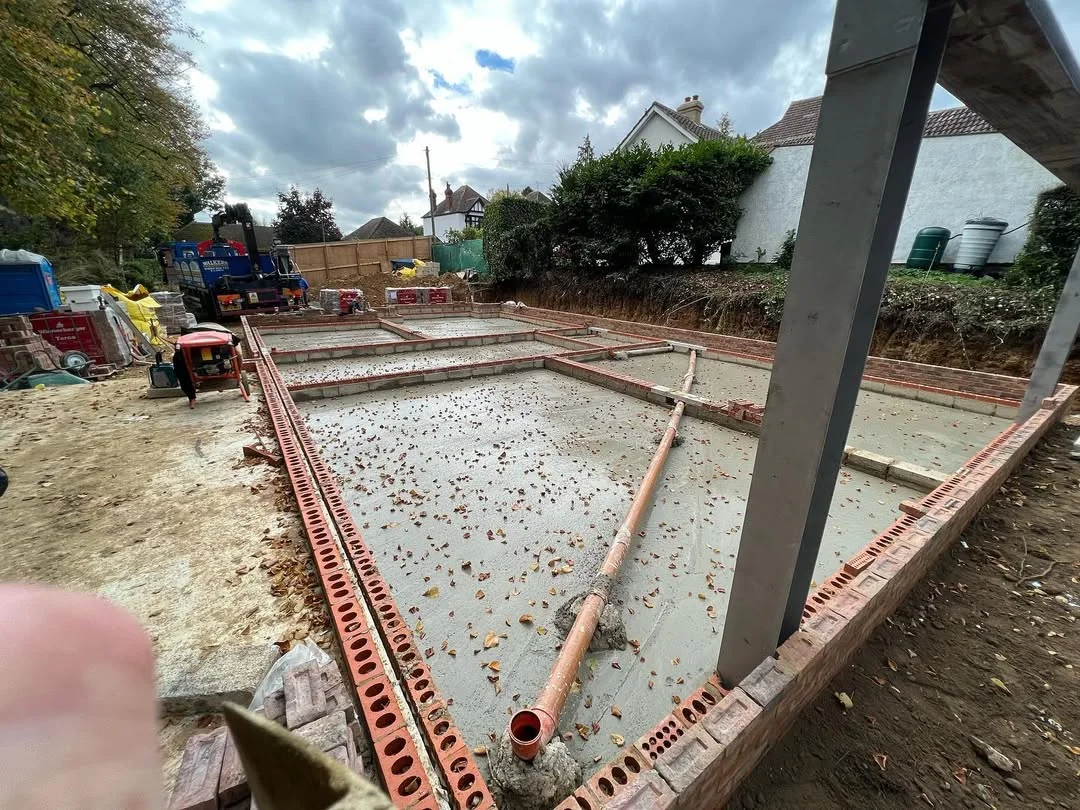
If there's one area of home extension construction where cutting corners produces consequences that compound over time, it's the groundworks. Every visible element of a finished extension — the walls, the floors, the roof — is only as good as what's underneath it. This is why Marshall Brickwork & Construction's groundworks capability is so central to the quality of their extension work.
Foundation Specification
Kent's geology varies considerably across the county. The chalk and greensand formations of the North Downs produce different foundation requirements from the heavy Weald clay soils that dominate south and central Kent. Clay soils are particularly challenging because they shrink in dry summers and expand in wet winters — a process called clay heave and shrinkage that can crack poorly founded structures within a few years of construction.
For extensions on clay soils, the standard strip foundation specification requires:
- Minimum 1 metre depth to reach stable, unaffected clay
- Wider trench width than on more stable ground — typically 600–750mm for a single storey, wider for two-storey
- Tree proximity assessment where mature trees are within root radius distance of the foundation location — trees on clay soil can dessicate the ground over a large area and necessitate deeper or piled foundations
A contractor who understands Kent's ground conditions won't guess at foundation depth — they'll specify the correct depth based on ground type, proximity to trees, and the structural load of the building above. This is non-negotiable knowledge for quality extension work.
Drainage
Almost every extension affects the existing drainage arrangement of a property, whether through adding new underground connections for the kitchen sink or dishwasher, redirecting existing surface water downpipes around the new structure, or managing the additional roof area's surface water run-off. In Kent, Building Regulations require separation of foul and surface water drains (where the local sewerage system is separated), and surface water must not be connected to the foul sewer without approval.
Drainage work done correctly is invisible and forgotten about for decades. Drainage work done incorrectly backs up, smells, causes subsidence, and is enormously disruptive to rectify once the extension is finished. Marshall's groundworks capability covers all drainage work as an integrated part of the extension build, not an afterthought subcontracted to a third party.
Concrete Slab and Insulation
The extension floor slab specification has become significantly more demanding since the introduction of updated Building Regulations Part L requirements around energy efficiency. The current minimum insulation standard for extension floors requires:
- A well-compacted and blinded hardcore sub-base (typically 150mm)
- 100mm rigid insulation under the concrete slab (PIR or EPS board)
- 150mm reinforced concrete slab
- Damp-proof membrane
- Screed finish (or direct tile bed for tiled finishes)
Underfloor heating, increasingly popular in kitchen extensions given its compatibility with large-format tiles, is best installed as a wet UFH system within the screed layer before the surface finish is laid — a decision that needs to be made before the slab is poured, not after.
The Brickwork Specification: Why It Matters More Than You Think
For most Kent homeowners, the visible brickwork of a new extension is primarily an aesthetic concern — will it match the existing house? But the specification and execution of the brickwork goes well beyond appearance and directly affects the structural performance and weathertightness of the building for its entire life.
Brick Matching
Kent's housing stock spans a wide range of brick types, from the red brick commons used in Victorian and Edwardian terraces in Rochester and Faversham to the lighter buff stocks common in postwar properties and the various machine-made facings used from the 1960s onward. Matching existing bricks — in colour, texture, size, and joint profile — is a skill that separates experienced bricklayers from those who simply lay bricks.
Marshall's bricklayers have 15+ years of experience working across Kent's diverse housing stock. They source reclaimed and matching bricks from specialist suppliers, specify mortar mixes that match the colour and strength of existing joints, and — critically — they understand that using a mortar that's too hard for the existing brickwork causes the brick face to spall when moisture freeze-thaws through the joint, a very common problem on Kent properties that have had poor-quality repair work done.
Cavity Wall Construction
Modern extensions are built to cavity wall specification: an outer leaf of facing brick, a cavity (typically 100mm), rigid cavity insulation boards, and an inner leaf of blockwork. The cavity insulation must be continuous, correctly clipped to wall ties at the specified intervals, and protected from mortar droppings at the base of the cavity that can bridge the gap and create cold bridges or damp paths.
Wall ties must be the correct type and spacing for the wall height and exposure category — a detail that affects the structural stability of the wall under wind loading. For extensions on exposed Kent properties close to the coast or on elevated ground, tie specification is a meaningful structural consideration, not a box-ticking exercise.
Lintels
Every opening in the extension — windows, external doors, bifold door openings — requires a structural lintel spanning the gap in the masonry above it. Lintel selection depends on the span, the load above, and whether a cavity wall system is being used. Undersized or incorrectly bearing lintels are a consistent cause of structural cracking above openings. The correct bearing length is minimum 150mm either side of the opening; on wider spans, structural engineering calculation is required.
When you contact Marshall Brickwork & Construction for a quote, this level of structural detail is considered as standard — not as an optional extra.
How Marshall Brickwork & Construction Approaches Extension Projects
With over 500 completed projects and 15 years of construction experience across Kent, Marshall Brickwork & Construction brings a structured, transparent approach to every extension build. Here's what that actually looks like in practice.
The Consultation
Every project starts with a face-to-face consultation at the property. This isn't a brief walk-around followed by a ballpark figure sent by text — it's a detailed discussion of what you want to achieve, what your timeline and budget look like, and what the site conditions present in terms of access, ground type, drainage arrangements, and planning context.
Marshall's team will identify at this stage whether your project falls under Permitted Development or needs planning permission, whether Party Wall Notices are likely to be required, and what the groundworks are likely to involve based on the site. This early clarity prevents the most common source of cost overruns: surprises that weren't flagged until the project was underway.
Transparent Pricing
The quote you receive from Marshall is a detailed, itemised document — not a single figure on a sheet of paper. It specifies the scope of work, the materials to be used (including brick specification where brickwork is involved), the drainage arrangement, the foundation depth, and the terms of the staged payment plan. There are no hidden items in the small print.
Flexible staged payment plans are available for extension projects, meaning you don't need to have the full project cost available at the outset. Payments are linked to defined construction milestones, giving you financial control throughout the build.
The Build
Marshall operates as a single coordinated team, not a loose chain of subcontractors who've never worked together before. The groundworks, the brickwork, the drainage, and the structural elements are all handled by people who've worked on hundreds of projects together. That coordination matters enormously in extensions, where the sequencing of work — groundworks before slab, slab before walls, walls before roof, roof before first-fix services — requires each trade to complete their element correctly before the next phase begins.
The Guarantee
All work carried out by Marshall Brickwork & Construction comes with a comprehensive workmanship guarantee. This isn't a verbal assurance — it's a documented commitment that if anything isn't right, it will be put right. For a project as significant as a home extension, that guarantee is a fundamental part of what you're buying.
Choosing an Extension Builder in Kent: The Questions That Separate Good from Bad
The home extension market in Kent, like every region of England, includes contractors operating at every quality level. Here are the questions that reveal where a contractor actually sits on that spectrum.
Ask to see completed extension projects in person. Not photographs — actual finished buildings. Any builder who is genuinely proud of their work will welcome this. Those who hesitate or redirect you to a gallery of stock images should be treated with caution.
Ask specifically about their groundworks capability. Can they describe the foundation specification appropriate for your soil type? Do they carry out their own groundworks, or do they subcontract? What depth will they excavate to and why?
Ask about their brickwork experience with Kent properties. What mortar specification do they use? How do they approach brick matching on extension work? Can they give you examples of period properties where they've matched existing brickwork?
Ask for a detailed, itemised written quote. A one-page quote for a £50,000 extension is not a detailed quote. You should see individual line items for foundations, drainage, external walls, roof structure, insulation, and structural openings as a minimum.
Ask who will be on site daily. On quality construction projects, the named contractor — or a directly employed site manager — is present throughout. Projects where the main contractor visits briefly on Fridays and leaves a crew of labourers to work unsupervised for the rest of the week are a significant risk.
Ask whether they carry public liability and employer's liability insurance, and check the certificates. These are basic requirements. Not having them is not a technicality — it's a fundamental problem that leaves you exposed if anything goes wrong on site.
Marshall Brickwork & Construction is fully licensed and insured, and operates with the transparency and direct communication that these questions should reveal in any contractor worth hiring.
Frequently Asked Questions: Home Extensions in Kent
Does a home extension add value to my property in Kent?
Yes, reliably so. A well-built single-storey extension that adds functional living space to a Kent property typically adds 10–15% to its market value. A double-storey extension can add 15–20% or more, particularly if it adds a bedroom. The key qualifier is "well-built" — poorly executed extensions, or those that are too large for the plot, can add less than their cost or, in worst cases, have a neutral or slightly negative effect on value.
How long does a home extension take to build in Kent?
A standard single-storey rear extension in Kent takes between 10 and 16 weeks from groundworks start to practical completion, depending on size and specification. Double-storey extensions run to 16–24 weeks. This assumes no significant ground condition surprises and that materials are on order before groundworks begin. Weather delays of 1–2 weeks are common in winter builds. The planning and design phase before construction begins typically adds 3–6 months, including planning application processing time where required.
Can I stay in my house during an extension build?
In most cases, yes. Single-storey rear extensions typically allow continued occupation throughout, with access to the rear garden restricted during the build and the existing rear wall opened up only during the final connection phase (usually just a few days). Double-storey extensions that involve significant structural work on the existing building, or that require removal of the first-floor ceiling for structural steel installation, may necessitate temporary relocation for specific phases of the work.
Do I need building regulations approval for a home extension?
Yes, always. Building Regulations approval is a separate requirement from planning permission and applies to all home extensions regardless of whether planning permission is needed. It ensures the structural, insulation, drainage, fire safety, and ventilation standards of the new work meet current requirements. Building Control inspectors will visit at key stages — typically after foundations are dug, after the slab is poured, during frame and roof construction, and at final completion.
What is the difference between planning permission and building regulations?
Planning permission is about land use, visual impact, and the effect of development on the surrounding area — it is a decision by your local council about whether the extension should be built at all. Building Regulations are about how it's built — structural safety, energy efficiency, fire protection, and drainage. A project can have planning permission but still fail Building Regulations (if it's built to a poor structural standard), or it can qualify for Permitted Development (no planning needed) but still require full Building Regulations compliance.
How do I find out if my property has Permitted Development rights?
The starting point is the Planning Portal (planningportal.gov.uk), which provides an interactive guide to PD rights. However, checking whether your specific property has had PD rights removed — either because it's a flat, in a Conservation Area, or subject to a planning condition — requires a search of your local council's planning records. Your architect or builder should carry out this check as a matter of course before any project design begins.
Do I need a party wall agreement for my extension?
If your extension is built within 3 metres of a neighbouring building's foundations, or if any part of it involves work on a shared wall, you are required under the Party Wall etc. Act 1996 to serve Party Wall Notices on affected neighbours. If they agree in writing within 14 days, a formal Party Wall Award isn't needed. If they dissent, surveyors are appointed and a formal agreement is drawn up. Marshall's team will identify during the initial site consultation whether Party Wall Notices are likely to be required for your project.
Extension Projects Across Kent: Areas We Serve
Marshall Brickwork & Construction is based in Rochester, ME2, and carries out extension and construction work across the full county of Kent and beyond. Areas where they regularly work include:
Medway and Rochester — the home base, with deep knowledge of the local housing stock from Rochester's Victorian terraces to Strood's postwar semis and the newer estates of Hoo and Rainham.
Maidstone and the surrounding villages — including work in Bearsted, Aylesford, Snodland, and the rural settlements of the Maidstone borough.
Sittingbourne and Swale — strong presence in ME10 and ME9 postcodes, with experience of the area's predominantly brick-built postwar housing.
Canterbury and East Kent — extension work in Canterbury, Whitstable, Faversham, and the villages of the East Kent downs.
Tonbridge, Tunbridge Wells, and the Weald — with particular awareness of the heavier clay soils and the Conservation Area constraints common in this area.
London — Greater London area extension and brickwork projects, particularly for clients relocating from Kent who want to keep the same trusted contractor.
If you're outside these areas but in the Southeast, get in touch — Marshall regularly works further afield for the right project.
Ready to Start Planning Your Kent Extension?
A home extension is one of the most significant construction projects a homeowner undertakes, and the builder you choose will determine whether the result exceeds your expectations or becomes a source of stress and regret. With 15+ years of experience, a perfect 5-star rating from over 500 completed projects, and the full in-house capability to handle groundworks, brickwork, drainage, and structural elements without relying on a rotating cast of subcontractors, Marshall Brickwork & Construction is the name Kent homeowners trust for extensions that are built to last.
The process starts with a free consultation and a transparent, itemised quote. There's no pressure, no upselling, and no ballpark figures designed to win the job before the real costs emerge. Just honest advice, clear pricing, and the craftsmanship to back it up.
Get in touch today for a free consultation and quote — or explore the full range of services Marshall offer across Kent and beyond.
Marshall Brickwork & Construction | 14 Poplar Road, Rochester, ME2 2NR | 07724 730872 | info@mbconstruction.group
Serving Kent, Greater London, Surrey, and Sussex. Licensed, insured, and fully guaranteed on all work.