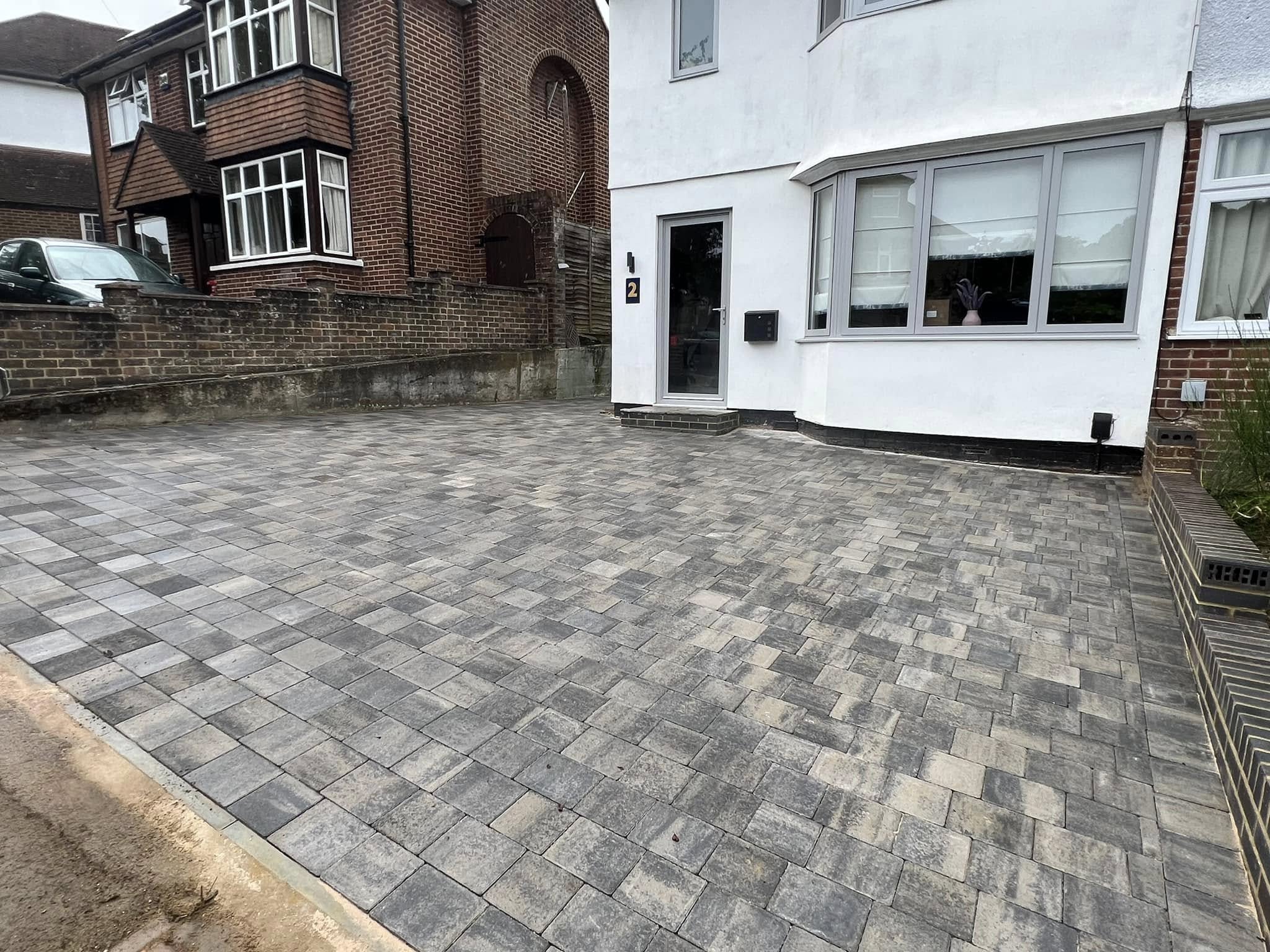
Master the technical standards of heavy-duty vehicular pavement design, BS 7533-101 compliance, interlocking block mechanics, and SuDS architecture.
The structural commissioning of vehicular pavements demands a strict application of civil engineering principles to resist severe dynamic, static, and environmental stress profiles. Whether deploying high-density modular precast units or continuous open-matrix polymeric aggregates, a pavement is an active multi-layered structure engineered to distribute high concentrated axle loads down to subterranean subgrades without suffering shear failure, localized rutting, or pavement shifting.
In the modern structural landscape, pavement designs must transition away from empirical rule-of-thumb placement toward precise, mathematically verified geological and hydraulic models. This technical manual details the physical parameters, material sciences, and statutory drainage requirements necessary to build high-performance, heavy-duty driveways and vehicular hardscapes that conform to modern structural standards.
1. Civil Structural Design Under the BS 7533-101 Framework
The structural design of modular, block, and sett paving arrays in the United Kingdom is governed by the code of practice outlined in British Standard BS 7533-101. This comprehensive framework consolidates historical legacy pavement codes into a single engineering directive, ensuring that modular vehicular hardscapes are constructed to uniform structural performance indexes.
The Scope of BS 7533-101 Consolidation
BS 7533-101 coordinates the structural parameters for all modular pavements surfaced with concrete paving blocks, clay pavers, stone setts, and concrete or natural stone flags. Prior to its implementation, pavement configuration was fragmented across seven distinct design standards, which frequently led to engineering configuration conflicts, mismatched component layer calculations, and premature pavement deformation.
The current framework standardizes the selection of laying courses, jointing materials, and sub-base configurations based on calculated load cycles. It establishes a clear division between bound configurations, where paving units are locked into position using rigid cementitious mortars, and unbound structures, which utilize strictly graded aggregate fractions to absorb physical movements and dynamic load vectors through controlled particle friction.
Calculating Traffic Categories and Standard Axle Wheel Profiles
A core mandate of BS 7533-101 is the verification of the design traffic load profile over a projected operational lifespan, typically calculated across a twenty-year or thirty-year parameter loop. Pavement thickness matrices cannot be generalized; they are explicitly determined by calculating the number of Standard Axles per commercial vehicle expected to interface with the surface.
+-------------------------------------------------------------------------+
|                  BS 7533-101 TRAFFIC LOAD PROFILE MATRIX                |
+-------------------------------------------------------------------------+
| Traffic Category | Standard Axle Capacity (MSA) | Vehicular Load Profile|
+------------------+------------------------------+-----------------------|
| Category 1       | Light Domestic Pedestrian    | Zero Commercial Loads |
| Category 2       | Domestic Light Vehicular     | Light Passenger Cars  |
| Category 3       | Up to 0.15 Million Axles     | Light Vans, Refuse 4x2|
| Category 4       | 0.15 to 0.50 Million Axles   | Heavy Multi-Axle HGV  |
| Category 5       | 0.50 to 1.50 Million Axles   | Industrial Logistics  |
+-------------------------------------------------------------------------+
For domestic and light commercial assets, designers must classify the system within Traffic Categories 2 through 4. Category 2 handles light passenger vehicles with negligible commercial traffic, whereas Category 4 transitions to support multi-axle heavy goods vehicles (HGVs), municipal refuse transport systems, and emergency service vehicle access vectors.
The physical load calculation tracks the cumulative damage index inflicted by single-axle weights up to eleven thousand kilograms. The structural base layers—specifically the sub-base and base binder layers—must scale in direct physical thickness to match the calculated Traffic Category, neutralizing the localized point-load stresses before they reach vulnerable subterranean horizons.
Geotechnical Strain Transitions and Subgrade Subgrade Performance
The ultimate layer of the structural pavement engine is the natural earth foundation. When a heavy vehicular wheel rolls across a modular pavement surface, the vertical stress travels down through the blocks, beds, and granular aggregate layers. As the stress moves downward, the physical footprint of the force vector expands, creating a cone-shaped dissipation profile.
The thickness of the MOT Type 1 aggregate base must be engineered to ensure that by the time the force vector reaches the subgrade boundary, the concentrated point load has been brought safely below the maximum allowable vertical strain threshold of the soil. If the subgrade consists of expansive clays, its shear strength will degrade radically as moisture levels shift. Under high-load conditions, an under-engineered aggregate depth will result in subgrade pumping, where soft clay is forced upward into the aggregate voids, destroying the compaction profile of the stone base and causing structural depressions across the surface.
2. Mechanics of Interlocking Modular Blocks and Vector Physics
Precast concrete and clay block paving arrays provide exceptional structural durability under high vehicular loads due to the mechanical interlock that develops between individual modular paving units. When configured correctly, individual blocks cease to act as isolated components; they function as a single, flexible structural slab that distributes vertical and horizontal forces across a massive geometric footprint.
The Physics of the Herringbone Interlock Engine
The capacity of a modular pavement to resist horizontal shear stresses—specifically the intense braking, turning, and acceleration forces exerted by heavy vehicular tires—is directly determined by the physical layout pattern of the blocks. The industry standard for all trafficked zones mandates the execution of a forty-five-degree or ninety-degree herringbone configuration.
+-----------------------------------------------------------------------+
|                    HERRINGBONE MECHANICAL VECTOR INTERLOCK            |
+-----------------------------------------------------------------------+
|                                                                       |
|         +--------------+                                              |
|         |  BLOCK UNIT  | ===> Horizontal Braking Force Vector         |
|         |   A (90°)    |                                              |
|   +-----+--------+-----+----+                                         |
|   |  BLOCK UNIT  |  BLOCK   | <--- Frictional Interlocking Planes     |
|   |   B (45°)    |  UNIT C  |      Distribute Forces Across Both Axes |
|   +--------------+----------+                                         |
|                                                                       |
+-----------------------------------------------------------------------+
Linear laying styles, such as stretcher bonds or basket-weave patterns, feature long, continuous joint lines running parallel to traffic vectors. When a vehicle brakes hard on a stretcher bond surface, the lateral force acts directly along these continuous seams, causing the joints to open up and forcing the blocks to creep out of position along the axis of travel.
A herringbone pattern eliminates continuous linear joints across both structural axes. Every single block is oriented at a right angle to its neighbor, locking the units into an interlaced matrix.
When a lateral wheel force is applied to Block A, the force is immediately split into divergent vectors and transferred onto the flanks of Blocks B, C, and D. This multi-directional energy dissipation prevents horizontal block displacement, preserves the spatial alignment of the pavement field, and ensures compliance with modern masonry construction standards.
Jointing Sand Kinetics and Frictional Shear Stress Transmission
The mechanical interlock of a herringbone block pavement is completely dependent on the presence and performance of the jointing sand that fills the narrow gaps between the blocks. This sand layer does not merely keep debris out of the joints; it functions as a critical shear-stress transmission medium.
The specification for jointing sand mandates a clean, unwashed, sharply graded kiln-dried sand with particle sizes concentrated between one millimeter and zero point one five millimeters. Fine beach sands or rounded builders' sands are strictly prohibited; their rounded particle profiles act like microscopic ball bearings, causing the blocks to shift under load.
Sharp kiln-dried sand consists of highly angular, multi-faceted quartz grains. When the block field is processed with heavy mechanical plate compactors, these angular grains are compressed tightly inside the narrow two-to-four-millimeter joint gaps, locking together through high internal friction.
When a vehicular tire applies a vertical or horizontal load to a single block, the load is transmitted through the compressed sand matrix into adjacent blocks. This frictional shear transmission converts localized point impacts into broad, uniformly distributed stress fields, protecting individual block margins from structural chipping or splitting.
Rigid Edge Restraint Architecture and Lateral Thrust Control
A flexible modular block pavement functions under high horizontal compression. When a heavy vehicle interfaces with the surface, the herringbone field experiences a lateral thrust vector that pushes the blocks outward toward the perimeter boundaries of the asset. If the perimeter lacks structural containment, the outer joints will slowly open up, causing the jointing sand to drop down out of the gaps and triggering a total breakdown of the mechanical interlock.
To control this lateral thrust, the pavement must incorporate heavy-duty, cast-in-place concrete edge restraints or granite sett curbs installed prior to laying the main block field. The edge restraints must be bedded on a reinforced concrete structural haunching line that measures a minimum of one hundred and fifty millimeters in thickness and projects upward behind the rear face of the curb unit. This concrete backing ensures that the perimeter boundary can absorb intense horizontal stresses without shifting or cracking, preserving the tight compression of the inner herringbone block field indefinitely.
3. Permeable Resin-Bound Polymeric Engineering vs. Resin-Bonded Layers
The integration of advanced polymers into external surfacing infrastructure has delivered high-performance alternatives to traditional asphalt and concrete surfaces. Resin-based applications are classified into two distinct engineering methodologies based on their internal matrix profiles: resin-bound systems and resin-bonded configurations.
Resin-Bound Systems: The Open-Matrix Permeable Framework
A resin-bound pavement is an engineered, fully open-matrix surfacing system designed to combine extreme mechanical durability with complete fluid permeability. The installation process requires clean, completely dry natural aggregates to be thoroughly blended with a clear, two-part polyurethane resin binder inside specialized mechanical forced-action mixers.
+-----------------------------------------------------------------------+
|                    RESIN-BOUND OPEN-MATRIX POROSITY                   |
+-----------------------------------------------------------------------+
|                                                                       |
|      [Polyurethane Polymer Resin Film Coating Every Aggregate]        |
|             /                     |                     \             |
|     (Angular Stone) <-----> (Angular Stone) <-----> (Angular Stone)   |
|            \                      /                     /             |
|         [ OPEN CONTINUOUS GEOMETRIC VOID SPACE FOR WATER FLOW ]       |
|                                                                       |
+-----------------------------------------------------------------------+
The polyurethane binder is specified as an aliphatic polymer system. Aliphatic resins possess high UV-stability, meaning their chemical backbone resists molecular breaking when exposed to solar radiation, preventing the surface from yellowing, becoming brittle, or cracking under thermal cycles. The aggregate fractions—typically ranging from three millimeters to six millimeters or a balanced blend of six-to-ten-millimeter angular granites and flints—are entirely coated in a clear polymer film.
When placed and troweled flat to a standard vehicular depth of eighteen to twenty-two millimeters, the aggregate chunks touch only at their outer structural points. The polyurethane resin cures to form high-strength chemical welds at these contact interfaces, locking the stones into a durable, monolithic structural layer.
Because the stone fractions are not packed with fine sands or dust fillers, the space between the aggregates forms a continuous network of interconnected geometric voids. This open-matrix configuration delivers an exceptionally high void ratio, allowing water to pass through the surface at a rate of thousands of liters per square meter per minute. This eliminates surface water sheeting, standing puddles, and hydroplaning hazards.
Resin-Bonded Surfaces: The Non-Permeable Scatter Overlay
Resin-bonded configurations are fundamentally different from open-matrix resin-bound systems. A resin-bonded layout is a non-permeable, purely cosmetic surface treatment applied as a thin overlay sheet across a pre-existing solid concrete or dense asphalt base layer.
The execution protocol requires a thin film of non-UV stable polyurethane or epoxy resin to be spread uniformly across the solid base substrate using squeegees. While this resin film remains in a liquid state, clean natural aggregate stones are scattered over the top layer. Once the adhesive cures, the excess loose stone is swept away, leaving a thin, single-stone layer anchored to the solid base.
Resin-bonded installations exhibit zero fluid permeability; the underlying solid resin film forms a complete barrier to water movement. Rainwater hitting a resin-bonded surface must be managed using surface falls and traditional slot drainage channels to prevent water accumulation.
Furthermore, resin-bonded layers are highly vulnerable to surface peeling and stone shedding when subjected to high wheel turning stresses; because the aggregates are only anchored at their base rather than being fully encapsulated in a polymer matrix, high-torque vehicular maneuvering will snap the structural bond, leading to localized bald spots and rapid cosmetic degradation.
Substrate Infrastructure Configurations for Resin Surfacing
A resin-bound open-matrix surfacing layer possesses high tensile flexibility but lacks independent structural load-bearing capacity; it functions as a flexible carpet that mirrors the performance of the underlying substrate infrastructure. If the substrate base cracks, shifts, or experiences localized settlement, the surface resin layer will tear apart along the exact same failure lines.
To guarantee long-term stability, the base infrastructure beneath a vehicular resin-bound system must be engineered as a porous, structural layer. The baseline standard mandates a minimum of forty to fifty millimeters of open-graded porous asphalt concrete binder course, laid over a minimum of one hundred and fifty millimeters of heavily compacted sub-base aggregate.
The asphalt binder course must utilize a specialized aggregate sizing mix that leaves open voids between the stones, ensuring that water passing through the surface resin-bound layer can flow uninterrupted down through the asphalt layer and into the aggregate sub-base beneath, preventing water from trapping at the material interface.
4. SuDS Compliance, Structural Attenuation, and Environmental Water Management
The development of expansive vehicular driveways and commercial parking assets significantly alters the natural hydrology of a site. Replacing natural, permeable topsoils with impermeable surfaces prevents rainwater from absorbing into the ground, generating massive volumes of instantaneous surface water runoff that can overwhelm municipal storm drainage networks.
The Legislative Mandate of Sustainable Drainage Systems
To mitigate flash flooding risks and reduce the chemical pollution of natural waterways, the UK General Permitted Development Order dictates that any hardscape transformation exceeding five square meters across the front external boundary of a property must integrate Sustainable Drainage Systems (SuDS). Property owners cannot legally discharge un-attenuated surface runoff directly from a driveway asset out into public highway gutters or combined sewer systems without formal planning permission.
SuDS compliance requires that all surface rainwater falling within the asset footprint must be completely managed inside the boundary lines of the property through natural ground infiltration, localized bio-retention, or structured subterranean attenuation facilities. This legislative framework ensures that modern external landscape developments protect local water tables and help maintain the structural integrity of neighboring properties by preventing unmanaged surface flooding.
MOT Type 3 Open-Graded Aggregate Infrastructure
To construct a pavement that satisfies the dual mandates of structural load bearing and SuDS water storage, traditional sub-base materials must be re-engineered. While standard MOT Type 1 aggregate is ideal for solid structural foundations, its high concentration of fine dust particles restricts water storage and blocks fluid movement. SuDS-compliant permeable pavements must utilize an aggregate configuration specified as MOT Type 3.
+-----------------------------------------------------------------------+
|                    MOT TYPE 3 OPEN-VOID WATER RESERVOIR               |
+-----------------------------------------------------------------------+
|                                                                       |
|     [ 40mm Clean Angular Crushed Granite / Limestone Blocks ]         |
|              /                       |                       \        |
|      (Angular Stone)              (Void)              (Angular Stone) |
|             |                        |                       |        |
|      (Angular Stone)              (Void)              (Angular Stone) |
|                                                                       |
|     [ Zero Fine Dust - Leaving a 30% Continuous Water Storage Cell ]  |
|                                                                       |
+-----------------------------------------------------------------------+
MOT Type 3 consists entirely of clean, crushed angular granite or limestone washed free of fine dust particles, with sizes carefully distributed between forty millimeters and four millimeters. Because the fine particle filler is omitted, the compacted MOT Type 3 matrix features a continuous network of interconnected structural voids, delivering an active interstitial void ratio of approximately thirty percent.
This means that within a one-cubic-meter volume of compacted MOT Type 3 aggregate, three hundred liters of water can be stored inside the structural void spaces. This engineered layer acts as an active underground reservoir, safely holding peak storm volumes during intense cloudbursts without losing its structural load-bearing capacity.
Geotextile Infiltration and Perforated Collection Routing
A SuDS-compliant sub-base infrastructure must operate in three distinct structural phases: extraction, attenuation, and infiltration.
- Geotextile Protection Filters: The MOT Type 3 aggregate reservoir must be lined with a non-woven, needle-punched geotextile protection membrane. This specialized fabric layer permits water to pass through freely while acting as a microscopic physical filter that captures fine sand sediments, motor oil residues, and surface pollutants, preventing them from contaminating the deep subgrade soil table.
- Perforated Routing Networks: On sites situated over low-permeability soils where natural ground infiltration occurs too slowly to keep pace with extreme rainfall events, the sub-base reservoir must incorporate perforated land-drain collection pipes. These pipelines are embedded deep within the lower horizon of the MOT Type 3 layer. As stormwater accumulates inside the stone voids, the water levels rise and enter the perforations, allowing the pipe matrix to route the collected water at a slow, strictly metered rate out into public storm networks via flow-control vortex valves. This prevents the system from triggering localized flash floods.
5. Subgrade Testing, Base Densification, and Structural Component Matrices
The successful execution of high-load vehicular surfaces demands a systematic evaluation of sub-surface engineering parameters. Soil profiles and structural layer component depths must be configured to match verified site data to guarantee long-term performance.
California Bearing Ratio (CBR) Geotechnical Auditing
The design of a heavy-duty vehicular pavement cannot proceed without establishing a definitive baseline measurement of the load-bearing capacity of the natural subgrade soil. Geotechnical engineering teams quantify this capacity using the California Bearing Ratio (CBR) test framework.
The CBR test measures the resistance of a soil stratum to mechanical penetration by a standardized piston, comparing the results directly against a high-quality crushed rock standard. Testing is performed on site using vehicle-mounted hydraulic digital penetrometers or by extracting undisturbed soil cores for precise laboratory analysis.
A low CBR value (typically between one percent and three percent) indicates a soft, cohesive clay soil that will suffer structural deformation under load. When a low CBR profile is identified, the structural design team must increase the overall thickness of the aggregate sub-base or specify mechanical stabilization grids to reinforce the soil and prevent sub-grade failure.
+-------------------------------------------------------------------------+
|                      PAVEMENT STRATIFICATION MATRIX                     |
+-------------------------------------------------------------------------+
| Pavement Layer       | Material Specification   | Engineered Thickness  |
+----------------------+--------------------------+-----------------------|
| Surface Finish Leaf  | Interlocking Block / Resin| 60mm-80mm / 20mm      |
| Bedding Course       | Sharp Quartz Sand / Open | 30mm-50mm             |
| Binder Base Layer    | Dense AC / Porous AC     | 50mm-70mm             |
| Sub-Base Reservoir   | MOT Type 1 / MOT Type 3  | 150mm-250mm           |
+-------------------------------------------------------------------------+
Mechanical Geogrid Stabilization Systems
Where bulk excavation exposes low-strength, high-moisture clay matrices, traditional mass aggregate dumping is an economically inefficient method to build structural strength. Instead, the design should incorporate multi-axial polypropylene geogrids directly over the subgrade horizon.
A geogrid is an engineered structural mesh featuring high tensile modulus junctions and open aperture windows. When the first lift of MOT Type 1 or Type 3 aggregate is placed over the geogrid grid and processed with heavy mechanical plate compactors, the angular stone chunks are forced down into the open mesh apertures.
The stones lock into the grid windows, creating a structural mechanical interlock. This confinement locks the aggregate into a rigid platform, preventing horizontal particle movement and converting lateral load thrusts into vertical compression forces. The integration of structural geogrids increases the overall load-bearing capacity of the sub-base, allowing for up to a thirty percent reduction in required aggregate thickness without sacrificing the safety profile of the pavement asset.
Multi-Axis Laser Profiling and Final Level Closures
The final durability of a vehicular pavement relies completely on the spatial accuracy achieved across every component layer during the construction phase. Site teams must transition away from old string-line methods, deploying multi-axis automatic tracking laser levels to guide grading and screeding operations.
The surface of the compacted aggregate sub-base must be graded to follow the exact slope profiles of the finished pavement surface, ensuring a uniform bedding course thickness across the entire field. The maximum allowable level deviation across the completed sub-base is restricted to plus or minus ten millimeters when measured beneath a three-meter straightedge.
Any high spots will compress the bedding course too thin, leading to point-load fractures across the surface blocks, while low spots create thick pockets of bedding sand that will settle unevenly under future traffic, leading to localized puddles and early pavement deformation.
6. Comprehensive Project Lifecycle and Hardscape Transformation Workflow
Executing a comprehensive external transformation—incorporating heavy civil excavations, drainage infrastructure placement, base stabilization, and advanced surfacing finishes—demands a rigorous, phased project management workflow to ensure long-term structural success.
Phase 1: Pre-Commencement Mapping, Utility Auditing, and Clearances
Before any heavy mechanical machinery tracks onto the asset footprint, the work area must be mapped and legally cleared.
- Statutory Clearances and SuDS Audits: Verify all boundary operations against national planning policy guidelines. Ensure that all designs for non-porous hardscape extensions exceeding five square meters incorporate active SuDS attenuation loops to satisfy local building control mandates and prevent un-attenuated public discharge penalties.
- Subterranean Infrastructure Location: Conduct full ground penetrating radar (GPR) scans and cross-reference national utility databases to plot the exact locations of all buried water mains, high-pressure gas feeds, high-voltage electrical conduits, and fiber-optic cables. All service lines must be clearly marked at surface level, and manual hand-digging protocols must be strictly enforced within one meter of these corridors to ensure total site safety.
Phase 2: Bulk Earthworks, Geotechnical Profiling, and Drainage Integration
This phase manages the structural removal of redundant materials and shapes the foundational ground topology.
- Bulk Demolition and Excavation: Deploy tracked excavators to break out and remove all old asphalt layers, fractured concrete slabs, and organic topsoils. All excavated waste matrices must be routed away from the site via certified muck-away transport systems.
- Forming the Drainage Slopes: Cut the subgrade earth down to the precise design levels, shaping the mandatory 1 in 60 to 1 in 80 drainage fall profiles directly into the raw sub-surface ground layers to guide future water runoff.
- Installing Sub-Surface Services: Lay all primary underground drainage networks, place modular SuDS attenuation crates, build solid concrete foundations for inline silt traps, and mount heavy-duty linear slot channels along the boundary vectors, wrapping all buried lines in clean pea shingle gravel to prevent damage from future ground movement.
Phase 3: Geo-Mesh Integration and Sub-Base Densification
This phase establishes the primary load-bearing engine of the hardscape asset, building up the layers that protect the subgrade from wheel-load deformations.
- Geotextile and Geogrid Placement: Roll out the non-woven geotextile filtration membrane over the subgrade soil bed, ensuring a minimum overlap of three hundred millimeters at all seams, and overlay the multi-axial polypropylene geogrids across the high-load traffic paths.
- Aggregate Installation and Compaction: Introduce clean MOT Type 1 or washed MOT Type 3 aggregate in controlled seventy-five-millimeter lifts. Process each layer with a minimum of six passes of a heavy-duty mechanical vibrating plate compactor to ensure aggregate interlocking and maximum density.
- Perimeter Edge Restraint Erection: Construct concrete haunching foundations along all outer edges and anchor heavy curb units or granite setts into position to lock the pavement field and prevent lateral shifting under vehicular loads.
Phase 4: Bedding Course Screeding, Surfacing Execution, and Handover
The final phase where the aesthetic surface finishes are integrated with the structural base layers and detailed for final commissioning.
- Screeding the Bedding Layer: Lay out and flat-screed a uniform course of clean sharp sand or open-graded aggregate bedding mortar to a calibrated thickness of thirty to forty millimeters, maintaining level alignments with laser-guided precision.
- Surfacing Material Placement: Lay the precast block units in a 45-degree herringbone configuration, maintaining consistent three-millimeter joint gaps, or trowel down the aliphatic resin-bound aggregate matrix to a uniform thickness of twenty millimeters.
- Joint Stabilization and Handover Curing: Process block paving arrays with rubber-faced plate compactors while sweeping sharp kiln-dried sand into the joints, or allow the polymer resin matrix a forty-eight-hour chemical stabilization window to cure completely. Conduct a final structural inspection, verify all drainage paths, and sign off the high-performance hardscape asset for immediate operational handover.