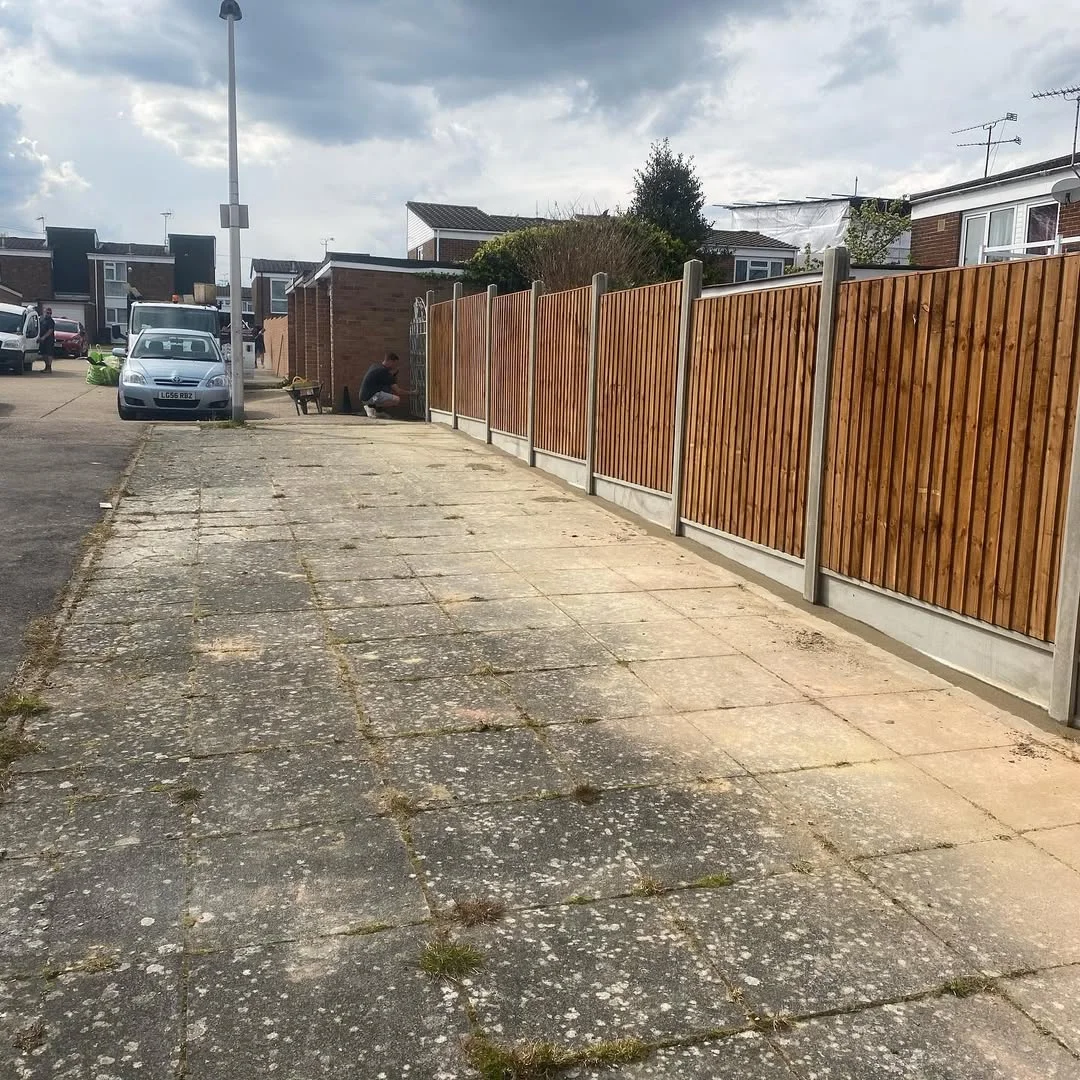
Garden fencing in Kent — complete 2026 guide to closeboard, panel, slatted and composite fencing. Costs, planning rules, post installation and storm damage advice.
A fence does something deceptively simple: it marks the boundary between yours and everything else. It creates privacy from neighbours and the street. It provides security for children and pets. It defines the edges of a garden and frames the outdoor space it surrounds.
When it's done well, you stop thinking about it. It's just there — solid, level, clean, doing its job through every Kent winter without demanding attention. When it's done badly, it becomes one of the most persistent sources of frustration a homeowner can have: panels blowing out in the first storm, posts that lean progressively regardless of how many times they're straightened, wood that rots at the base within three years.
The difference between those two outcomes is almost entirely in the installation. Specifically: how the posts are set, what they're set in, and at what depth.
Marshall Brickwork & Construction installs fencing across Kent as part of its comprehensive outdoor construction offering — always to the specification that makes fencing last rather than the specification that makes it cheap to install. This guide covers everything Kent homeowners need to know: the types of fencing available, the costs, the planning rules, the installation details that determine longevity, and how to choose the right fence for your specific property and purpose.
Why Most Fencing Fails — And What Good Installation Actually Looks Like
Before the material choices and the costs, it's worth understanding why so much residential fencing in Kent fails within five to seven years, because understanding this makes every other decision easier.
The Post Problem
Almost all fencing failures originate at the post. Not the panel, not the boards, not the rails — the post. And almost all post failures have the same cause: inadequate depth in inadequate material.
A 1.8m (6ft) fence panel requires a post of at least 2.4m — the extra 600mm needs to go in the ground. The ground socket depth should be approximately one third of the total post height. For 1.8m fencing, that means a minimum of 600mm below ground level, ideally 750mm in exposed positions or on the clay soils common across the Medway towns and much of Kent.
Those posts need to be set in concrete — not rammed earth, not sharp sand, not just soil firmed back around them. Properly mixed concrete (minimum C20 grade), poured to at least 300mm depth around the base of the post, allowed to cure for a minimum of 24 hours before any load is applied.
On Kent's clay soils — which expand when wet and contract when dry — concrete post footings should be slightly tapered at the base to allow for frost and ground movement without the post heaving. This is a detail that experienced installers include automatically and that DIY installations almost never get right.
Posts set in rammed earth last two to three years before movement begins. Posts set in insufficient concrete last five to seven years. Posts set correctly in appropriate concrete at adequate depth last twenty years or more.
Everything else about a fence — panel quality, wood treatment, hardware specification — is secondary to getting the posts right.
Treatment and Material
Pressure-treated timber is the standard for residential fencing in Kent. The treatment process forces preservative deep into the wood cells, providing resistance to rot, insect attack, and moisture ingress from the inside out. Untreated or surface-painted timber rots from the cut ends and the ground contact points regardless of surface treatment — the wood treatment must be systemic.
Concrete posts are an excellent alternative to timber posts for anyone who wants to eliminate the post maintenance question entirely. Concrete posts don't rot, don't move with ground moisture changes, and last essentially indefinitely. The initial cost is slightly higher; the lifetime maintenance cost is significantly lower.
Types of Garden Fencing: What Each One Does and Who It's Right For
Closeboard Fencing (Feather-Edge)
Closeboard fencing — also called feather-edge fencing — is the most popular residential fencing choice across Kent and the most structurally sound of all timber panel types. It's the right choice for most applications and the one Marshall recommends as a default where privacy and longevity are the priorities.
The construction is what makes it strong. Rather than a pre-made panel hung between posts (which is what overlap panel fencing is), closeboard fencing uses individual feather-edge boards nailed directly to arris rails fixed between the posts. The boards overlap each other, the thicker edge facing outward, creating a surface that sheds water rather than holding it.
Because the boards are fixed individually to the structural framework, the fence continues to perform even if individual boards are damaged — you replace the board, not the panel. This repairability advantage alone makes closeboard the better long-term investment for most Kent gardens.
Best for: Privacy fencing for rear gardens and side boundaries, situations where wind exposure is significant (the board-by-board construction is more wind-resistant than panel fencing), properties where long-term maintenance cost matters more than upfront cost.
Height options: 0.9m, 1.2m, 1.5m, 1.8m — all standard heights.
Cost: £120–£200 per linear metre installed including posts, arris rails, boards, gravel boards, and concrete post footings. A typical 10 linear metres of 1.8m closeboard: £1,200–£2,000.
Overlap Panel Fencing
Overlap panels — the standard rectangular panel with horizontally lapped boards — are the most commonly installed and most commonly problematic fencing type in Kent gardens. They're cheap to install quickly. They're also the fencing type that blows down first in a storm, fails at the posts first, and needs replacing most often.
The structural weakness is inherent to the design: the panel is a rigid unit hung between posts. When the panel catches wind load, all that force transfers directly to the post fixings and the posts themselves. Closeboard fencing dissipates that force more effectively because the individual boards can flex slightly relative to each other.
That said, overlap panels are a legitimate choice for lower-exposure situations, for shorter fence runs, and where budget is the primary consideration. Installed correctly — with posts set at adequate depth in proper concrete — they'll give a reasonable service life.
Best for: Shorter fence runs, sheltered gardens, situations where upfront cost is the primary consideration.
Cost: £80–£140 per linear metre installed. A 10 linear metre run of 1.8m panels: £800–£1,400.
Slatted Screen Fencing
Slatted fencing — horizontal boards with deliberate gaps between them — has grown in popularity across Kent in recent years, driven by contemporary garden design trends. The horizontal slatted aesthetic has a clean, architectural quality that suits modern extensions and contemporary outdoor spaces.
The design creates an interesting visual effect: full privacy at 5m distance, partial privacy at 2m, very little privacy at 0.5m. Whether that works for your garden depends on the specific sightlines and what you're screening.
From an installation perspective, slatted fencing requires the same post specification as any timber fence, plus careful attention to the spacing consistency between slats — the gaps need to be even throughout, which takes more care than panel fixing.
Best for: Contemporary properties, gardens adjacent to modern extensions or landscaping, situations where full privacy at a distance is the requirement rather than close-up.
Cost: £150–£250 per linear metre installed depending on board spacing and material. Premium hardwood slatted fencing: from £250 per linear metre.
Trellis and Decorative Fencing
Trellis panels — the diamond or square lattice wood panels — aren't structural fencing. They're garden features. Used at height above a closeboard fence (adding 300–600mm of trellis on top of 1.5m solid fence to reach a 1.8m–2.1m total height without requiring planning permission), or as screening within a garden to divide spaces and support climbing plants.
Decorative options — picket fencing for front gardens, post-and-rail for rural character, estate fencing for more formal settings — all have their appropriate applications. Picket fencing (1–1.2m height, traditional painted white or natural timber) suits period properties and cottage-style gardens particularly well.
Cost for trellis additions: £40–£80 per linear metre for trellis fixed to existing posts. Picket fencing: £80–£140 per linear metre installed.
Composite Fencing
Composite fencing boards — made from a combination of recycled wood fibre and plastic — have improved significantly in quality over the past five years. The key advantage is zero maintenance: no painting, no staining, no rot. The material is stable, resistant to moisture, and retains its appearance through years of Kent weather without treatment.
The aesthetic is more uniform and less natural than timber. For homeowners who want the appearance of timber without the maintenance commitment, composite is an increasingly viable choice.
Cost: £180–£300 per linear metre installed for quality composite fencing.
Fencing Costs in Kent: Honest 2026 Pricing
Here's the complete pricing breakdown for the most commonly installed fencing types across Kent in 2026. All prices are fully installed including posts set in concrete, all fixings, and waste removal.
Fence TypePer Linear Metre10m Run (typical garden)20m RunOverlap panels, 1.8m£80–£140£800–£1,400£1,600–£2,800Closeboard, 1.8m£120–£200£1,200–£2,000£2,400–£4,000Slatted screen, 1.8m£150–£250£1,500–£2,500£3,000–£5,000Composite, 1.8m£180–£300£1,800–£3,000£3,600–£6,000Picket, 1.2m£80–£140£800–£1,400£1,600–£2,800Post-and-rail£50–£90£500–£900£1,000–£1,800
What drives the variation within each range:
Post type — concrete posts cost more than timber but last longer and are factored into the quality end of each range.
Gravel boards — concrete or timber boards at the base of the fence between the posts, protecting the panel bottoms from ground contact and moisture. Essential for longevity; often excluded from cheap quotes.
Ground conditions — rocky ground or roots that complicate post setting increase cost. Very soft ground that requires deeper footings increases cost.
Removal of existing fencing — breaking out old concrete post footings is labour-intensive and adds to the project cost.
Access — narrow side access requires manual materials handling rather than mechanical delivery.
Planning Permission for Fencing in Kent: What You Need to Know
Most residential garden fencing is permitted development in England — meaning no planning permission required. But there are important exceptions that affect a significant number of Kent properties.
The key rules:
Fencing up to 2 metres in height is permitted development for most properties when not adjacent to a highway.
Fencing up to 1 metre in height is permitted development when adjacent to a highway (road, public footpath, or other public right of way). This affects front garden boundaries on most residential streets.
Conservation areas: In Kent's numerous conservation areas — Rochester, Faversham, parts of Maidstone, Tunbridge Wells, Canterbury, and many others — permitted development rights for fencing may be more restricted. Some conservation areas require that fencing visible from the street maintains a traditional character, and certain fence types or materials may require consent.
Listed buildings: Any work affecting the curtilage of a listed building requires listed building consent in addition to any planning permission needed.
Always check your title deeds: Boundary responsibility (which neighbour is responsible for which fence) is often specified in title deeds. Getting this wrong before installing a fence — or installing when you're not the responsible party — creates legal complications.
Marshall's team advises on planning considerations for fencing as part of every site consultation in Kent. It's better to know before you order materials.
Storm Damage and Fence Replacement in Kent
Kent's position — exposed to south-westerly weather off the English Channel, with the coastal areas facing direct Atlantic weather influence — makes it one of the higher-risk counties in England for storm damage to garden fencing.
The pattern after every significant storm is predictable: overnight winds, morning survey, the discovery that one or more fence panels have blown down or that posts have lifted. For many homeowners, this is when the deeper problem becomes visible — the fence that failed wasn't a victim of an exceptional storm, it was a fence that was already compromised and waiting for the storm to expose it.
Fence panels blow down when posts fail. Posts fail when they weren't set deeply enough, weren't set in concrete, or when the concrete deteriorated over time and allowed movement to develop. A fence that withstands Kent's weather year after year does so because its posts are set correctly.
When replacing storm-damaged fencing, the question worth asking isn't just "what new panels do I want?" — it's "why did this fence fail, and how do we make sure the replacement doesn't?" Sometimes the post can be re-set in new concrete. Often, when a post has failed once, it's better replaced.
Marshall's team assesses the cause before recommending the repair — exactly the same diagnostic approach applied to brickwork repairs.
Fencing as Part of a Complete Outdoor Project
Fencing rarely sits in isolation. In most Kent garden projects, the fencing is one element of a wider outdoor transformation — and coordinating it as part of a single project rather than commissioning it separately delivers better results and often better value.
The most common combinations:
Driveway + front boundary fencing. A new driveway with updated front boundary fencing and gates creates a complete front-of-house transformation that photographs well, surveys well, and genuinely improves the first impression of the property.
Patio + rear garden fencing. A new patio is significantly more private and more usable when the garden boundary is secure and well-maintained. Coordinating both means the fencing heights, materials, and colours can be chosen to complement the patio design.
Landscaping + fencing. A complete garden transformation that includes artificial grass, planting areas, and patio work benefits from coordinated boundary fencing that frames the finished design.
Brickwork + fencing. Period properties often have a combination of brick boundary walls (front) and timber fencing (sides and rear). Marshall's dual capability — brickwork expertise alongside fencing installation — means both can be addressed in a single project with consistent quality standards throughout.
Fencing in Kent's Specific Locations: What Matters Where
Rochester and Medway towns: The Medway area's clay soils mean post settings need to account for seasonal ground movement. Concrete posts rather than timber are worth the modest additional cost in this area. Conservation area boundaries in Rochester require particular attention — check before any front boundary changes.
Sittingbourne and Swale: Coastal exposure increases wind loads on fencing in exposed positions. Closeboard is strongly recommended over panel fencing for Swale properties on open aspects. Slatted fencing allows wind through rather than catching it — a genuine structural advantage in exposed Swale gardens.
Maidstone: The varied soil conditions across the borough — chalk to the north, clay to the south and east — mean site-specific post depth assessment is important. Maidstone's conservation areas include restrictions that affect fence materials and heights in certain streets.
Coastal Kent (Whitstable, Herne Bay, Folkestone, Thanet): Salt air accelerates corrosion of metal fence fixings. Specify stainless steel or hot-dip galvanised fixings throughout. Timber treatment specification should be enhanced — end-grain treatment is particularly important in coastal environments where moisture exposure is high.
How to Get Fencing Right: Questions to Ask Any Contractor
What post specification are you using, and how deep will the footings be? Expect a specific answer: post length, concrete mix, depth. Any vagueness is a red flag.
Are you using concrete or timber posts? Both are acceptable. Concrete is more durable; timber is less expensive. Know which you're getting.
Are gravel boards included? These protect the base of the fence from ground contact and are essential for longevity, especially on clay soils. They're often quietly excluded from budget quotes.
Does this require planning permission for our specific property? Any knowledgeable contractor will have considered this and will raise it proactively for conservation area and highway-adjacent properties.
What timber treatment is specified? Pressure-treated to BS8417 is the standard for external fencing timber. Ask for this to be confirmed in writing.
What warranty covers the installation workmanship? Quality contractors guarantee their work. Get it in writing.
Getting Your Fencing Quote in Kent
Marshall Brickwork & Construction installs fencing across Kent from the Rochester base — closeboard, panel, slatted, composite, decorative, and everything in between. Every installation is specified to last: posts at the correct depth in proper concrete, pressure-treated timber, gravel boards included, fixings specified for the exposure conditions.
Free site visits. Detailed, itemised quotes. Work guaranteed. One team for fencing and every other element of your outdoor project — driveways, patios, brickwork, landscaping, extensions.
Phone: 07724 730872 Email: info@mbconstruction.group Contact: mbconstruction.group/contact/
For location-specific information on fencing and construction services in your area: Rochester and Medway guide, Sittingbourne guide.
Marshall Brickwork & Construction. Kent's complete outdoor specialists. Fencing, driveways, patios, brickwork, landscaping — all done properly, all guaranteed.
Frequently Asked Questions About Fencing in Kent
How long should a well-installed fence last in Kent? Closeboard fencing with posts correctly set in concrete and pressure-treated timber throughout: 15–25 years. Overlap panel fencing correctly installed: 10–15 years. Composite fencing: 25+ years with zero maintenance. The biggest variable is post installation quality — properly set posts double the service life of any fence.
Can I install my own fence panels after getting posts installed professionally? Yes — this is a reasonable division of labour. Getting the posts set correctly is the most technical element. Panel fixing is more accessible to confident DIYers. Marshall can discuss this hybrid approach during a consultation.
My neighbour's fence is falling down and it's their responsibility — what can I do? The boundary responsibility issue is between you and your neighbour. If the falling fence is causing a nuisance or risk to your property, the legal position is that the responsible party is obliged to maintain it. A solicitor can advise on formal steps if the neighbour is unresponsive. In practice, most situations are resolved between neighbours — sometimes one party pays for the repair to avoid the delay.
Can fence posts go through a concrete base? Yes — if your garden has a concrete base (former yard, old driveway), posts can be set using specialist post anchors fixed into the concrete, or core-drilled holes with posts set in the holes. Both methods are used regularly in Kent renovation projects.
What's the maximum height fence I can build without planning permission? 2 metres for rear and side boundaries not adjacent to a highway. 1 metre for any boundary adjacent to a road or public footpath. These limits apply in most circumstances — conservation areas and listed buildings have different rules. When in doubt, check with your local planning authority or ask Marshall during the site visit.
How quickly can you replace storm-damaged fencing in Kent? Storm damage is treated as a priority. Contact the team after storm damage and Marshall will assess availability for a rapid response. Post-storm periods are busy across Kent but the team does its best to minimise the time clients are left without boundary security.
Marshall Brickwork & Construction Ltd | 14 Poplar Road, Rochester, ME2 2NR | 07724 730872 | mbconstruction.group