Master the forensic diagnostics, mechanical crack stitching protocols, and material science required to execute durable structural brick repairs across Kent.
The structural stabilization and remediation of degraded masonry within the county of Kent requires a deep understanding of historic building materials, local environmental stress factors, and forensic structural engineering principles. Masonry assets across this region are subjected to distinct microclimates—ranging from severe marine exposure along the extensive coastal boundaries to complex sub-surface movements driven by seasonal moisture shifts within regional clay soils.
When a masonry wall exhibits spalling, open joint degradation, or structural fracturing, the execution of superficial patch repairs is an engineering failure vector. Lasting remediation hinges on precise diagnostic evaluation to isolate the root cause of structural failure, followed by the deployment of targeted mechanical stabilization frameworks. This comprehensive manual details the engineering specifications, structural diagnostics, and physical restoration protocols required to execute high-performance masonry restoration to the absolute standard of brick repair kent.
1. Forensic Diagnostics of Regional Masonry Degradation Vectors
Remedial engineering must begin with an environmental and chemical analysis of why the host masonry fabric has transitioned into a failing state. In Kent, two primary atmospheric and thermal vectors drive structural degradation.
Coastal Chloride Infiltration and Sub-Florescence Crystallization
Properties situated within coastal zones—encompassing locations such as Thanet, Dover, Folkestone, and the Isle of Sheppey—experience extreme exposure to airborne marine sands and high atmospheric chloride concentrations. Soluble salt ions are carried by wind-driven precipitation deep into the open pore networks of porous facing bricks and mortar matrices.
As the masonry dries during thermal exposure cycles, the water evaporates from the outer surface skin. This evaporation process forces the dissolved salt ions to crystallize. If crystallization occurs directly upon the external face of the brick, it manifests as a harmless cosmetic white powder known as efflorescence. However, if the evaporation boundary resides beneath the outer surface—within the internal microscopic pore channels—the salts crystallize behind the brick face.
This phenomenon, known as sub-florescence, is highly destructive. The physical volumetric growth of the salt crystals generates immense internal expansive pressures that quickly exceed the tensile strength limit of the fired clay. The result is the complete loss of the outer structural face of the brick, leaving a friable, deeply degraded surface that permits accelerated water penetration into the core of the building asset.
Wind-Driven Rain Saturation and the Freeze-Thaw Disruption Loop
The geographic placement of the South East exposes external building envelopes to continuous high-velocity, wind-driven rain vectors originating from the English Channel. This environmental stress results in prolonged, deep saturation of external masonry walls.
+-----------------------------------------------------------------------+
|                 THE DESTRUCTIVE FREEZE-THAW DISRUPTION LOOP           |
+-----------------------------------------------------------------------+
|                                                                       |
|   Driving Rain Saturation       Sudden Sub-Zero Drop     Volumetric   |
|   ======================>     =====================>    Expansion     |
|     [Porous Brick Face]         [Trapped Core Water]    (9% Increase) |
|     (Capillary Pores Full)      (Ice Crystal Formation)  |            |
|                                                          v            |
|     Structural Spalling <================================+            |
|     (Clay Tensile Bound Snaps)                                        |
|                                                                       |
+-----------------------------------------------------------------------+
When a porous clay brick achieves absolute moisture saturation, its internal capillary pathways are entirely filled with water. If the asset experiences a sudden ambient temperature drop below zero degrees Celsius, this trapped water undergoes a rapid phase transition into ice. The formation of ice crystals induces an immediate nine percent volumetric expansion within the confined pore network.
This expansion generates immense internal hydrostatic pressures against the internal clay boundaries. If the brick unit lacks a high density or frost-immune classification, the internal tensile bonds snap, culminating in structural spalling, where large sections of the brick face fracture cleanly away from the wall plane.
2. The Structural Cracking Diagnostic Index
Fractures traversing a masonry panel are visual declarations of internal structural distress. Remedial contractors must execute a systematic diagnostic evaluation to map the orientation, width, and velocity of cracks before deploying stabilization hardware.
+-------------------------------------------------------------------------+
|                  STRUCTURAL CRACK DAMAGE CLASSIFICATION                 |
+-------------------------------------------------------------------------+
| Category | Crack Width Boundary | Structural Action Level               |
+----------+----------------------+---------------------------------------|
| 0        | Less than 0.1mm      | Hairline fracture - Baseline Monitor  |
| 1        | 0.1mm to 1.0mm       | Cosmetic issue - Fine Mortar Infill   |
| 2        | 1.0mm to 5.0mm       | Serviceable stress - Crack Stitching  |
| 3        | 5.0mm to 15.0mm      | Structural Risk - Mechanical Shoring  |
| 4        | 15.0mm to 25.0mm     | Severe Distortion - Rebuild Mandatory |
+-------------------------------------------------------------------------+
Distinguishing Subsidence Fractures from Thermal Deflection
The spatial configuration of a fracture provides direct insight into the specific load imbalance affecting the structure.
- Subsidence and Geotechnical Movements: Cracks caused by deep foundation settlement typically manifest as stepped, diagonal paths that follow the horizontal bed joints and vertical perpends of the brickwork pattern. These fractures indicate localized ground downward movement, often driven by tree root desiccation within expansive clay subgrades or failures within subterranean drainage assets. These cracks are invariably wider at the top of the masonry run than at the ground formation level, indicating a rotation vector away from the stable core of the building.
- Thermal Expansion and Contraction Anomalies: Vertical, straight fractures traversing directly through both the brick units and mortar joints are typical indicators of structural thermal restraint failure. If a long masonry wall run lacks integrated structural movement joints, the daily thermal expansion cycles generate immense internal compressive stress. When the wall cools rapidly, the material contracts; if the wall ends are rigidly restrained, the tension forces exceed the masonry capability, creating clean vertical fractures along the center of the panel.
Lintel Deflection and Horizontal Shear Vectors
Horizontal cracking localized above window openings and door portals indicates an immediate structural failure of the overhead lintel assembly. Traditional iron or mild steel lintels installed across older properties suffer from hidden oxidation when moisture penetrates the external masonry leaf.
As steel rusts, the resulting iron oxide scaling undergoes up to a six-fold increase in physical thickness relative to the original un-corroded metal bar. This expansive phenomenon, known as rust jacking, exerts high upward and downward structural pressures against the surrounding brickwork courses. This pressure forces the horizontal bed joints open, creating long horizontal cracks and lifting the overhead masonry panels out of true horizontal alignment, which can compromise the integrity of nearby structural components like floor joists or home extensions steel frames.
3. Advanced Crack Stitching and Structural Reinforcement Engineering
Once the root cause of masonry fracturing has been isolated and permanently arrested—either via geotechnical stabilization or the installation of modern subterranean drainage infrastructure—the fractured masonry panel must be mechanically stitched to restore its structural continuity and tensile capabilities.
The Helical Bar Engineering Protocol
Mechanical crack stitching bypasses the traditional, non-structural method of simply smeared mortar over an active fracture. The modern engineering standard demands the strategic implantation of high-tensile, stainless steel helical bars across the fracture line to redistribute tensile loads evenly through the masonry mass.
+-----------------------------------------------------------------------+
|                    STRUCTURAL CRACK STITCHING DETAILS                 |
+-----------------------------------------------------------------------+
|                                                                       |
|   =================================================================   |
|   ----[ THIXOTROPIC GROUT ]===[ HELICAL BAR ]===[ GROUT ]----------   |
|   ============================|   |================================   |
|   +-----------------------+   | F |   +-----------------------+       |
|   |                       |   | R |   |                       |       |
|   |      FACING BRICK     |   | A |   |      FACING BRICK     |       |
|   |                       |   | C |   |                       |       |
|   +-----------------------+   | T |   +-----------------------+       |
|   ============================| U |================================   |
|   ----[ THIXOTROPIC GROUT ]===[ R ]=============[ GROUT ]----------   |
|   ============================| E |================================   |
|                                                                       |
+-----------------------------------------------------------------------+
- Slot Preparation: Horizontal slots are cut mechanically into the bed joints traversing across the crack using diamond-tipped twin-blade chasing saws. The slots must extend a minimum distance of five hundred millimeters on either side of the fracture line to ensure an adequate structural bond length. The depth of the slot must equal thirty-five to forty millimeters in a standard one-hundred-and-two-millimeter brick skin.
- Debris Flushing: The open slot must be thoroughly cleared of all loose mortar, sand dust, and brick debris using high-pressure water jetting. This flushing phase is critical; any residual fine dust will form a physical barrier that prevents the chemical bonding agent from adhering to the solid structural brick core.
- Grout Priming: A continuous bead of shrink-compensated, thixotropic cementitious grout is injected into the back of the wet slot using a mechanical grout gun. Thixotropic grout is explicitly engineered to flow smoothly under injection pressure but lock instantly into a high-viscosity gel state once placed, preventing it from running out of vertical or overhead joints.
- Helical Bar Insertion: A high-tensile Grade 304 or 316 stainless steel helical bar is pressed firmly into the grout bed. The unique twisted fins of the helical bar lock mechanically into the grout matrix along its entire length. A secondary capping bead of thixotropic grout is applied over the bar, encapsulating it completely inside the bed joint, leaving space for a final aesthetic finish matching the existing masonry construction.
Installing Lateral Restraint Systems
When an external masonry leaf begins to separate or bow outward away from the internal timber floor structure of a property, horizontal lateral restraints must be deployed. This process secures the structural envelope without requiring heavy external scaffolding setups or rebuilding major sections of the facade.
Specialized long-reach drive rods are inserted through small pilot holes drilled cleanly through the external facing brick skin from the outside. These rods are driven mechanically through the intervening cavity space and spun directly into the sides of the internal timber floor joists.
The unique self-tapping thread layout cuts cleanly into the timber grain, forming an unyielding mechanical connection. The external end of the tie rod is then secured to the outer facing brick skin using high-strength polyester or epoxy resin injections, anchoring the external masonry skin back to the structural floor framework of the host asset.
4. Spalling Remediation and Structural Brick Replacement Protocols
When individual brick units have suffered absolute structural failure through severe spalling or deep frost disruption, they can no longer handle compressive floor or roof loads. These compromised units must be systematically removed and replaced with high-durability matching components.
The "Dental Extraction" Mechanical Protocol
Removing a damaged brick from a solid, load-bearing wall configuration requires extreme care to avoid disrupting the structural load pathways of the overhead masonry courses. The procedure must utilize the dental extraction methodology rather than brute-force impact methods.
Operatives must execute a continuous perimeter matrix of small-diameter drill holes through the degraded mortar joints surrounding the targeted brick using rotary percussion drills. Heavy mechanical impact breakers or large sledgehammers are strictly forbidden, as the shockwaves travel vertically through the wall, fracturing the delicate mortar bonds of adjacent stable bricks and loosening structural wall ties inside the cavity.
Once the surrounding mortar joints are systematically perforated, the damaged brick unit is carefully broken downward from its center using hand chisels and extracted in fragments. The vacant structural pocket must be thoroughly scraped clean of all residual mortar beds back to the raw, solid internal block or brick core.
Material Sourcing: Density, Composition, and Chemical Matching
The replacement brick unit must match more than the aesthetic coloration of the surrounding wall; it must conform to exact chemical and physical performance standards.
- Yellow Kentish Stocks: Historically deployed across London and Kent, these traditional bricks possess a highly porous, open-textured matrix manufactured from calcareous clays mixed with local chalk and organic materials. They exhibit high initial water absorption rates but possess excellent vapor permeability. Replacing a historic Kent stock with a modern, dense, non-porous wire-cut engineering brick creates a severe localized thermal and moisture mismatch, trapping water inside the surrounding wall envelope and accelerating the failure of adjacent historic bricks.
- Red Rubbers and Heritage Units: Soft, highly refined clay units frequently utilized for decorative arches and fine-jointed window surrounds. Replacement requires sourcing genuine hand-made replicas fired to historical temperature curves to preserve the uniform movement characteristics of the global structure.
- Engineering Bricks: When repairing subterranean masonry configurations or elements located below the damp proof course, Class B engineering units must be deployed to block hydrostatic water movement and deliver high compressive capabilities.
The replacement brick must be fully pre-soaked in clean water prior to installation to satisfy its capillary suction profile. It is then bedded into the prepared structural pocket on a full mortar bed, ensuring complete compaction across the horizontal bed joints and vertical perpends to re-establish uninterrupted load-bearing contact across the entire wall section.
5. Mortar Matrix Rebalancing: Undoing Portland Cement Failures
A significant percentage of modern masonry degradation across Kent is directly caused by historical, low-quality patch repairs executed using incorrect material choices. Understanding the science of mortar compatibility is a critical competency in professional brickwork repointing.
The Catastrophic Incompatibility of Modern Portland Cement
Throughout the twentieth century, the widespread availability of Ordinary Portland Cement (OPC) led to the common practice of repointing older, lime-bound historic buildings with dense cement sand mixes. This creates a catastrophic structural and physical imbalance inside a breathing wall envelope.
+-----------------------------------------------------------------------+
|             THE PORTLAND CEMENT FAILURE MECHANISM IN HISTORIC WALLS   |
+-----------------------------------------------------------------------+
|                                                                       |
|   [POROUS BRICK] <==== [IMPERMEABLE OPC JOINT] ====> [POROUS BRICK]   |
|         ||                                                 ||         |
|   Trapped Moisture     Sudden Sub-Zero Freeze      Trapped Moisture   |
|         ||                                                 ||         |
|         v                                                   v         |
|   [BRICK EXPLOSION]                                 [BRICK EXPLOSION]  |
|   (Face Spalls Off)                                 (Face Spalls Off)  |
|                                                                       |
+-----------------------------------------------------------------------+
Traditional historic masonry relies on soft, highly porous bricks bound together by flexible, vapor-permeable lime mortars. Rainwater absorbed by the wall envelope during wet weather drains out primarily through the breathable lime mortar joints, which act as environmental release valves.
When a contractor rakes out the soft lime mortar and injects a dense, rigid, impermeable Portland cement mix, this moisture escape route is blocked. The cement forms an absolute barrier to water movement.
Trapped moisture inside the wall is forced to escape through the only remaining exit path: the porous faces of the bricks. As the water tracks through the clay matrix toward the exterior, it carries dissolved salts to the surface, triggering sub-florescence and rapid frost spalling. Over subsequent seasonal cycles, the faces of the bricks crumble completely away, while the hard, incorrect cement mortar joints remain standing proud—a classic indicator of systemic masonry failure.
Acid-Digestion Testing and Custom Aggregate Matching
To execute an authentic, non-destructive structural repair, the replacement mortar matrix must be carefully engineered to match or be slightly weaker than the physical properties of the host brick units. On historic or complex projects, sample pieces of the original mortar must be extracted and routed to an analytical laboratory for acid-digestion processing.
The sample is weighed and submerged in a controlled solution of dilute hydrochloric acid. The acid dissolves the calcium carbonate binding element (the lime or cement paste), leaving behind the clean sand and aggregate particles.
The remaining sand is washed, dried, and passed through a series of calibrated geological sieves to plot its precise particle size distribution curve. This testing process allows engineers to source local sands with matching particle ranges and color characteristics. The aggregate is then blended with the appropriate classification of Natural Hydraulic Lime (typically NHL 2 or NHL 3.5) to deliver an engineered mortar matrix that matches the breathing capabilities, physical flexibility, and historical appearance of the original structure.
6. Preventative Wall Tie Remediation and Cavity Stabilization
In structural cavity walls built across the South East throughout the mid-to-late twentieth century, a primary structural failure point is the degradation of the original internal wall tie matrix.
The Mechanics of Internal Tie Oxidation
Historical wall ties were typically manufactured from mild steel strip metals protected by thin coatings of zinc galvanization or bitumen paints. Over decades of exposure to high moisture levels tracking through the external brick leaf, this protective barrier degrades, allowing the underlying mild steel core to oxidize.
The structural impact of this oxidation loop is two-fold:
- Loss of Structural Continuity: As the metal bar rusts away, it loses its cross-sectional mass and structural strength. The tie can no longer handle the lateral loads required to bridge forces between the inner and outer leaves, leaving the external brick skin highly vulnerable to wind-induced buckling or collapse.
- Volumetric Expansion and Lifting: The formation of iron oxide scaling on the embedded tie ends results in a significant volume increase. This expansion exerts immense upward forces inside the bed joints of the external brick skin. Because this lifting force occurs at regular vertical intervals (typically every four or five courses where a tie is bedded), it causes long horizontal cracks to open along the exact lines of the tie rows, distorting the vertical plumb of the facade.
Modern Remedial Wall Tie Installation Parameters
Remediating a failing wall tie matrix requires a dual-phase process: locating and structurally isolating the old failing ties, followed by the installation of modern corrosion-resistant replacements.
+-----------------------------------------------------------------------+
|                    REMEDIAL MECHANICAL TIE INSTALLATION               |
+-----------------------------------------------------------------------+
|                                                                       |
|   +-------------------+                +-------------------+          |
|   |    OUTER LEAF     |  CAVITY SPACE  |    INNER LEAF     |          |
|   |    FACING BRICK   | <------------> |    BLOCK WORK     |          |
|   +-------------------+                +-------------------+          |
|   ==========================================================          |
|   <--- [ REINFORCED HELICAL CORROSION-PROOF REMEDIAL TIE ] --->       |
|   ==========================================================          |
|   +-------------------+                +-------------------+          |
|   |    OUTER LEAF     |                |    INNER LEAF     |          |
|   +-------------------+                +-------------------+          |
|                                                                       |
+-----------------------------------------------------------------------+
First, a high-sensitivity metal detector or subterranean wall-scanner is passed over the external brick facade to map the precise coordinates of every existing original wall tie. Once located, the outer end of each tie is isolated. This is achieved by carefully drilling a small access hole into the surrounding mortar bed and executing a clean cut to sever the tie end, or by encapsulating it completely inside a special corrosion-inhibiting expanding foam. This isolation process ensures that as the old metal continues to oxidize, it can no longer exert upward physical pressure against the surrounding masonry courses.
Concurrently, new remedial ties are installed into clean zones of the wall panel. Modern remedial ties are manufactured from high-grade austenitic stainless steel and are classified into mechanical expansion ties or resin-bonded helical ties.
For a resin-bonded installation, a pilot hole is drilled through the outer leaf and into the inner load-bearing block wall. A dual-component chemical anchoring resin is injected into the rear of the hole, and a precision-twisted stainless steel tie bar is inserted. The resin locks the inner tip of the tie to the blockwork, while a secondary resin charge secures the outer end to the facing brick leaf, restoring the structural integrity of the cavity wall assembly.
7. Strategic Preservation of Surrounding Hardscape Assets
Executing extensive structural masonry repairs and heavy ground scaffolding setups introduces immediate physical risks to the surrounding external landscape assets. A comprehensive remediation program must incorporate strict material protection and site staging frameworks to preserve neighboring platforms from damage.
Scaffolding Load Management on Premium Patios
When heavy independent tube-and-fitting scaffolding matrices must be erected over finished external surfaces—such as high-value vitrified porcelain slabbing patios or contemporary walkways—the high point loads concentrated through the vertical scaffold standards can crush the underlying surface finishes.
Scaffold standards must never be placed directly onto finished paving tiles or block surfaces. The vertical baseplates must rest on thick timber sole boards or heavy-duty load-spreading pads spanning across multiple paving units. This scaffolding setup ensures that the dead load of the steel tubes and the dynamic live loads of workers and stored bricks are distributed across a wide surface area, preventing localized point loads from exceeding the compressive limit of the paving sub-grade.
Furthermore, the entire workspace footprint beneath the scaffold frame must be covered with thick rubber stabilization mats to capture accidental tool drops and prevent impact fractures across the porcelain surfaces.
Runoff and Chemical Contamination Protection Matrix
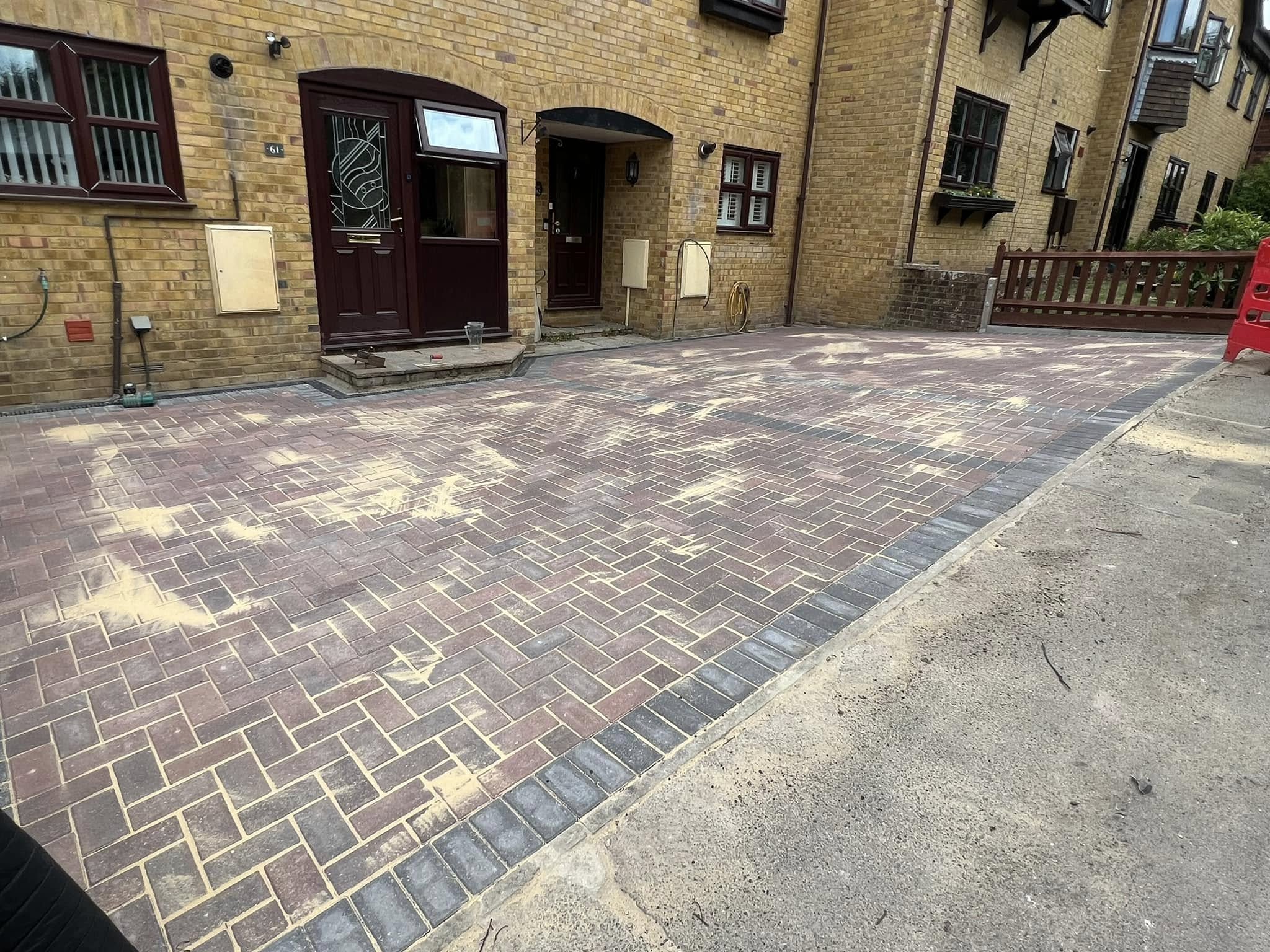
The chemical cleaning phases and mortar mixing operations associated with structural brickwork remediation present severe contamination hazards to nearby horizontal hardscapes, including interlocking driveways and decorative paths.
+-------------------------------------------------------------------------+
|                    HARDSCAPE RUNOFF PROTECTION STRATEGY                 |
+-------------------------------------------------------------------------+
| Hazard Source        | Risk Vector             | Mitigation Protocol    |
+----------------------+-------------------------+------------------------|
| Mortar Mix Splash    | Alkaline Staining       | Heavy Geotextile Wrap  |
| Acid Wash Cleanup    | Surface Etching/Pitting | Neutralizing Sump Nets |
| Fine Sand Dust       | Joint Infiltration      | Continuous Dry Vacuum  |
+-------------------------------------------------------------------------+
- Alkaline Staining Mitigation: Fresh mortar dropped onto porous stones or interlocking block paving layouts leaves high-alkaline cement or lime stains that chemically bond to the aggregate, creating permanent white discolored halos. The entire workspace boundary must be lined with heavy-duty, impermeable geotextile sheets sealed with water-resistant tapes to capture all mortar fallouts instantly.
- Acid Wash Protection Protocols: The final cleaning of completed brickwork often utilizes diluted hydrochloric acid washes to remove residual mortar smears. If this acidic runoff drains downward onto a natural limestone patio or concrete block driveway, it will instantly attack the calcium carbonate matrix of the stone, causing severe chemical etching, color pitting, and permanent structural degradation.
To isolate this risk, the base of the wall must integrate a temporary fluid-capture trough that channels all cleaning runoff into a dedicated holding container. The captured water is treated with alkaline neutralizing agents, such as sodium bicarbonate, before safe disposal via designated trade effluent points, ensuring the structural integrity and aesthetic finish of all surrounding landscape assets remain completely uncompromised.