
A new driveway is one of the highest-return property investments a Kent homeowner can make — but only when it's built properly. This comprehensive guide to driveway construction services in Kent covers every surface type from block paving and resin-bound gravel to tarmac, porcelain, and natural stone, along with the sub-base specification details that determine whether your driveway lasts five years or thirty. You'll find realistic 2026 pricing, the planning permission rules Kent homeowners need to know, the questions that reveal whether a contractor really knows their trade, and an honest look at what separates quality driveway construction from the kind that looks fine on day one and starts failing within years.
Your driveway is working harder than you probably give it credit for. Every day it absorbs the weight of vehicles, handles surface water runoff, weathers every frost and heatwave the English climate can produce, and — whether you like it or not — forms the first impression every visitor, delivery driver, and potential buyer has of your home.
When a driveway is done well, you stop thinking about it. It just works — for fifteen, twenty, even thirty years — looking good, draining properly, staying level and solid. When it's done badly, you think about it constantly: the cracked sections, the sunken patches, the puddles that appear after every rain, the blocks that rock underfoot.
The difference between those two outcomes is almost entirely determined by one thing: how the job is done, not what it costs.
This guide covers everything Kent homeowners need to know about driveway construction services — from surface options and the specification questions that actually matter, to costs, planning considerations, and how to find a contractor who genuinely knows their trade.
Why Driveway Construction in Kent Has Its Own Specific Demands
Kent's diversity as a county is one of the things that makes it such an interesting place to live. From the coastal towns of Thanet and Folkestone to the clay-heavy soils of the Medway towns and the chalk downlands of the North Downs, the county covers a remarkable variety of ground conditions, climate exposures, and housing stock types.
That variety matters enormously for driveway construction. The right specification for a driveway in a coastal area — where salt air accelerates surface deterioration and drainage requirements are often more demanding — differs from the right specification for a property on heavy clay in Sittingbourne, where seasonal ground movement requires careful sub-base engineering to prevent settlement.
Similarly, the character of Kent's housing stock matters. Victorian and Edwardian properties in Rochester, Chatham, and Maidstone often have narrower frontages and older drainage infrastructure that affects what's possible and what's compliant with current regulations. Modern estates have their own set of considerations around covenants and estate road adoptions.
Genuinely experienced driveway construction services Kent homeowners can rely on don't treat every job as the same job. They assess the specific site conditions, soil type, drainage situation, and property context before making a recommendation. That's the starting point for work that performs well over time.
Your Complete Guide to Driveway Surface Options
The surface material is what most homeowners focus on when planning a new driveway — understandably, since it's what you see every day. Here's an honest breakdown of every major option, including what each one actually requires to perform as it should.
Block Paving: The Classic That Earns Its Popularity
Block paving is the most widely installed driveway surface in Kent, and it earns that position. The individual block format offers something no other surface type can match: repairability. If you need access to underground pipes or cables, individual blocks can be lifted, the work done, and the surface reinstated without demolishing the whole driveway. If a section settles or a handful of blocks are damaged, they can be replaced without touching the rest of the surface.
The design flexibility is also genuine. Herringbone bonds for strength and pattern interest, stretcher bond for a cleaner contemporary look, basket weave for a more traditional character — and an enormous range of colours and textures available. A well-specified block-paved drive in the right pattern and colour for the house can genuinely transform the front elevation of a property.
What makes or breaks a block paving installation is the sub-base. The blocks themselves will last indefinitely if what's underneath them is sound. Lay them on a shallow, poorly compacted sub-base and they'll start rocking, sinking, and cracking within a few years regardless of their quality. Marshall Brickwork & Construction specifies and excavates to the correct depth for every block paving installation — minimum 200-250mm total construction depth for a car-bearing driveway — and compacts the Type 1 MOT hardcore properly before any surface material goes down.
Resin-Bound: Contemporary, Permeable and Low-Maintenance
Resin-bound gravel has grown from a niche premium product to one of the most popular driveway choices in Kent over the past several years, and the reasons are substantive rather than merely fashionable.
The surface is permeable — water drains through it into the sub-base rather than running off across it. This means it meets the planning requirements for front garden hard-surfacing without additional drainage infrastructure in most situations. It's also genuinely resistant to weed growth, which is one of the most common maintenance headaches with block paving. And the appearance — a smooth, speckled finish in a wide range of aggregate colours and blends — is clean and contemporary in a way that works well with both modern and traditional properties.
The installation quality is everything with resin-bound surfaces. The aggregate must be completely dry before mixing with the resin — any moisture prevents proper bonding. The resin must be applied at the right temperature and worked quickly, as the open time is limited. The finished depth must be consistent across the whole surface. Done properly, by experienced installers in appropriate weather conditions, resin-bound gravel is an exceptional driveway surface. Done with shortcuts, it debonds, becomes patchy, and looks terrible within a year or two.
Tarmac: Practical, Durable, Underrated
Tarmac suffers from an image problem that its actual performance doesn't deserve. A tarmac driveway laid over a proper base is one of the most durable surfaces available — resistant to the freeze-thaw cycling that tests block paving, quick to install, and easy to maintain. It can also be installed at a lower cost than premium paving options, which makes it the right choice for large driveways where coverage area is the primary consideration.
Modern tarmac installations for residential use typically involve a binder course and a wearing course — two layers that together produce a stable, weather-resistant surface. The wearing course can be specified in different aggregate grades for aesthetic variation, and decorative edge restraints in block or brick can add visual interest to what might otherwise be a purely utilitarian finish.
The main practical limitation is that tarmac softens in extreme heat — a real consideration for south-facing driveways in a hot summer — and can be marked by oil spills if not treated promptly. Regular sealing helps maintain both appearance and performance.
Porcelain and Natural Stone: Premium Aesthetics, Demanding Installation
For homeowners who want a genuinely high-end finish — a driveway that looks like an extension of an architect-designed house or a premium garden design — large-format porcelain and natural stone offer something no other surface type can match aesthetically.
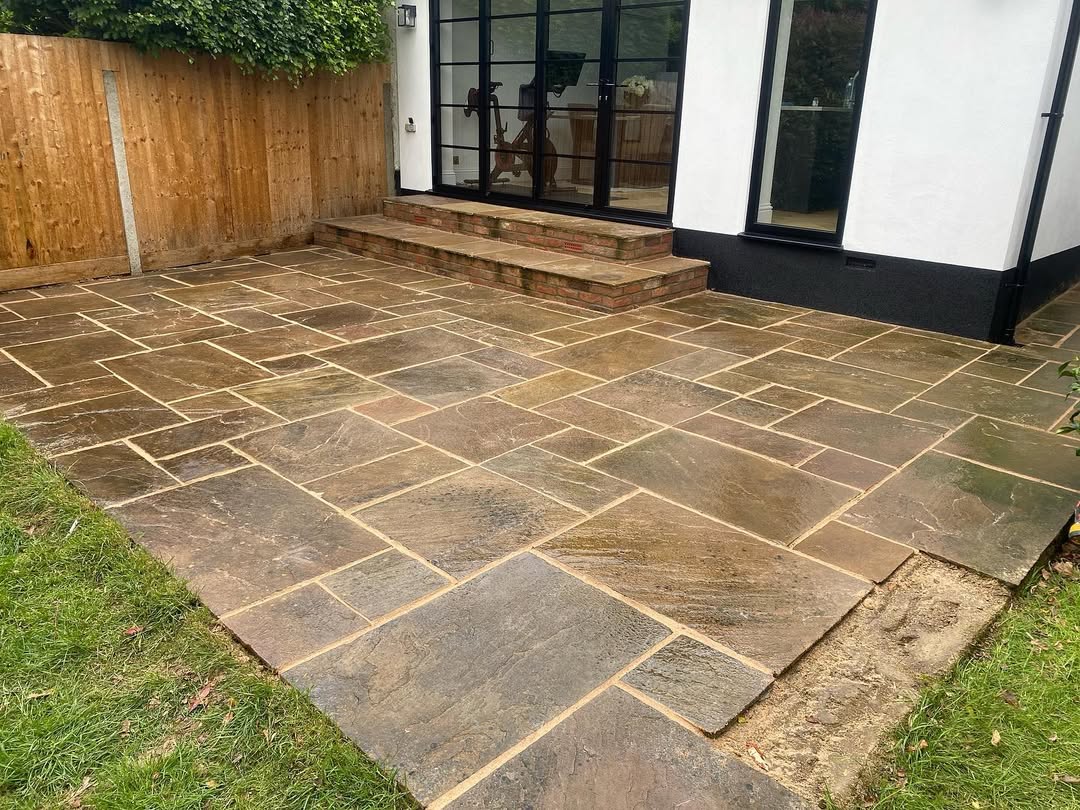
Porcelain in particular has become the material of choice for premium driveway and patio installations. The surface is impermeable, hard-wearing to an exceptional degree, available in finishes that convincingly replicate natural stone at consistent scale, and virtually maintenance-free once installed. The colour and texture won't fade. It won't absorb oil stains in the way that natural stone can.
The demanding element is installation. Porcelain must be laid on a full mortar bed — not the sand bedding used for block paving — which requires more skill and more labour. Large-format slabs require careful cutting and handling to avoid cracking during installation. And the sub-base must be absolutely solid, because porcelain is unforgiving of any movement. The groundworks underneath a porcelain driveway need to be specified and executed to a higher standard than for more flexible surfaces.
When it's done right by a team with the technical knowledge to execute it properly, a porcelain driveway is spectacular and virtually permanent. When it's done by a contractor who hasn't worked with the material extensively, the results range from disappointing to catastrophic.
Gravel: The Low-Cost Option With Its Own Logic
Gravel is the most affordable driveway surface by a significant margin, and for the right property and the right homeowner, it's a completely rational choice. It's fully permeable, requires no complex installation, and the noise it makes as vehicles drive over it provides a natural security deterrent.
The downsides are real: gravel migrates, requiring periodic replenishment and raking; it doesn't compact underfoot the way paved surfaces do; and it doesn't work well on gradients, where it tends to wash or roll to the bottom. Good containment — robust edging restraints around the perimeter and a proper weed membrane beneath the aggregate — addresses the worst of the maintenance issues.
For large rural driveways, properties with modest kerb appeal requirements, or homeowners who genuinely prefer the relaxed character of a gravel surface, it's a legitimate choice that Marshall's driveway and groundworks team installs properly when it's the right fit.
Sittingbourne homeowners dealing with clay soil conditions will find our dedicated Sittingbourne construction guide covers the specific local groundworks challenges in detail.
The Sub-Base: The Part That Actually Determines Whether Your Driveway Lasts
If there's one thing in this entire guide that's worth reading carefully, it's this section.
The sub-base is the structural foundation of your driveway — the compacted layers of material beneath the visible surface that carry the load of vehicles, prevent settlement, and manage the movement of water through and away from the surface. It's invisible once the job is complete. It's the most consequential part of the installation. And it's the part where corners are most easily cut without immediate detection.
A correctly specified sub-base for a standard residential driveway involves:
Excavation to the right depth. For a driveway bearing standard domestic vehicles, total construction depth should be around 200-250mm. This means excavating the existing surface and ground to that depth, removing the arisings from site. Contractors who excavate to 100mm and then apply a thin sub-base are setting up the project for failure.
Geotextile membrane. A ground stabilisation membrane laid on the formation level separates the sub-base material from the underlying soil, preventing intermixing over time and maintaining the structural integrity of the compacted hardcore above it.
Type 1 MOT limestone hardcore. The primary sub-base material, laid in layers and compacted with a vibrating plate compactor. Minimum 150mm compacted depth for domestic driveways. The compaction is as important as the depth — loose, uncompacted hardcore will settle and move under load.
Appropriate bedding layer. 40mm sharp sand for block paving. Full mortar bed for large-format porcelain. Tarmac binder course for asphalt. Each surface type has its own bedding requirement, and using the wrong one is a common shortcut.
Drainage provision. This is where many installations fail. Surface water must have somewhere to go — either through the surface (permeable installations like resin-bound or gravel), via a channel drain at the base of the drive directing to a soakaway or drain, or via carefully designed falls that direct water away from the property and off site without causing issues for neighbours or public highways.
When you ask for a quote, ask specifically about each of these elements. The answers will tell you more about the quality of the contractor than any amount of marketing material.
Planning Permission: What You Need to Know Before You Start
Since 2008, planning permission is required in England to hard-surface a front garden larger than 5m² with an impermeable surface. The key word is impermeable — surfaces that don't allow water to pass through them require drainage to be directed to a garden area or permeable soakaway.
Permeable surfaces — resin-bound gravel, permeable block paving, gravel — are exempt from this requirement regardless of size.
In conservation areas, additional restrictions apply. The appearance of properties in conservation areas is more tightly controlled, and certain surface types or edge treatments may require consent that wouldn't be needed outside a conservation area. Kent has numerous conservation areas — Rochester, Faversham, parts of Maidstone, Tunbridge Wells, and many other towns have significant designated areas where these rules apply.
Listed buildings have their own separate requirements, and any external works including driveway construction require listed building consent in addition to any planning permission that may be needed.
Marshall's team knows the local planning picture across Kent and will advise on any permission or consent requirements as part of the initial consultation. It's not something you should be figuring out after the work has been quoted.
Driveway Construction Costs in Kent: Realistic 2026 Pricing
Pricing for driveway construction varies significantly with size, surface type, ground conditions, and drainage requirements. These are realistic reference figures for 2026, not the bottom of the market:
Block paving: £80–£130 per square metre installed, including sub-base. A typical double driveway of around 40m² would be in the range of £3,200–£5,200. Decorative borders, special patterns, or difficult access can increase this.
Resin-bound gravel: £70–£120 per square metre for a new installation on a prepared base. The quality of the resin and aggregate blend affects both the price and the performance — cheaper resin products have a significantly shorter lifespan.
Tarmac: £50–£90 per square metre for a two-course installation. Tarmac is typically the most cost-effective option for large coverage areas.
Porcelain/large-format stone: £100–£160 per square metre, reflecting the higher material and installation labour costs.
Gravel: £25–£50 per square metre including membrane and edging. The ongoing cost of periodic replenishment should be factored into the total cost of ownership.
These figures assume a standard residential site with reasonable access. Ground conditions that require additional excavation depth or drainage engineering, restricted access requiring smaller plant, or unusual site characteristics will affect pricing.
What these numbers don't capture is the long-term cost differential between correct and incorrect specification. A driveway built on a shallow sub-base is typically cheaper upfront and significantly more expensive over a five-to-ten-year period, when it needs lifting and reinstating or — in the worst cases — complete removal and rebuilding.
The Questions Worth Asking Before You Accept Any Quote
The quote process is where you learn whether a contractor actually knows what they're doing. Here are the specific questions that will tell you the most:
"What depth will you excavate to, and what sub-base material are you specifying?" A contractor who knows their trade will answer this specifically and confidently. One who's planning to cut corners will become vague.
"How will you manage drainage?" What happens to the surface water? Where does it go? Is a channel drain or soakaway included in the scope?
"Does this installation require planning permission for our property?" Any reputable contractor will know the answer and will have raised it proactively.
"What edge restraints are you using?" Haunched concrete edging is the standard for block paving. Inadequate edge restraints allow the surface to spread at the perimeter over time.
"What does your workmanship guarantee cover, and for how long?" Quality contractors stand behind their work.
"Who will actually be doing the work — your own team or subcontractors?" This affects accountability and quality control.
Marshall's team answers all of these questions before they're asked. Every quote from Marshall Brickwork & Construction includes a full specification of the sub-base depth, drainage provision, edge restraint specification, and materials used — along with a clear timeline and a workmanship guarantee.
The Marshall Approach to Driveway Construction in Kent
Marshall Brickwork & Construction has completed over 180 driveways across Kent and the surrounding areas over 15 years of operation. That track record spans every surface type — block paving, resin-bound, tarmac, porcelain, natural stone, and gravel — across a wide range of site conditions, property types, and budgets.
The process starts with a free site visit. Not a kerb-side assessment but a proper on-site consultation: measuring the area, assessing the existing surface and sub-base condition, checking drainage, discussing your design preferences and budget, and identifying any planning or access considerations that affect the specification.
The quote that follows is itemised and specific. You'll know exactly what depth of excavation is included, what sub-base material is being used, what surface product and specification is being applied, and what drainage provision is included in the scope. There are no line items vague enough to expand later. The price you agree is the price you pay, except for genuine unforeseen site conditions that are discussed and agreed before any additional work proceeds.
The project gallery at mbconstruction.group/projects/ shows the quality of completed driveway work across multiple surface types. Browse it before any conversation — it gives a genuine sense of the standard of finish and the range of projects the team has handled.
For any specific driveway project, the team can also discuss how it fits alongside other outdoor works you might be considering — whether that's a complementary patio or slabbing project for the rear garden, landscaping to complete the front garden picture, a new boundary wall in brickwork, or fencing to frame the finished space. Managing all of these as a single project reduces coordination complexity and often produces a more coherent finished result.
After the Driveway: Maintenance That Protects Your Investment
A quality driveway needs relatively little maintenance, but what it needs should be done consistently.
Block paving benefits from an annual weed and moss treatment in autumn to prevent organic growth establishing in the joints, and periodic kiln-dried sand topping-up to maintain the joint fill. A quality sealant applied every three to five years maintains colour and makes surface cleaning easier. Avoid jet washing the joints at high pressure — it erodes the jointing sand.
Resin-bound is the lowest maintenance of all the surface types. Occasional sweeping and periodic jet washing at low pressure keeps it looking good. Avoid harsh chemical cleaners that can degrade the resin binder.
Tarmac benefits from crack-filling if small surface cracks appear — addressing them before they widen prevents water ingress and sub-base damage. A tarmac sealant every few years maintains the surface and reduces the appearance of weathering.
Porcelain and natural stone should be cleaned with appropriate pH-neutral cleaners. Acid cleaners damage the surface. Regular sweeping prevents grit and debris from scratching the finish.
If anything changes in the drainage behaviour of your driveway — water pooling where it previously drained, or running in a direction it didn't before — it's worth having it looked at promptly. Drainage changes often indicate sub-base movement that's easier and cheaper to address early.
For any maintenance or repair questions about a completed driveway, Marshall's team is available on 07724 730872. Existing clients always get prompt responses.
Ready to Start Your Driveway Project?
If you're planning a new driveway — whether you're replacing an old, tired surface, upgrading from tarmac to something more contemporary, or installing a driveway for the first time — the next step is straightforward.
Contact Marshall Brickwork & Construction for a free, no-obligation site visit and quote. The team covers the full county of Kent from its base in Rochester, as well as Greater London and select areas of Surrey and Sussex.
Phone: 07724 730872 Email: info@mbconstruction.group Contact form: mbconstruction.group/contact/
Read more about the company on the about page, explore the full range of construction services, browse completed projects for inspiration, and check the blog for practical guides and industry insights.
The driveway you stop thinking about — because it simply works, year after year — starts with the right conversation.
Marshall Brickwork & Construction Ltd | 14 Poplar Road, Rochester, ME2 2NR | 07724 730872 | mbconstruction.group
Common Driveway Mistakes Kent Homeowners Should Avoid
Understanding what goes wrong with driveway installations is just as valuable as understanding what should go right. These are the mistakes that come up repeatedly across Kent — and that a quality contractor will actively prevent rather than allow.
Skipping the site survey. Accepting a quote for a new driveway without a proper site visit is one of the most common mistakes homeowners make. An on-site survey is how a contractor identifies ground conditions, drainage constraints, planning requirements, and access challenges. A quote produced without visiting the site is at best an estimate and at worst an invitation for scope disputes and surprises mid-project.
Choosing on price alone. The driveway market in Kent, like any competitive trade market, has contractors at every price point. The lowest price almost always reflects a thinner sub-base, cheaper materials, or reduced labour time on the preparation stages. You don't see the shortcut on day one. You see it in year two or three, when the problems emerge. The right question isn't "who's cheapest?" but "what am I actually getting for this price?"
Ignoring drainage. This is the most technically consequential oversight in driveway construction. A surface that directs water toward your house, that pools in the centre, or that discharges surface water onto the public highway can create significant problems — from damp penetrating the property to drainage enforcement action by the local authority. Drainage should be addressed in the specification, not treated as an afterthought.
Not asking about planning. Since 2008, impermeable front garden hard-surfacing above 5m² requires drainage provision or a permeable surface. Most homeowners don't know this. Many contractors don't raise it — not because they're dishonest, but because they haven't kept up with the regulations. If your planned driveway affects the front garden and will be over 5m², ask the question explicitly.
Accepting a vague specification. A quote that says "driveway installation — block paving — as discussed" is not a specification. It commits the contractor to nothing beyond what they choose to deliver. A proper quote itemises excavation depth, sub-base material and depth, bedding type, surface product specification, edge restraint detail, and drainage provision. If a contractor won't provide this level of detail, consider why.
Not getting the guarantee in writing. A verbal guarantee is worth very little if there's a dispute. Any reputable contractor will confirm their workmanship guarantee in the written quote. Marshall's guarantee covers materials and workmanship for a meaningful period and is backed by a team that's still operating, still reachable, and still accountable long after the job is complete.
How Marshall Compares to the Competition in Kent
The driveway contractor market in Kent is competitive. Broadoak Paving, Crown Contractors, Tidey & Webb, and numerous smaller local operators all serve the same homeowner base. So what makes Marshall Brickwork & Construction the right choice?
The answer isn't one single thing — it's a combination of factors that consistently matter most to homeowners who've commissioned significant outdoor construction work.
Brickwork expertise embedded in driveway work. Most driveway specialists are exactly that — specialists in surface installation. They may not have the structural brickwork capability to build the retaining wall that the driveway design requires, or to address the boundary brickwork that needs repair before a new driveway can go in. Marshall does. The same team that lays your driveway can build the entrance pillars, repair the side wall, install the new boundary fencing, and create the planted area that completes the front garden design. That joined-up capability produces more coherent results and fewer coordination headaches.
Family-run accountability. Marshall is a family-run business. The people making decisions about specification and quality are the same people whose professional reputation is on the line with every project. There's no corporate layer between client experience and decision-maker accountability.
Verified track record. Over 500 completed projects with a 5-star rating isn't achievable through marketing. It's achievable through consistently delivering what was promised, to the right specification, on time. The projects page shows real completed work — not renders or stock photography.
Geographic knowledge. Based in Rochester, serving Kent as genuinely local contractors, Marshall's team understands the ground conditions, planning environment, and housing stock across the county in a way that contractors travelling in from outside the area simply can't match.
Full-service capability. Driveways are often part of a bigger picture. A patio for the back garden, landscaping to complete the outdoor environment, brickwork repairs to the front elevation, new fencing on the boundaries — managing all of these through a single trusted contractor is significantly easier and often produces better value than coordinating multiple specialists.
If you're ready to have a conversation about a driveway project — or any outdoor construction work across Kent — reach out to the Marshall team. The first step is free, there's no pressure, and the advice is honest. Visit mbconstruction.group/contact/ or call 07724 730872.