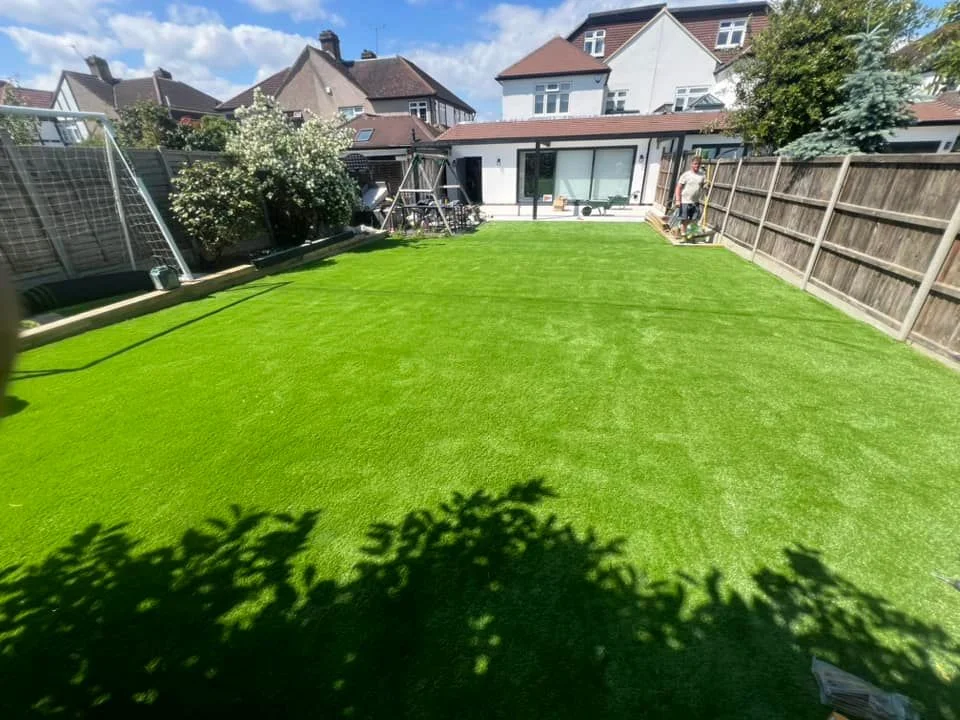
Artificial Grass Kent: The Complete 2026 Guide to Installation and Getting It Right
There is a specific kind of frustration that belongs to the Kent garden in autumn. The lawn — never quite recovered from last summer's dry spell — is now waterlogged from a fortnight of rain. There are muddy channels where the dog cuts the same path every morning. The kids are bringing the garden inside on their shoes. And somewhere under a tarpaulin in the shed is a lawnmower that was expensive to buy, expensive to service, and is now sitting idle until March.
It is no coincidence that artificial grass has become one of the fastest-growing garden requests across Kent. The product has changed dramatically in the last decade — modern premium artificial turf looks and feels close enough to natural grass that first-time visitors rarely spot the difference, and it is built to handle fifteen or more years of Kent weather without fading, compressing, or requiring anything more than an occasional brush and rinse.
But artificial grass is only as good as the installation underneath it. The product itself is the last thing that goes down. Everything that happens before — excavation, drainage, sub-base specification, membrane installation, edging — determines whether the finished lawn stays flat, drains properly, and looks pristine in year ten the same as year one. Getting those steps wrong, or skipping them, is the reason some artificial lawns look tired within three years of installation.
This guide covers everything Kent homeowners need to know before commissioning artificial grass: the realistic 2026 costs, the installation process done correctly, the product specifications that matter, how Kent's clay soil affects the groundworks requirement, the questions that separate good installers from cut-corner operators, and how Marshall Brickwork & Construction's landscaping team approaches every artificial lawn project across the county.
Why Artificial Grass Works Particularly Well in Kent
Kent's climate makes the case for artificial grass more compelling than in many other parts of the UK. The county sits in one of England's wetter south-eastern pockets — annual rainfall of 600–700mm across most of the county, with higher figures along the North Downs escarpment — and its predominantly clay geology means that water doesn't drain away from lawns quickly. The result is the seasonal cycle most Kent homeowners know well: dry, sun-baked, yellowing grass through July and August, followed by waterlogged, compacted, heavily worn turf from October through to late spring.
Against that backdrop, the appeal of a surface that stays green regardless of rainfall, doesn't compact under foot traffic, doesn't develop bare patches along the dog's favourite route, and requires no mowing, feeding, scarifying, or aerating is easy to understand. For families with young children and pets, for homeowners who travel frequently, for rental properties where tenants shouldn't be expected to maintain a natural lawn, and for gardens where mature trees or north-facing aspects make healthy natural grass growth difficult, artificial grass is frequently the most sensible long-term solution as well as the most attractive one.
It also combines naturally with the patios and landscaping work that completes a garden transformation — artificial grass lays beautifully around a new Indian sandstone or porcelain patio, against raised brick planters, and alongside new garden fencing, creating a cohesive, finished outdoor space that no individual element achieves alone.
What Good Artificial Grass Actually Looks Like: The Product Specifications That Matter
Walk into any builder's merchant or garden centre and you'll find artificial grass at prices from £5 per square metre to £40 per square metre for supply only. That range exists because the products are genuinely different — not just in price but in appearance, durability, and how they perform over time. Here's what to look at when comparing products.
Pile Height
The pile height is the length of the individual grass blades, measured in millimetres. Shorter pile (around 20–25mm) looks neater and more formal, closer to a closely mown lawn, and is easier to maintain. Longer pile (35–40mm+) has a lusher, more natural appearance but can flatten in high-traffic areas over time if the fibre quality is insufficient.
For most Kent residential gardens, a pile height in the 30–37mm range offers the best balance of natural appearance and durability. Very long pile products (40mm+) look impressive on display but need regular brushing to maintain their appearance on busy family lawns.
Stitch Rate and Blade Density
The stitch rate — the number of tufts per square metre — is the primary driver of how realistic and how durable artificial grass looks. Higher stitch rates produce a denser, more natural-looking surface with better resilience to heavy use. Budget products cut stitch rates to reduce material cost; this produces a surface that shows gaps between blades, looks noticeably synthetic, and flattens quickly under foot traffic.
A quality residential artificial grass should have a stitch rate of at least 14,000 stitches per square metre. Premium products used for high-traffic family gardens or pet owners typically run to 18,000–22,000 stitches. This number should be stated in the product specification; if a supplier or installer cannot tell you the stitch rate of the product they're recommending, that's a red flag.
Blade Shape and Colour
Modern artificial grass uses a combination of blade shapes within the same product — flat blades, ribbed blades, and curled or kinked blades — to mimic the natural variation of real grass. Products that use a single blade type look flat and artificial. Multi-blade products with two or three complementary tones (varying shades of green with a thatch base layer of brown or olive) produce a convincing, natural appearance at all viewing angles.
The UV stability of the fibres determines how the colour holds over years of Kent sunlight. Cheap products use fibres that aren't fully UV-stabilised — they bleach and lose colour within three to five years. Quality products use UV-stabilised polyethylene fibres and should retain their colour for the full 15-year life of the product.
Drainage Rate
The drainage rate of the backing determines how quickly rainfall passes through the surface. Kent's rainfall profile makes this important — a surface that drains too slowly will pool water after heavy rain, which becomes a moss and algae harbour over time. The backing should have a drainage rate of at least 30 litres per square metre per minute; quality products achieve 60 litres or more. This specification should be in the product data sheet. Combined with a correctly designed sub-base (see below), good drainage rate means the surface dries quickly and never puddles.
The Installation Process: What Correct Looks Like
The difference between an artificial grass installation that performs for fifteen years and one that looks dated within three comes down entirely to what happens before the turf is unrolled. Here is the correct process — the one Marshall Brickwork & Construction follows on every artificial lawn project across Kent.
Step 1: Mark Out and Excavate
The installation area is marked out, and existing lawn, turf, and topsoil are removed to a minimum depth of 70mm — typically 80–100mm on Maidstone and Medway clay soils where greater depth is needed for adequate drainage and sub-base compaction. Topsoil and turf are removed cleanly; any tree roots, large stones, or debris are cleared.
This step cannot be rushed. Inadequate excavation depth is the primary cause of lumpy, uneven artificial lawns — if insufficient material is removed, the sub-base and sand layer cannot be installed to the correct depths, and the finished surface will follow the undulations of the natural ground beneath.
Step 2: Geotextile Weed Membrane
A high-permeability woven geotextile membrane is laid across the excavated base before the sub-base material is placed. This serves two functions: it suppresses weed growth through the base layers, and it prevents the sub-base material from mixing with the natural soil beneath over time. The membrane should overlap by a minimum of 300mm at any joins.
A thin or permeable membrane — or no membrane at all — is a cost-cutting shortcut that produces a lawn that develops weeds pushing up through the surface within two to three years.
Step 3: Sub-Base Installation and Compaction
The sub-base is the most structurally important element of the entire installation. For residential artificial grass in Kent, the correct material is compacted Type 1 MOT crushed stone, installed to a minimum depth of 50mm after compaction — typically 70mm on clay-heavy sites. The sub-base is laid in layers and compacted with a plate compactor until it is firm and level.
This step is where the most corners are cut on budget installations. Inadequate sub-base depth produces a soft, springy surface that compresses under foot traffic over time. Uneven compaction produces a finished surface that shows lumps and dips. On Kent's clay soils, an undersized sub-base also fails to provide the drainage fall needed to move water away from the surface — ponding results.
The sub-base must also have a slight fall (typically 1:60 to 1:80) toward a drainage point — a border, a channel, or a patio gully — so that rainfall doesn't pool. Achieving this fall deliberately during sub-base installation, rather than hoping the natural ground provides it, is part of proper specification.
Step 4: Sharp Sand Levelling Layer
A 10–15mm layer of sharp washed sand is applied over the compacted sub-base and screeded to a perfectly level, smooth finish. This layer is not for drainage — it is purely for surface levelling. It takes the sub-base, which is inherently rough from the aggregate material, and provides the smooth, even bed that the turf lays on top of.
The sand layer must be dry when the turf is laid. Installing turf over wet sand produces a surface that shifts and settles unevenly as the sand dries and compacts under foot traffic.
Step 5: Turf Laying and Joining
The artificial turf is rolled out and allowed to relax in position for 30–60 minutes — particularly important in warm weather when the turf has been stored in a roll and has a tendency to retain a curve that needs to flatten before it is fixed.
Where more than one roll is needed, joins must be made with precision: the two edges are trimmed along the blade rows (not between them), butted together with zero visible gap, and fixed beneath with joining tape and adhesive. A well-made join is invisible — the blade direction and density should be continuous across the join. A poorly made join, trimmed inaccurately or not properly glued, is the most immediately visible defect in an artificial lawn.
The turf is trimmed around the perimeter and fixed to the edging boards using galvanised U-pins or nails at 150mm centres.
Step 6: Silica Sand Infill
Kiln-dried silica sand infill is brushed into the turf fibres at a rate of approximately 4–6kg per square metre, using a stiff power brush or a drag brush. The infill serves multiple purposes: it adds weight to keep the turf stable and in place, it helps the blades to stand upright, and it contributes to the overall underfoot feel of the surface.
The infill is brushed in two passes at 90 degrees to each other to ensure even distribution across the full area. The surface is then brushed upright to raise the blade angles to their natural standing position.
The finished result should look immaculate: uniform colour, blades upright, no visible joins, clean edges, and perfect fall toward the drainage point.
Artificial Grass and Kent's Clay Soil: Why Drainage Specification Matters More Than You Think
Every aspect of correct artificial grass installation matters, but for Kent properties on clay soil — which accounts for a large proportion of gardens across Medway, Maidstone, Swale, and much of West Kent — the drainage design deserves specific attention.
Clay soil has a very low permeability. Rainfall that hits an artificial grass surface drains through the turf backing within seconds — but then it hits the sub-base. If the sub-base is correctly specified and has adequate fall, the water moves laterally through the drainage layer and exits at the perimeter. If the sub-base is too thin, too compact, or has no deliberate fall, that water saturates the base and sits there — creating exactly the same waterlogging problem the homeowner was trying to solve.
The correct approach for Kent clay gardens includes: excavating to full depth, installing a correctly graded sub-base with deliberate fall, and — on sites with particularly poor natural drainage or no clear outfall — installing a peripheral drainage channel or soakaway before the sub-base is laid. This is not an optional upgrade. For many Kent gardens it is the difference between an artificial lawn that drains perfectly and one that develops green slime and ponded areas within two years.
Marshall's groundworks capability means that drainage design is assessed as an integrated part of every artificial grass project they install — not added as an afterthought after problems emerge.
Combining Artificial Grass With Other Garden Work
The most common mistake Kent homeowners make when commissioning artificial grass is treating it as a standalone project rather than part of a coordinated garden improvement. The same site visit, the same excavation, and the same project management that delivers the artificial lawn can deliver the complete garden in a single coordinated programme — often for significantly less than commissioning the elements separately.
Typical combinations that Marshall's landscaping team regularly delivers as single projects across Kent:
Artificial grass + new patio: The patio is constructed first to the correct finished level, then the artificial grass sub-base is built up to the patio edge. The transition between the two surfaces is seamless. See the complete patio construction guide for Kent for patio material options and specification.
Artificial grass + raised brick planters: Raised beds are built to their finished height first; the artificial grass runs up to their base. The combination of crisp brickwork and uniform green turf is one of the most effective and popular garden aesthetics in Kent's residential stock. Marshall's brickwork team handles the raised beds as part of the same project.
Artificial grass + new fencing: New fencing provides the privacy backdrop; artificial grass delivers the finished garden floor. Both commissioned together mean one set of access disruption, one skip, one programme.
Full garden transformation: Artificial grass, patio, raised beds, fencing, and planting areas delivered as a single design. Marshall's project portfolio includes numerous full garden transformations across Kent that combine all these elements.
For pricing context on patio components, see how much does a patio cost in Kent in 2026 and porcelain vs Indian sandstone — the 2026 patio comparison.
Artificial Grass Across Kent: Location-Specific Notes
Marshall Brickwork & Construction installs artificial grass throughout Kent and Greater London. A few location-specific considerations:
Rochester and Medway (ME1–ME8): Clay subsoils are prevalent across most of the Medway valley floor. Gardens on the slopes above the river tend to have better natural drainage; gardens in the lower-lying areas of Strood, Chatham, and Gillingham need sub-base drainage design as standard. See the Rochester and Medway construction guide for general local context.
Maidstone (ME14–ME20): Heavy Wealden clay across much of the borough — drainage design is more important here than almost anywhere else in the county. North-facing gardens in the Bearsted, Loose, and Shepway areas in particular benefit from careful sub-base drainage planning. See the Maidstone construction guide for more local detail.
Sittingbourne and Swale (ME9–ME13): Mix of clay and mixed soils depending on exact location. Gardens on the southern slopes above Sittingbourne drain better than the flat areas north of the town toward the Thames Estuary. See the Sittingbourne guide for local notes.
Canterbury, Tonbridge, Ashford and beyond: Marshall's operational area extends across the full county. Contact the team with your location and project details for a free site assessment.
Maintenance: What Artificial Grass in Kent Actually Needs
One of the primary reasons homeowners choose artificial grass is to reduce maintenance burden. It's worth being precise about what the reduction actually looks like.
What you no longer need to do: Mow, edge, water, fertilise, scarify, aerate, re-seed bare patches, treat moss or thatch, or deal with seasonal wear patterns.
What the lawn benefits from:
Monthly: A light brush with a stiff broom or a garden brush to keep the fibres upright and remove any surface debris — leaves, twigs, and general garden detritus. Leaves left on an artificial lawn for extended periods can create a micro-climate for moss growth on the surface.
As needed: A rinse with a garden hose to clear any accumulated dust, pollen, or light soiling. Pet owners will want to rinse more regularly — artificial grass is pet-friendly but urine should be diluted with water promptly to prevent odour build-up.
Annually: A more thorough brush using a powered lawn brush (available to hire) to redistribute the silica sand infill that gradually migrates toward the perimeter and low points over time, and to fully raise the blade fibres that have been compressed in heavy-use areas.
Very occasionally: If moss or algae begins to appear on the surface — typically only in very shaded, damp areas — it can be treated with a dilute biocidal wash approved for synthetic turf.
The total annual maintenance time for a typical Kent residential artificial lawn is realistically 2–4 hours per year. Compare that to the 50–80 hours of cumulative mowing, edging, and care that a natural lawn of similar size demands in the same period.
The Questions to Ask Any Artificial Grass Installer in Kent
The artificial grass installation market in Kent includes operators at every quality level, from experienced landscaping teams with proper groundworks capability to labourers with a roll of cheap turf and a sand spreader. These questions distinguish them.
What depth do you excavate to, and how do you determine this for clay soil? The correct answer involves assessing the site, determining the existing drainage conditions, and specifying excavation depth accordingly — minimum 70mm, more on clay-heavy sites. An answer of "we do standard depth" without any reference to soil conditions is a concern.
What sub-base material do you use, and how do you compact it? The answer should be Type 1 MOT crushed aggregate, compacted in layers with a plate compactor. A contractor who says "just hardcore" or doesn't mention compaction equipment should be pressed for more detail.
What drainage fall do you build into the sub-base? This question is the clearest differentiator between contractors who understand the work and those who don't. The answer should involve building a deliberate fall of 1:60–1:80 into the sub-base toward the drainage outfall.
What joining method do you use and can I see a sample join you've previously done? Well-made joins are invisible. Any installer who is confident in their joining quality will welcome this question.
Does your quote include waste removal and skip hire? Always confirm this in writing.
What is the stitch rate and pile height of the specific product you're proposing, and can I see the product specification sheet? A professional installer will have this information immediately available.
Why Marshall Brickwork & Construction for Artificial Grass in Kent
Marshall Brickwork & Construction is not an artificial grass specialist in isolation — they are a full-service outdoor construction company that has been delivering complete landscaping transformations across Kent for over 15 years. That distinction matters for artificial grass installation because the work that determines the outcome — groundworks, drainage, edging, sub-base compaction — is construction work, not just turf-laying.
Their team specifies sub-base depth and drainage design based on site-specific assessment of the Kent clay soils they work with every day. They don't apply a standard template regardless of conditions. They carry plate compaction equipment, install drainage channels where needed, and build deliberate fall into every sub-base they lay. The result is an artificial lawn that performs correctly from the first rain after installation, not just on a dry day before the clay has had a chance to test it.
They also offer the joined-up approach that most homeowners eventually want — coordinating the artificial grass with the new patio, the raised planters, and the new fencing as a single project, managed by one team, to a single timeline.
With over 500 completed projects across Kent and a 5-star rating maintained across all platforms, the standard of workmanship is not a promise — it is a track record. And every project comes with a comprehensive workmanship guarantee, because Marshall's family-run values mean that what they build, they stand behind.
Get in touch today for a free consultation and no-obligation quote — for artificial grass alone or as part of a complete garden transformation across any Kent location.
Frequently Asked Questions: Artificial Grass in Kent
How long does artificial grass last? Quality artificial grass installed to the correct specification should last 12–20 years in a residential Kent garden. The lifespan depends primarily on UV stability of the fibres, traffic levels, and how well the sub-base has been installed. Products with a manufacturer's warranty of 8–10 years are typically the mid-range products that will realistically last 12–15 years with reasonable care. Premium products with 10-year warranties routinely exceed 15 years.
Is artificial grass suitable for dogs? Yes — artificial grass is widely used in Kent gardens with dogs. The surface is durable against claw traffic, easy to clean (diluted urine washes through the drainage backing), and mud-free regardless of rainfall. The main practical consideration is ensuring the drainage specification is adequate, and that the turf is brushed and rinsed regularly in high-use areas. Silica sand infill rather than crumb rubber is the preferred infill for pet owners as it is easier to maintain hygienically.
Can artificial grass be installed over concrete or an existing hard surface? Yes, in some circumstances. If the existing concrete or hardstanding is structurally sound, level, and well-drained, artificial grass can be installed directly onto it using adhesive fixing. This eliminates the excavation and sub-base cost and is a faster installation. The drainage of the existing surface must be assessed before this approach is taken — if the existing concrete ponds water, installing turf over it will not solve the problem. Marshall's team will assess whether your existing surface is suitable during the initial site visit.
Does artificial grass get too hot in summer? Quality modern artificial grass uses UV-stable, heat-reflective fibres that are significantly cooler than older synthetic surfaces or dark hard materials like tarmac or slate. In direct strong sunlight on a very hot day, the surface will be warmer than natural grass — but not uncomfortably so in the UK's climate. If heat is a specific concern, lighter green shades and shorter pile heights reduce heat retention, and the surface cools rapidly with a light spray of water.
Is artificial grass permeable — does it comply with SUDS regulations? Yes. Quality artificial grass has a drainage rate far higher than most impermeable hard surfaces, and it is generally treated as a permeable surface for planning purposes. This means it typically does not require planning permission in the same way that solid impermeable driveways do. However, for front gardens where the implications for surface water run-off to the highway are relevant, the planning authority's specific guidance should be checked.
What about the environmental impact? Artificial grass is made from plastic — polyethylene fibres on a polypropylene backing — and it is not biodegradable at end of life. It also does not provide the ecological benefits of natural turf (carbon sequestration, insect habitat, cooling). These are genuine considerations. In gardens where natural lawn has consistently failed due to shade, clay, or heavy use, artificial grass is a practical replacement. Gardens where natural lawn performs well are better maintained as natural lawn where the homeowner is willing to maintain it. Combining artificial grass in the lawn areas with genuine planting and border areas elsewhere in the garden provides a more ecologically balanced outcome.
Marshall Brickwork & Construction | 14 Poplar Road, Rochester, ME2 2NR 07724 730872 | info@mbconstruction.group Artificial grass installation across Rochester, Medway, Maidstone, Sittingbourne, Canterbury and throughout Kent. Fully licensed, insured, and guaranteed on all work.